To measure control effectiveness, test two things and watch a third: whether the control is designed to stop the risk it is mapped to (design effectiveness), whether it operated as designed throughout the period (operating effectiveness, shown by tests), and whether the losses, incidents and findings it should have prevented stayed away (outcome). A control effectiveness rating is then accurate when it agrees with all three, and whether a whole cycle's ratings are accurate can be measured with five numbers: a loss back-test, test support, finding conflicts, staleness and challenge outcomes. The difficulty is that the tests sit in a GRC system, the findings in an issue register and the losses in the general ledger, so control ratings in a risk and control self-assessment are easily made from memory. Botminds' Risk & Control Self-Assessment (RCSA) puts those three sources beside each rating and checks each rating against them with written rules.
The examples come from a fictional sample credit union as it runs through the solution: Norrell Federal Credit Union, whose 2026 cycle rates 412 controls across 186 risks.
Five measures of whether your control ratings are accurate
Loss back-test
risks whose window losses exceed the impact band their rating allows ÷ risks rated
The Basel principles' own test of a self-assessment: do the ratings agree with what was actually lost?
Above a few percent, the scale or the ratings are drifting.
Test support
Effective control ratings with a passing test in the window ÷ Effective control ratings
An Effective rating without a test is an opinion, however experienced the owner.
Target 100% for key controls.
Finding conflict
Effective control ratings with an open audit or exam finding against the control ÷ Effective control ratings
A control internal audit has found wanting cannot be Effective until the finding closes.
Target zero.
Staleness
control ratings whose newest test is older than the testing cycle ÷ control ratings
A pass from two years ago says little about this year's operation.
Watch the trend; fix the test plan, not the rating.
Challenge outcome
challenges ending in a changed rating ÷ challenges decided
Near zero, the challenge is a formality; near all, first-line ratings are not being made on evidence.
Read alongside the challenges raised per unit.
How do you measure control effectiveness? Design, operation and outcome
Control effectiveness is measured on three kinds of evidence, and a rating should name which it rests on. Design is judged once, when the control is mapped to the risk and whenever the process changes. Operation is judged by testing, over the period. Outcome is judged by what happened: incidents, losses and findings the control should have stopped.
The Basel Committee puts the first two in one sentence: the analysis of controls "ensures these are suitably designed for the identified risks and operating effectively" (BCBS, 2021). It assigns the work to the business: an effective first line includes "establishing appropriate controls to mitigate inherent operational risks, and assessing the design and effectiveness of these controls through the use of the operational risk management tools". The third kind of evidence is the one the principles use to check the other two, and it is the one a form-based RCSA most easily leaves out.
What is the difference between design and operating effectiveness?
Design effectiveness asks whether the control, operated perfectly, would stop or catch the risk it is mapped to. Operating effectiveness asks whether it was in fact operated as designed, by the right people, every time, across the period. A control can fail either way, and the fixes differ: a design failure needs a new or redesigned control, an operating failure needs discipline, staffing or evidence.
Two ways the same control can fail, on one sample risk
Design question: Would a monthly review of card velocity rules catch rules that are tuned too loosely? Mostly, if a second person approves each change.
Operating question: Was the review done and evidenced every month? No: the July 14 test found April and May not evidenced. Failed.
Design question: Does scoring at authorisation stop card-not-present fraud rings? Only partly: a ring testing small amounts can stay under the score.
Operating question: Did scoring run on the sampled transactions? Yes: 25 of 25 in the April test. Passed.
Design question: Does fast reissue limit losses after compromise? Yes, for the compromised card.
Operating question: Were compromised cards reissued within a day? 24 of 25 in the March test. Passed.
The real-time scoring row is the instructive one. It passed its operating test, yet debit card fraud losses at the sample credit union rose from $176,200 to $389,400 in a year and the largest incident was a card-not-present ring across 31 cards. A passed test proves the control ran; it does not prove the control was enough. That is why outcome evidence belongs in every rating, and why measure 1 above exists.
What is a control effectiveness rating scale?
A control effectiveness rating scale is a short set of levels, usually three to five, each defined by what the evidence must show. A frequent weakness is defining levels by adjectives ("operates as intended in most respects") that two people read differently. Defining each level by evidence makes the rating checkable.
A four-level control effectiveness rating scale, defined by evidence
| Level | Evidence it requires | What moves it down |
|---|---|---|
| Effective | Key controls passed every test in the window; no open finding against them; after any failure, two clean quarters of retests | Any failed test, any open finding rated Moderate or higher |
| Partially effective | A failure in the window, then at least one clean independent retest | A second failure, or a retest not done on time |
| Needs improvement | A failed key-control test or an open finding, with no clean retest yet | Losses the control should have stopped, or a repeat finding |
| Ineffective | Repeated failures, or the control not operating at all | (lowest level) |
The two-clean-quarters rule in the top row is a policy choice, and a deliberate one. It stops a single passed retest, done the week before the rating is due, from restoring a control to Effective. One clean retest earns Partially effective; sustained operation earns Effective.
How do control test results affect residual risk?
Control test results set the control effectiveness rating, and the residual risk matrix combines that rating with inherent risk. One failed key-control test can therefore move residual risk by a full level, which is exactly what it should do. On debit card fraud at the sample credit union, inherent risk was High; with the control rated Needs improvement after the July failure, the matrix gave High residual risk, above an appetite of Moderate or lower.
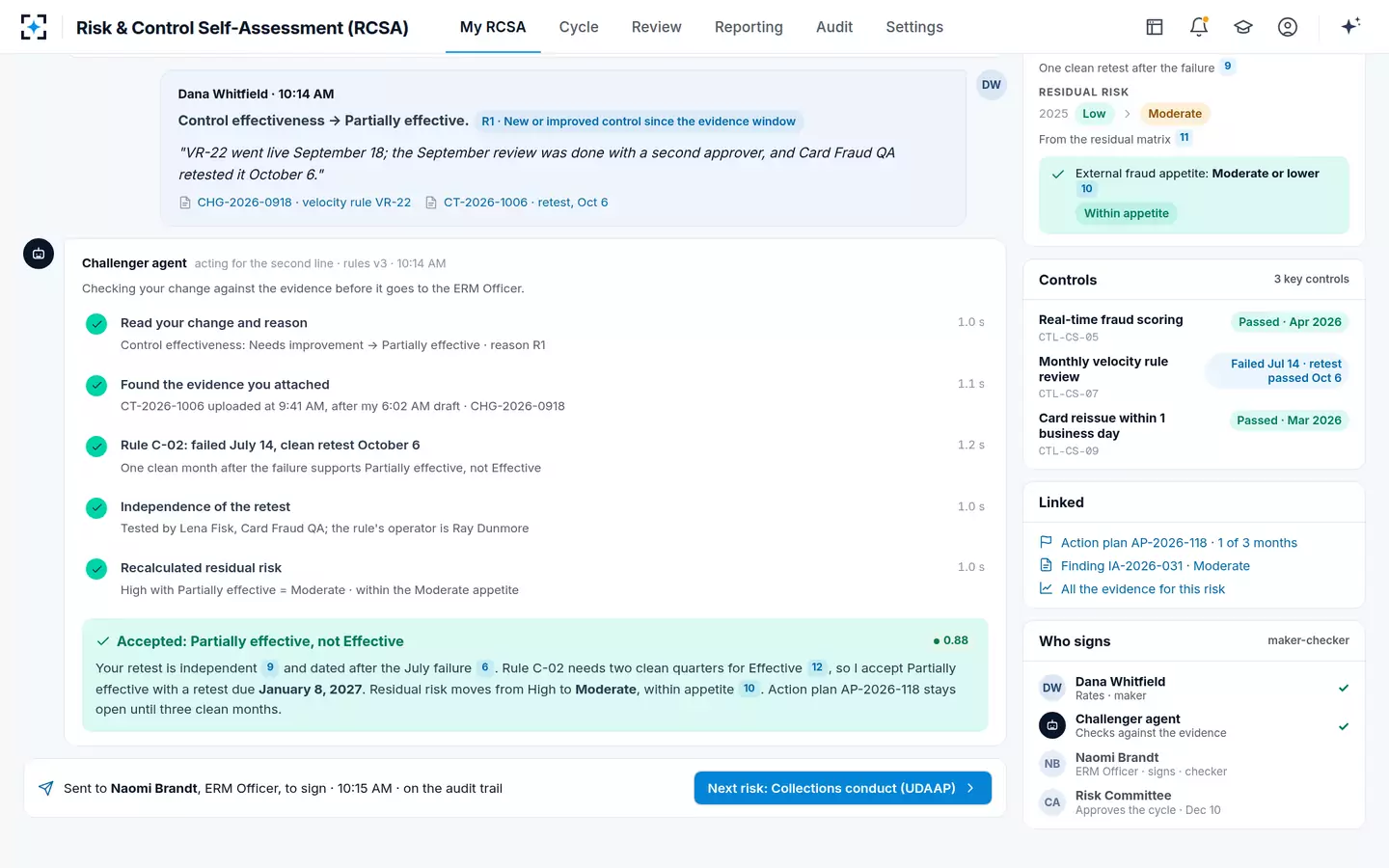
The owner then credited a new velocity rule, live on September 18, and a clean independent retest on October 6, both after the evidence window closed. The Challenger agent checked the claim against rule C-02: one clean retest after a failure supports Partially effective, not Effective. High inherent risk with a Partially effective control gives Moderate residual risk, within appetite, and a retest was set for January 8, 2027. The rating moved because new evidence moved it, and only as far as the evidence allowed.
The second line's check of a control rating, before anyone signs
How often should controls be tested, and what is a key control?
Controls should be tested as often as their risk demands, and at least once in each evidence window for key controls. The Basel principles ask that "Controls should be regularly reviewed, monitored, and tested to ensure ongoing effectiveness" (BCBS, 2021) and set no fixed frequency. The Federal Reserve's guidance for institutions under $100 billion adds who should do it: "Internal controls should be tested by an independent party who reports either directly to the institution's board of directors or its designated committee" (Federal Reserve, SR 16-11), with the footnoted allowance that small community banks may rely on regular reviews by other staff.
A key control is one whose failure would let the risk through on its own, or whose failure would not be caught by another control in time. Debit card fraud at the sample credit union has three key controls: real-time fraud scoring, the monthly velocity rule review and card reissue within one business day. Every key control should have a test in every window; a non-key control can be tested on a longer cycle, as long as the staleness measure above is watched.
How to keep test evidence in a form an examiner accepts is its own discipline, covered in control evidence that holds up for examiners and auditors; whether to test every transaction or a sample is compared in AI control testing vs sampling by hand.
Five measures that tell you whether your control ratings are accurate
The five measures in the figure above test the ratings, not the controls. Each can be computed on the last completed cycle, so a bank can know where it starts before changing anything. The first is the Basel Committee's own: "comparing the frequency and severity of internal losses with self-assessments can help the bank determine whether its self-assessment processes are functioning effectively" (BCBS, 2021).
The loss back-test needs only the rating scale's impact bands and the general ledger. A risk rated Low residual that lost more in the window than the Low band allows is a mismatch, whatever the reason. The other four need the control library joined to the test results and the issue register, which means joining three systems by hand unless something does it for you. In the solution, two of the seven Challenger rules are measures 2 and 3 written as checks: a failed test against an Effective rating, and an open finding against an Effective rating.
One cycle's control ratings, measured against their evidence
1,204
checks run against seven second-line rules this cycle
8
Effective ratings challenged: five on a failed test, three on an open finding
9 of 15
resolved challenges ended with the owner changing the rating
27
action plans open for controls rated Needs improvement or Ineffective, 3 overdue
The challenge outcome needs care in reading. Nine of 15 resolved challenges at the sample credit union ended in a changed rating, which says the challenges are finding real disagreements. A figure near zero would say the opposite: either the rules are too loose or the second line accepts every answer. A figure near 100% would say owners are not rating on evidence in the first place, which the interview format is meant to prevent.
How do you challenge a control rating?
You challenge a control rating by naming the rule it breaks, the evidence that breaks it and what the owner said, and by having someone other than the challenger decide. The OCC's heightened standards for the largest banks expect independent risk management to escalate material disagreements with front line units; at any size, a challenge that leaves no trace cannot be shown to an examiner.
An opinion rating and an evidenced rating of the same control
Rated from memory: Effective, as last year.
Rated against the evidence: Needs improvement: the July test failed with two of six months not evidenced.
Rated from memory: "No issues I'm aware of."
Rated against the evidence: Test CT-2026-0714, internal audit finding IA-2026-031 (rule changes self-approved), open.
Rated from memory: Whoever argues best in the challenge session.
Rated against the evidence: A clean independent retest: Partially effective now, Effective after two clean quarters.
Rated from memory: Nothing until next year.
Rated against the evidence: Action plan AP-2026-118, due December 31, 2026, validated by internal audit after three clean months.
The decision belongs to a person. At the sample credit union only the ERM Officer decides a challenge: uphold it and return the rating to its owner, or accept the owner's rating, with a reason code in either case. The Challenger agent never overrides a rating. What a challenge looks like from the owner's side, in the interview, is shown in RCSA questions.
Where losses say a control failed even when its test passed
Outcome evidence catches what test evidence misses: a control that runs as designed but is no longer enough. The sample credit union's evidence pane for debit card fraud shows it in one view. Monthly losses ran above the key risk indicator's amber line of $32,000 from April and crossed the $40,000 red line in August at $48,900, while two of the three key controls passed their tests.
Losses against the indicator, beside every control test
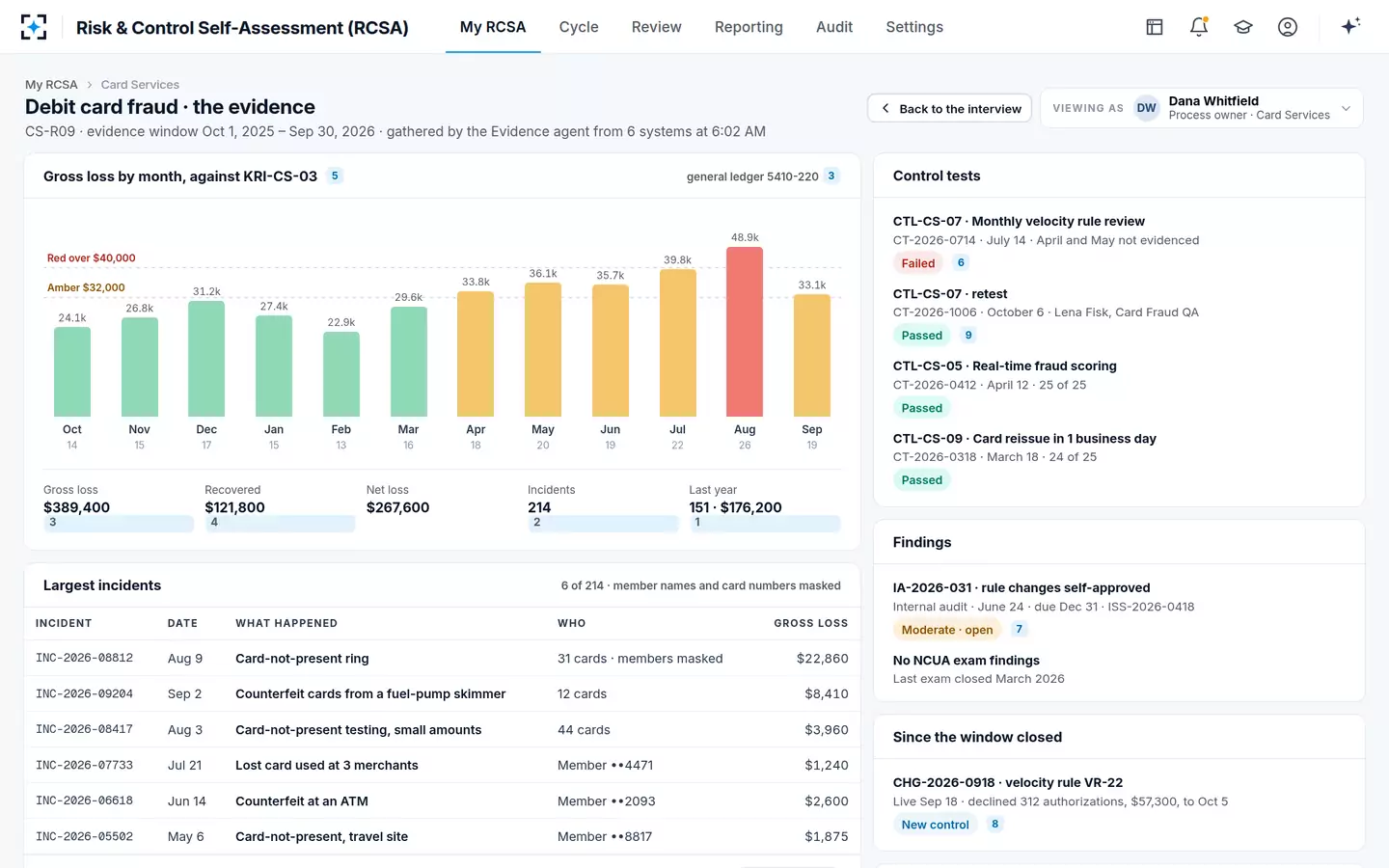
That pattern is a design question, not an operating one, and the right response is to ask whether the control set still matches the risk. Here the answer was a new velocity rule, which by October 5 had declined 312 authorizations worth $57,300. Measuring that new control's effectiveness starts the cycle again: designed, operated, and then judged by next year's losses. The full RCSA, with the ratings, challenges and sign-off that rest on these measures, is Risk & Control Self-Assessment (RCSA).
Questions people ask
What is a good control effectiveness rating scale, 1 to 5 or three levels?
Fewer levels with sharper evidence definitions usually beat more levels with vaguer ones. Four levels, as in the sample scale, leave room for a control that failed and has started to recover (Partially effective) without inviting a neutral middle. Whatever the count, each level should name the test results and findings it requires.
Can a control be effective if it has never been tested?
It can be well designed, but there is no evidence that it operates, so it should not be rated Effective. A new control can be credited once it has a test; until then, the honest rating reflects the controls that were tested. In the sample cycle, the agent mentioned a new rule with no test and did not credit it until a retest was attached.
Who tests controls for an RCSA, the first line or the second?
Both, in different ways. The first line monitors and self-tests its own controls; the second line or internal audit tests key controls independently. The Federal Reserve's SR 16-11 expects internal controls to be tested by an independent party reporting to the board or its committee, with an allowance for small institutions.
How does control effectiveness differ from control coverage?
Effectiveness asks whether each control works; coverage asks whether the set of controls covers the risk's causes, by prevention, detection and response. The Basel principles ask banks to consider "the sufficiency of control coverage, including adequate prevention, detection and response strategies." A risk can have effective controls and still be under-covered, which shows up as losses in measure 1.
How do you measure control effectiveness for a KRI?
A key risk indicator is not a control; it is a measure that tells you whether controls are holding. Its value in rating control effectiveness is as outcome evidence: months in amber or red against a control rated Effective are a reason to challenge the rating, which is what the sample credit union's rule on red indicators does.