Control self assessment tools are the templates, GRC modules and software that let business units assess their own operational risks and the controls over them, usually as a risk and control self-assessment (RCSA) with inherent risk, control effectiveness and residual risk for every risk. Whichever tool an institution chooses, it needs the same inputs: a risk and control library, a rating scale and residual matrix, a risk appetite statement, last cycle's ratings, and a year of evidence per risk, meaning incidents, loss and recovery postings, control test results, audit and exam findings and key risk indicators. The tool decides how much of that evidence reaches the person rating; the institution decides whether the evidence exists. Botminds' Risk & Control Self-Assessment (RCSA) reads it from the systems where it already sits and proposes each rating with every figure cited, so its first cycle is only as good as what this guide lists.
Where examples are needed they come from a fictional sample credit union as it runs through the solution: Norrell Federal Credit Union, whose library holds 186 risks and 412 controls across 14 business units.
What to bring: the inputs inventory, minimum first, then the ideal additions
- Minimum · Risk and control library
Risks per business unit, each mapped to its controls, with owners. Key controls marked. A spreadsheet export is enough to start.
- Minimum · Rating scale and residual matrix
Likelihood and impact levels with written definitions and money bands; control effectiveness levels; the matrix that combines them.
- Minimum · Last cycle's signed ratings
Inherent, control and residual per risk, with the scale version they were made on.
- Minimum · Incidents for twelve months
Date, description, business unit and event type. Personal details can be masked on the way in.
- Minimum · Operational loss and recovery postings
General ledger accounts that separate operational losses, and recoveries kept apart from gross loss.
- Minimum · Control test results
Control, test date, tester, result, and what failed. The tester's name is what proves independence.
- Ideal · Audit and exam findings with action plans
Severity, status, due date, and the control each finding is against.
- Ideal · Key risk indicators with thresholds
Monthly values with amber and red lines, mapped to the risks they watch.
- Ideal · Risk appetite statement by event type
So residual ratings can be read against what the board accepts.
- Ideal · Product and change feeds
New products, process and system changes, card processor rule changes: the events that should reopen a rating.
What are control self assessment tools? Three kinds, one dependency
Control self assessment tools come in three kinds: templates (a spreadsheet or form per unit), GRC workflow modules (assessments routed, tracked and stored inside a governance, risk and compliance system), and evidence-reading agents (software that gathers each risk's evidence and proposes the rating). The term "control self-assessment" is also used for internal audit's facilitated workshops; this guide is about the operational risk RCSA, where the business rates its own risks and controls.
All three depend on the same thing. A template shows the owner an empty box; a GRC module shows her a box with a deadline; an agent shows her a proposal. Only the third reads the evidence for her, and it can only read evidence that exists in a system it can reach. That is why a buying decision about control self assessment tools should start with the inventory above, not the feature list. How the three kinds handle the same risk is compared in RCSA software compared.
What data does an RCSA tool need, and which rating does each input feed?
An RCSA tool needs evidence for each of the three ratings and for the challenge, and each input feeds one of them more than the others. Incidents and losses drive inherent risk; tests and findings drive control effectiveness; the matrix, the appetite and the indicators drive residual risk; last cycle's ratings and peers' ratings feed the challenge.
Each input feeds a different rating in a risk and control self-assessment
Inherent risk
- Incidents in the window and the year before
- Gross loss and recovery postings
- The rating scale's likelihood and impact bands
Control effectiveness
- Control test results with dates and testers
- Open audit and exam findings
- Controls added or changed since the window
Residual risk
- The residual matrix
- The risk appetite statement by event type
- Key risk indicator months in amber or red
Challenge and sign-off
- Last cycle's signed ratings
- Peer units' ratings of shared risks, as reference only
- Owners, approvers and reason codes
The Basel principles make the link between events and ratings explicit. Describing event management, they say: "This information is an input to the self-assessment and, in particular, to the assessment of control effectiveness" (BCBS, 2021). A tool that cannot read incidents cannot meet that expectation except by asking the owner to remember them.
What is a risk and control library?
A risk and control library is the inventory of every risk each business unit carries and every control mapped to those risks, with owners. It is the spine of the RCSA: a risk not in the library is never rated, and a control not mapped to a risk is never tested against it. The Basel principles expect the operational risk framework to "inventory risks and controls implemented by all business units (eg in a control library)" (BCBS, 2021).
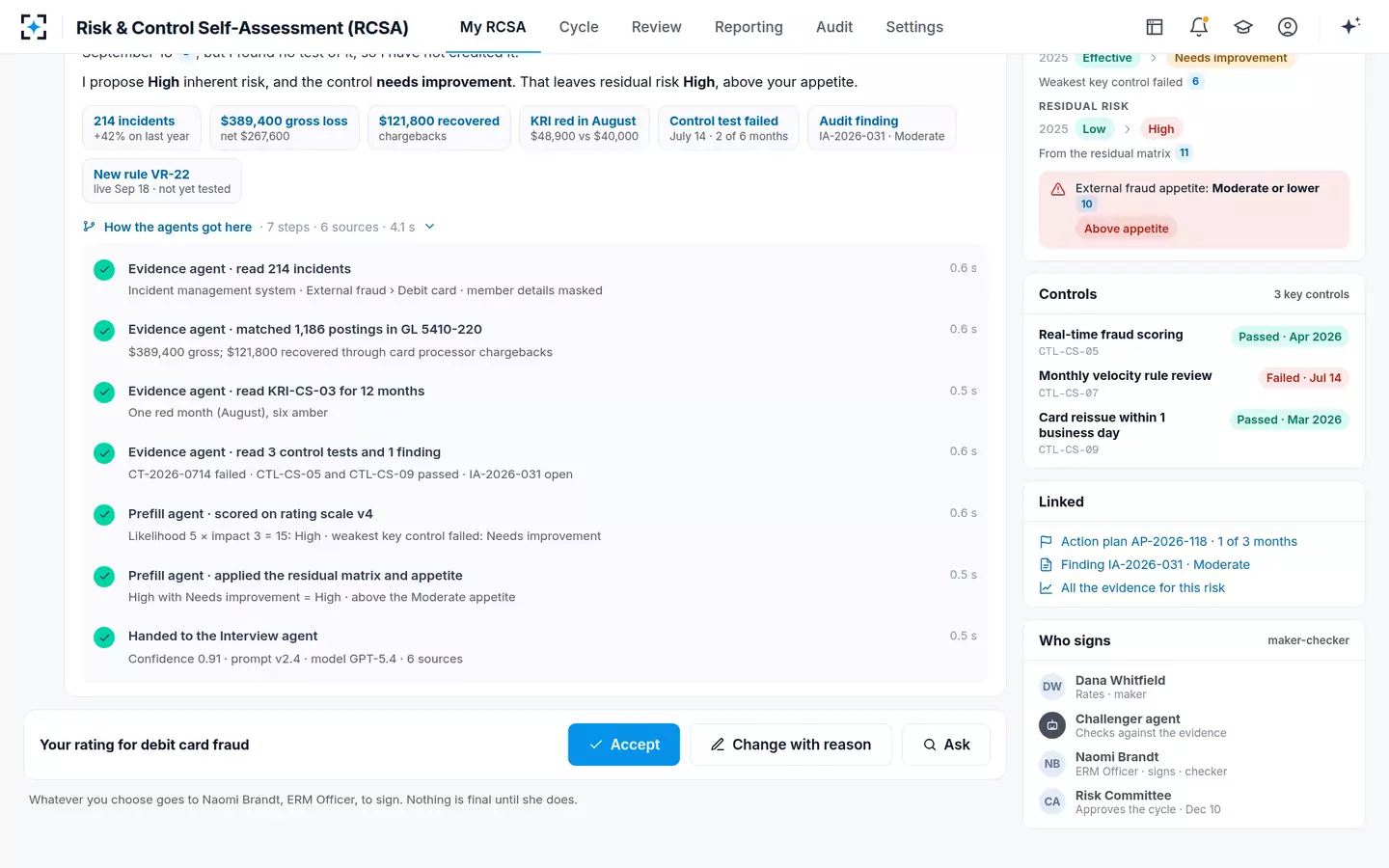
The sample credit union's library holds 186 risks and 412 controls in 14 units, an average of about 2.2 controls per risk. Debit card fraud, risk 9 of 14 for Card Services, has three key controls: real-time fraud scoring, a monthly velocity rule review and card reissue within one business day. Libraries drift: units are added, controls duplicated, risks left without incidents for years. In the solution a Library agent proposes new risks from unmapped incidents, merges duplicate controls and retires unused ones, and every proposal is prepared by an ERM analyst, approved by the ERM Officer and versioned.
How do you map incidents to risks?
You map incidents to risks through a shared event-type taxonomy: each incident gets an event type and a business unit, and each risk in the library has the same two keys. The Basel principles want event data "classified according to a taxonomy defined in the ORMF policies and consistently applied across the bank", each event carrying its occurrence, discovery and accounting dates (BCBS, 2021). The seven Basel event types, from internal fraud to execution, delivery and process management, are a common top level, and the sample credit union reports residual risk against them.
Mapping can trip a first cycle in two opposite ways. Incidents that map to no risk mean the library is behind the business; the sample credit union treats them as a refresh trigger. Incidents mapped to the wrong risk inflate one rating and flatter another; the owner can flag them with a reason code for evidence attributed to the wrong risk, and the second line checks the mapping before the rating is recalculated. The loss side of the same mapping, deciding which postings are operational losses at all, is a discipline of its own.
What the agents read for one risk, step by step
What evidence window should an RCSA use?
An RCSA should use a fixed twelve-month evidence window that closes shortly before the cycle opens, the same window for every unit. Fixed and shared matters more than the exact dates: if Card Services reads October to September and Payments reads January to December, their ratings are not comparable and the committee cannot add them up.
The sample credit union reads October 1, 2025 to September 30, 2026 for a cycle that opens October 1. Anything later, such as a control that went live in September and was retested in October, can still be credited, but only by the owner, with a reason code and the evidence attached. Bring last year's window too: "214 incidents" means little until it sits beside 151 the year before.
Do I need a GRC system to automate an RCSA?
No. You need the library, the tests and the findings to exist in a structured, dated form somewhere; a GRC system is the usual home but not the only one. Spreadsheets with one row per control test, a date, a tester and a result can be read. What cannot be read is a test result that exists only as a sentence in last year's committee pack.
Starting with the minimum set and starting with the ideal set
Minimum set: Proposed from incidents and losses; impact from the largest event and the year's gross loss.
Ideal set: Same, plus the year before for trend, and external events where the unit has none of its own.
Minimum set: Proposed from test results; findings asked of the owner.
Ideal set: Tests and open findings read together; a failed test or an open finding against an Effective rating is challenged automatically.
Minimum set: From the matrix; appetite applied by the ERM Officer.
Ideal set: From the matrix against the appetite by event type, with red indicator months as a challenge rule.
Minimum set: Losses over the trigger amount reopen a rating.
Ideal set: Losses, red indicators, failed tests, new findings and unmapped incidents each reopen a rating.
Minimum set: More questions, because more is missing.
Ideal set: Mostly confirmation, with questions only where the evidence is thin.
The minimum set is enough to change the conversation, because incidents, losses and tests answer most of what an owner would otherwise be asked. The ideal set is what lets the second line's checks run without a person assembling them, and what makes refresh triggers possible between cycles.
Formats that make or break the first cycle
The inputs above fail in predictable ways, and almost all of them are format problems, not missing data. The table lists the ones that cost the most time if found late.
Input formats that stall a first RCSA cycle, and the fix for each
| Input | What goes wrong | Fix before day one |
|---|---|---|
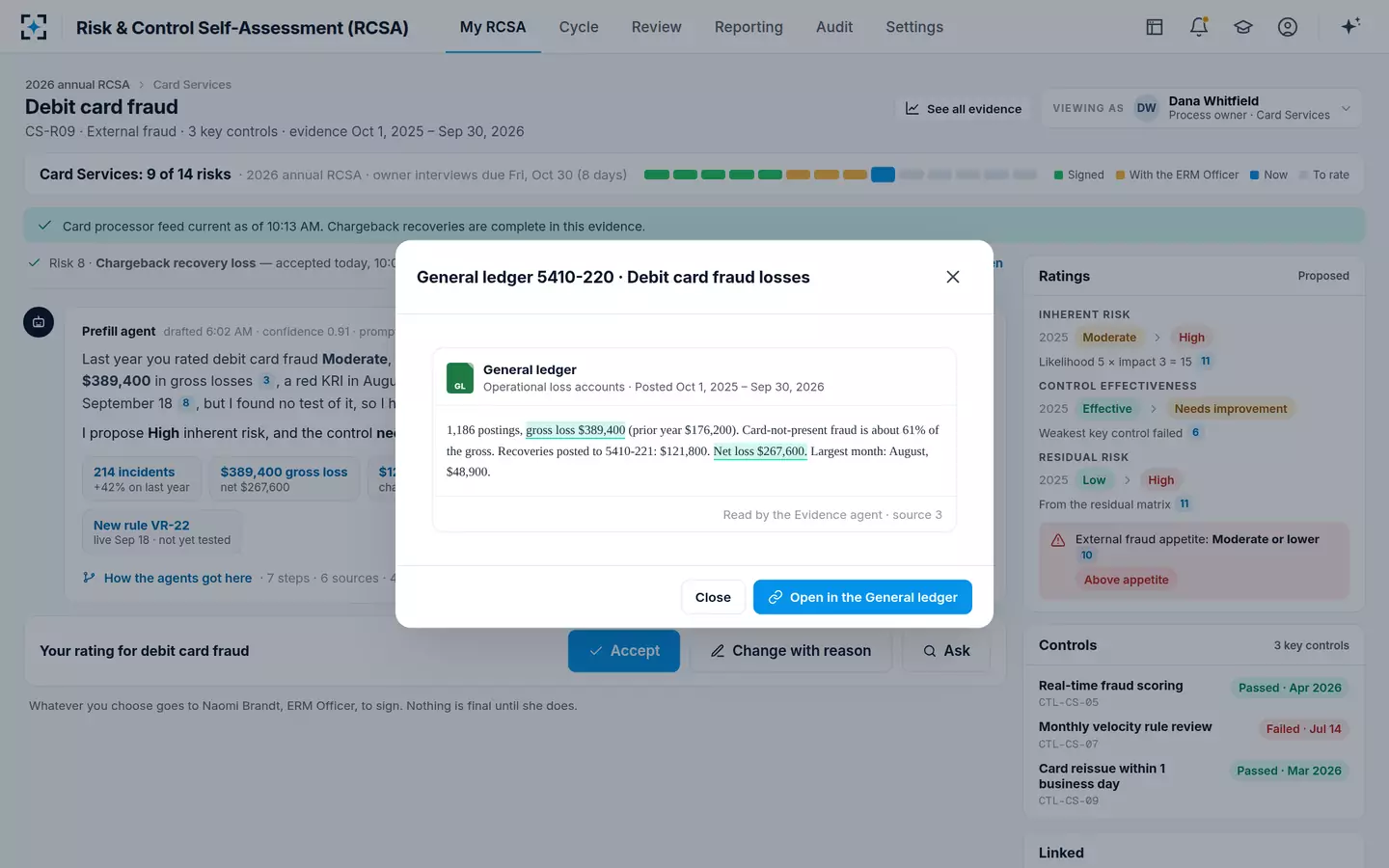
| Loss postings | Operational losses mixed into general expense accounts; recoveries netted into the loss | Dedicated operational loss accounts, and recoveries posted to their own account (the sample uses 5410-220 for losses and 5410-221 for recoveries) |
| Incidents | Free text only, no event type or business unit; customer details in the description | Event type and unit as fields; masking of names, account and card numbers on the way in |
| Control tests | Pass or fail with no date, no tester, no sample size | Date, tester, sample and exceptions on every test, so independence and staleness can be judged |
| Findings | Severity missing, or findings not linked to the control they are about | Severity and the control ID on every finding; action plans linked to the issue register |
| Key risk indicators | Values without thresholds, or thresholds changed mid-year without a note | Amber and red lines with an effective date; changes versioned |
| Last cycle's ratings | Ratings without the scale version, after the scale changed | Scale version stored with each rating, so last year's Moderate is read on last year's scale |
The Basel principles set the standard the fixes aim at: the outputs of operational risk assessment tools should be "based on accurate data, whose integrity is ensured by strong governance and robust verification and validation procedures" (BCBS, 2021). An agent that cites every figure makes data problems visible fast, because an owner who clicks a loss and finds the wrong account says so on the first day.
Every number opens its source, which is how data problems surface
What is the minimum data to start an automated RCSA, and what is a template for?
The minimum data to start an automated RCSA is the library, the rating scale and residual matrix, last cycle's ratings, and twelve months of incidents, loss postings and control tests. With those, an agent can propose inherent risk and control effectiveness for most risks and ask about the rest. Findings, indicators and the appetite statement can follow during the first cycle.
A control self-assessment template still has a job in that set-up: it defines the fields every rating must carry, so ratings from different units can be compared and reported. A good template has the three ratings, the scale version, the reason for any change, the evidence cited, the owner and the signer. What one filled-in rating looks like end to end, with every field populated, is shown in an RCSA example.
Privacy belongs in the inventory too. Incident descriptions carry customer names and account numbers; suspicious activity report material carries confidentiality obligations. The sample credit union masks member names, account and card numbers in incident text, counts suspicious-activity-related evidence without listing it for anyone outside the BSA team, and keeps all RCSA content out of member-facing views. Decide those rules before the first feed is connected, not after. The economics of connecting the full set, against the minimum, are in RCSA automation: what one cycle costs, and the solution is at Risk & Control Self-Assessment (RCSA).
Questions people ask
What is the control self assessment process?
In operational risk, the control self assessment process runs from refreshing the risk and control library, through gathering a year of evidence and rating inherent risk, control effectiveness and residual risk, to second-line challenge, sign-off and reporting against appetite. Action plans follow for weak controls, and ratings are reopened between cycles when the evidence moves.
Can I run a control self-assessment in Excel?
Yes, for a small library. The limits are the ones the inputs inventory exposes: a spreadsheet does not read the incident system or the general ledger, so the evidence has to be pasted in or remembered, and it does not keep a trail of who changed which rating and why.
What is a control self assessment checklist?
A checklist of what each rating must contain before it can be signed: the three ratings on the current scale, the evidence cited for each, any change from last year with its reason, open findings and action plans, and the owner and signer. The inputs inventory above is the same checklist applied to the institution rather than the rating.
How much historical data does an RCSA tool need?
Twelve months for the current window and twelve for the year before, so trends are visible. More history helps for rare, high-severity risks, where a single year often has no events at all.
Who should own the inputs?
Each input keeps its existing owner: operations owns incidents, finance owns the loss accounts, the control owners and testers own test results, internal audit owns its findings. The RCSA reads them; it should not become a second place where they are maintained.