RCSA software is any tool an institution uses to run its risk and control self-assessment: to hold the risk and control library, collect each business unit's ratings of inherent risk, control effectiveness and residual risk, route them for challenge and sign-off, and report the result against risk appetite. It comes in three forms. A spreadsheet holds ratings; a GRC workflow module routes and stores them; an evidence-reading agent gathers each risk's incidents, losses, tests and findings and proposes the rating with every figure cited. All three can produce a signed RCSA. They differ in what the person rating and the person reviewing can see when they decide, and that difference decides whether the ratings match the losses. Botminds' Risk & Control Self-Assessment (RCSA) is an evidence-reading approach; this guide compares it fairly with the other two on the same risk.
The risk comes from a fictional sample credit union as it runs through the solution: debit card fraud at Norrell Federal Credit Union, rated Moderate inherent, Effective control and Low residual last year, in a year when its gross losses rose from $176,200 to $389,400.
One risk through three kinds of RCSA software: what the owner and the reviewer see
| Step | Spreadsheet | GRC workflow module | Evidence-reading agents |
|---|---|---|---|
| Cycle opens | Last year's row, copied into this year's tab | A task assigned to the owner with a due date | Last year's rating, what happened since, and a cited proposal |
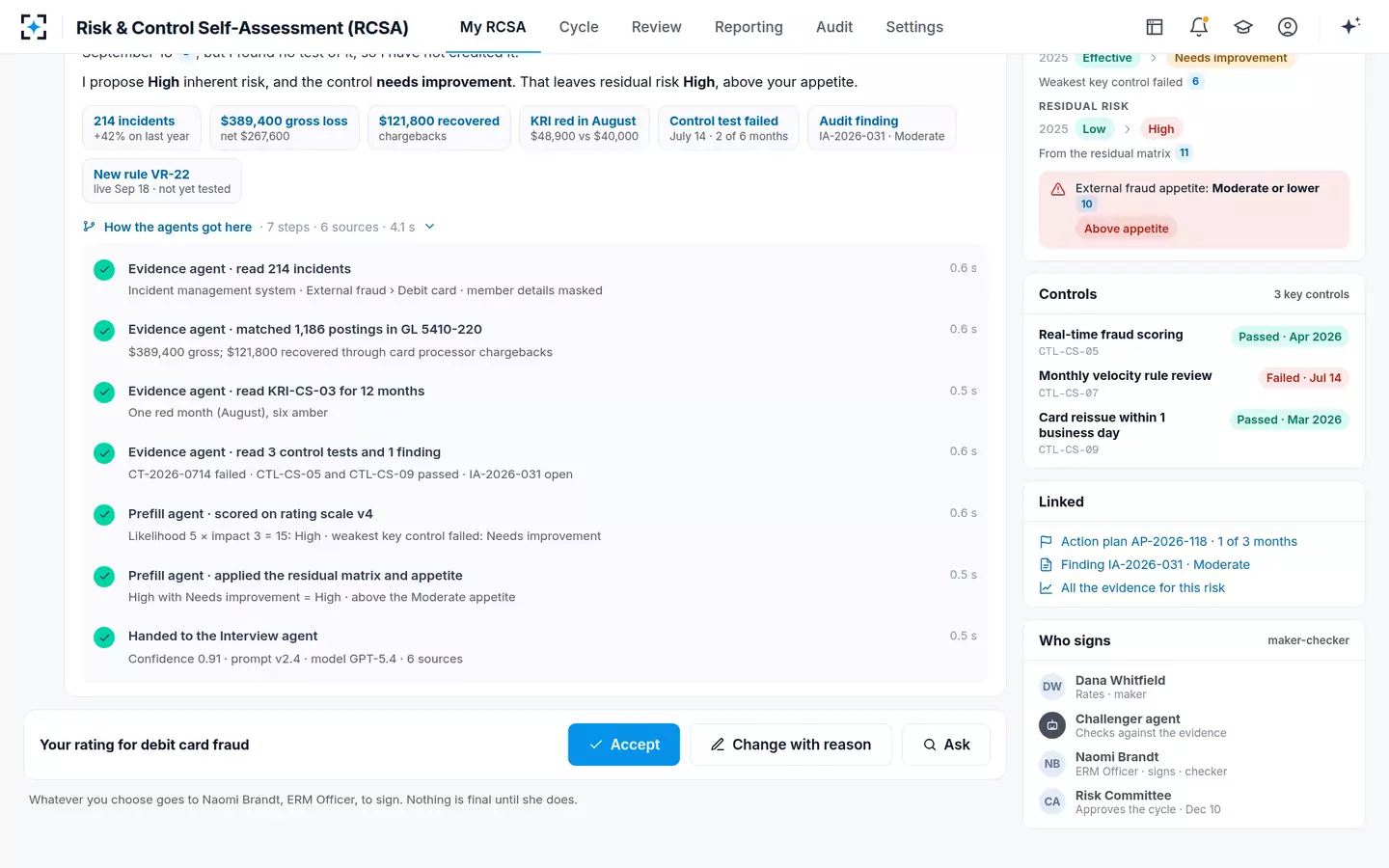
| Incidents and losses | Whatever the owner pastes in or remembers | Usually outside the module; attached if the owner exports them | 214 incidents and 1,186 loss postings read; $389,400 gross, $121,800 recovered |
| Control tests and findings | A free-text note, if any | Tests held in the module; findings if the issue register is linked | The July test failure and the open audit finding cited beside the control |
| Indicators | Not visible | Visible if held in the module | Twelve months against amber and red lines; August red |
| Rating | Owner types it | Owner selects it from the scale | Agent proposes; owner accepts, changes with a reason code, or asks |
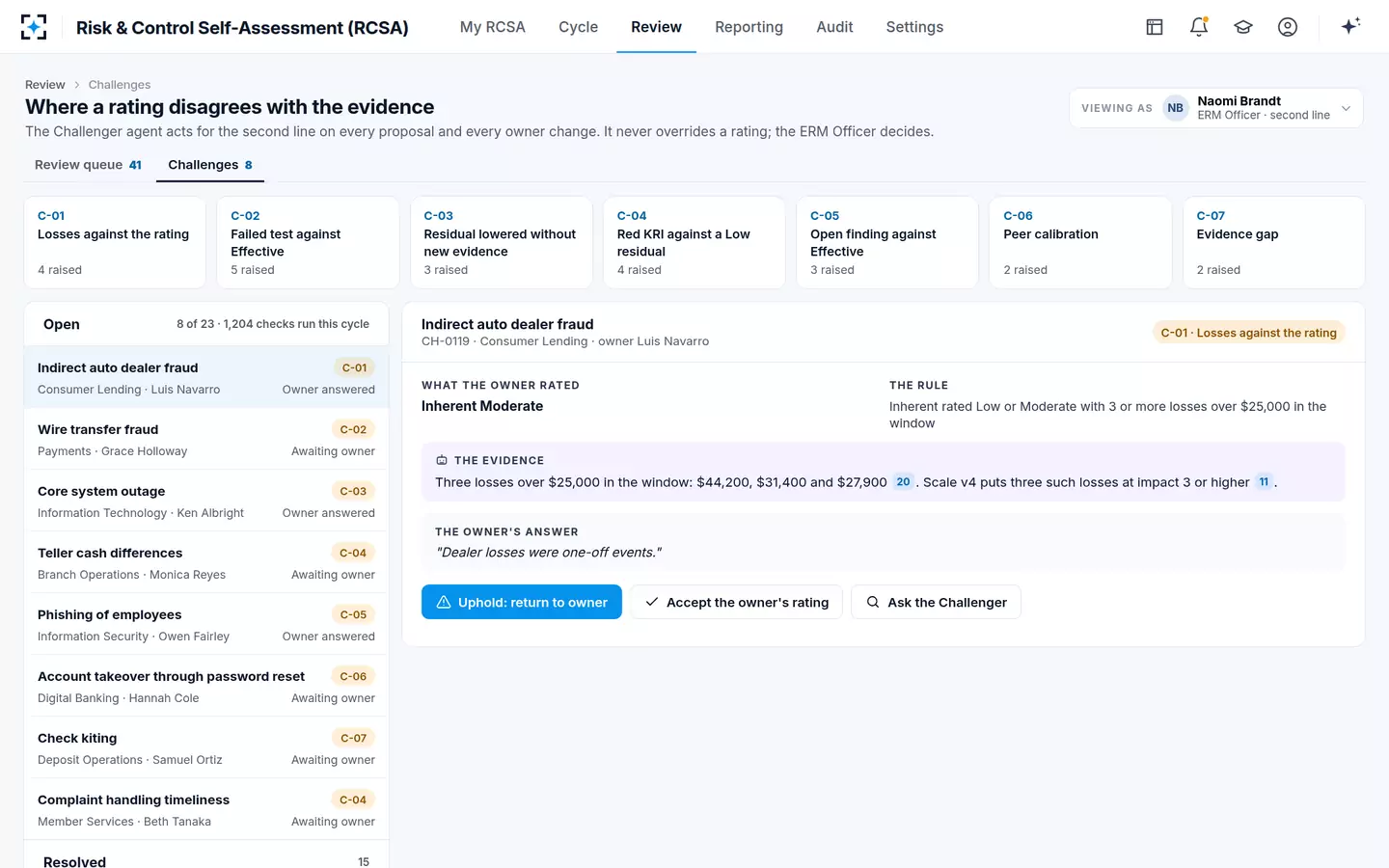
| Challenge | Second line reviews the sheet, by meeting or email | Reviewer task; challenge as comments | Seven written rules on every proposal and change; ERM Officer decides each |
| Likely outcome on this risk | Low residual again, unless the owner remembers the year | Depends on what the owner attaches; the failed test may surface | High residual proposed; Moderate after the owner credits a retested new control |
What is RCSA software, and what is an RCSA tool?
RCSA software, or an RCSA tool, is the system in which an RCSA is carried out and kept: library, ratings, challenges, sign-offs, action plans and reports. The Basel Committee's description of what the framework must hold sets the minimum any tool needs to support: an inventory of each unit's risks and controls, thresholds for inherent and residual risk, and "appropriate independent review and challenge of the outcomes of the risk management process" (BCBS, 2021).
The table above shows why the three forms are not three price points for the same thing. They place the evidence differently. In a spreadsheet the evidence is wherever the owner keeps it. In a GRC module, part of it sits beside the rating and part does not. With agents, the evidence is gathered first and the rating is proposed from it, so the owner's job becomes agreeing or saying why not.
Can RCSA be done in Excel?
Yes, and for a small library it may be the right choice. A spreadsheet is free, flexible and understood by everyone. Its limits are structural: it does not read the systems where the evidence lives, it keeps no reliable trail of who changed which rating and why, and it lets every unit drift into its own version of the scale.
That last point matters more than it looks. The Basel principles ask that banks "have unified classification, methodology, and procedures of operational risk management" (BCBS, 2021), and copies of a workbook are where unified methods quietly fork. A spreadsheet RCSA works when the library is small enough for one second-line reviewer to know every risk, and when the institution accepts that the evidence will be brought by memory.
Does GRC software include RCSA?
Most GRC platforms include an RCSA or risk assessment module: the library, assessment templates, workflow, issue management and reporting. What a module adds over a spreadsheet is control of the process: tasks, due dates, routing, versioning, a trail. What it does not usually add is the evidence from outside the GRC system, such as incident text, general ledger loss postings and card processor fraud data.
That is the gap the debit card fraud example exposes. A GRC module can show the owner that the velocity rule review failed its test, if the test is held there. It does not usually show her that losses doubled, because those sit in the general ledger. An owner who sees a failed test and no loss trend may still rate residual risk Low. An owner who sees both is unlikely to.
Kinds of evidence in front of the owner at rating time, for one risk
What should RCSA software do?
RCSA software should put the evidence for each rating in front of the person rating it, capture why any rating differs from what the evidence suggests, keep the challenge on the trail, separate who rates from who signs, and show residual risk against appetite. Everything else, dashboards included, follows from those five.
Seven things RCSA software should do, whatever form it takes
- Show the evidence at rating time
Incidents, losses with recoveries apart, tests, findings and indicators for the window, per risk.
- Record the reason for every change
A reason code and the owner's own words, with evidence attached.
- Run the challenge as rules
So every rating is checked the same way, and the decision on each challenge is a person's.
- Separate maker and checker
Whoever rates cannot sign; whoever signs did not rate.
- Reopen ratings between cycles
On defined triggers: a large loss, a red indicator, a failed test, a new finding.
- Version the scale, the rules and the library
So last year's rating is read on last year's scale.
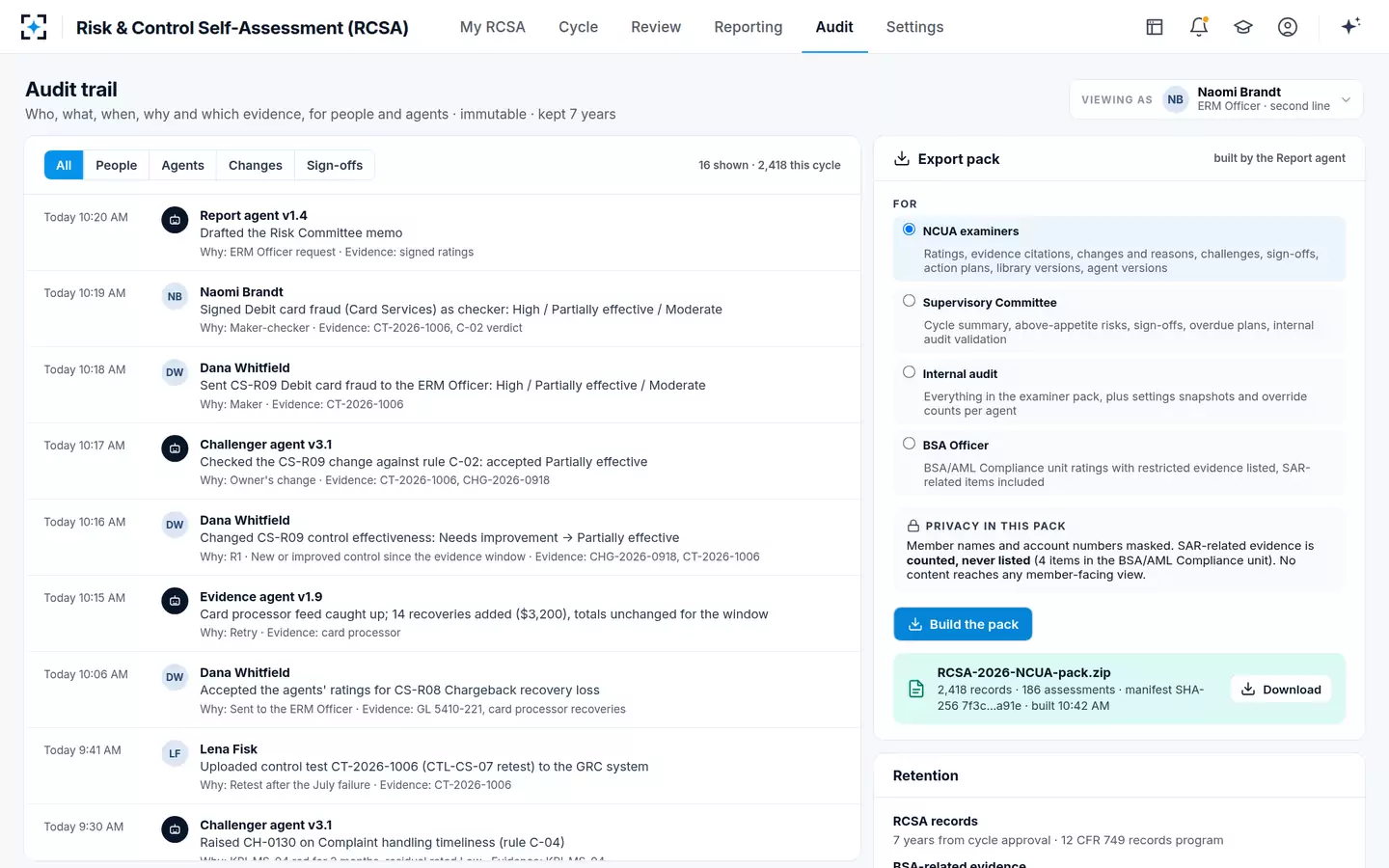
- Export a trail an examiner can follow
Every action by people or software, with why and on what evidence.
What is the difference between RCSA software and GRC?
GRC is the broader system: policies, risks, controls, issues, compliance obligations and audits across the institution. RCSA software is one use of it, or a separate tool that works alongside it. The useful question is not which label a product carries but where the evidence for a rating comes from and who can see it.
A GRC workflow module and an evidence-reading layer, on the same RCSA
GRC workflow module: The GRC platform: library, tests, issues.
Evidence-reading agents alongside the GRC system: Still the GRC platform; the agents read from it.
GRC workflow module: The owner, from what she knows and what the module shows.
Evidence-reading agents alongside the GRC system: A proposal from six systems, every figure cited; the owner decides.
GRC workflow module: A reviewer's comments in the workflow.
Evidence-reading agents alongside the GRC system: Seven versioned rules on every proposal and change, decided by the ERM Officer.
GRC workflow module: A scheduled re-assessment.
Evidence-reading agents alongside the GRC system: Ratings reopened when a trigger fires, with the evidence that fired it.
GRC workflow module: Read incident text, general ledger postings or card processor data.
Evidence-reading agents alongside the GRC system: Replace the GRC platform, sign, or close an action plan.
The second line's challenge as written rules, each decided by a person
How do you compare RCSA tools? Test them on your last cycle
Compare RCSA tools by running each on your own last completed cycle and checking what it would have shown, not by comparing feature lists. Pick a unit with real losses in the window, give each tool the same inputs, and see which ratings each would have moved and why. A tool that cannot show you its evidence on your data will not show it to your owners either.
Questions to put to any RCSA software, with the answer to look for
| Ask | A good answer |
|---|---|
| Show me one rating's evidence on our data | Every figure opens its source: the posting, the test, the finding |
| What happens when the evidence is thin? | The tool says so and asks; it does not fill the gap with a guess |
| Who can change a proposed rating, and what is kept? | Only the owner, with a reason code, her words and evidence |
| Can the software sign or submit? | No; maker and checker are people, and nobody signs their own rating |
| How is the challenge done? | Written, versioned rules; a person decides each challenge with a reason |
| Are other units' ratings used as evidence? | Shown for reference only, never used to set a rating |
| What reopens a signed rating? | Named triggers with thresholds, each logged |
| How are customer data and suspicious activity material handled? | Masked in incident text; suspicious-activity evidence counted, not listed, outside the BSA team |
| What does an examiner get? | An export of the cycle with a manifest and a hash |
The answers to the economics question, what the tool saves and what it should be measured on afterwards, are in RCSA automation: what one cycle costs, and the data each approach needs to start is in control self assessment tools.
Where evidence-reading agents add risks of their own
Agents remove the collecting and add two risks a buyer should weigh: owners who accept proposals without reading them, and proposals that are wrong in ways that look right. The Basel principles note the general trade: "automated processes are less prone to error than manual processes" (BCBS, 2021), but they bring risks of their own that need governing. The Financial Stability Board's 2026 sound practices list among the misconceptions that weaken oversight the assumptions "that AI models or systems nearly always produce correct output" and "that human involvement ensures effective oversight" (FSB, October 2026).
The defences are design choices to check for. A confidence threshold below which the agent proposes nothing. Citations on every figure, so a wrong number is visible as wrong. Overrides counted per agent, so a unit that accepts everything stands out. Versioned agents, promoted only when someone approves the new version. In the solution the confidence threshold and each agent version change only with a second person's approval, and overrides are counted per agent. On the regulatory side, the April 2026 revised model risk guidance from the Federal Reserve, OCC and FDIC leaves generative and agentic AI out of its scope, as explained in the guide to customer risk rating models; that does not make an RCSA agent ungoverned, it makes its governance the institution's own policy.
How the agents got to a proposal, step by step
Which approach fits which institution?
The right approach follows from library size, where the evidence lives and how much challenge the second line can give by hand. None is right for everyone, and moving from one to the next is only worth it when the current one is the bottleneck.
A rough guide to choosing an RCSA approach
- Spreadsheet
A few dozen risks, one or two units, a second-line reviewer who knows every risk, and evidence that owners can realistically bring themselves.
- GRC workflow module
Many units and a need for routing, deadlines, versioning and a trail; evidence mostly held in the GRC platform already.
- Evidence-reading agents
A library of a hundred risks or more, evidence spread across the incident system, the general ledger, the card processor and the issue register, and a second line that wants to challenge on evidence rather than chase forms.
- Agents alongside GRC
A likely end state for larger institutions: the platform stays the system of record, the agents read across it and the other systems.
What a single rating looks like at the end of the evidence-reading route, from the first source read to the signature and the action plan, is in an RCSA example. To run the comparison on your own last cycle, start from Risk & Control Self-Assessment (RCSA).
What every approach should end with: a trail an examiner can follow
Questions people ask
What is the best RCSA software?
There is no single best; the right tool depends on library size, where the evidence lives and how the second line challenges. The better test than any ranking is to run candidates on your own last cycle and see which would have moved the ratings your losses say were wrong.
What is an RCSA dashboard?
A view of the cycle and its results: progress by unit, ratings awaiting sign-off, open challenges, residual risk against appetite and action plans. It is useful only if the ratings behind it rest on evidence; a dashboard over opinion ratings is a well-presented opinion.
How long does RCSA software take to implement?
It depends mostly on the inputs: a library export, the rating scale and twelve months of incidents, loss postings and tests. Format problems in those inputs, not configuration, are what usually take the time. A pilot on one or two units during a live cycle is a sensible way to start.
Can RCSA software work with our existing GRC system?
An evidence-reading tool should. Risk & Control Self-Assessment (RCSA) reads the library, control tests and indicators from the GRC system and the rest from the incident system, general ledger, card processor, core banking system and issue register, without replacing any of them.
Do examiners expect RCSA software?
Examiners expect risk to be identified, assessed, challenged and reported reliably; they do not prescribe a tool. What a tool changes is how easily the institution can show that: who rated, on what evidence, who challenged and who signed.