The RCSA process, or risk and control self-assessment process, is the cycle in which each business line rates its own operational risks and the controls over them, the second line challenges those ratings, a second person signs them and the risk committee approves the result. In order, the steps are: refresh the risk and control library, gather the year's evidence, rate inherent risk, control effectiveness and residual risk, challenge, sign, report against risk appetite, track the action plans, and reopen ratings between cycles when the evidence moves. The hard part is not the rating. It is that the incidents, loss postings, control tests, audit findings and key risk indicators a rating should rest on sit in five or six systems that few process owners open at rating time. Botminds' Risk & Control Self-Assessment (RCSA) exists to put that evidence in front of the owner first, as a cited proposal, so the weeks of the cycle go on judgment and challenge instead of on collecting.
The calendar and people below come from a fictional sample credit union as it runs through the solution: Norrell Federal Credit Union, with $6.8 billion in assets, 14 business units, 186 operational risks and 412 controls in its 2026 annual cycle.
Most of a ten-week cycle is the owners' month and the second line's fortnight
- Rate their risks in interviewsOct 1–30
- Answer challengesto Nov 13
- Work their action plansto Dec 10
- Sign changes, decide challenges, as ratings arriveOct 1–Nov 13
- Committee memo and appetite viewto Dec 10
- Waits for a fully signed cycle, then approvesOct 1–Dec 10
- Reads the trail and the export pack, never ratesall cycle
What are the RCSA process steps, in the right order?
The RCSA process steps, in order, are scope, evidence, rating, challenge, sign-off, reporting, remediation and refresh. Every bank names them differently, but the dependencies fix the order: an owner cannot rate a control before the year's tests are in front of her, and a committee cannot approve a cycle with unsigned ratings in it.
The RCSA process steps, and what each one must leave behind
- 1. Scope and refresh the library
Add risks for new products and unmapped incidents, merge duplicate controls, retire unused ones. Leaves: a versioned list of risks and controls per unit.
- 2. Fix the evidence window
Twelve months that end before the cycle opens. Leaves: a dated window every rating is read against.
- 3. Gather the evidence per risk
Incidents, loss and recovery postings, control tests, audit and exam findings, key risk indicators. Leaves: a file per risk, sources named.
- 4. Rate the three ratings
Inherent risk, control effectiveness, residual risk from the matrix. Leaves: ratings with the reasons written down.
- 5. Challenge
The second line tests each rating against its evidence. Leaves: every challenge with the rule, the evidence and the owner's answer.
- 6. Sign
A second person signs every rating the owner made or changed. Leaves: maker and checker, never the same person.
- 7. Report against appetite
Residual risk by event type against the Risk Appetite Statement. Leaves: a committee memo built from signed ratings only.
- 8. Remediate and refresh
Action plans for weak controls; reopen a signed rating when a trigger fires. Leaves: plans with owners and dates, and a refresh log.
Step 1 is the one most often skipped, and it is where the cycle's blind spots start. A risk that is not in the library cannot be rated, so incidents that map to no risk are the signal that the library is behind the business. At the sample credit union the library grew from 177 risks in April to 186 by July, and Member Business Lending, a unit new this cycle, brought nine risks no one had rated before.
Step 2 sounds clerical and is not. The sample cycle reads the twelve months from October 1, 2025 to September 30, 2026, so a control change that went live after September 30 is outside the window. An owner can still credit it, but only by saying so, with a reason and the evidence attached. That is how a later change stays visible instead of quietly lowering a rating.
Who participates in an RCSA? Five seats, and what each owns
An RCSA has five seats: the process owner who rates, the second line that challenges and signs, the risk committee that approves, internal audit that assures, and the analysts who keep the library and the evidence current. The Basel Committee's principles put the rating with the business: the first line identifies and assesses the operational risks of its own unit, the second line forms an independent view and challenges it, and the third line reviews the whole framework (BCBS, 2021).
The RCSA process, seen from each seat
Today
Rates a year of risks in an afternoon, often from memory, while the incidents, losses and tests sit in systems she does not open at rating time.
With agents
Answers one risk at a time: last year's rating, what happened since and a cited proposal. Accepts, changes with a reason, or asks.
Still theirs: the rating, and the reason for any change
Today
Spends weeks of the cycle chasing owners with reminders, then argues opinions in challenge sessions.
With agents
Signs every change as the checker with the evidence beside it, decides each challenge, and signs unchanged ratings in bulk.
Still theirs: every signature and every challenge decision
Today
Receives a pack built by hand and asks which risks are above appetite and who owns the fix.
With agents
Sees residual risk by event type against appetite, each above-appetite risk with an owner and a plan.
Still theirs: approval of the cycle
Today
Rebuilds who changed which rating, why and on what evidence from spreadsheets and email.
With agents
Reads every step by people and agents, read-only, with an export pack that carries a manifest and a hash.
Still theirs: independent assurance
The second line's job is the one most often misread as administration. The Basel principles define it as "challenging the relevance and consistency of the business unit's implementation of the operational risk management tools, measurement activities and reporting systems, and providing evidence of this effective challenge" (BCBS, 2021). Evidence of challenge is the operative phrase: a challenge that left no trace did not happen, as far as an examiner is concerned.
For the largest national banks the OCC's heightened standards make the split formal: front line units assess and manage their own risks and report their compliance with risk limits to independent risk management "at least quarterly" (12 CFR part 30, Appendix D). Those guidelines apply to banks with $50 billion or more in average total consolidated assets; a credit union is not bound by them, but they are the clearest US statement of who should own an assessment. Why the first line's own findings now carry regulatory weight is the subject of the first line of defense guide.
How long does an RCSA take? The calendar drawn to scale
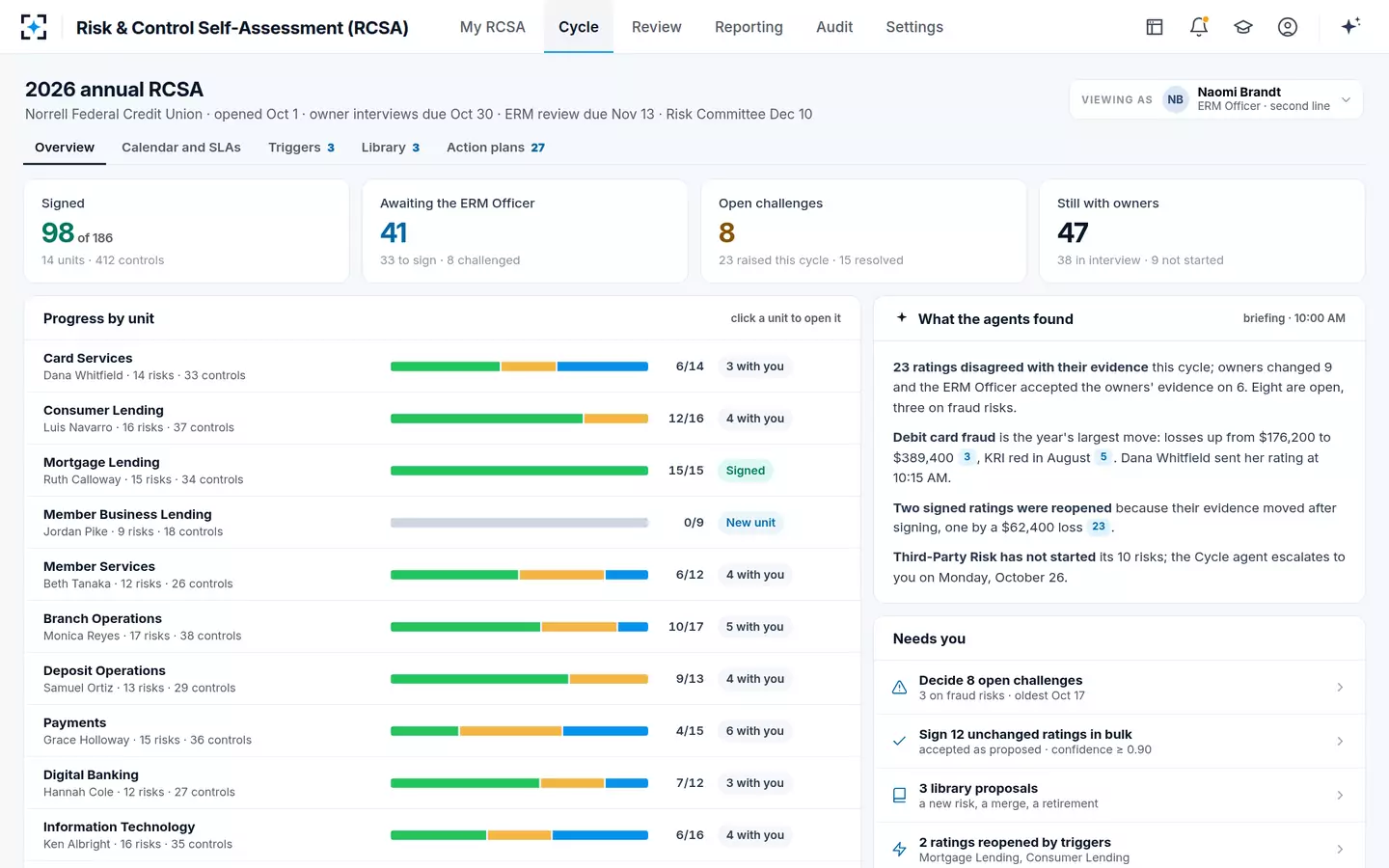
The sample credit union's annual RCSA runs ten weeks from opening to committee approval, and the timeline above shows how they divide: four weeks of owner ratings, two of second-line review, then a month in which the committee pack is built and the remaining challenges close. The weeks are not the problem. The problem is what fills them.
In a cycle run on forms, the owner's month is mostly retrieval. The solution's own estimate of one risk's rating, done by hand and counting the owner's and the second line's minutes together, is 45 minutes pulling incidents and loss postings, 30 reading tests, findings and indicators, 20 rating, 20 writing the rationale and 30 answering the second line, about 145 minutes, against a design target of about 20 minutes when the evidence arrives pre-read. Across 186 risks the difference is nearly 390 hours, and more than half of the hand-done minutes go on finding and reading evidence rather than judging it. The arithmetic, and the KPIs worth tracking instead of completion rates, are in RCSA automation: what one cycle costs.
The whole RCSA cycle on one page, day 22
What happens in an RCSA workshop, and what an interview changes
An RCSA workshop puts a process owner, colleagues from the unit and an operational risk facilitator in a room to agree ratings risk by risk. Its strength is debate; its weakness is that the evidence is rarely in the room, so the debate is between memories. The interview format keeps the conversation but changes its first move.
A workshop and an interview reach the same ratings by different routes
Facilitated workshop: Last year's rating, read aloud.
Evidence-first interview: Last year's rating, what happened since, and a proposal with every figure cited.
Facilitated workshop: In the systems, fetched afterwards if someone asks.
Evidence-first interview: One click from each number: the loss posting, the failed test, the open finding.
Facilitated workshop: The most senior person present.
Evidence-first interview: The proposal, then the owner, who accepts, changes with a reason, or asks.
Facilitated workshop: A line in the minutes, if anyone wrote one.
Evidence-first interview: The owner's reason code, her note verbatim and the evidence attached.
Facilitated workshop: As long as the room needs.
Evidence-first interview: Design target about 20 minutes, owner and second line together.
The interview is what the agents in the solution run, one risk at a time; the questions an RCSA interview should ask covers what the agent says first, when it declines to propose, and how an owner's reason is kept.
How often should an RCSA be performed? Annually, and whenever the evidence moves
An RCSA is normally performed once a year in full, with ratings reopened between cycles when a defined event shows the rating may be wrong. Neither the Basel principles nor US guidance fixes the frequency; what they ask for is assessment that keeps up with change. The Basel principles want the first line to "perform operational risk and control assessments of new products, activities, processes and systems" (BCBS, 2021), and the Federal Reserve's guidance for institutions under $100 billion asks examiners whether senior management "has identified and reviewed risks associated with engaging in new activities or introducing new products" (Federal Reserve, SR 16-11).
What is a refresh trigger, and which events should reopen a rating?
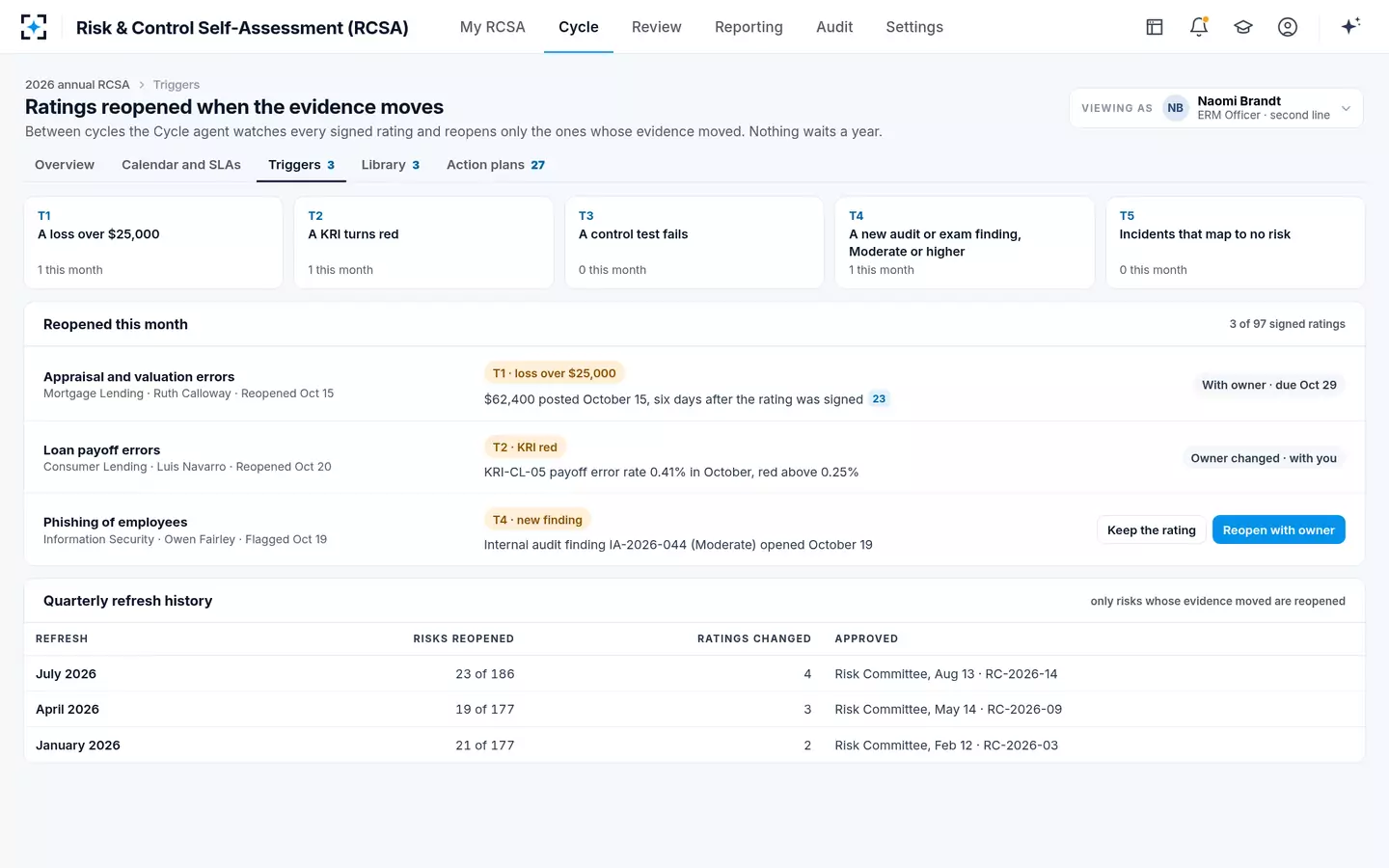
A refresh trigger is a defined event that reopens a signed rating between annual cycles, and it turns that expectation into a rule the calendar can run. The sample credit union uses five: a loss over $25,000, a key risk indicator turning red, a failed control test, a new audit or exam finding rated Moderate or higher, and incidents that map to no risk. A trigger reopens only the ratings whose evidence moved, so a quarterly refresh touches a fraction of the library rather than all of it.
Quarterly refreshes reopened about one rating in nine, and changed a handful
The case for triggers is easiest to see on a single risk. At the sample credit union, a $62,400 loss on appraisal and valuation errors in Mortgage Lending posted on October 15, six days after the rating was signed. Without a trigger it would have waited a year for the next cycle; with one, the rating went back to its owner the same day, due October 29.
Ratings reopened when the evidence moves
What is the second line's role in an RCSA? Challenge on evidence, then sign
The second line's role in an RCSA is to form an independent view of each rating, challenge the ones its evidence does not support, and sign. It does not rate. The OCC's heightened standards expect independent risk management to report "significant instances where independent risk management's assessment of risk differs from that of a front line unit" (12 CFR part 30, Appendix D), which only works if the disagreement is written down rule by rule.
One rating's path through the cycle, and the line no agent crosses
Agent
Evidence agentReads the risk's incidents, losses, recoveries, tests, findings and indicators for the window, member details masked.
Never: edits a source system
Agent
Prefill agentScores likelihood and impact, rates the control from its tests, applies the residual matrix, cites each figure.
Never: proposes below 0.70 confidence
A person decides
Process owner ratesAccepts the proposal, changes it with a reason code and evidence, or asks.
Agent
Challenger agentTests the rating against seven second-line rules and raises a challenge where it disagrees.
Never: overrides a rating
A person decides
ERM Officer signsSigns as checker, or returns with a reason, or escalates to the committee.
A person decides
Risk Committee approvesApproves the cycle once every rating is signed.
Writing the challenge as rules is what lets a small second line cover 186 risks. The sample cycle's seven rules range from losses against the rating to a failed test against an Effective control and a gap of two levels from peer units; they raised 23 challenges from 1,204 checks, and the ERM Officer decided each one with a reason code. The rules do not replace judgment. They decide where it is spent.
What the committee receives, and when a cycle is finished
A cycle is finished when every rating is signed and the committee has approved residual risk against appetite, not when the forms are in. The committee's question is narrow: which risks sit above the appetite the board set, who owns each one and what the plan is. At the sample credit union, 13 of 186 residual ratings were above appetite, each with an owner and an action plan, and the memo to the committee is drafted from signed ratings only, every figure cited.
The cycle's last output is the one that lasts longest: the trail. Every rating, change, reason, challenge and signature by people and agents is kept with the evidence behind it, and exported for examiners with a manifest and a hash. Following one risk through all of it, from the first evidence read to the signature and the action plan, is the subject of an RCSA example. The solution itself is at Risk & Control Self-Assessment (RCSA).
Questions people ask
Is an RCSA required by regulation?
No US regulation names the RCSA as such. The Basel Committee's 2021 principles list self-assessments among the tools banks use to identify and assess operational risk, and the OCC's heightened standards expect front line units at banks of $50 billion or more to assess their material risks on an ongoing basis. For institutions under $100 billion, the Federal Reserve's SR 16-11 has examiners assess an institution's "formal or informal systems for identifying, measuring, monitoring, and controlling" its risks, and an RCSA is the usual operational-risk form of one.
How do you conduct an RCSA for the first time?
Start with a library of risks and controls per business unit, a rating scale with written definitions for each level, and twelve months of evidence per risk. Run a pilot unit first, ideally one with real losses in the window, so the scale and the challenge rules are tested on ratings that should move. Then extend unit by unit.
Who owns an RCSA rating?
The first line owns the rating: the process owner who manages the risk rates it and answers for it. The second line owns the challenge and, at most institutions, the sign-off; internal audit owns assurance over the whole process. The IIA's Three Lines Model is explicit that managing risk stays with the first line even where a second line exists to support and challenge it.
What is the difference between an RCSA and a risk register?
The RCSA is the assessment; the risk register is where its results are kept. The Basel principles describe a register as a way "to collate this information to form a meaningful view of the overall effectiveness of controls" for senior management and the board. A register with no assessment behind it is a list; an assessment with no register is hard to oversee.
How long should the evidence window be?
Twelve months is the natural choice for an annual cycle, ending shortly before the cycle opens so the evidence is complete when owners rate. The sample credit union reads October 1 to September 30 for a cycle that opens October 1. Anything that happens after the window closes can be credited by the owner, with a reason and the evidence attached.