The difference between inherent vs residual risk is the controls: inherent risk is the likelihood and impact of a risk before any controls are considered, and residual risk is the exposure that remains after the controls are taken into account. In a risk and control self-assessment (RCSA), a business unit rates both for every operational risk, with control effectiveness in between, and compares residual risk with the risk appetite the board has set. The difficulty is that residual risk is only lower than inherent risk if the controls are shown to work, so an RCSA whose control ratings rest on memory produces residual ratings that look reassuring and mean little. Botminds' Risk & Control Self-Assessment (RCSA) rates inherent risk from the year's incidents and losses and control effectiveness from tests and findings, so the step from one to the other always names its evidence.
The examples come from a fictional sample credit union as it runs through the solution: Norrell Federal Credit Union, with 186 operational risks rated in its 2026 cycle.
Inherent vs residual risk: four combinations, four banking examples
High inherent · Controls weak
High residual
Debit card fraud as first proposed: 214 incidents and $389,400 of gross losses in the year, and the monthly velocity rule review failed its July test. High with Needs improvement stays High, above an appetite of Moderate or lower.
High inherent · Controls working
Lower residual
The same risk after the owner credited a new velocity rule and a clean independent retest: High with Partially effective is Moderate, within appetite. Effective, and a lower residual, needs two clean quarters.
Lower inherent · Controls weak
Low residual, still flagged
A risk with few events and small losses keeps a Low residual even with a weak control, but the failed test still raises an action plan: residual risk is not the only output of the assessment.
Lower inherent · Controls working
Low residual
Last year's debit card fraud rating, before the evidence moved: Moderate inherent with an Effective control read Low. A low rating on both axes is the one most worth re-testing against the year's losses.
What is the difference between inherent and residual risk?
Inherent risk is what a product, process or activity carries on its own; residual risk is what is left once the controls in place are counted. The Basel Committee's definitions are the ones most banks use: self-assessments "typically evaluate inherent risk (the risk before controls are considered), the effectiveness of the control environment, and residual risk (the risk exposure after controls are considered)" (BCBS, 2021).
The middle term in that sentence is the one that matters. Residual risk is not a separate judgment about how worried to be; it is inherent risk adjusted by an evidenced view of the controls. That makes the rating chain a sequence of claims, each checkable: how often and how badly could this go wrong, how well do the controls work, and what does that leave.
Inherent and residual risk, side by side
Inherent risk: How likely and how severe is this risk if no control works?
Residual risk: How likely and how severe is it with the controls as they actually operate?
Inherent risk: Incidents, losses, volumes, external events, the nature of the product.
Residual risk: The inherent rating plus control tests, open findings and indicator breaches.
Inherent risk: Changes in the business: new products, volume, channels, fraud patterns.
Residual risk: Changes in the business, and changes in how well the controls work.
Inherent risk: The scale's likelihood and impact bands.
Residual risk: The risk appetite statement, by event type.
Inherent risk: Which risks deserve key controls and frequent testing.
Residual risk: Action plans when residual sits above appetite.
Inherent vs residual risk examples from banking
Three risks from the sample credit union's 2026 cycle show how the same structure produces different answers, and why each answer has to name its evidence.
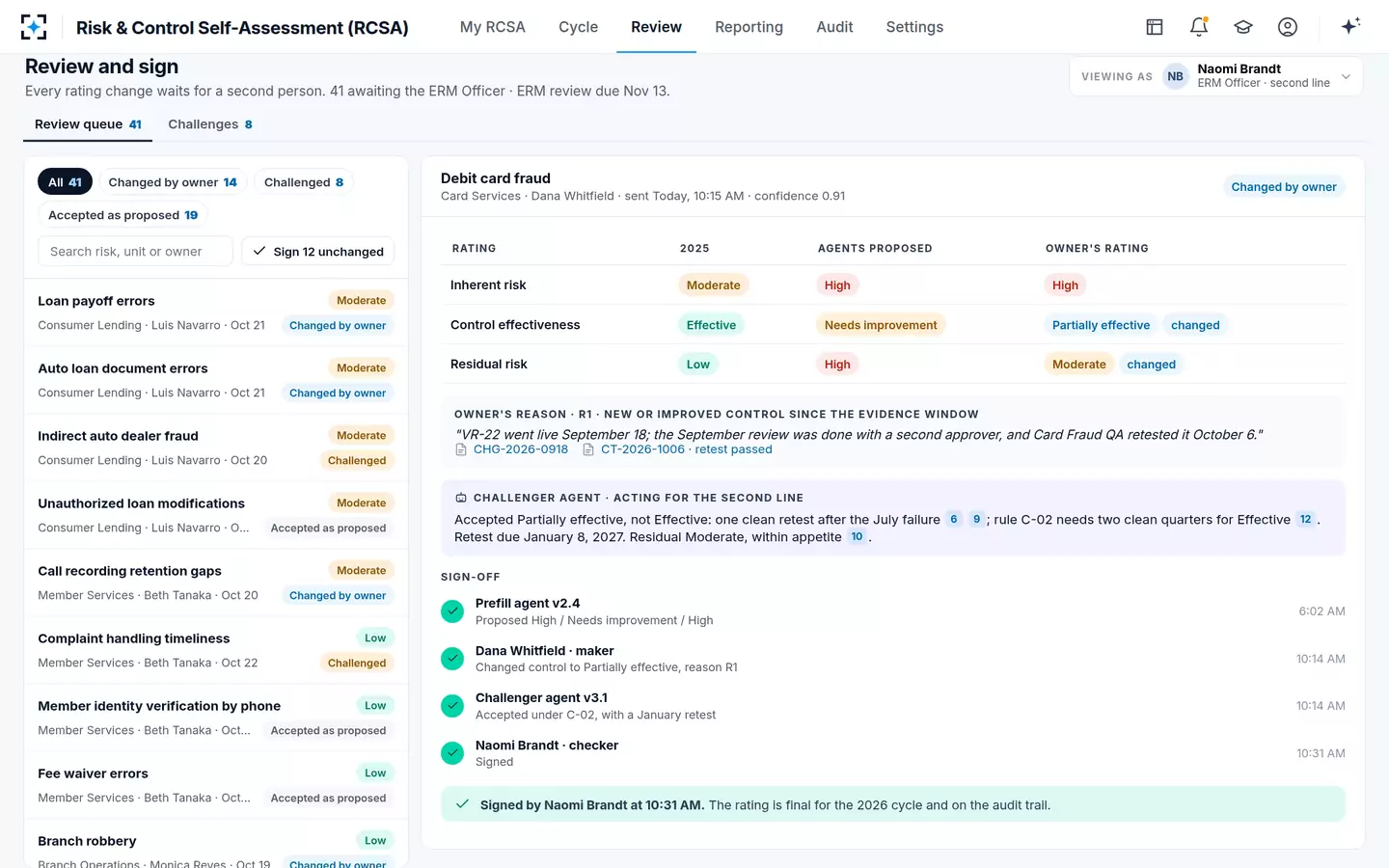
Debit card fraud, Card Services. Inherent risk scored likelihood 5 and impact 3 on the sample scale, 15, which is High: 214 incidents and $389,400 in gross losses, up from 151 and $176,200. The monthly velocity rule review failed its July test, so control effectiveness was proposed as Needs improvement, leaving High residual risk. The owner then credited a new velocity rule, live on September 18 and retested cleanly on October 6. Control effectiveness became Partially effective and residual risk Moderate, within the appetite of Moderate or lower. Same inherent risk, a different residual, for a reason anyone can check.
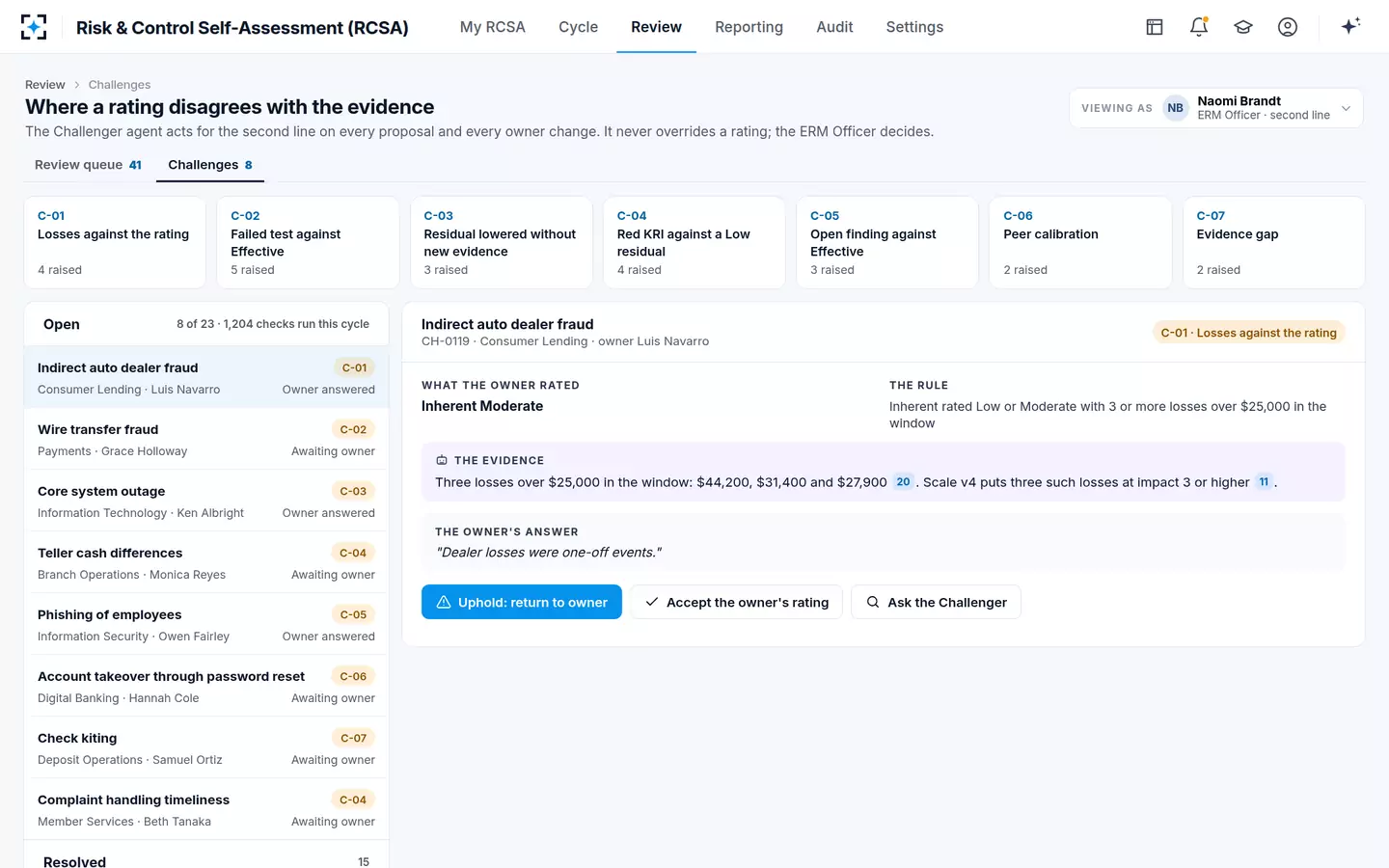
Indirect auto dealer fraud, Consumer Lending. The owner rated inherent risk Moderate. The window held three losses over $25,000, of $44,200, $31,400 and $27,900, and the sample scale puts three such losses at impact 3 or higher. The second line challenged the inherent rating, not the controls: the owner's answer, "Dealer losses were one-off events", is the kind of reason a challenge exists to test. Residual risk can only be as right as the inherent rating it starts from.
Wire transfer fraud, Payments. The owner rated the control Effective after a failed callback test, and the second line's rule on failed tests raised a challenge, still awaiting the owner's answer on day 22. Until it is decided, the residual rating rests on a control claim the evidence contradicts, which is precisely what a challenge exists to keep away from the committee.
The challenge that questions an inherent rating, not a control
How do you calculate residual risk in an RCSA?
Residual risk is calculated by combining the inherent risk rating with the control effectiveness rating, either through a residual matrix (a table that gives a residual level for each pair) or through a score reduction (an inherent score multiplied down by a control factor). Both are conventions an institution sets in its policy; neither is prescribed by regulation. What the Basel principles ask is that the framework "describe the bank's accepted operational risk appetite and tolerance; the thresholds, material activity triggers or limits for inherent and residual risk" (BCBS, 2021).
A residual risk matrix: inherent risk across, control effectiveness down
| Control effectiveness | Low inherent | Moderate inherent | High inherent | Critical inherent |
|---|---|---|---|---|
| Effective | Low | Low | Low | Moderate |
| Partially effective | Low | Low | Moderate | High |
| Needs improvement | Low | Moderate | High | Critical |
| Ineffective | Low | Moderate | High | Critical |
The matrix route is the more defensible of the two for an RCSA, because every cell is a visible policy choice that a committee can approve and an examiner can read. The score route looks more precise and often is not. A "control factor" of 40% or 70% is a judgment dressed as a number, and NIST's guide to risk assessment warns that "rigor is significantly lessened when subjective determinations are buried within assessments" (NIST SP 800-30 Rev. 1). If an institution uses scores, the factor should come from the control rating's evidence, not from the owner's sense of confidence.
Worked on the sample: debit card fraud's inherent score is likelihood 5 times impact 3, 15, which the scale's bands (Low 1–5, Moderate 6–11, High 12–19, Critical 20–25) place at High. Critical would need a score of 20, such as impact 4, meaning an annual gross loss over $1 million or a single event over $100,000; the largest event was $22,860. The matrix then turns High with Needs improvement into High residual, and High with Partially effective into Moderate. How the likelihood and impact scores themselves should be calibrated across units is the subject of the likelihood and impact matrix guide.
What is a residual risk rating, and what is target risk?
A residual risk rating is the level the matrix produces after controls, and target risk is the level the business intends to reach, usually set by the risk appetite. When residual sits above target, the gap is what an action plan has to close. The sample credit union's appetite for external fraud is Moderate or lower; for internal fraud it is Low or lower.
Residual risk above appetite, by event type: 13 of 186 risks
Who reports residual risk, and what goes with the rating?
The first line reports residual risk, and the losses and deficiencies behind it go with the rating: reporting residual risk against appetite is a first-line duty, not only a second-line one. The Basel principles list among the first line's responsibilities "reporting residual operational risks not mitigated by controls, including operational loss events, control deficiencies, process inadequacies, and non-compliance with operational risk tolerances" (BCBS, 2021). The residual rating is the summary; the losses, deficiencies and breaches behind it are the substance.
How do controls reduce inherent risk?
Controls reduce inherent risk in three ways: by preventing the event, by detecting it early enough to limit the loss, or by recovering part of the loss afterwards. A rating should say which, because they move different things: prevention lowers likelihood, detection and recovery mostly lower impact.
From inherent to residual: the rating steps, and who does each
Agent
Score inherent riskLikelihood and impact from the window's incidents and losses, on the institution's scale.
Never: counts a control at this step
Agent
Rate the controlsControl effectiveness from key-control tests and open findings.
Never: credits a control with no test
Agent
Apply the matrixResidual risk from the pair, compared with appetite for the event type.
A person decides
Owner decidesAccepts, or changes a rating with a reason code and evidence; residual recalculates before sending.
A person decides
Second person signsThe ERM Officer signs as checker; above-appetite risks need an action plan.
Can residual risk be higher than inherent risk?
In a well-formed matrix, residual risk cannot be higher than inherent risk, because controls only subtract. When an assessment shows residual above inherent, one of two things has happened. Either inherent risk was rated with the controls already in mind, a frequent error in the first column of an RCSA, or a "control" has created a risk of its own. The Basel principles note the second case directly: automated processes "introduce risks that must be addressed through sound technology governance and infrastructure risk management programmes" (BCBS, 2021). The fix is to rate the new risk as a risk, not to let it push residual above inherent.
Last year, the agents' proposal and the owner's rating, side by side
What is an inherent risk rating, and why it must not assume the controls
An inherent risk rating is the likelihood and impact score of a risk as if none of its controls existed. In practice, owners find it hard not to count controls they know are there, and an inherent rating that quietly assumes the controls makes the residual step meaningless: both ratings end up the same, and control effectiveness has nothing to subtract from.
Rating inherent risk from the events themselves is the practical remedy. If the evidence shows 214 incidents and $389,400 of gross losses, that is what the risk did with the controls in place; the gross figure, before recoveries, is a floor for inherent impact, not a ceiling. The anti-money laundering version of the same pair, where inherent risk comes from customers, products and geographies rather than loss events, is covered in inherent and residual risk in AML. The solution that runs the operational risk version is Risk & Control Self-Assessment (RCSA), and a full rating followed through a year is in an RCSA example.
Questions people ask
Is residual risk the same as net risk?
Usually, yes: banks use residual risk, net risk and controlled risk for the exposure left after controls. Gross risk is sometimes used for inherent risk. The terms matter less than using one definition consistently across every unit.
Should inherent risk change every year?
Only when the business changes or the evidence does. New products, higher volumes, new fraud patterns and a year of larger losses all move inherent risk. In the sample cycle, debit card fraud moved from Moderate to High inherent because incidents rose 42% and gross losses more than doubled.
What is a residual risk rating matrix?
A table that gives the residual level for every combination of inherent risk and control effectiveness. It turns two ratings into a third by policy rather than by opinion, so it should be approved, versioned and applied the same way in every unit.
Who rates inherent and residual risk?
The first line, meaning the business unit that owns the risk, rates both; the second line challenges and, at most institutions, signs. In the sample credit union the process owner rates, the ERM Officer signs every change, and the Risk Committee approves residual risk against appetite.
How does residual risk relate to risk appetite?
Residual risk is what the institution compares with its appetite. A residual rating above the appetite for its event type needs an owner, an action plan and committee visibility; at the sample credit union, 13 of 186 residual ratings were above appetite, each with a plan.