An RCSA example should show one operational risk rated end to end: its inherent risk, control effectiveness and residual risk, the evidence behind each, who rated it, who challenged it, who signed it, and what happens if the evidence moves afterwards. Here is that example in full. Debit card fraud, risk 9 of 14 for Card Services at a fictional credit union, was rated Moderate inherent, Effective control and Low residual last year. In the next twelve months its gross losses more than doubled, a control failed its test and internal audit opened a finding, and the rating still read Low when the 2026 cycle opened. Botminds' Risk & Control Self-Assessment (RCSA) is built for exactly that gap: its agents read the year's evidence before the owner rates, propose a rating with every figure cited, and reopen a signed rating when a defined trigger fires between cycles.
Everything below comes from a fictional sample credit union as it runs through the solution: Norrell Federal Credit Union, $6.8 billion in assets and 520,000 members. The process owner is Dana Whitfield, VP Card Services, who owns 14 risks and 33 controls; the ERM Officer is Naomi Brandt.
The rating card for debit card fraud, last year and as signed this year
Inherent risk
2025Moderate
2026, signedHigh
What moved itLikelihood 5 × impact 3 = 15 on scale v4: 214 incidents (151 last year) and $389,400 gross loss ($176,200 last year).
Control effectiveness
2025Effective
2026, signedPartially effective
What moved itMonthly velocity rule review failed on July 14; new rule VR-22 live September 18 and retested cleanly October 6. One clean retest, not two clean quarters.
Residual risk
2025Low
2026, signedModerate
What moved itHigh with Partially effective, from the residual matrix. Appetite for external fraud: Moderate or lower. Within, with a retest due January 8, 2027.
What is an example of an RCSA? One risk, rated end to end
An example of an RCSA is a single risk carried through every step: evidence, three ratings, challenge, signature, action plan and reporting. The card above is the end state. The rest of this page is how it got there, and why each step left something an examiner or internal auditor can read.
The Basel Committee's standard for a self-assessment is the right test for any example: an independent reviewer should be able to see from it how each rating was reached, from the business environment and the causes of the risk to the controls and how well they work (BCBS, 2021). A template with three coloured cells and no evidence fails it, however neat it looks.
Last year's Low stood for six months while the losses ran amber and red
- Low residual, from the 2025 cycleto Oct 22, 2026
- Moderate, signedto Jan 8, 2027
- Losses below the amber lineOct–Mar
- Amber from April, red in AugustApr–Sep
- Signed, plan, retestOct 1–Jan 8
What evidence is used in an RCSA example?
The evidence in this example is the risk's year from six systems, read by the solution's Evidence agent before the owner opened the risk. It is what an owner would have needed to rate honestly, and what a form-based cycle would have left in those systems.
The year's evidence for one risk, dated
| When | What happened | Source |
|---|---|---|
| Oct 2025 – Sep 2026 | 214 incidents (151 the year before); 1,186 loss postings, $389,400 gross, $121,800 recovered through chargebacks, $267,600 net | Incident system; general ledger 5410-220 and 5410-221 |
| March 18 and April 12 | Card reissue within one business day passed (24 of 25); real-time fraud scoring passed (25 of 25) | GRC system, control tests |
| April to July | Monthly gross loss above the $32,000 amber line every month | Key risk indicator KRI-CS-03 |
| June 24 | Internal audit finding IA-2026-031: fraud rule changes self-approved; rated Moderate, open | Issue register |
| July 14 | Monthly velocity rule review failed its test: April and May not evidenced | GRC system, test CT-2026-0714 |
| August | $48,900 gross loss, over the $40,000 red line; largest incident a card-not-present ring across 31 cards, $22,860 | KRI-CS-03; incident INC-2026-08812 |
| September 18 (after the window, credited by the owner) | New velocity rule VR-22 live; by October 5 it had declined 312 authorizations worth $57,300 | Card processor, change CHG-2026-0918 |
| October 6 | Independent retest of the velocity rule review passed, by Card Fraud QA | GRC system, test CT-2026-1006 |
Two things in that table decide the rating. The failed July test means the key control cannot be rated Effective. The losses mean inherent risk cannot stay Moderate: on the sample scale, likelihood 5 and impact 3 give a score of 15, which is High. Neither needed anyone's opinion.
What does an RCSA rating look like when the agent proposes it?
On day 22 of the cycle the owner opened the risk and the agent spoke first: last year's rating, what happened since, and its proposal of High inherent risk, a control that needs improvement and High residual risk, above an appetite of Moderate or lower. It mentioned the new velocity rule and said it had not credited it, because it found no test. It gave its confidence as 0.91, above the 0.70 below which it would have proposed nothing.
Dana knew what the proposal could not: the new rule had been retested on October 6, after the window closed. She changed control effectiveness from Needs improvement to Partially effective, chose reason code R1 (new or improved control since the evidence window), attached the change ticket and the retest, and wrote: "VR-22 went live September 18; the September review was done with a second approver, and Card Fraud QA retested it October 6." Residual risk recalculated to Moderate before she sent it. What the agent asks in other situations, and when it asks instead of proposing, is in RCSA questions.
How is a challenged rating resolved?
A challenged rating is resolved by testing the owner's claim against a written rule and having a different person decide. The Challenger agent checked Dana's change against rule C-02: the control failed on July 14 and passed an independent retest on October 6, which supports Partially effective but not Effective, because Effective needs two clean quarters after a failure. It also checked that the retest was independent: done by Card Fraud QA, not by the rule's operator. It accepted the change, set a retest for January 8, 2027, and kept action plan AP-2026-118 open.
Maker and checker: the ERM Officer signs with everything side by side
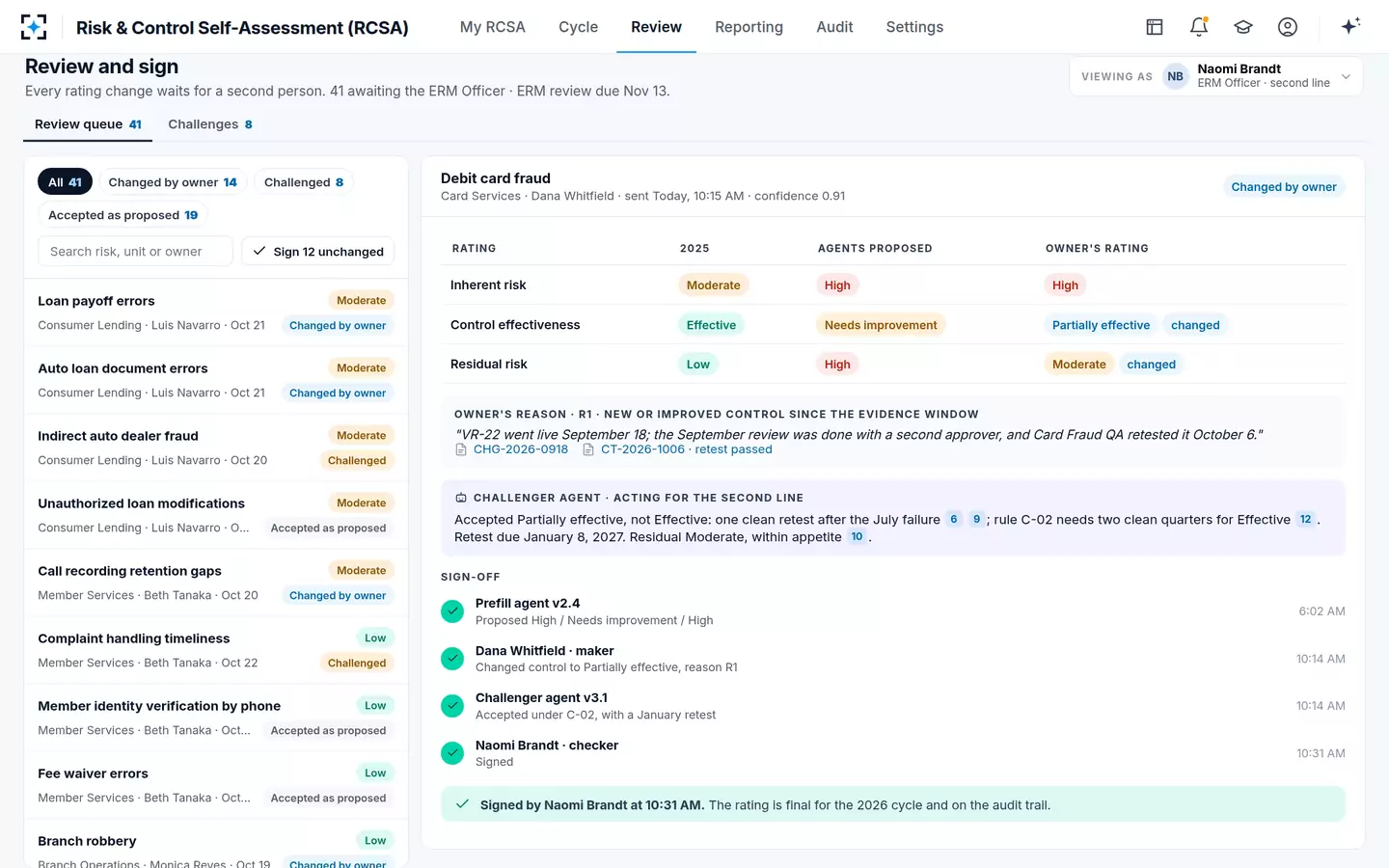
Naomi Brandt then signed as the checker, with last year's rating, the proposal and the owner's rating side by side, the reason, the evidence and the verdict beside them. She could instead have returned it with a reason code or escalated it to the Risk Committee. Other challenges in the same cycle went the other way: on indirect auto dealer fraud, an owner rated inherent risk Moderate against three losses over $25,000 and answered, "Dealer losses were one-off events"; that challenge was still open for the ERM Officer to decide.
What is an RCSA template for banks? The fields this example filled
An RCSA template for banks is the set of fields every rating must carry so that ratings can be compared across units, challenged and reported. This example filled every one of them; a template is only as good as the evidence that goes into its fields.
RCSA template fields, filled in for one risk
| Field | This example |
|---|---|
| Risk, unit, owner, event type | CS-R09 debit card fraud · Card Services · Dana Whitfield · external fraud |
| Evidence window | October 1, 2025 to September 30, 2026 |
| Key controls and latest tests | CTL-CS-05 passed · CTL-CS-07 failed July 14, retest passed October 6 · CTL-CS-09 passed |
| Inherent risk, with scores | High: likelihood 5 × impact 3 = 15 on scale v4 |
| Control effectiveness | Partially effective (proposed Needs improvement; changed with R1) |
| Residual risk and appetite | Moderate; appetite Moderate or lower; within |
| Reason for any change | R1, with the owner's note verbatim and two evidence items |
| Challenge and outcome | Rule C-02: accepted Partially effective, not Effective |
| Maker and checker | Dana Whitfield rated; Naomi Brandt signed |
| Action plan | AP-2026-118, due December 31, 2026, linked to issue ISS-2026-0418 and finding IA-2026-031 |
| Next review or trigger | Retest January 8, 2027; reopens on a loss over $25,000, a red indicator, a failed test or a new finding |
What is a refresh trigger in an RCSA?
A refresh trigger is an event that reopens a signed rating between annual cycles because its evidence has moved. Without one, a loss the week after signing waits a year. The Basel principles ask that reporting frequency "reflect the risks involved and the pace and nature of changes in the operating environment" (BCBS, 2021); a trigger is how an annual assessment keeps that pace.
What happens when a loss comes after a rating?
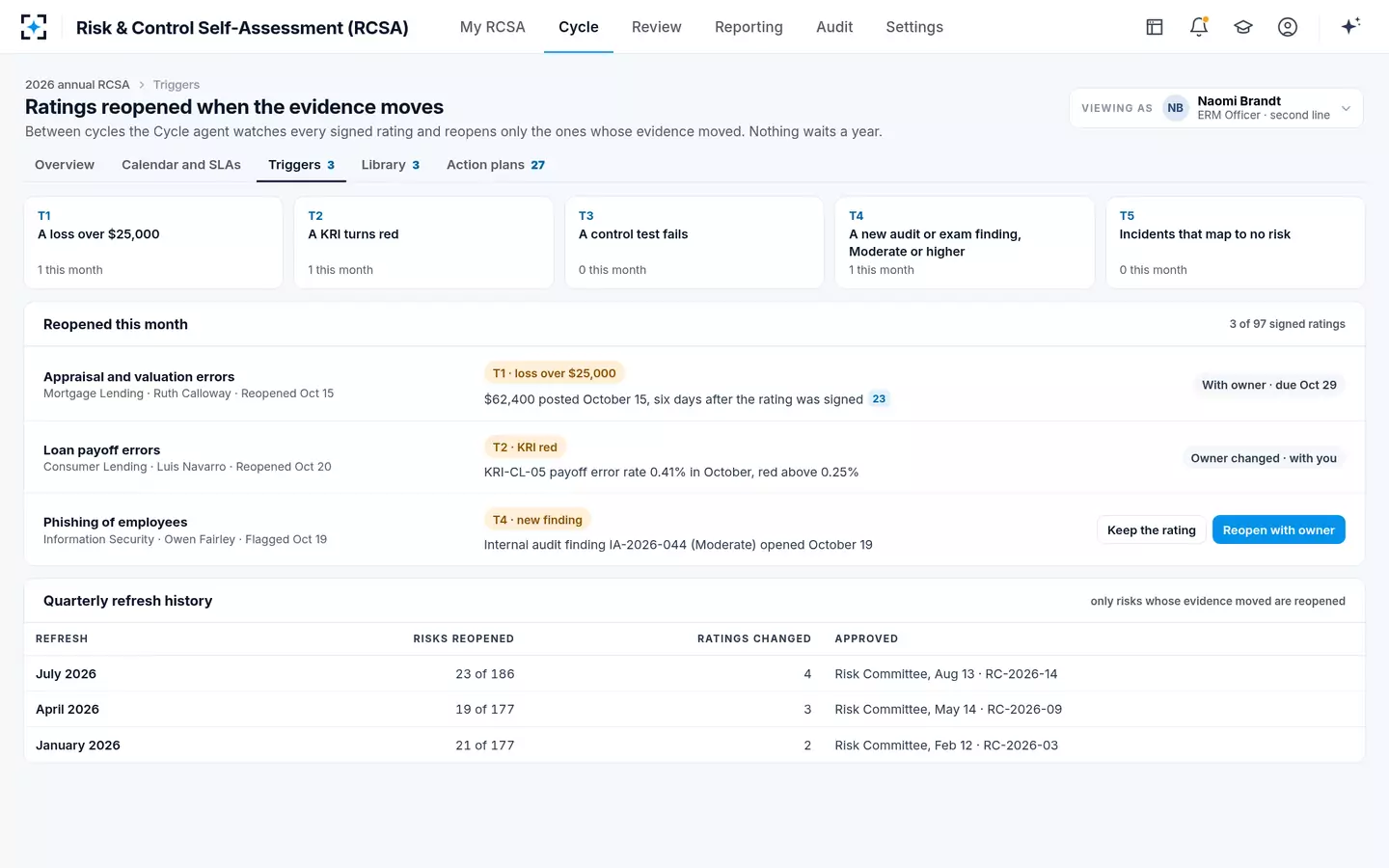
When a loss over the trigger amount posts after a rating is signed, the rating goes back to its owner the same way it came, through re-rating and a second signature. The sample credit union's second example shows it. Appraisal and valuation errors in Mortgage Lending, owned by Ruth Calloway, was signed in October. On October 15, six days later, a $62,400 loss posted against it. The loss crossed the $25,000 trigger, and the rating went back to its owner the same day, due October 29.
A loss after signing: how the rating reopens
Agent
Loss posts$62,400 against appraisal and valuation errors, six days after the rating was signed.
Agent
Cycle agentMatches the loss to trigger T1, a loss over $25,000, and reopens only this rating.
Never: extends a due date or closes an item
Agent
Evidence updatedThe new loss joins the risk's evidence, cited to its general ledger posting.
A person decides
Owner re-ratesAccepts, changes with a reason, or asks; due October 29.
A person decides
ERM Officer signsSigns the reopened rating as checker, as in the annual cycle.
Ratings reopened when the evidence moves, this month
How is an RCSA reported to the risk committee?
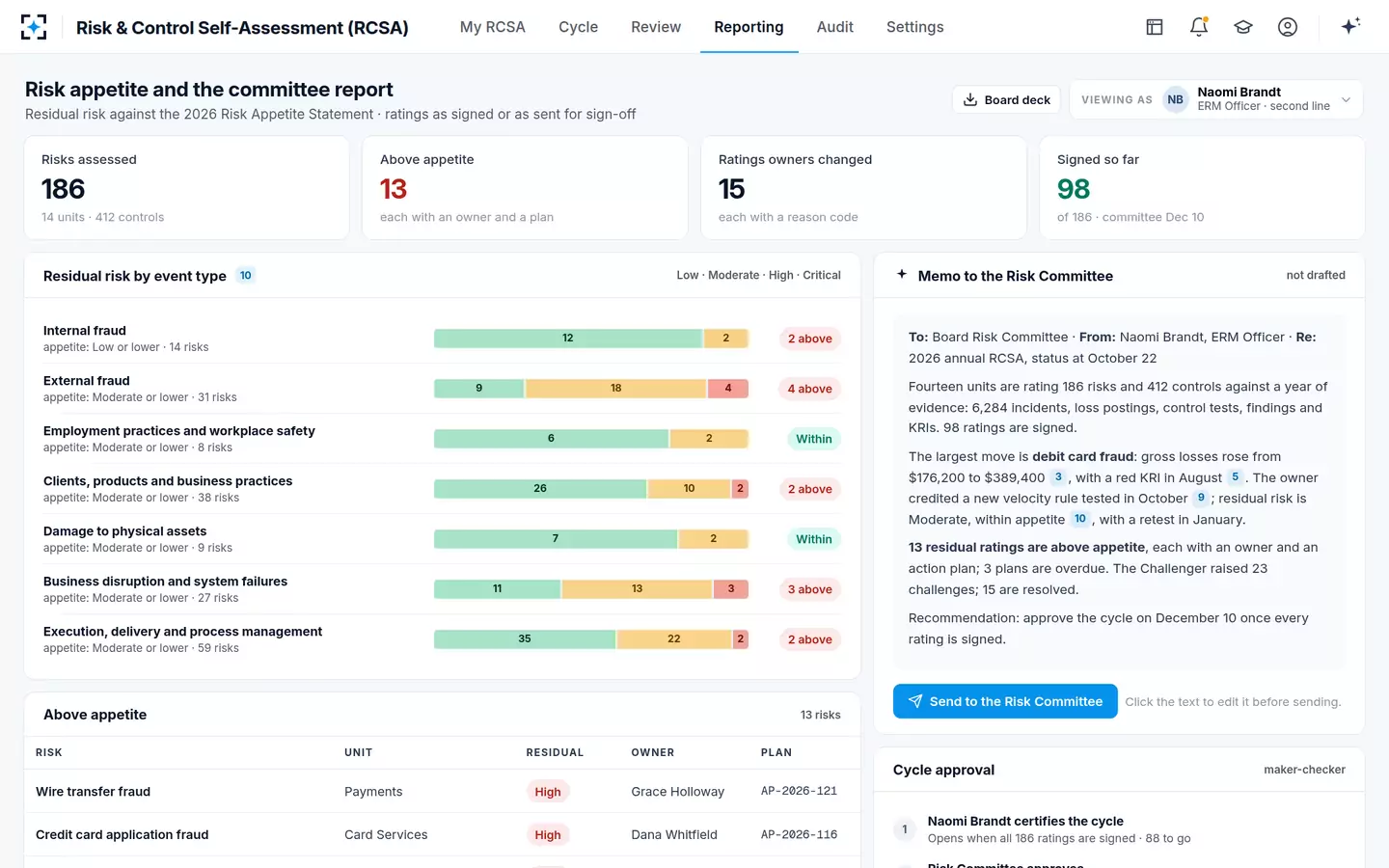
An RCSA is reported to the risk committee as residual risk against appetite, with the risks above appetite, their owners and their plans, and the largest moves of the year explained. The Basel principles expect operational risk reports to include "Details of recent significant internal operational risk events and losses (including root cause analysis)" (BCBS, 2021), which is what a committee needs to judge whether a rating moved for the right reason.
The sample credit union's memo to its Board Risk Committee, drafted from signed ratings only, names debit card fraud as the year's largest move: gross losses up from $176,200 to $389,400 with a red indicator in August, a new velocity rule tested in October, residual risk Moderate and within appetite, and a retest in January. It reports 13 residual ratings above appetite, each with an owner and an action plan, and recommends approving the cycle on December 10 once every rating is signed. Every figure in the memo opens its source.
Residual risk against appetite, and the memo to the committee
The full calendar this example sits in is in the RCSA process guide, and the measures that tell a second line whether ratings like this one are accurate across a whole cycle are in how to measure control effectiveness. To see the same steps on your own last cycle, start from Risk & Control Self-Assessment (RCSA).
Questions people ask
What does an RCSA rating look like?
Three ratings for one risk, inherent risk, control effectiveness and residual risk, each on the institution's scale, with the evidence and reasons behind them, the owner who rated and the person who signed. In this example: High, Partially effective, Moderate, with the scores, the tests and the owner's note attached.
Why did the residual rating go down when losses went up?
It did not, compared with what the evidence first showed. The agents' proposal was High residual, because the key control had failed. Residual became Moderate only after the owner credited a new rule and a clean independent retest; last year's Low was the rating the evidence contradicted.
Is there an RCSA example in Excel?
The template table above can be laid out as a spreadsheet row per risk. What a spreadsheet cannot do is fill the evidence fields from the source systems, keep the owner's reason with its evidence, or reopen the row when a loss posts.
How long did this one risk take?
The owner's part was a short session on day 22 of the cycle, a few minutes from opening the risk to sending her change, and the second-line check ran before the ERM Officer signed the same day. The solution's design target is about 20 minutes per risk across the owner and the second line, against an estimate of about 145 by hand.
What happens to the action plan after the rating is signed?
It stays open on its own timetable. AP-2026-118 has three steps: a second approver on every fraud rule change (done September 1), an evidenced monthly review for three months, and validation by internal audit after three clean months. It is due December 31, 2026 and linked to the issue register.