RCSA automation means software that does the collecting, scoring and checking in a risk and control self-assessment, so that people spend the cycle judging and signing. Priced honestly, it saves an institution with a library like the sample's a few hundred hours a year: for a library of 186 risks, the solution's own estimate is nearly 390 hours of owner and second-line time, worth roughly $22,000 to $31,000 at 2025 BLS median wages. That is a real saving and not, on its own, a reason to buy. The reasons are in what the hours used to hide: ratings that lag a year behind the losses, challenges argued on opinion, and deficiencies an examiner finds first. Botminds' Risk & Control Self-Assessment (RCSA) is built for those, and the KPIs below are how a CRO can tell whether any RCSA automation is delivering them.
Figures marked as sample come from a fictional credit union as it runs through the solution: Norrell Federal Credit Union, $6.8 billion in assets, 186 risks and 412 controls across 14 business units. Wage figures come from the Bureau of Labor Statistics; the minute estimates are the solution's own, and the rest of the arithmetic is ours.
By hand, half of a rating's minutes go on finding evidence; with agents, three-quarters go on judgment
By hand · about 145 minutes per risk
- Pulling incidents and loss postings · 31%
- Reading tests, findings and indicators · 20.7%
- Rating the three ratings · 13.8%
- Writing the rationale · 13.8%
- Answering the second line · 20.7%
With the agents · design target about 20 minutes per risk
- Pulling · 10%
- Reading · 15%
- Rating · 25%
- Rationale · 25%
- Second line · 25%
What is RCSA automation, and what does it actually automate?
RCSA automation covers four jobs: gathering each risk's evidence from the systems that hold it, proposing ratings from that evidence, checking ratings against second-line rules, and running the calendar, reminders and reports. It should not automate the decisions: the rating stays the owner's, the signature a second person's and the approval the committee's. Tools sold as "RCSA automation" differ mainly in how many of the four jobs they do and whether the evidence or the form is at the centre.
The Basel Committee's 2014 review of 60 systemically important banks in 20 jurisdictions found operational risk identification and assessment among the four least thoroughly implemented principles, and the 2021 revision, looking back on that review, puts RCSAs and key risk indicators first in the list of areas where principles "had not been adequately implemented" and needed further guidance (BCBS, 2014; BCBS, 2021). Those were systemically important banks. The gap automation addresses is not effort alone but the distance between the assessment and the evidence. Where the alternatives sit, from spreadsheets to GRC workflows, is compared in RCSA software compared.
How much time does an RCSA take? One cycle, priced
An annual RCSA of 186 risks takes about 450 hours of owner and second-line time by hand on the solution's estimate, and about 62 hours at its design target. At 2025 BLS median wages, that is roughly $25,000 to $36,000 of time by hand and $3,500 to $5,000 with the agents. The range comes from pricing the time at two wage levels, because the minutes belong to both risk specialists and business-line managers.
One annual RCSA cycle of 186 risks, priced at 2025 median wages
| Line | Hours | At $56.41 an hour | At $80.08 an hour |
|---|---|---|---|
| By hand (145 minutes per risk) | 449.5 | $25,356 | $35,996 |
| With the agents (target 20 minutes) | 62.0 | $3,497 | $4,965 |
| Difference per annual cycle | 387.5 | $21,859 | $31,031 |
Two things in that table deserve a buyer's attention. First, the saving scales with the library, not with the institution's assets: a bank with 600 risks saves about three times as much time, one with 60 a third. Second, the by-hand column is the cost of a cycle in which owners actually read the evidence. In a cycle where they do not, the hours are lower and the cost moves somewhere less visible, into ratings that miss what happened.
What does an RCSA cost when a rating is wrong?
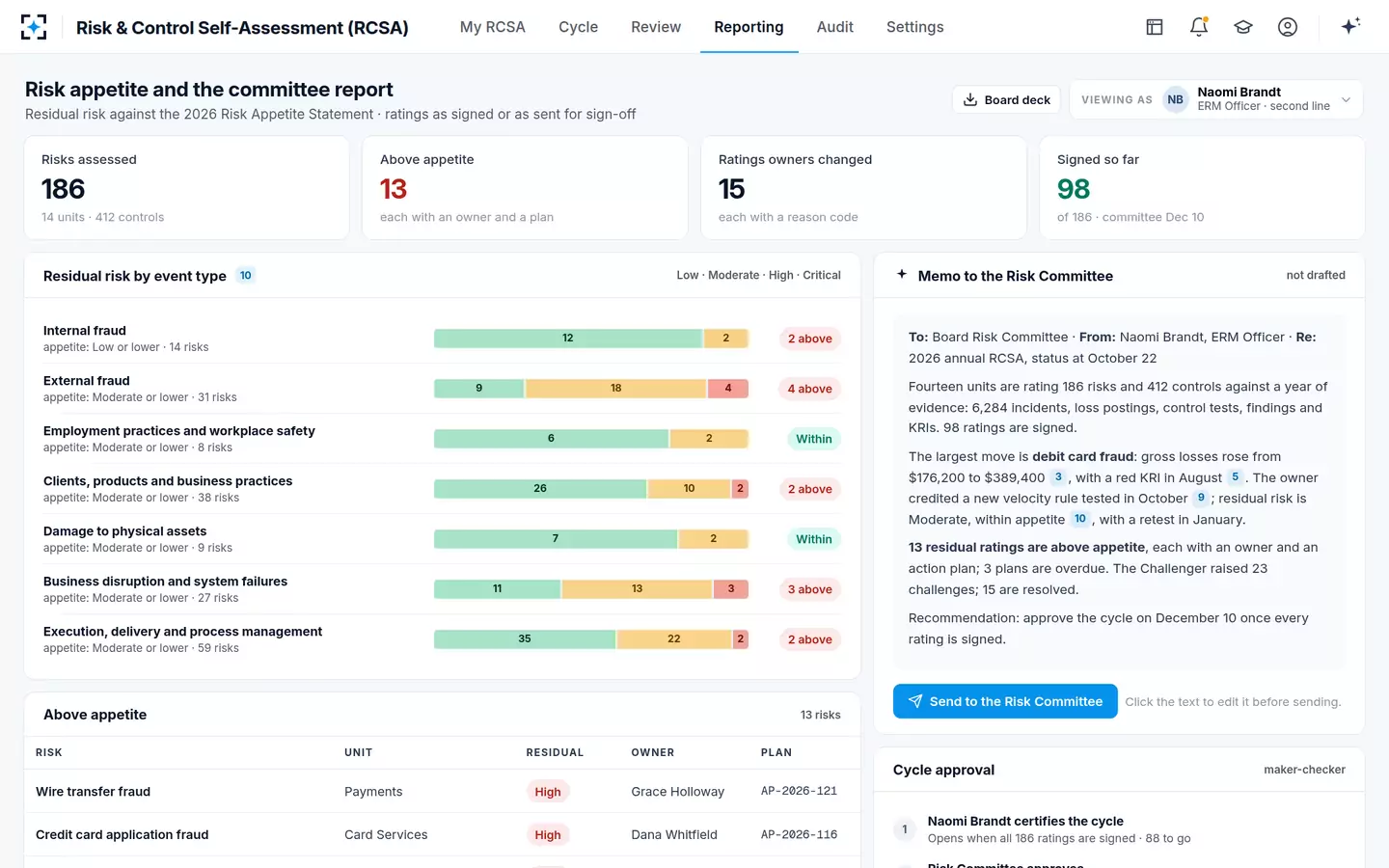
A wrong rating costs nothing on the day it is signed and shows up later as a loss nobody planned for, an action plan that was never raised, or a finding someone else made. The sample credit union's debit card fraud risk shows the scale. Last year's RCSA rated it Moderate inherent, Effective control, Low residual. Over the next evidence window, gross losses rose from $176,200 to $389,400, the key risk indicator went red in August, the monthly velocity rule review failed its test and internal audit opened a finding.
One mis-rated risk next to the cost of the whole cycle
$213,200
rise in gross debit card fraud losses in a year, on a risk rated Low residual
$267,600
net loss after $121,800 of chargeback recoveries
$21,859–$31,031
estimated saving in owner and second-line time for one annual cycle of 186 risks
13 of 186
residual ratings above appetite this cycle, each with an owner and a plan
The honest reading is not that automation would have saved $213,200. It is that the rating sat at Low for a year while the evidence said otherwise, and nothing in a form-based cycle would have moved it before the next annual round. An RCSA earns its cost when its ratings move early enough for someone to act, as the owner here did with a new velocity rule that had declined 312 authorizations worth $57,300 by October 5.
What KPIs measure an RCSA program? Seven that track value, not completion
The KPIs that measure an RCSA program compare its ratings with what later happened and with who found the problems. Completion rate, the share of assessments submitted on time, is the most common RCSA metric and the least informative: a cycle can be 100% complete and 100% wrong. The Basel principles set the bar for any operational risk metric: "Effective metrics clearly link to the associated operational risks and controls" (BCBS, 2021).
Seven RCSA KPIs, each with a formula a finance partner can audit
| KPI | Formula | What good looks like |
|---|---|---|
| Loss foresight | losses over the trigger amount that fell on risks already rated High or above appetite ÷ all losses over the trigger amount | Rising, year on year |
| Self-identified share | issues found by the first or second line ÷ all issues opened, including audit and examiners | Rising, with findings that hold up |
| Ratings moved by evidence | ratings changed after a challenge or a trigger ÷ ratings signed | Neither near zero nor most of them |
| Days to reopen | days from a trigger event to the rating being back with its owner | Same week |
| Evidence coverage | ratings with every figure cited to a source ÷ ratings signed | Target 100% |
| Challenge outcome | challenges ending in a changed rating ÷ challenges decided | Stable, read by unit |
| Owner and second-line minutes per risk | time logged on the cycle ÷ risks rated | Falling, without the others falling |
Loss foresight is the headline. It asks the question a board actually cares about: when we lost money, had our own assessment already flagged the risk? It needs only the general ledger's loss postings over a threshold and the ratings in force on the posting date. The sample credit union's $62,400 loss on appraisal and valuation errors, posted six days after that risk's rating was signed, would count against foresight in this year's figure, and the trigger that reopened the rating the same day is what keeps the next one from doing the same. How to measure the control side of the same question is covered in how to measure control effectiveness.
Why self-identified findings are now worth money
Self-identified findings are the KPI that changed most in 2026. The Federal Reserve's updated operating principles now presume that a deficiency serious enough for an MRA, which a Fed-supervised banking organization finds itself and promptly starts to fix in a way supervisors judge reasonable, is treated as a supervisory observation rather than an MRA; how that presumption works, and what it needs, is set out in the guide to self identified issues. For national banks and FDIC-supervised banks, the OCC and FDIC's final rule redefining MRAs takes effect on November 2, 2026, explained in the MRA and supervisory observation rule.
Where the open findings are makes the point for operational risk in particular. At year-end 2025, IT and operational risk, cyber included, was the largest category of outstanding MRAs and MRIAs at the Federal Reserve's community and regional banking organizations, with risk management and internal controls next (Federal Reserve, Supervision and Regulation Report, June 2026). The largest pool of open supervisory findings at those institutions sits in exactly the area an RCSA assesses. An RCSA that surfaces a weak control in the first line's own assessment, with the evidence and an action plan, is the institution's cheapest route to the observation label instead of the MRA.
Residual risk against appetite, and the memo drafted from signed ratings
Does automating the RCSA reduce losses?
Automating the RCSA does not reduce losses by itself; controls reduce losses, and the RCSA decides which controls get attention and when. What automation changes is timing and coverage. A rating that reopens the week a loss over $25,000 posts, instead of at next year's cycle, moves an action plan up by months; a library that grows from unmapped incidents covers risks a static list would miss.
We know of no peer-reviewed study that measures the effect of RCSA automation on operational losses, and a vendor quoting a loss-reduction percentage should be asked for the method. The defensible claim is narrower and testable: with evidence-first ratings, loss foresight and self-identified share should rise within a cycle or two, and both can be measured on the institution's own data before and after.
RCSA automation tools: where the solution fits, and where it does not
RCSA automation tools fit best where the evidence already exists in systems and the library is large enough that collecting it by hand is the bottleneck. They fit poorly where the evidence does not exist yet, because no software can rate from data an institution never captured.
Where Risk & Control Self-Assessment (RCSA) fits, and where it does not
- Fits: an incident system and loss accounts in the general ledger
The agents read incidents and loss and recovery postings; without them, ratings fall back on the owner's word.
- Fits: a library of a hundred risks or more
Below a few dozen risks, a well-kept spreadsheet with a second-line review may be enough; the hours saved scale with the library.
- Fits: an existing GRC system
The solution reads the library, control tests and indicators from it and is designed to work alongside it, not to replace it.
- Fits: a second line that wants to challenge on evidence
The Challenger agent writes the challenge as rules; someone still has to decide each one.
- Does not fit: operational risk capital modelling
Scenario analysis and capital calculation are separate disciplines; the RCSA feeds them, it does not run them.
- Does not fit: an institution with no loss data separated from other expense
Start by separating operational loss accounts; the self-assessment can follow.
The inputs themselves, from the risk and control library to the rating scale, are listed with a minimum and an ideal set in control self assessment tools: the evidence you bring.
How do you measure the value of an RCSA before buying anything?
Measure your last completed cycle on the seven KPIs, using the ratings as signed and the evidence that existed at the time. Loss foresight needs only the general ledger's loss postings and the ratings in force on each posting date; evidence coverage and days to reopen need last cycle's files and the dates of the events that should have reopened a rating. Those numbers are the baseline any vendor, including Botminds, should be held to.
The useful pilot is the same exercise run forward: one or two units, a real evidence window, and the KPIs compared with the baseline. A unit with real losses in the window is the better test, because a quiet unit will show the hours saved and nothing else. To see the agents on your own last cycle, start from Risk & Control Self-Assessment (RCSA).
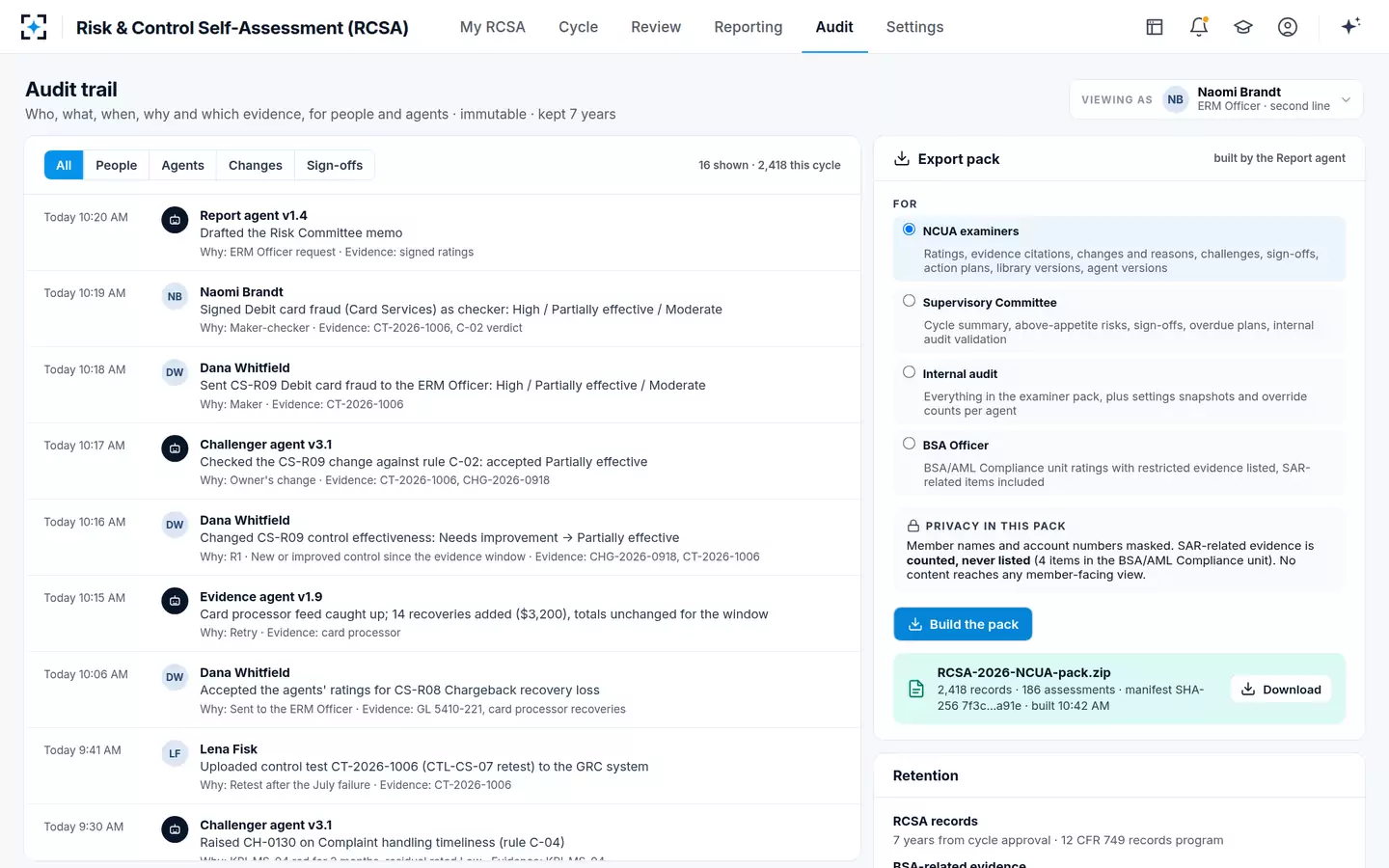
The audit trail and the examiner pack that come out of every cycle
Questions people ask
What does an RCSA cost?
Mostly people's time. On the solution's estimate, an annual cycle of 186 risks done by hand takes about 450 hours of owner and second-line time, roughly $25,000 to $36,000 at 2025 BLS median wages before benefits. Committee preparation, quarterly refreshes and audit's review come on top.
What is a good RCSA completion rate?
A completion rate below 100% at the committee date is a problem, but 100% says nothing about quality. Track it as a hygiene measure and put the weight on loss foresight, evidence coverage and the share of issues the first and second lines find themselves.
How many owner hours does an RCSA need?
By hand, the solution's estimate is about 145 minutes of owner and second-line time per risk, of which about half is finding and reading evidence. With the evidence gathered and a cited proposal in front of the owner, the design target is about 20 minutes per risk.
Is RCSA automation the same as a GRC system?
No. A GRC system holds the risk and control library, tests, issues and workflow; RCSA automation reads the evidence across those systems and others, such as the general ledger and the incident system, and proposes and checks ratings. The solution works with an existing GRC system rather than replacing it.
How long before RCSA automation pays back?
On hours alone, payback depends on library size and the price paid, and for a small library it may be slow. The faster payback is in findings: one deficiency that becomes a supervisory observation rather than an MRA, or one rating that moves before a loss, changes the arithmetic. Measure both on a pilot unit before deciding.