A ghost network in healthcare is a health plan network that looks larger in the directory than it is in practice, because many listed providers have left, moved, stopped taking the plan or never see its members. The Senate Finance Committee's majority staff put it simply: "Ghost networks occur when a health plan's provider directory is filled with inaccurate provider listings or unavailable providers." They are hard to find because nobody reports them: the doctor who stopped seeing patients at an address rarely tells every plan that lists her there. The most reliable test is the plan's own paid claims, which show where each provider actually saw members. Provider Directory Accuracy, a Botminds solution, runs that test on every listing every night and puts each likely ghost in front of a provider data analyst with the evidence.
How much of a directory can be ghosts: four federal and peer-reviewed measures
What is a ghost network in healthcare?
It is the gap between the network a plan lists and the network members can use. HHS's Inspector General defines it by cause: ghost networks "occur when a plan's network contains providers who should not be listed as network providers (such as providers who have retired or changed locations)" (OIG, October 2025). Researchers studying Oregon Medicaid called the listed-but-unused providers "phantom" providers (Zhu et al., Health Affairs, 2022).
Two kinds of listing make up a ghost network. Some are simply wrong: the provider retired, moved to another group or never contracted. Others are technically right but useless: the provider is in network but has a closed panel, works only with one population, or answers a number no one picks up. A directory check has to find both, and claims are best at the first kind.
How common are ghost networks?
Common: each recent federal and peer-reviewed study that looked for them found them. In October 2025 the Inspector General reported that across 40 Medicare Advantage and 20 Medicaid managed care plans in ten counties, "on average, in Medicare Advantage, 55 percent of behavioral health providers listed in plans' networks did not provide a single service to enrollees in 2023", against 28 percent in Medicaid. Rural Medicare Advantage plans averaged 63 percent, urban ones 50 percent. In 18 Medicare Advantage plans more than 60 percent of listed providers were inactive, and in one, "only 3 out of 356 network providers actually provided a service to an enrollee from that plan" (OIG, OEI-02-23-00540).
The Oregon study found 58.2 percent of directory listings were providers who did not see Medicaid patients in 2018, rising to 67.4 percent for mental health prescribers, with plans ranging from 17.1 to 91.9 percent (Zhu et al., 2022). The Senate staff's smaller call study of Medicare Advantage mental health listings in 2023 could book an appointment only 18 percent of the time, from 0 percent in Oregon to 50 percent in Colorado (Senate Finance Committee, May 2023).
How do you detect ghost providers?
Count, for each listing, the paid claims for that provider's NPI at that service address over a fixed window, and flag the listings with none. That is the method both studies used. The Oregon researchers treated a provider as in network for a plan if there were "any medical claims filed for at least five unique Medicaid beneficiaries", and tested thresholds of one and ten. The Inspector General used encounter data and called a provider inactive if it provided no service to the plan's enrollees in the year, then recommended that CMS "promote the use of encounter data to monitor provider networks".
The address matters as much as the NPI. A provider can be active at one office and a ghost at five others: the Inspector General found one provider "listed in the directory under 19 different practice locations" who had retired years before. So the test runs per listing, provider and address together, and looks at where else the NPI billed, which is what turns a ghost into a move.
Every listing's last claim at its address, with the likely ghosts by specialty and county
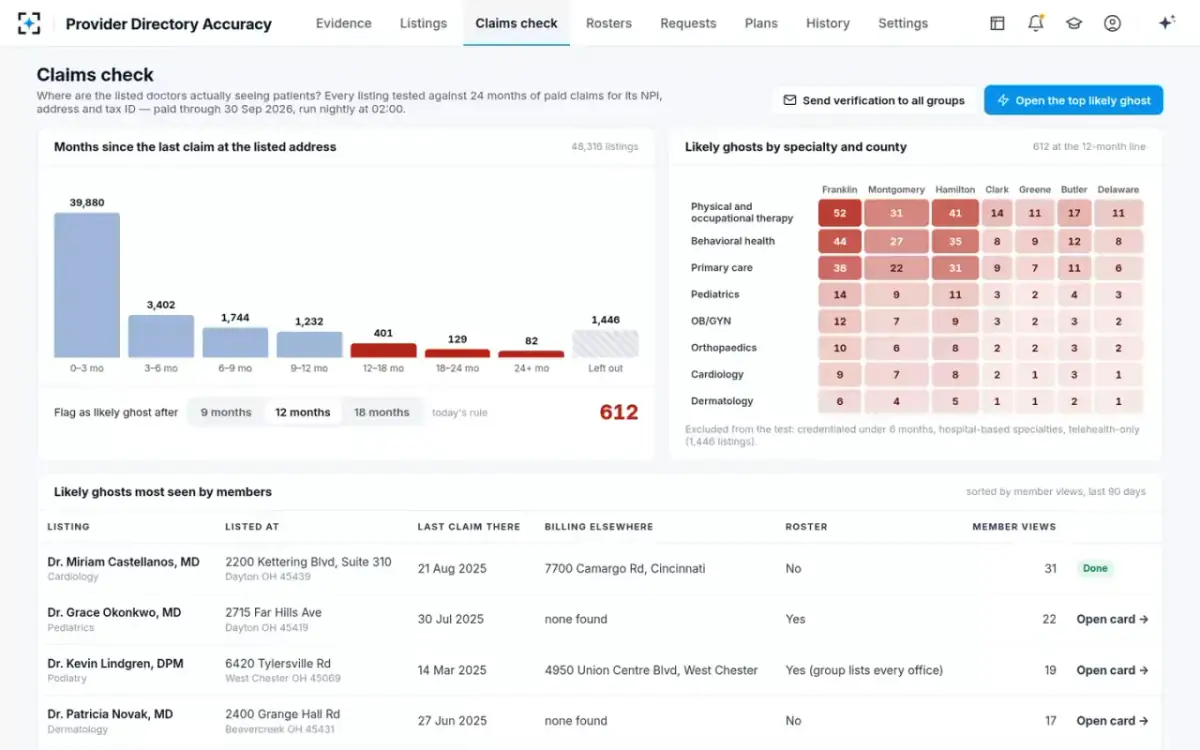
Setting the claims rule: window, threshold and exclusions
The rule has three settings, and each trades missed ghosts against false alarms. They should be written down and versioned, because a regulator or a provider may ask why a listing was flagged.
The three settings of a ghost-listing test, and what each trades off
| Setting | Common choices | Too loose | Too tight |
|---|---|---|---|
| Window with no claims at the address | 6, 9, 12, 18 or 24 months | Ghosts stay listed for years | Part-time and seasonal practices flagged |
| Activity threshold | Any claim; at least 5 unique patients; at least 20 patients a year for some roles | One stray claim keeps a ghost alive | Small but real panels flagged |
| Exclusions | New starters; hospital-based specialties; telehealth-only providers; salaried staff who do not bill | False alarms swamp the team | Real ghosts hidden behind an exclusion |
CMS already uses an activity test of this kind. To count toward Medicare Advantage outpatient behavioral health adequacy, a physician assistant, nurse practitioner or clinical nurse specialist must have furnished the relevant services "to at least 20 patients within a 12-month period" (42 CFR 422.116(b)(2)(xiv)(A)). A plan can borrow that logic for its own test.
Exclusions protect against the known false alarms. New providers have no history yet. Hospital-based specialists, radiology, anaesthesia, emergency medicine and pathology, rarely bill from an office address. Telehealth-only providers should be tested against telehealth claims. And some providers never bill the plan directly: the Oregon authors noted salaried clinicians in hospitals and clinics, and that providers below the threshold "could still be in network and technically available". That is why a claims flag starts an inquiry; it does not end one.
No claims at an address is a question, not a verdict. It is the question no roster or attestation will ever raise on its own.
What to do with a listing that has no claims
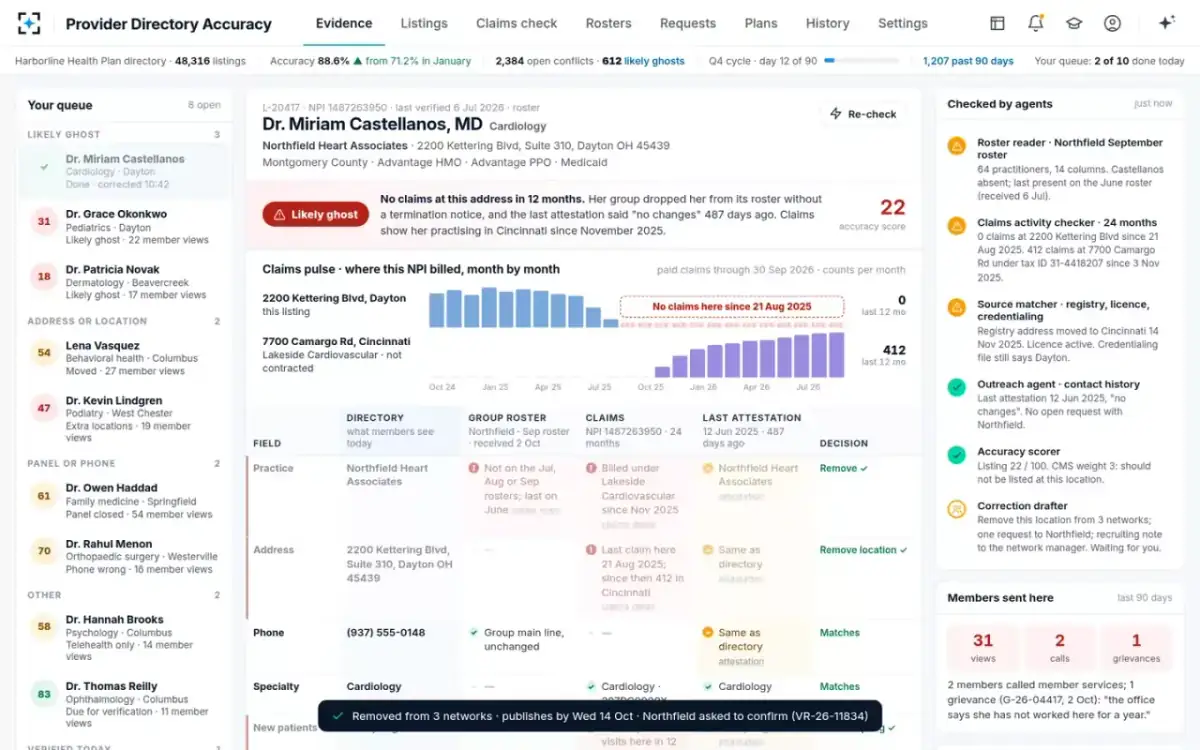
Find out why, in the cheapest order, and decide. The flow below is how Provider Directory Accuracy works a likely ghost; the reasons it most often finds match what the Inspector General heard when it surveyed inactive providers.
From a claims flag to a decision in Provider Directory Accuracy
Agent
Claims activity checkerFlags the listing: no paid claims at this address past the line, and shows where the NPI billed instead.
Never: Treats low volume alone as proof.
Agent
Roster reader and source matcherChecks the group’s last rosters, the national registry, the licence board and credentialing for a move, a departure or a lapse.
Never: Overwrites credentialing.
Agent
Outreach agentAsks the group one precise question with monthly claims counts attached, and follows up on day 7 and 14.
Never: Contacts members.
Agent
Correction drafterProposes the smallest correct change, with the county count before and after.
Never: Publishes.
A person decides
Provider data analystRemoves, moves or keeps the listing; the network manager decides removals that cut a county margin below 10%.
Why inactive behavioral health providers were not seeing enrollees
Random sample of inactive providers, Medicare Advantage and Medicaid, 2023
- Not working at any listed location · 46%
- Did not accept the plan · 21%
- Administrative roles, no patient care · 5%
- Could have been network providers · 28%
The decisions follow from the reasons. A provider who left every listed location is removed, and from 2028 a Medicare Advantage plan that determines a provider has left the network has 5 business days to do it. A provider who moved within the group is moved. A provider who is in network but not seeing new patients keeps the listing with the panel marked closed. And a provider the plan cannot reach is not deleted on a guess: commercial plans need a written removal procedure for unverifiable listings (42 U.S.C. 300gg-115), and Medicare Advantage plans will flag them as possibly out of date (CMS-4214-P).
A likely ghost resolved: removed from three networks, the group asked to confirm
Are ghost networks illegal?
No statute uses the phrase, but the conduct breaks several. A listing for a provider who has left the network breaches the commercial duty to verify every 90 days and remove unverifiable providers, the Medicare Advantage duty to keep an accurate directory and, from 2028, to remove departed providers within 5 business days, and the Medicaid requirement to update within 30 calendar days. Members who rely on such a listing are entitled to in-network cost sharing under the No Surprises Act now and, from 2028, in Medicare Advantage; how a plan's member services line must answer a member who checks a doctor before a visit is set out in network status inquiry.
The Senate staff wanted more: they wrote that "Congress can also require additional steps to ensure provider directory accuracy including regular audits, transparency, and financial penalties for non-compliance" (Senate Finance Committee, May 2023). Three years later the REAL Health Providers Act supplied the audits and the transparency, in the form of an annual accuracy score that CMS will publish.
Why ghost listings inflate network adequacy
Because adequacy is usually measured on the listed network. The Inspector General warned that "plans with large ghost networks may appear to meet network adequacy standards but may not have enough providers to meet the needs of enrollees", and recommended that inaccuracies "be corrected before compliance with the network adequacy standards is assessed". In Oregon, directories showed 4.0 mental health prescribers per 1,000 enrollees; claims showed 0.7 (Zhu et al., 2022).
That is why removing ghosts is a network decision as well as a data one. Medicare Advantage plans must reach 85 or 90 percent of beneficiaries within time and distance standards, depending on county type. A plan that cleans its directory may find a county it thought was covered is not, and the network manager should see that before the listing goes, with a recruiting plan if a provider has moved to a group the plan does not contract with.
How ghost networks affect mental health care
Most of the evidence is about mental health, and it is where ghosts are densest. Mental health prescribers had the highest phantom share in Oregon; the Inspector General found social workers and psychologists more often inactive than psychiatrists; and the Senate staff, posing as relatives of an older adult with depression, reached an appointment in fewer than one call in five. Congress wrote the specialty into the REAL Health Providers Act, which names mental health and substance use disorder treatment as a likely high-inaccuracy specialty for the annual sample. The Medicaid secret shopper survey tests outpatient mental health listings every year from 2028.
A plan running the claims test should start with behavioral health, set its exclusions carefully for clinicians who work in group practices under another provider's billing, and pair the claims flag with a call. The registry can help explain a flag, as NPPES data in a directory check shows, and the inputs the test needs are listed in the sources provider data management software must read.
Running the claims test on your own data this quarter
A plan does not need new software to take a first measure of its own ghost network; it needs a directory extract and a claims query. Five steps are enough for a first pass.
One: extract every listing as a provider, address and phone, keyed by NPI, with the networks it appears in. Two: count paid claims for each NPI by service address and month for the last 24 months, as counts only. Three: apply the exclusions in writing, new starters, hospital-based specialties, telehealth-only providers and known salaried clinicians, and set the line, 12 months with no claims at the address is a common starting point. Four: for each flagged listing, look for the same NPI billing elsewhere; a claim stream at another address turns a ghost into a move and tells the network manager where the provider went. Five: sort the flags by how often members view the listing and by specialty, starting with behavioral health, and work the top of the list by roster check and a question to the group.
The first count is the number to report to leadership, with its method and exclusions, because it is the number a regulator or researcher could reproduce from the same data, as the Inspector General and the Oregon team did. Run monthly after that, it becomes a measure of whether the directory process is keeping up.
Questions people ask
What did the Senate find about ghost networks?
In a May 2023 staff study, the Senate Finance Committee's majority staff called 120 mental health providers listed by 12 Medicare Advantage plans in six states. A third of listings were wrong, non-working or never returned the call, and staff could book an appointment only 18% of the time. It is a small study, but its finding matches larger ones.
Can claims data prove a listing is a ghost?
Not on its own. No claims at an address is strong evidence, but salaried clinicians, new starters, hospital-based specialists and telehealth-only providers can be real and still show none. The claims flag should trigger a roster check, a registry check and a question to the group before anyone removes the listing.
Do ghost networks exist in Medicare Advantage?
Yes. The Inspector General found an average of 55% of listed behavioral health providers in the Medicare Advantage plans it studied had provided no service to enrollees in 2023, and CMS's 2022–24 directory reviews found 44.29% of listed locations had at least one inaccuracy.
How often should a plan run a claims check on its directory?
As often as claims arrive, if it can. A monthly run catches departures within a cycle; Provider Directory Accuracy runs nightly against 24 months of paid claims. The line itself, such as 12 months with no claims at the address, should be a setting the plan can change and justify.
What is the difference between a ghost listing and an unverified listing?
A ghost is a listing members cannot use: the provider is gone, out of network or not seeing them. An unverified listing is one the plan has not confirmed in its cycle; it may be perfectly accurate. Commercial plans need a removal procedure for unverifiable listings, while Medicare Advantage plans will flag them from 2028.