Provider data management companies sell health plans the work of keeping provider data true: calling and faxing offices to verify listings, processing group rosters, cleaning records against reference sources and, in some cases, running the directory itself. A plan can buy that, do it with its own staff, or run agents that do the reading and chasing while a smaller team decides. The fair way to compare the three is the cost of each verified listing and of each error caught before a member meets it, and new federal rules now put a price on the errors. Provider Directory Accuracy, a Botminds solution, is the third option: six agents that test every listing against rosters, paid claims and provider replies, with a provider data analyst approving each correction.
This guide is for network operations and finance leaders and for procurement. No public source publishes vendors' prices, so it does not quote any. It gives the unit costs CMS itself uses, a formula to compare quotes, and the costs of getting it wrong.
The cost driver: how many listings need a person to ask
One cycle on a fictional sample plan, 48,316 listings
- Confirmed from data: roster, or claims and roster · 50.5%
- Provider attestation · 29.6%
- Reply to a specific request · 11.2%
- Still open: request out or past 90 days · 8.7%
What do provider data management companies do?
Most offer some mix of five services: outbound verification by phone, fax, email or portal; roster intake and normalisation; matching listings against reference data such as the national provider registry and licence boards; directory publishing and machine-readable files; and audits or mock reviews. Some sell the labour, some the software, some both. The useful question is not which services are on the list, but which source settles each listing and who decides when two sources disagree.
That question matters because the obligation does not move. The No Surprises Act puts the 90-day verification and 2-business-day update on the plan or issuer (42 U.S.C. 300gg-115), and CMS proposes to hold Medicare Advantage plans accountable for "the data the MA organization submits, verifies, and attests to, and to the rigor of the MA organization's own verification processes" (CMS-4214-P, October 2026). A vendor's verification is evidence the plan relies on, not a transfer of the duty.
Three ways to run directory verification
Outsourced, in-house or agents: what each model buys
| Outsourced verification | In-house team | Agents and a smaller team | |
|---|---|---|---|
| Who does the reading and asking | Vendor staff or vendor systems | Your analysts and provider relations | Agents; your analysts decide |
| What you pay for | Per listing, per contact or a fixed fee | Salaries, systems and management | Software and fewer analyst hours |
| What settles a listing | Usually the office’s answer | Whatever the analyst can find in time | Roster, claims, registry and reply side by side |
| Finds a doctor who stopped seeing members | Only if the office says so | If someone queries claims | From claims, nightly |
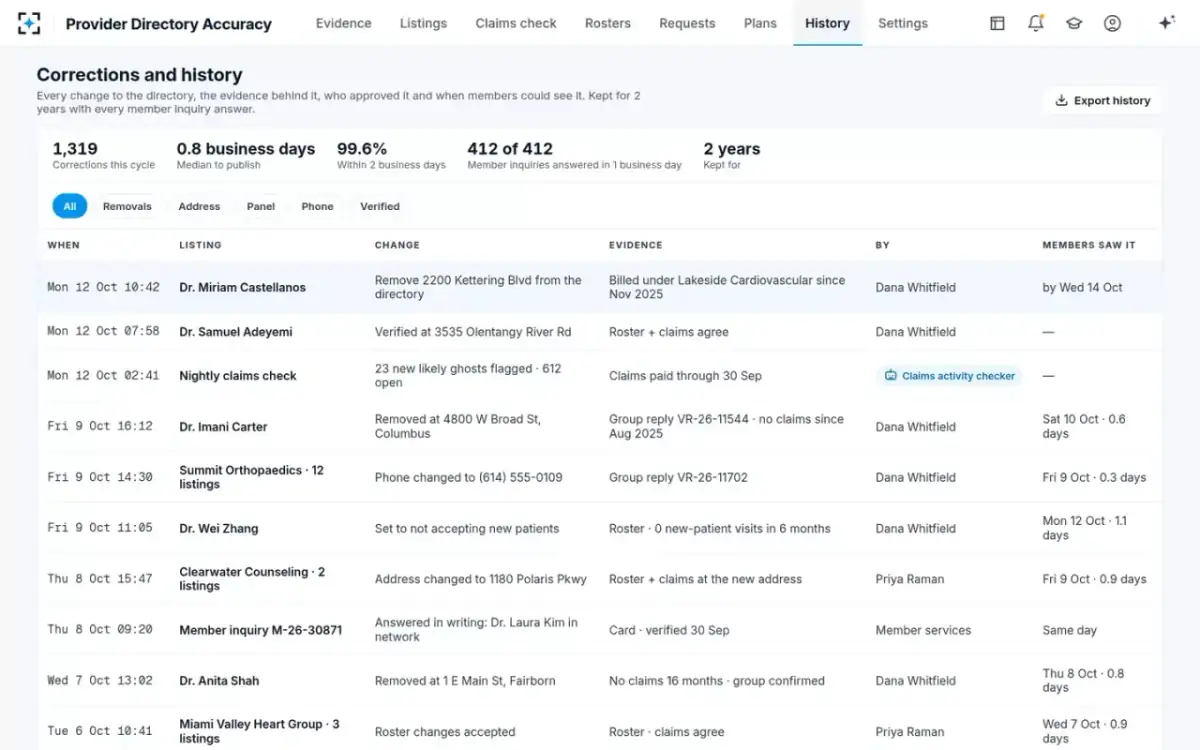
| Evidence you keep | The vendor’s status file | Notes and spreadsheets | Each change with its evidence, approver and publish date |
| Best fit | Peaks, or plans without claims access | Small directories, few groups | Large directories, many groups, several programs |
What does provider data management cost? Start from CMS's own numbers
The most defensible unit cost is the one CMS uses in its own burden estimates. In the October 2026 proposal, CMS assumes "each direct verification contact would take about 15 minutes for the provider and 15 minutes for the MA organization", so verifying a provider every 90 days costs the plan about an hour a year. It prices plan staff at $90.36 an hour for a business operations specialist, which is the Bureau of Labor Statistics' May 2025 mean wage doubled to cover benefits and overhead. CMS's estimates exclude verification done from "existing plan information or CMS-maintained data sources" (CMS-4214-P).
That last exclusion is the economics of the whole decision. A listing confirmed by a roster and by claims costs the plan almost nothing; a listing that needs a question asked costs about a quarter of an hour of someone's time, every cycle, plus the chasing when the office does not answer. The model below applies CMS's unit to a fictional plan with 20,000 providers.
Plan staff hours a year for direct verification contacts, 20,000 providers
Cost per verified listing: a formula for comparing quotes
Vendors quote per listing, per provider, per contact or per year, and in-house costs hide in salaries. Put all three on one footing: the cost of each listing actually verified in the cycle, with evidence, and the cost of each error found before a member did.
A cost per verified listing you can compare across all three models
Outside fees
contract price ÷ listings verified
Count only listings returned with a source and a date; a "no response" is not a verification.
Vendor manager
Staff time
hours × loaded rate
Contacts, roster work, conflicts, publishing and member answers. CMS uses $90.36 an hour.
Provider data lead
Software and data
licences + claims and registry feeds
Include the IT work to give read access to claims by NPI and address.
IT
Errors that reach members
− errors found later × cost each
Cost-sharing protections, member complaints, rework and regulator findings; see below.
Compliance and finance
What is the cost of an inaccurate provider directory?
Three kinds of cost follow an error: what the plan owes the member, what it costs to prove and process, and what the regulator can require. All three grew in 2026.
What a directory error can cost a plan, by program
| Cost | Commercial (No Surprises Act) | Medicare Advantage (from 2028, proposed) | Medicaid managed care |
|---|---|---|---|
| Member’s cost sharing | Limited to in-network amount if the directory or the plan’s answer said in-network, since 2022 | Lesser of in-network or otherwise applicable cost sharing if listed on the day the appointment was made | Set by state contract |
| Processing | Plan’s own claims rework | CMS estimates 1.5 hours per request and 0.5 hours per refund | Plan’s own |
| Proof | Written answers to member calls kept 2 years | Daily directory archive kept 10 years; built for about 40 developer hours per contract | Secret shopper results posted by the state |
| Regulator | State and federal regulators | Public accuracy grade from 2029; compliance actions | Remedy plan within 90 days, issue fixed within 12 months |
CMS puts the industry-wide cost of the proposed Medicare Advantage directory provisions at $6,025,071 in contract year 2028 and $1,608,453 a year after that, across 708 contracts (CMS-4214-P). Those figures cover only the work CMS judged new: contract terms, the annual analysis and report, the archive and request handling. They put no total on routine verification, which CMS treats largely as usual business and which is where the real money is, and no price on the grade itself. From 2029, every enrollee who opens the directory will see it.
Members feel the errors directly. In KFF's 2023 survey of insured adults, 26% said an in-network doctor they needed had no available appointments in the past year, and 14% that a doctor or hospital they needed was not covered (KFF, June 2023). Each such call lands on member services, and some become grievances.
Who pays when a member relies on a wrong directory?
The plan does, in commercial coverage today and in Medicare Advantage from 2028. Under the No Surprises Act, if a member is treated by an out-of-network provider whom the plan's directory, database or phone answer said was in network, the plan may not charge more than in-network cost sharing and must count it toward the in-network deductible and out-of-pocket maximum (42 U.S.C. 300gg-115(b)). The Departments said in 2021 that, pending rules, they would not find a plan out of compliance with the directory provisions as long as it honoured that protection (FAQs Part 49). A provider who bills the member more must refund the excess "plus interest" (42 U.S.C. 300gg-139(b)).
For Medicare Advantage, CMS proposes that the burden of proof sits with the plan: if it cannot document the appointment date or show from its archive that the provider was not listed that day, the protection is applied "in favor of the enrollee" (CMS-4214-P, proposed § 422.124(f)). California's regulator can already require a plan to cover care at in-network cost where an enrollee "reasonably relied upon materially inaccurate, incomplete, or misleading information" in its directory (Cal. Health & Safety Code § 1367.27(q)). The REAL Health Providers Act guide walks through the proposed request process.
Every change with its evidence, its approver and when members saw it
Should a health plan outsource provider data management?
Outsource the calling if the plan cannot staff it, but keep the decision and the evidence in house. Three tests help. First, can the plan give anyone, a vendor or its own tool, read access to paid claims by NPI and service address? Without it, every model depends on offices telling the truth, and CMS found in 2018 that providers had confirmed information that turned out to be wrong when CMS called (CMS, 2018). Second, how many groups send rosters? A plan with a few hundred groups covering most of its listings can verify most of its directory without a single call. Third, how many programs share the directory? A listing in commercial, Medicare Advantage and Medicaid networks has to meet three sets of clocks at once.
A plan with many groups, claims access and several programs will usually find the third model cheapest per verified listing, because it asks only where sources disagree. A small plan with a few thousand listings may do better with one experienced analyst and a good spreadsheet. A plan with no claims access should fix that first: it is the cheapest error detector it owns. Finding ghost networks in your own claims sets out the test.
How do provider data vendors verify listings?
Mostly by asking: calls, faxes, emails and portal attestations, sometimes checked against reference data. That is the same method CMS's proposal lists for most elements of the 2028 score, where telephone and email verify phone, address, panel, accessibility and telehealth. It is weaker for the element CMS proposes to weight most: network participation, 40% of the score, which the proposal lets plans verify from internal plan data, attestations or claims, not from a phone call.
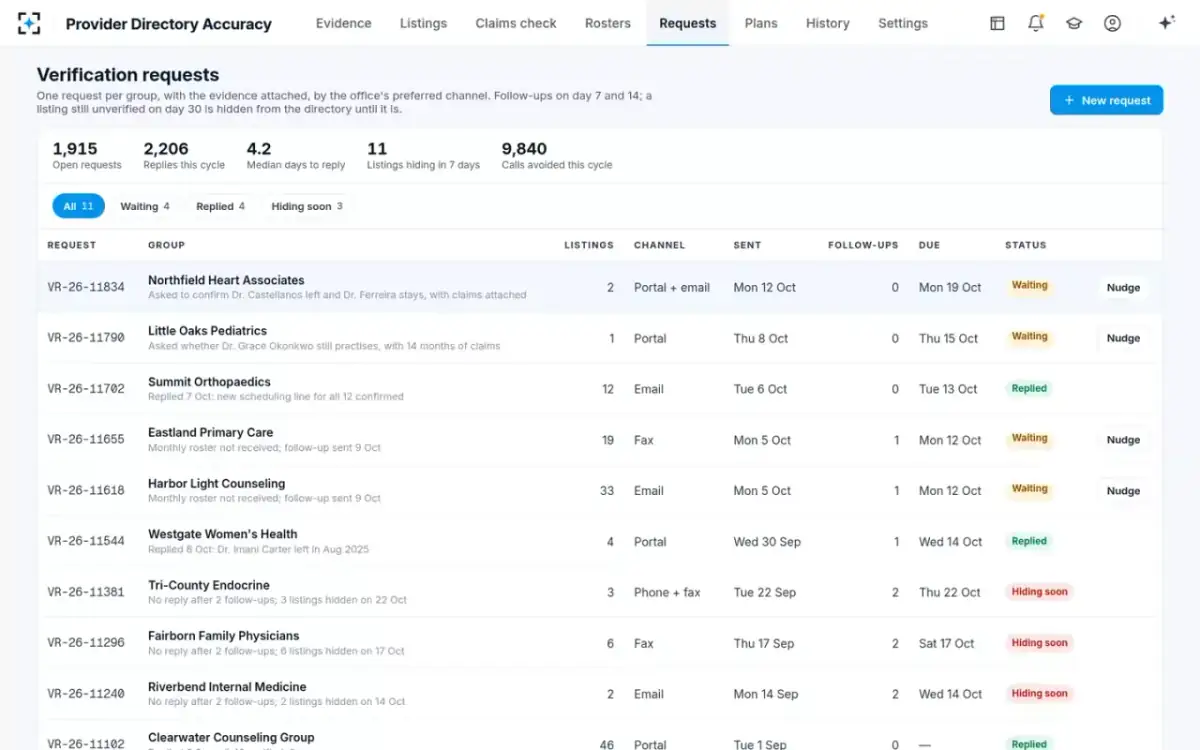
Ask any vendor, and your own team, to show the source and date behind each status it returns, and what it does with an office that never answers. CMS's 2017–18 reviewers counted a location that did not answer after three attempts on different days as a deficiency. A "no response" returned as "verified" is the most expensive line in any contract. Provider directory software with agents lists the questions to ask in a demonstration.
One open request per group, and a date for every listing that has not replied
What is the return on provider directory accuracy?
It is the verification cost avoided plus the error cost avoided, less what the new model costs. Both halves can be estimated from the plan's own data before any purchase: the share of listings that could be settled from rosters and claims without a call, and the number of member complaints, grievances and cost-sharing adjustments tied to directory errors last year. On CMS's unit costs, moving 10,000 providers a year from "ask" to "confirmed from data" saves about 10,000 hours, or roughly $904,000 at $90.36 an hour, before any error cost is counted. That is our arithmetic on CMS's assumptions, not a measured result.
Seven questions for a provider data management company, or your own team
- What settles each listing?
A reply, a roster, claims, the registry, or two of them agreeing. Ask for the source and date per listing.
- What do you do with silence?
Attempts, days and channels before a listing is flagged, hidden or removed, by program.
- Can you use our claims?
Counts by NPI, service address and tax ID, with no member detail leaving the plan.
- Who decides a removal?
A named person at the plan, with the network effect shown first.
- Which clocks do you run?
2 business days commercial, 30 days Medicare Advantage and Medicaid, 5 business days for Medicare Advantage removals from 2028.
- What do we keep if we leave?
Every change, its evidence and its approver, in a form your auditors can read.
- How do you price silence?
Unverified listings should not be billed as verified.
Questions people ask
How much does provider data management cost?
No public source gives market prices. CMS's own assumption is about 15 minutes of plan time per direct verification contact, or roughly an hour a year per provider on a 90-day cycle, at $90.36 an hour. The cost falls sharply for listings that rosters and claims can confirm without a call.
What is the cost of an inaccurate provider directory?
It includes in-network cost sharing the plan must honour when a member relied on the directory, the work of proving what the directory said, and regulatory exposure. CMS estimates the proposed Medicare Advantage directory provisions alone at about $6.0 million across the industry in 2028, excluding routine verification.
Does outsourcing move the compliance risk to the vendor?
No. The statutes put directory duties on the plan or issuer, and CMS's October 2026 proposal ties Medicare Advantage accountability to the data the plan submits and attests to and to the rigour of its own verification. A vendor's work is evidence the plan relies on.
Do health plans need provider data management software if they outsource?
Usually yes, to hold the evidence and to check the vendor's results against claims and rosters. Without a way to test what comes back, a plan cannot tell a verified listing from an unanswered one. Provider Directory Accuracy can run alongside a vendor and flag where its results and the plan's data disagree.
How long does it take to switch models?
The long pole is data access, not the tool: claims by NPI and service address, rosters from every group, and the credentialing file. Running the new model alongside the old one for one 90-day cycle shows, on the plan's own listings, how many need a call and what each costs.