Provider directory accuracy is the share of what a health plan's directory says about its network providers that turns out to be true when someone checks: that the provider is in the network, at that address, reachable on that number, in that specialty and taking new patients. Measured that way, directories have been wrong at four to five in ten listed locations in every federal review since 2016. The measure is about to become public. Under the REAL Health Providers Act, Medicare Advantage plans must estimate an accuracy score every year from 2028, and CMS will post the scores from 2029. Provider Directory Accuracy, a Botminds solution, scores each listing and each plan continuously, so a plan knows its number before CMS publishes it.
This guide is for compliance and provider data leaders. It shows how CMS has measured accuracy, how the score it proposed in October 2026 would work, what a worked score looks like, how large a sample has to be, and why the same directory can honestly be called 59% accurate and 87% accurate at once.
The proposed provider directory accuracy score: what is checked, by what, and how much it counts
| Element | Weight | Methods that may verify it for the score |
|---|---|---|
| Network participation | 40% | Internal plan information, provider attestation, claims data |
| Contact information (phone) | 20% | Telephone, email, provider attestation |
| Primary office or facility address | 20% | Telephone, email, provider attestation |
| Specialty | 10% | Internal plan information, telephone, email, attestation, claims data |
| Accommodations for people with disabilities | 3.5% | Telephone, email, provider attestation |
| Telehealth capabilities | 3.5% | Telephone, email, provider attestation |
| Accepting new patients | 3% | Telephone, email, provider attestation |
| Name, cultural and linguistic capabilities, ownership | Not scored | Required in the directory but left out of the score |
How accurate are provider directories?
Not very, by every federal measure. CMS's third review of Medicare Advantage directories, run from November 2017 to July 2018, called the offices of 5,602 providers at 10,504 listed locations and found "48.74% of the provider directory locations listed had at least one inaccuracy", with plans ranging "from 4.63% to 93.02%" (CMS, November 2018). CMS ran three more rounds between June 2022 and June 2024 and did not publish a report; it disclosed the result only in its October 2026 proposal: across 11,360 providers and 18,852 locations in 142 organisations, "44.29 percent of the location listings in the online provider directories contained at least one inaccuracy" (CMS-4214-P).
The other programs look no better. In Medicaid managed care, HHS's Inspector General found in 2014 that "51 percent of providers were either not participating in the plan at the location listed or not accepting new patients enrolled in the plan" (OIG, OEI-02-13-00670). For Marketplace plans, CMS's reviews of issuers' machine-readable provider files from plan years 2017 to 2021 found that "no more than 47 percent of the provider entries we reviewed" carried a complete set of accurate phone numbers, addresses, specialties, plan affiliations and new-patient status (CMS, October 2022).
Share of Medicare Advantage directory locations with at least one error, by CMS review
How CMS has measured directory accuracy, 2016 to 2024
CMS measured by calling. In each round it sampled one contract per organisation and one plan per contract, chose a county and a search ZIP code, drew providers from the online directory and phoned every listed location. In 2017–18 the sample was 108 providers per organisation, 27 each of primary care physicians, cardiologists, oncologists and ophthalmologists. Reviewers asked, in order, whether the provider sees patients at the location, accepts the plan there, accepts new patients, has the listed specialty, and whether the address, phone and name are right. A location that did not answer after three attempts on different days and times counted as a deficiency (CMS, 2018).
The 2022–24 rounds reviewed 80 to 100 providers per plan, 20 from each specialty, and the third round added 20 mental health providers. CMS also added two finer findings: "should not be listed ... information could not be verified" and "should not be listed ... does not accept plan". It considered naming primary care, cardiology and oncology as high-inaccuracy specialties because each had deficiency rates of 45 percent or above, but proposed only mental health and substance use disorder treatment for now (CMS-4214-P).
What counts as a directory error?
Anything a member would act on and find false. CMS's 2018 method weighted each finding from 0 to 3 by how badly it blocks access, then scored each location by its worst finding, so that a location with a wrong address (2) and a wrong phone (3) scored 3, not 5.
How CMS weighted directory errors in its 2017–18 review
| Finding | Weight |
|---|---|
| Provider should not be listed at any of the listed locations | 3 |
| Provider should not be listed at this location | 3 |
| Phone number needs to be updated | 3 |
| Listed as accepting new patients, but is not | 3 |
| Address needs to be updated | 2 |
| Suite number needs to be updated | 1 |
| Listed as not accepting new patients, but is | 1 |
| Specialty needs to be updated | 1 |
| Provider name needs to be updated | 0 |
That weighted method is still a useful internal measure because it ranks what to fix: a closed panel listed as open sends members to a door that will not open, while a misspelt name does not. It is not, however, the score CMS has proposed for 2028, which counts elements, not locations, and turns the result into a letter grade.
How is provider directory accuracy measured under the proposed rule?
Under CMS's proposal, each Medicare Advantage plan would draw a simple random sample of its directory every year, verify each sampled listing element by element, and compute a weighted composite. The unit sampled is a "provider record" with "a unique provider, address, and phone number", and CMS recommends the NPI to identify the provider. The proposal puts 65 percent of the sample on providers outside the high-inaccuracy specialties and 35 percent on providers in them, which for now means mental health and substance use disorder treatment, identified by Medicare specialty codes such as 26 (psychiatry), 62 (psychologist) and 80 (licensed clinical social worker) (CMS-4214-P, proposed § 422.123(d)(2)).
Each element is either "accurate" or "not accurate", and an element with several parts, such as an address, is accurate only if every part is right; "st" for "street" does not count against it. CMS considered and did not propose a half point for partly right elements, and a confidence approach that would need two sources to agree. The verification method is restricted by element for the score: internal plan data may confirm only network participation and specialty, claims may confirm the same two, and phone and email cover the rest. The share of sampled providers accurate on each element is multiplied by its weight, the products are summed, and the result is rounded and graded: A for 90 to 100, B for 80 to 89, C for 70 to 79, D for 60 to 69, E for 50 to 59 and F for 49 and below. Plans would report by the first Monday in April of the following year. How these dates fit together is set out in what the REAL Health Providers Act requires from 2028.
A worked provider directory accuracy score for one plan
Take a fictional plan, Calder Ridge Advantage, and a sample of 200 provider records drawn as proposed: 130 general and 70 behavioral health. Each element is checked with a permitted method. The figures below are invented to show the arithmetic; they are not drawn from any plan.
From 200 checked records to a letter grade
Network participation
184 / 200 × 40% = 36.80
Claims and the contract file confirm 184; 16 had left the network.
Internal data or claims
Contact information
158 / 200 × 20% = 15.80
42 numbers wrong, disconnected or reaching another practice.
Phone or email
Address
164 / 200 × 20% = 16.40
36 addresses wrong in at least one part.
Phone or email
Specialty, accommodations, telehealth, new patients
9.60 + 2.98 + 3.08 + 2.25 = 17.91
192, 170, 176 and 150 accurate of 200, at 10%, 3.5%, 3.5% and 3%.
Phone, email, attestation
One directory, two answers: why 87% and 59% are both true
The proposed score and CMS's past reviews measure different things, and a plan that confuses them will misread its own progress. The proposed score asks, element by element, what share of the sample is right, then weights the elements. CMS's reviews asked what share of listed locations had at least one thing wrong.
Run the second measure on the same 200 Calder Ridge records. The 206 element errors above are spread across 82 records, so 118 records, 59%, are right in every scored element; 41% have at least one error. That is close to the 44.29% CMS found across the industry in 2022–24. Yet the weighted score is 87, a B, because most errors sit in the lower-weighted elements and network participation, at 40% of the score, is 92% right.
Two measures of the same directory
Listing error rate (CMS reviews, 2016–24): Does this listed location have any error?
Proposed accuracy score (from 2028): For each element, what share of the sample is right?
Listing error rate (CMS reviews, 2016–24): Listed location
Proposed accuracy score (from 2028): Provider record: unique provider, address and phone
Listing error rate (CMS reviews, 2016–24): Worst error at a location, 0 to 3
Proposed accuracy score (from 2028): Fixed weights by element, 40% to 3%
Listing error rate (CMS reviews, 2016–24): 41% of records with at least one error
Proposed accuracy score (from 2028): 87, grade B
Listing error rate (CMS reviews, 2016–24): Finding listings members cannot use
Proposed accuracy score (from 2028): The public grade, compared across plans
A directory can earn a B while four listings in ten still have something wrong with them. The grade weights what matters most; members meet every error.
How big a sample does a directory accuracy score need?
Larger than most plans expect, because a grade band is only ten points wide. CMS has not proposed a sample size; it asked for comments on minimums, maximums and whether non-responding providers should be replaced (CMS-4214-P). The arithmetic is standard. For a share near 59%, a simple random sample of 200 gives a 95% margin of about plus or minus 6.8 points; 400 gives 4.8; 800 gives 3.4. For network participation near 92%, 200 records give about plus or minus 3.8 points. Every element carries its own error, so a plan scoring 87 on 200 records cannot be sure it is a B rather than an A.
Non-response shrinks a sample fast. In a 2025–26 peer-reviewed secret shopper study of mental health listings, 61.3% of 5,822 calls reached no definitive outcome, most often an answering machine; the Medicaid secret shopper survey guide works through what that does to a sample. A plan measuring itself should draw more records than it needs and decide in advance how it will treat an office that never answers.
How often should provider directories be audited?
Continuously in effect, annually for the formal score. The two duties are separate. The REAL Health Providers Act requires every listing to be verified at least every 90 days, or every 12 months for hospitals and certain facilities, and separately requires an annual accuracy analysis on a random sample. CMS is weighing whether to fix the date each plan draws its sample, to stop plans tidying up for a known day; it noted the risk of plans focusing "on accuracy efforts for a known date rather than maintaining accuracy on an ongoing basis" (CMS-4214-P).
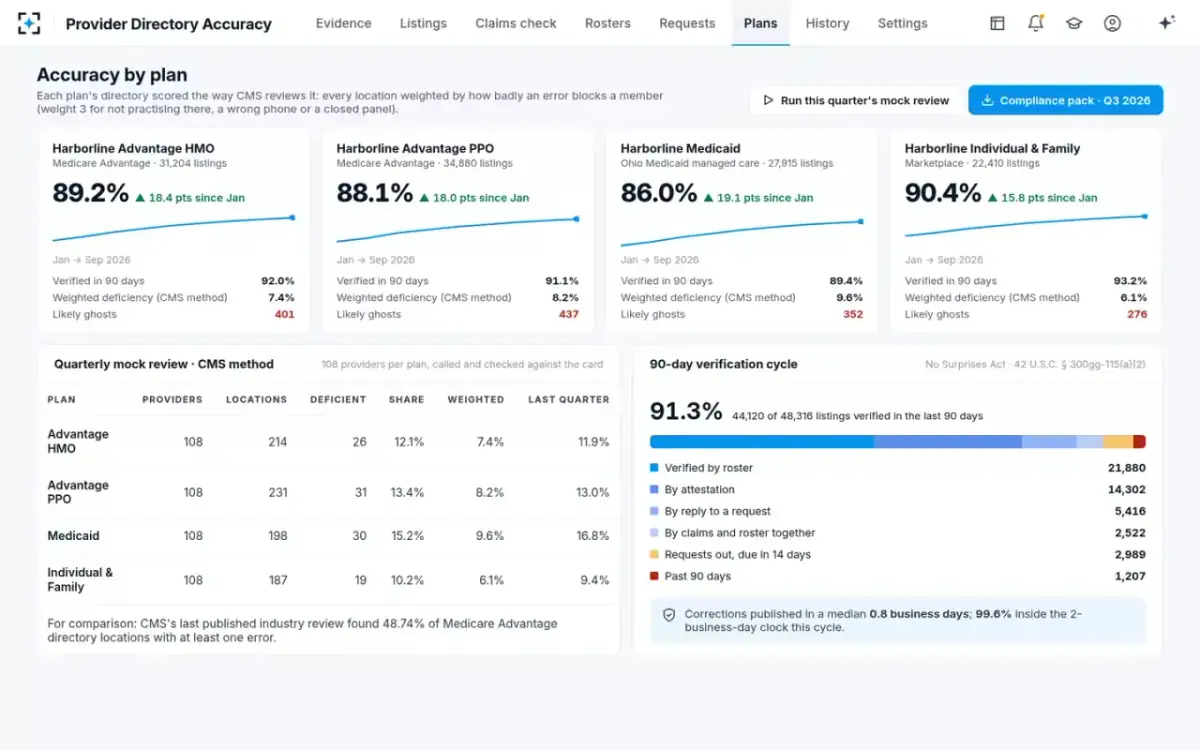
A quarterly internal review on CMS's past method, plus listing-level scores updated as evidence arrives, gives a plan early warning. Commercial plans have a parallel reason to keep checking: the No Surprises Act's 90-day verification cycle has applied since 2022 (provider directory requirements by program).
Each plan scored on CMS's past method, quarter by quarter
What is a good provider directory accuracy rate?
Under the proposal, an A means a composite of 90 or more, and that is the realistic target. On the older location-level measure, the best plans in CMS's 2017–18 review were under 10% deficient while the worst were over 90%: two of the 52 organisations were below 10% and two were at 90% or above. Variation that wide says the problem is process, not fate.
How 52 Medicare Advantage organisations' directories scored, 2017–18
The middle of that distribution is the industry norm, and CMS's reaction to it was compliance letters: 18 notices of non-compliance, 15 warning letters and 7 warning letters requiring a business plan after the third round. A plan that would sit in the left-hand rows on CMS's old method is the kind most likely to earn an A on the new one.
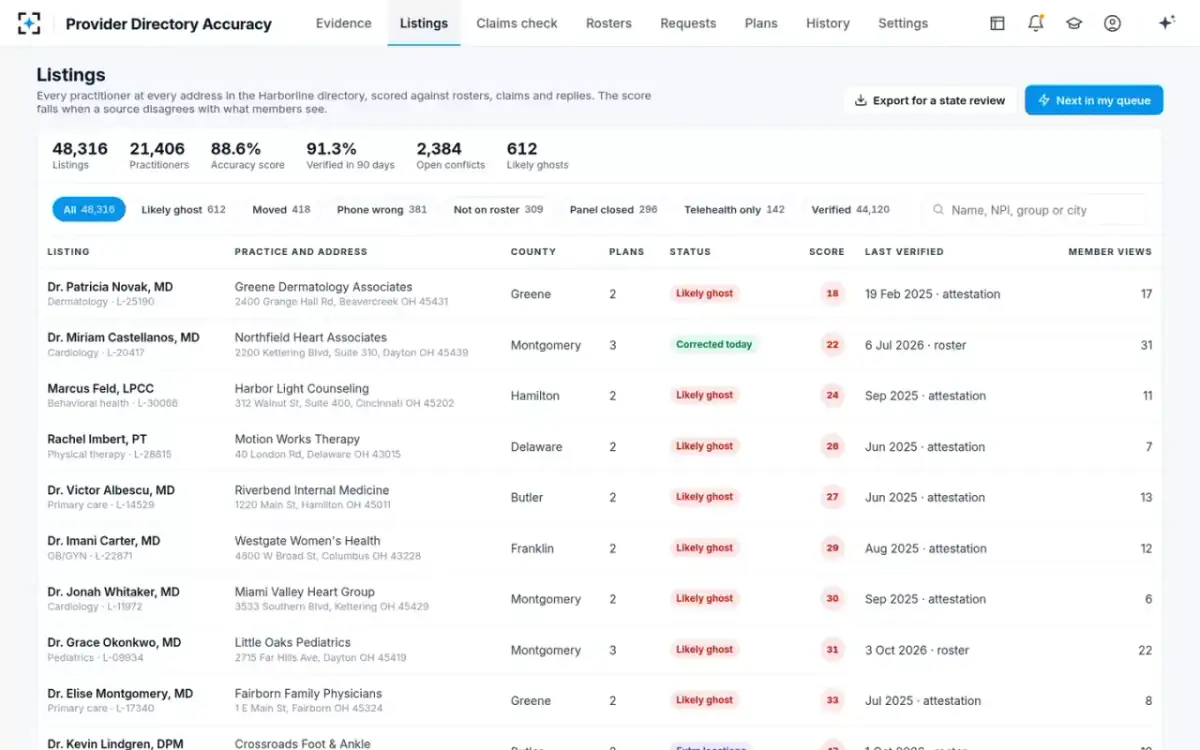
A good internal standard has three parts: a public grade target, a ceiling on listings with any error that members actually view, and a ceiling on listings where the provider should not be there at all. In Provider Directory Accuracy each listing carries a score out of 100 that falls when a source disagrees with what members see, so the team works the low scores with the most member views first.
Every listing scored, with the conflicts members are most likely to meet
Measuring before 2028: a checklist
Run the proposed score on your own directory now
- Build the sampling frame
Every unique provider, address and phone combination in each plan’s directory, keyed by NPI.
- Tag the high-inaccuracy specialties
Map Medicare specialty codes and NUCC taxonomies for mental health and substance use treatment; draw 35% from them.
- Fix the method for each element
Internal data and claims for network status and specialty; phone, email or attestation for the rest.
- Score each element right or wrong
Every part of an address must match; ignore abbreviations.
- Oversample and set a non-response rule
Decide in writing how many attempts and days before a method counts as exhausted.
- Compute both measures
The weighted composite and the share of records with any error.
- Report the margin of error
A score of 87 on 200 records is a range, not a grade.
- Keep the evidence
Each sampled record’s result, method, date and source, ready for a third-party review CMS may require.
Questions people ask
What is a provider directory accuracy score?
Under the REAL Health Providers Act, it is the annual estimate each Medicare Advantage plan must make of how accurate its directory is, from contract year 2028. CMS has proposed a weighted composite of seven elements turned into a letter grade from A to F; the rule is not final.
Who will see the accuracy score?
Everyone. The statute requires CMS to post the scores in a machine-readable file from 2029, and plans must display their most recent score prominently in their directories. CMS suggested wording such as "Information Accuracy: [insert letter grade score]" at the end of the directory's introduction.
Does the 90-day verification count toward the score?
Not as proposed. CMS considered blending the results of routine verification with the annual sample but did not propose it, citing complexity and the risk of plans timing verification to suit the score. The two remain separate duties: verify every listing on the cycle, and estimate accuracy from a sample.
Will a third party have to certify the score?
Possibly. CMS is considering requiring the annual analysis and score to be independently reviewed and certified before submission, and asked for comments on the auditor's qualifications and standards. Plans should keep the evidence for every sampled record as if that requirement will be adopted.
Are behavioral health listings scored differently?
They are sampled more heavily, at 35% of the sample under the proposal, but scored with the same weights. CMS is also considering whether high-inaccuracy specialties or rural listings should be weighted differently, and has not proposed either.