The REAL Health Providers Act, short for Requiring Enhanced and Accurate Lists of Health Providers, is the federal law that sets new provider directory duties for Medicare Advantage plans from plan year 2028. Enacted on 3 February 2026 as section 6220 of the Consolidated Appropriations Act, 2026, it requires each network-based plan to verify every listing at least every 90 days, flag listings it cannot verify, remove departed providers within 5 business days, measure and report its directory's accuracy every year, and cap a member's cost sharing when the member relied on a wrong listing. CMS proposed its implementing rules on 20 October 2026; they are not final, and comments close on 15 December 2026. Provider Directory Accuracy, a Botminds solution, checks every listing against rosters, claims and provider replies and keeps the evidence each duty will need.
From enactment to the first public accuracy grade
- Law, proposal, commentsFeb–Dec 2026
- Final rule, build2027
- Duties apply2028
- Scores2029
What is the REAL Health Providers Act?
It is section 6220 of the Consolidated Appropriations Act, 2026 (Pub. L. 119-75), which amends sections 1851, 1852 and 1857 of the Social Security Act. CMS describes its purpose as establishing "provider directory accuracy standards, accuracy score reporting, verification requirements, public transparency, and enrollee cost sharing protections" for Medicare Advantage (CMS-4214-P). It applies to "specified MA plans", which CMS proposes to define as every network-based plan: HMOs, PPOs, special needs plans, network-based medical savings account plans, cost plans and private fee-for-service plans that meet access standards through contracted networks. Non-network regional PPOs and PACE are outside.
It builds on rules already running. Since 1 January 2026, Medicare Advantage plans have sent directory data to CMS for Medicare Plan Finder, updated it within 30 days of learning of a change and attested to its accuracy at least annually (CMS-4208-F2). CMS says it means to "build directly upon, reinforce, and, where necessary, supplement" that framework rather than create a parallel one, and that it is "actively developing" a National Provider Directory that the submitted data may eventually feed.
When does the REAL Health Providers Act take effect?
On 1 January 2028, the start of contract year 2028, for verification, flagging, removal, the annual accuracy analysis and the cost-sharing protections. Two duties come a year later: from plan years beginning on or after 1 January 2029, CMS must post plans' accuracy scores in a machine-readable file, and each plan must list its score "prominently" in its directory. Under CMS's proposal, the first report, covering 2028, would be due by the first Monday in April 2029, so the first scores the public sees would describe 2028.
Members must also hear about the protection before they need it. The statute requires plans to tell enrollees about the cost-sharing protection, to the extent practicable, by the first day of the annual election period, and to describe it in the directory; CMS proposes that the first explanation of benefits each year carry it too.
What does the REAL Health Providers Act require?
The statute, as CMS sets it out, requires each plan, for plan year 2028 and later, to "maintain, on a publicly available internet website, an accurate provider directory"; to verify each provider's directory information "not less frequently than once every 90 days (or, in the case of a hospital or any other facility determined appropriate by the Secretary, at a lesser frequency specified by the Secretary but in no case less frequently than once every 12 months)"; if it cannot verify, to "include in such directory an indication that the information of such provider may not be up to date"; and to "remove a provider from such directory within 5 business days if the organization determines that the provider is no longer a provider participating in the network of such plan" (CMS-4214-P, section II.B.2).
It then adds measurement: an annual analysis of accuracy on "a random sample of providers", including a random sample of each specialty with a high inaccuracy rate, of which mental health and substance use disorder treatment may be one; a report to the Secretary with an accuracy score; and public posting. It defines provider directory information as what enrollees need to reach a contracted provider, "such as name, specialty, contact information, primary office or facility addresses ..., whether the provider is accepting new patients, accommodations for people with disabilities, cultural and linguistic capabilities, and telehealth capabilities". And it orders a study by the Government Accountability Office of the protections' use, score trends, provider response rates and administrative costs.
What CMS proposed in October 2026
CMS's proposal fills in what the statute left to the Secretary, and in several places it goes further. The comparison below separates the two. Everything in the right-hand column can still change.
The REAL Health Providers Act and CMS's proposed rules, duty by duty
The statute says: Hospitals and facilities the Secretary names may be verified less often, but at least every 12 months.
CMS proposes (CMS-4214-P, 20 October 2026): Acute inpatient hospitals, intensive care units and surgical services: every 12 months.
The statute says: The Secretary specifies verification methods, such as telephone or data sources the plan maintains.
CMS proposes (CMS-4214-P, 20 October 2026): Seven: internal plan information, telephone, email, provider attestation, claims data, CMS data sources and others CMS names.
The statute says: An indication that the information may not be up to date.
CMS proposes (CMS-4214-P, 20 October 2026): Example wording: "The provider's information may not be up to date."
The statute says: Silent.
CMS proposes (CMS-4214-P, 20 October 2026): Every provider contract must oblige the provider to keep its directory information current.
The statute says: Name, specialty, contact, addresses, new patients, accessibility, languages and culture, telehealth.
CMS proposes (CMS-4214-P, 20 October 2026): The same, plus common ownership or control with the plan or its parent.
The statute says: Annual, on a random sample including high-inaccuracy specialties.
CMS proposes (CMS-4214-P, 20 October 2026): 65% general and 35% mental health and substance use providers; weighted elements; letter grades A to F.
The statute says: A report with an accuracy score.
CMS proposes (CMS-4214-P, 20 October 2026): Due by the first Monday in April; independent certification under consideration.
The statute says: The Secretary may waive analysis and reporting for low-enrollment plans.
CMS proposes (CMS-4214-P, 20 October 2026): CMS is "inclined" not to waive them for any plan.
The proposal also tidies existing rules. It moves the 30-day update standard into a new § 422.123, requires a quarterly addendum for members who asked for a paper directory and a disclaimer on paper copies sending readers to the online version, and, if finalised, ends CMS's practice since 2020 of not counting an error that matches the national provider registry. How to measure provider directory accuracy works through the proposed score with a worked example.
How often must Medicare Advantage plans verify directories?
Every 90 days for each listed provider from 2028, and every 12 months for the facilities CMS names. Updates keep their existing 30-day clock, except that a provider the plan determines has left the network must be gone within 5 business days, from both the online directory and its printable copy. For a provider the plan cannot reach in a cycle, the statute's answer is the flag, not removal; the flag stays until the plan verifies or updates the information.
Verification may draw on any of the permitted methods, and CMS expects plans to combine them, noting that the national registry, for example, does not show "whether a provider is accepting new patients". The burden it assumes is modest per provider but large in total: a direct verification contact of about 15 minutes for the plan and 15 for the provider, so up to an hour a year for each provider on the 90-day cycle.
From 2028 the clock that matters most is not the 90 days. It is the 5 business days that start when the plan decides a provider has left.
What happens if a member relies on an inaccurate directory?
From contract year 2028, if a member is treated by a provider who was listed as in network on the day the appointment was made but is not in network when the care is given, the plan must limit the member's cost sharing to the lesser of the in-network amount and whatever would otherwise apply, and count it toward the in-network out-of-pocket maximum. Commercial plans have owed a similar protection since 2022 under the No Surprises Act (42 U.S.C. 300gg-115(b)).
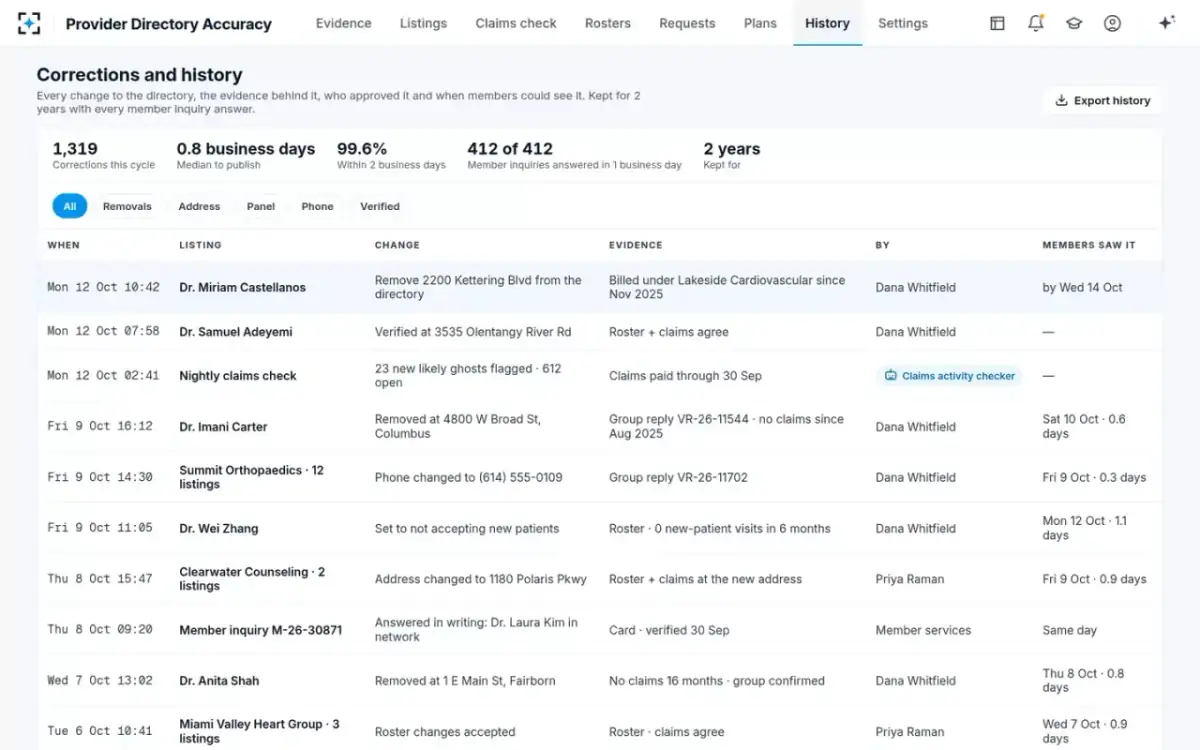
CMS's proposal makes the plan prove it. The request is handled as an organisation determination. The plan must look at "the earliest date on which the enrollee's appointment was scheduled, regardless of any subsequent rescheduling", which every provider contract must oblige the provider to document, and check an archive of its online directory "sufficient to identify whether any provider was listed in the specified MA plan's online directory at any point on a given date", kept for ten years and produced to CMS within 5 business days. A listing that appeared for any part of a day counts for the whole day. If the plan cannot document the facts in time, the protection is applied in the member's favour unless the plan can clearly show it does not apply (CMS-4214-P, proposed § 422.124).
A directory history that can answer 'was this doctor listed on 5 January?'
Has CMS finalized the REAL Health Providers Act rule?
No. As of 27 October 2026 the rule is a proposal, CMS-4214-P, published at 91 FR 66408 on 20 October 2026, with comments due by 5 p.m. Eastern on 15 December 2026. CMS asked for comment on dozens of open choices: sample size and timing, how to treat providers who never respond, partial credit for partly right addresses, a confidence approach needing two sources, extra weight for rural listings or high-inaccuracy specialties, third-party certification, whether paper directories should qualify for the cost-sharing protection, and the length of the archive.
The statutory duties take effect in 2028 whatever the final rule says. A plan can safely build for the parts the statute fixes, the 90-day cycle, the flag, the 5-business-day removal, an annual sample-based score and the protection, and keep the parts CMS may change as settings: weights, sample design and non-response rules.
What the REAL Health Providers Act will cost, by CMS's estimate
CMS's estimated hours for the annual analysis and report, by size of parent organisation
| Parent organisation offers | Parents | Analysis and score, hours a year | Report, hours a year |
|---|---|---|---|
| 10 or fewer specified plans | 113 | 13 | 8 |
| 11 to 50 plans | 38 | 20 | 12 |
| 51 or more plans | 12 | 30 | 18 |
Those hours look small because they exclude the work that produces a good score: verifying listings, chasing offices and correcting errors before the sample is drawn. Congress gave CMS $4,000,000 for fiscal year 2026 to implement the law. The plan's real cost is the verification cycle itself, which the cost per verified listing prices model by model.
The pressure behind the law is documented. HHS's Inspector General reported in October 2025 that in Medicare Advantage plans it studied, an average of 55 percent of listed behavioral health providers had not provided a single service to the plan's enrollees in 2023 (OIG, OEI-02-23-00540). CMS cites that finding to justify sampling mental health and substance use providers at 35 percent.
One request per group, with the evidence, before a listing changes
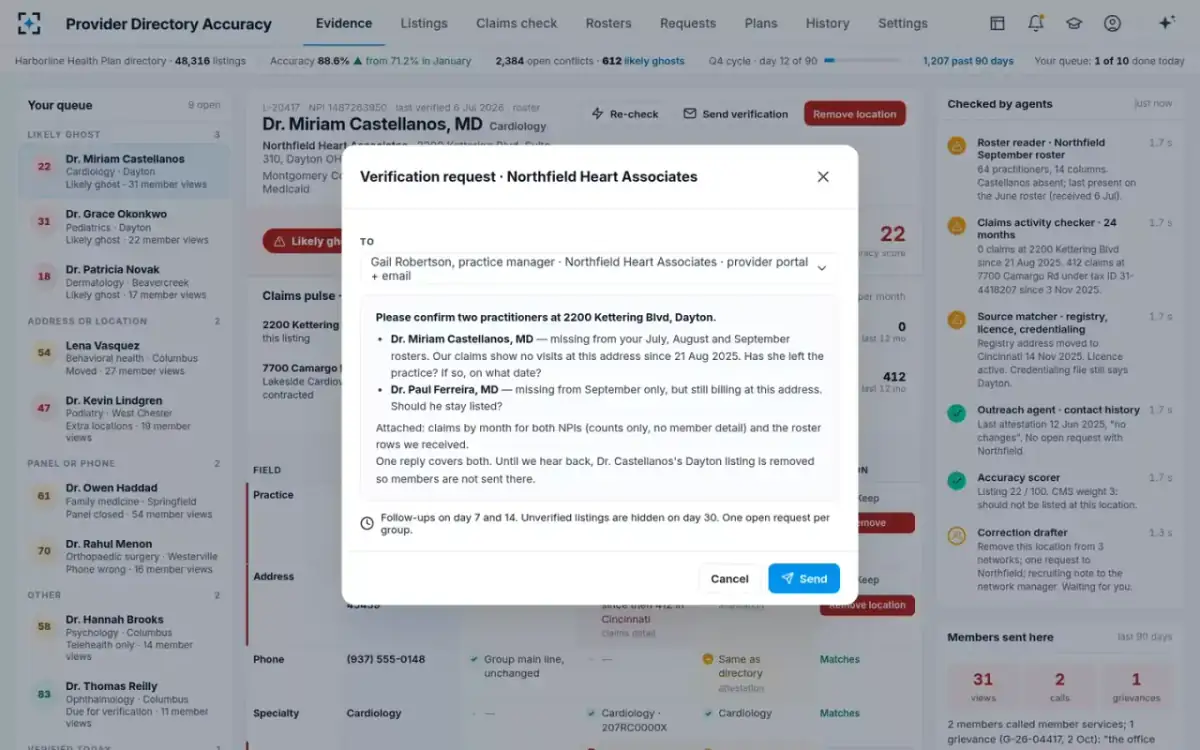
What to build before 2028
Nine things a Medicare Advantage plan can build now
- A 90-day verification cycle with a source for every listing
Rosters, claims, attestations and replies, dated per listing; 12 months for named facilities.
- A flag for unverified listings
Shown until the plan verifies or updates; not a removal.
- A removal clock that starts at determination
5 business days to the online directory and its printable copy; record when and why the plan decided.
- A provider contract clause
Keeping directory information current, and documenting the earliest date an appointment was scheduled.
- A daily directory archive
Able to say whether a provider was listed on any date, kept ten years, producible in 5 business days.
- A request route for the cost-sharing protection
As an organisation determination, with refunds and out-of-pocket tracking.
- An internal accuracy score
Run the proposed sample and weights now, and track the share of listings with any error.
- Specialty mapping
Medicare specialty codes and NUCC taxonomies for mental health and substance use providers.
- Member notices
Directory text and the first explanation of benefits each year describing the protection.
The same infrastructure serves the plan's other books: the commercial 90-day cycle has applied since 2022 and the Medicaid secret shopper surveys start in 2028. Provider directory requirements by program sets the three side by side.
Questions people ask
Does the REAL Health Providers Act apply to commercial or Medicaid plans?
No. It amends the Medicare Advantage provisions of the Social Security Act. Commercial plans have had similar duties under the No Surprises Act since 2022, and Medicaid managed care plans have their own directory and secret shopper rules.
Where is the text of the REAL Health Providers Act?
It is section 6220 of the Consolidated Appropriations Act, 2026, Public Law 119-75, enacted on 3 February 2026, which amends sections 1851, 1852 and 1857 of the Social Security Act. CMS sets out the statutory requirements, and its proposed regulation text for new §§ 422.123 and 422.124, in the October 2026 proposed rule.
What was the June 2026 public meeting?
CMS and the Office of the National Coordinator for Health Information Technology held a virtual meeting on 15 June 2026 to gather input on implementing the law. Participants named practice locations, specialty, new-patient status, telehealth and network participation as the hardest elements to keep accurate.
Will plans still be able to rely on NPPES?
As one method among several. Since 2020 CMS has not counted a directory error that matched the national registry if the plan asked the provider to fix it within 30 days; CMS intends to rescind that guidance if the rule is finalised, because the registry becomes one of the permitted verification sources.
Who studies whether the law works?
The Government Accountability Office. The law requires it to report on use of the cost-sharing protections, trends in accuracy scores overall and for mental health and substance use providers, provider response rates by verification method and administrative costs to plans and providers.