Provider directory software is the set of tools a health plan uses to keep its published list of network providers true: it takes in rosters and replies, checks each listing against other sources, contacts offices, scores accuracy and publishes corrections. The work is hard because the plan's own records lag reality, and an error is not a typo but a member sent to a doctor who left a year ago. Products sold under the name do very different parts of that job. Provider Directory Accuracy, from Botminds, is a team of six agents that tests every listing against rosters, paid claims and provider replies and drafts each correction for a provider data analyst to approve.
This guide is for directors of provider data and network operations choosing a tool. It sets out what the software must check, which steps agents can take on, which decisions should stay with a named person, and the questions that separate the categories in a demonstration.
Six jobs in Provider Directory Accuracy, and the one step that stays human
Agent
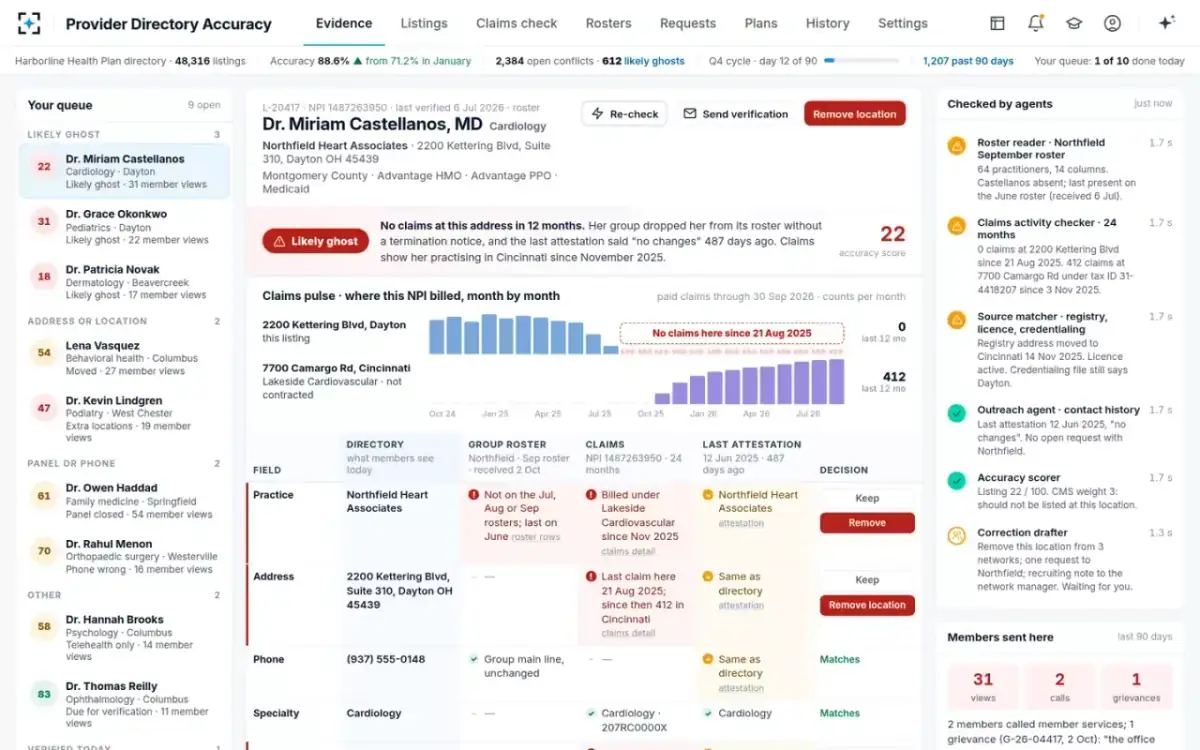
Roster readerReads each group roster in its own layout and compares every row with the directory: adds, departures, moves, phone changes.
Never: Deletes or edits a listing; a missing row is reported, not acted on.
Agent
Claims activity checkerCounts paid claims by NPI, service address and tax ID, month by month, to find listings where nobody is being seen.
Never: Uses member detail, or treats low volume alone as proof.
Agent
Source matcherCompares the listing with credentialing, the national provider registry and state licence boards.
Never: Overwrites the credentialing file.
Agent
Outreach agentSends one request per group with the evidence attached, follows up on day 7 and 14, reads replies by portal, email and fax.
Never: Contacts members, or marks a listing verified without a reply or roster and claims agreeing.
Agent
Accuracy scorerScores each listing and each plan with a weighted deficiency method.
Never: Changes a listing.
Agent
Correction drafterTurns the evidence into the smallest correct change, with its network effect and its publish deadline.
Never: Publishes.
A person decides
Provider data analystApproves, edits or rejects each correction; removals that cut a county margin below 10% go to the network manager.
What is provider directory software?
Four kinds of product are sold under the label, and a buyer should know which one is on the screen before comparing prices. Each solves a real problem; only some of them find a listing that is wrong.
Four kinds of provider directory software, and what each actually checks
| Category | What it does | Finds a doctor who left? |
|---|---|---|
| Directory publishing and search | Turns the plan’s provider file into the member-facing search, the printable copy and the machine-readable files | No: it publishes what it is given |
| Provider data management system | Holds the plan’s system of record for providers, contracts, locations and networks | Only if someone updates it |
| Verification service | Calls, faxes and emails offices to confirm listings, in-house or outsourced | Yes, if the office answers truthfully and the listing is in this cycle |
| Evidence and agent layer | Tests each listing against rosters, claims, registry and replies, then drafts corrections for a person | Yes, from claims, even when the office says nothing |
The difference matters because of where errors actually are. In its 2017–18 review of Medicare Advantage directories, CMS called 10,504 listed locations and found at least one inaccuracy at 48.74% of them (CMS Online Provider Directory Review, round 3). Two-thirds of the deficiencies were not typing errors at all: the provider should not have been listed at that location, or at any location.
What CMS found wrong in Medicare Advantage directories, 2017–18
What should provider directory software check?
It should check whether each listed provider is still practising, at that address, in that network, reachable at that number and taking the patients the listing says. Address standardisation and phone formatting are table stakes; the expensive errors are about presence. A tool that cannot answer "has anyone been seen here in the last year?" will pass the most common error CMS found.
That question has a data answer most plans already hold. CMS's own advice after its reviews was that plans "should actively use the data available to them, such as claims, to identify any provider inactivity that could prompt further investigation" (CMS, 2018). The October 2026 proposal to implement the REAL Health Providers Act lists claims data among the methods a Medicare Advantage plan may use to verify its directory, alongside internal plan information, telephone and email, provider attestations and CMS data sources (CMS-4214-P, proposed § 422.123(b)(2)). A buyer should ask to see a listing flagged from claims alone, with the months behind the flag.
Each agent's finding, listed beside the listing it tested
Can AI update a provider directory?
AI can do everything up to the update: read the roster, find the claims pattern, match the registry, write to the office, read the reply and draft the change. Nothing in federal directory law forbids automated updates, and CMS has said it wants room for new methods: in its October 2026 proposal it kept the list of verification methods open because "this is a space where technology and the use of artificial intelligence is quickly evolving" (CMS-4214-P). The proposal is not final, and it is about how a listing is verified, not who presses publish.
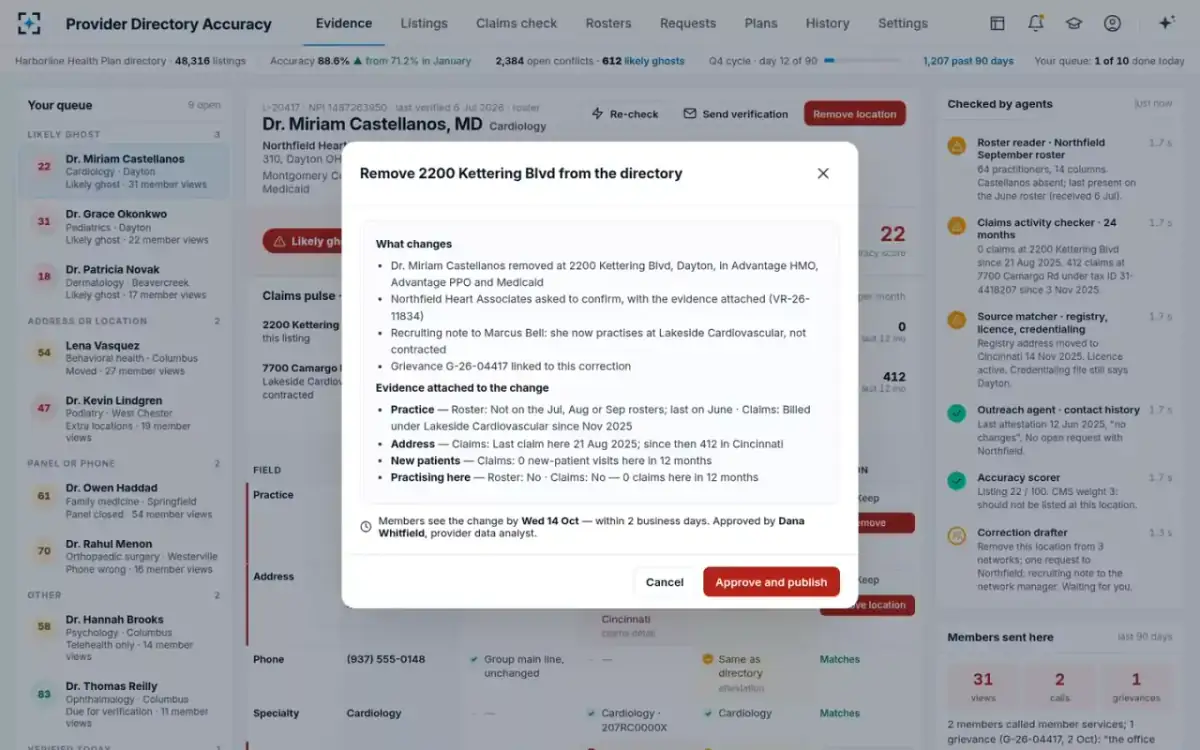
The case for keeping a person on the publish step is practical. A removal changes three things at once: what members see, whether the plan meets its network adequacy standards, and what the plan owes a member who already booked with that provider. Each has a different owner. An agent that publishes on its own also leaves no one to answer a regulator's question about why a listing changed. In Provider Directory Accuracy the correction drafter proposes the smallest correct change with its deadline and network effect; the analyst approves it, and the history keeps both.
Two ways to automate a directory, on the same stale listing
A rules-only check: The roster row is missing this month, so the rule fires.
Agents with evidence and an approver: The roster row is missing for three months, claims at the address stopped in August and the registry shows a new city.
A rules-only check: Delete the listing, or nothing, depending on the rule.
Agents with evidence and an approver: Draft "remove this location from three networks", with one request to the group and a recruiting note.
A rules-only check: A doctor left off one month’s roster by mistake is deleted.
Agents with evidence and an approver: A doctor missing from one roster but billing 61 claims there is flagged as a likely roster error, and kept.
A rules-only check: Found later, in the next adequacy review.
Agents with evidence and an approver: Shown before approval: county count before and after against the plan standard.
A rules-only check: A changed field and a timestamp.
Agents with evidence and an approver: The change, the evidence, the approver and the date members stopped seeing the listing.
Who approves removing a provider from a directory?
A named person at the plan should, and for some removals two. A listing removal is a network decision as much as a data one. Medicare Advantage plans must show that at least 90 percent of beneficiaries in large metro and metro counties, and 85 percent in micro, rural and counties with extreme access considerations, can reach at least one provider of each specialty type within CMS's published time and distance standards (42 CFR 422.116). Taking a ghost out is right, but the network manager needs to know before the county count drops, not after.
Law also fixes when a removal is due. Under the REAL Health Providers Act, from contract year 2028 a Medicare Advantage plan must remove a provider within 5 business days of determining that the provider has left the network (the statute's words, and CMS's proposed rule to carry them out, are in the guide to the REAL Health Providers Act); the clock starts at the determination, which is itself a judgement. Providers can also demand it: their contracts may require the plan to remove them from the directory at termination (42 U.S.C. 300gg-139(c)).
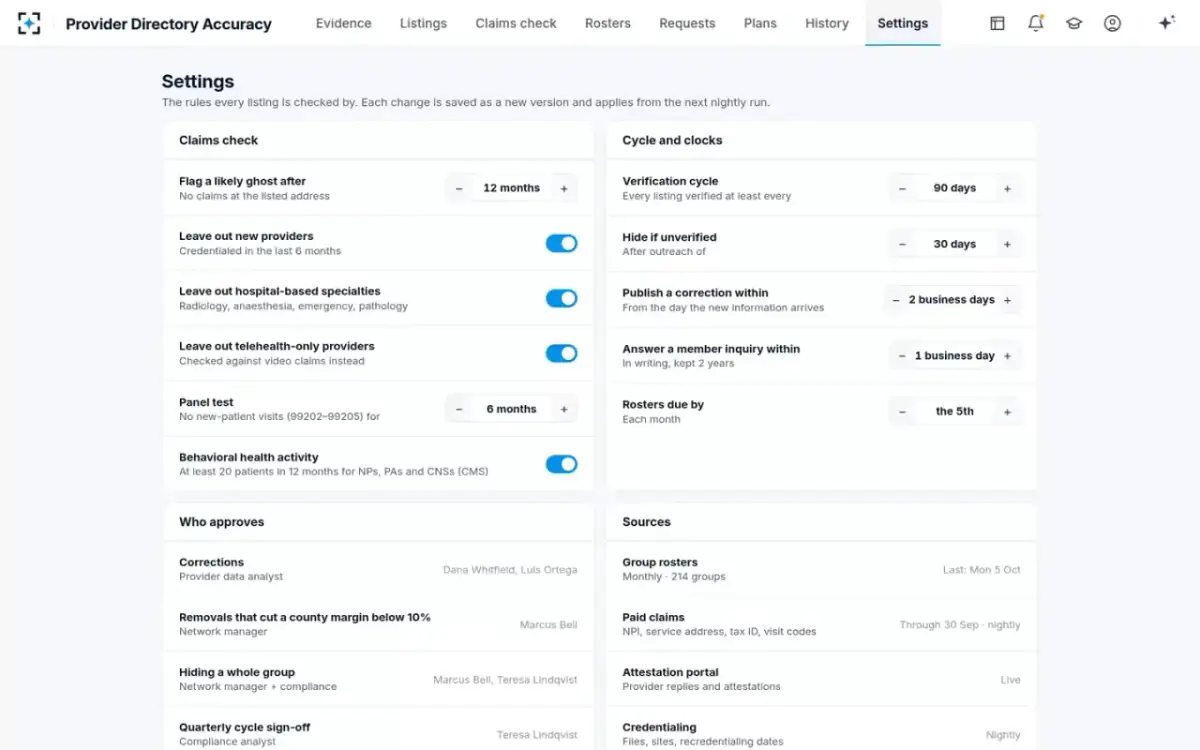
Provider Directory Accuracy routes approvals by effect. An ordinary correction needs the provider data analyst. A removal that would cut a county's margin over the plan's standard below 10% goes to the network manager; hiding a whole group needs the network manager and compliance. Each threshold is a setting the plan can change, saved as a new version.
The change, its evidence and when members will see it, before anyone approves
How does directory software contact providers?
Good software contacts the office once, with a precise question and the evidence, and keeps one request open per group. Bad outreach is the reason offices stop answering: five calls about five listings, each asking the practice to "confirm your information". California's statute shows what regulators count as a real attempt: to "verify" means to contact the provider "in writing, electronically, and by telephone" before a plan may delay payment to a provider who has not responded (Cal. Health & Safety Code § 1367.27).
CMS has floated a non-response rule for the accuracy analysis it proposed in October 2026: a method might be treated as exhausted "if a provider did not respond within 7 business days, including at least one reminder" (CMS-4214-P). That is under consideration, not proposed text. In Provider Directory Accuracy the outreach agent sends one request per group by the office's preferred channel, follows up on day 7 and day 14, and never contacts members.
Does provider directory software integrate with credentialing?
It should read credentialing, and it should not trust it. A credentialing file says a provider is qualified and which sites were approved at the last cycle, often years ago. CMS's reviewers found the habit at the root of many errors: plans "placed full faith in credentialing services and vendor support, and even in provider responses", and "these practices, while typical, have not been found to be a reliable means of ensuring directory accuracy" (CMS, 2018).
The right design reads credentialing as one source and writes nothing back. In Provider Directory Accuracy the source matcher compares each listing with the credentialing file, the national provider registry and state licence boards, and flags disagreements; it never overwrites the credentialing record, which has its own owners and audit trail. The sources provider data management software must read sets out what each input can prove.
The plan's own rules: thresholds, clocks and approvers
What to ask provider directory software in a demonstration
Ask to see each point on a listing from your own directory, not the vendor's sample. A tool that cannot show the evidence for a flag cannot defend a removal either.
Nine questions for any provider directory software
- Which sources does it test each listing against?
Rosters, claims, registry, licence boards, credentialing and replies; and which of them it needs from you.
- Can it flag a listing from claims alone?
Ask for the months behind the flag and the exclusions: new starters, hospital-based and telehealth-only providers.
- What does it do with a missing roster row?
It should report and ask, never delete.
- Who approves each change, and is that recorded?
Name, time, evidence and the date members stopped or started seeing the listing.
- How does it treat network adequacy?
A removal should show the county count before and after, and route to the network manager when it matters.
- How does outreach work?
One request per group, evidence attached, a follow-up schedule, and no member contact.
- Can it run each program’s clock?
2 business days for commercial updates, 30 days for Medicare Advantage and Medicaid, 5 business days for Medicare Advantage removals from 2028.
- How does it score accuracy?
By listing and by plan, with a method you can explain; and how it will meet the score CMS finalises.
- What happens to member data?
Claims should be read as counts by provider and address; nothing about members should go to offices.
Where Provider Directory Accuracy fits, and where it does not
It fits a plan that already has a provider system of record and a published directory, and whose problem is keeping them true: too many conflicts, too few people, and clocks that keep running. It reads rosters in any layout, tests every listing against 24 months of paid claims, matches the registry, licence boards and credentialing, writes to offices and drafts corrections, with each change approved by a provider data analyst.
It is not a member-facing search site, a credentialing system or a replacement for your provider system of record, and it does not decide network adequacy. It needs read access to paid claims by NPI, service address and tax ID; a plan that cannot provide that loses the strongest signal for ghost listings. It does not change the law's requirements for how accuracy is measured: Medicare Advantage plans will score their directories by CMS's method once it is final, and how to measure directory accuracy explains the proposed method. The deadlines it is built around are set out in the REAL Health Providers Act guide.
Questions people ask
What is the difference between provider directory software and a provider data management system?
A provider data management system is the plan's record of providers, contracts, locations and networks. Directory software publishes from that record or checks it. Many errors CMS found were faithfully published from a record that was itself out of date, so a plan usually needs both a system of record and something that tests it.
Can provider directory software find errors without calling offices?
Some, yes. Paid claims show whether a provider is being seen at the listed address, and the registry and licence boards show reported moves. Offices still have to confirm phone numbers, panel status and departures that claims cannot explain, which is why the proposed Medicare Advantage rules list telephone and email among the verification methods.
Does provider directory software help with network adequacy?
It should, by showing the effect of each removal on the county count before it is approved. Medicare Advantage plans must reach 90% of beneficiaries in metro counties and 85% in rural ones within CMS's time and distance standards, so a run of removals in one county is a network decision, not only a data fix.
Do the agents contact members?
No. In Provider Directory Accuracy the outreach agent writes only to provider offices, one request per group, and attaches claims as monthly counts with no member detail. Member questions about network status are answered by the plan's own staff, in writing within the clock the plan sets.
How is AI used in provider directory management?
Mostly to read and compare: turning rosters in many layouts into one, matching listings to claims, the registry and licence boards, reading replies and drafting changes. CMS's October 2026 proposal leaves room for new verification methods as the technology develops. The decision to publish, and the trail of who made it, should stay with a person.