A Medicaid secret shopper survey is an annual test, run by an entity independent of the state Medicaid agency and of the plans, in which callers posing as patients check whether each managed care plan's online provider directory is right and whether its providers offer routine appointments in time. CMS required it in its 2024 access rule, and it applies from each plan contract's first rating period beginning on or after 9 July 2028. The directory check covers four facts about each sampled listing; the appointment check requires a plan to meet the wait-time standards at least 90 percent of the time. Results are reported to CMS and posted publicly. Provider Directory Accuracy, a Botminds solution, tests every listing against rosters, paid claims and provider replies so a plan can find and fix what the shopper would find.
What the Medicaid secret shopper checks
- Active network status
Is this provider, at this listing, in the plan’s network today?
- Street address
Does the provider practise at the address the directory shows?
- Telephone number
Does the number reach the provider’s office?
- Accepting new enrollees
Is the panel open, as the directory says, or closed?
- Routine appointment in time
Within 10 business days for outpatient mental health and substance use disorder, 15 for primary care and for obstetrics and gynaecology, as states set within those limits.
- At least 90% of the time
The plan complies with the wait-time standards only if the survey finds appointments available within them at least 90% of the time.
What is a Medicaid secret shopper survey?
It is a mystery-caller audit required by federal regulation. "States must contract with an entity, independent of the State Medicaid agency and any of its contracted MCOs, PIHPs and PAHPs subject to the survey, to conduct annual secret shopper surveys" of each plan's directory accuracy and appointment wait times (42 CFR 438.68(f)). Independent means not part of the state agency, and not a plan, not owned or controlled by one, and not owning or controlling one. CMS chose a disguised caller on purpose: it rejected calls that announce themselves because secret shopper surveys "capture information that is unbiased, credible, and reflect what enrollees experience when trying to schedule an appointment" (CMS-2439-F, May 2024).
The need is long documented. HHS's Inspector General found in 2014 that 51 percent of Medicaid managed care providers it tried were not participating in the plan at the listed location or not accepting the plan's new patients (OIG, OEI-02-13-00670), and in 2025 that an average of 28 percent of behavioral health providers listed by the Medicaid plans it studied had served no enrollee in 2023 (OIG, OEI-02-23-00540).
When do Medicaid secret shopper surveys start?
With the first rating period, for each plan contract, beginning on or after 9 July 2028: the rule applies the survey requirement "4 years after July 9, 2024". Because states run rating periods on different calendars, the real start date differs by state, which is why the Inspector General described the surveys as "slated to begin as early as mid-2028". CMS encouraged states to start sooner, "particularly for surveys of provider directory data accuracy". The wait-time standards being measured apply a year earlier, from rating periods beginning on or after 9 July 2027.
When the first surveyed rating period starts, by contract calendar
- Before2 mo
- First surveyedfrom Sep 2028
- BeforeJul–Dec 2028
- First surveyedfrom Jan 2029
- BeforeJul 2028–Jun 2029
- First surveyedfrom Jul 2029
What does a secret shopper check in a provider directory?
Four facts, for four provider types, in the plan's "most current electronic provider directories": active network status, street address, telephone number and whether the provider accepts new enrollees, for primary care, obstetric and gynaecological, and outpatient mental health and substance use disorder providers, plus the provider type the state picks for its own wait-time standard (42 CFR 438.68(f)(1)). CMS called these "the most critical pieces of information that enrollees rely on". Paper directories are not tested.
The listing is judged as listed. CMS was explicit: "if the provider directory lists Dr. X, then the active network status, address, phone number, and open panel status for Dr. X must be verified; a directory reflecting accurate information for other providers in the same practice is not sufficient" (CMS-2439-F). A practice that offers the caller another clinician may pass the appointment test while the listing for the doctor the caller asked for fails the directory test.
Two surveys in one call: how each is scored
| Directory accuracy survey | Appointment wait-time survey | |
|---|---|---|
| Providers | Primary care, OB/GYN, outpatient mental health and substance use, one state-chosen type | The same service types |
| What is checked | Network status, address, phone, accepting new enrollees, for the listed provider | A routine appointment offered within the state standard |
| Standard | Accurate or not, per listing; no federal pass mark | 10 business days (mental health, substance use), 15 (primary care, OB/GYN), as states set; at least 90% compliance |
| Sample | Random, covering all areas of the contract | Random, all areas, and statistically valid for each plan |
| Errors found | To the state within 3 business days, to the plan within 3 more | Counted in the plan’s compliance rate |
| Results | Reported to CMS and posted on the state’s website within 30 calendar days | The same |
What is the appointment wait time standard?
States must set routine-appointment standards no longer than 10 business days from the request for outpatient mental health and substance use disorder services, 15 for primary care and 15 for obstetrics and gynaecology, plus one service the state selects. A plan "will be deemed compliant" when secret shopper results show appointment availability within the standards "of at least 90 percent" (42 CFR 438.68(e)).
The directory is the way into that test. A shopper who reaches a disconnected number or a doctor who left has no appointment to count, and CMS's preamble insists the shortfall must not shrink the appointment sample: if the directory data a state gives its surveyor do not permit a full statistically valid sample, "the State must provide additional data". For the directory survey itself, CMS said the opposite: "the identification of incorrect directory data is the intent of those surveys and should be reflected in a plan's compliance rate" (CMS-2439-F).
How many providers are sampled in a secret shopper survey?
The rule sets no number. Both surveys need a random sample covering every area of the contract, and the appointment survey must be "statistically valid" for each plan; the directory survey has no minimum. Surveyors will therefore reach for standard formulas, and plans should know what those imply, because a plan that truly meets the standard can still fail a small sample.
To estimate a compliance rate near 90 percent within plus or minus 5 points at 95 percent confidence takes about 138 completed calls; within 3 points, about 384. Now take a plan whose true appointment availability is 92 percent. With 138 completed calls it has roughly a one-in-five chance of scoring below 90 percent; with 384 calls the risk falls to about one in thirteen. That is our arithmetic on the binomial distribution, and it is why a plan with a thin margin should not count on a pass.
Completed calls needed, and dials needed if most calls get no answer
Non-response is the hidden cost. In that peer-reviewed study, run from October 2025 to March 2026 in Delaware, Montana, New Jersey, Rhode Island and Virginia, 61.3 percent of 5,822 calls yielded no definitive outcome, most often because callers reached only an answering machine or automated system. Among the calls that did, "only 23.6% resulted in a scheduled appointment while 55.6% were subject to directory errors, and 21.6% were subject to capacity constraints" (Haeder et al., 2026).
What fails a secret shopper call?
For the directory survey, any of the four facts being wrong for the listed provider: not in network, wrong address, wrong number, or the panel status wrong in either direction. For the appointment survey, no routine appointment inside the standard, or a telehealth-only offer from a provider who does not also see patients in person. The rule is silent on calls nobody answers, so each state's surveyor will set the rule.
Past federal practice gives a hint. In its 2017–18 directory reviews, CMS made at least three attempts on different days and times and counted a location that never answered as a deficiency (CMS, 2018). If a state's surveyor does the same, every unanswered listing is a failed listing, and a plan's best defence is a phone number that reaches a person.
The shopper does not need to prove the doctor left. A number that rings out three times may be enough to count against the plan.
What happens if a plan fails a secret shopper survey?
First, correction. The surveyor must send the state details of each directory error "sufficient to facilitate correction" within 3 business days of finding it; the state must pass it to the plan within 3 more; and the plan must use it to update its directory within the normal timeframes, 30 calendar days for the electronic directory (42 CFR 438.10(h)(3)). Second, publicity: results are reported to CMS and posted on the state's website within 30 calendar days.
Third, oversight. The state must review the secret shopper results before it certifies to CMS that each plan's network is adequate, and when the state, the plan or CMS identifies an area where access could be improved, the state must submit a remedy plan to CMS within 90 calendar days that addresses the problem within 12 months, with quarterly progress updates. The remedies the rule lists include higher payment rates, better provider outreach and less burdensome credentialing (42 CFR 438.207(d), (f)). Sanctions beyond that depend on the state's contract.
Who conducts secret shopper surveys, and what do they cost?
The state contracts an independent vendor. CMS estimated the state's own work in the first year at 85 hours of a business operations specialist and 25 of a general operations manager for procurement and contract set-up, then 50 and 15 hours a year to manage the contract and analyse results (CMS-2439-F). The calls themselves are the vendor's cost. Plans do not run the official survey, but nothing stops them running their own first.
Running your own secret shopper before the state does
A plan can rehearse the survey on itself: draw a random sample of listings of the four provider types across every county it serves, check the four facts by call, and request a routine appointment in the same call. It should oversample, keep a strict rule for unanswered calls, and fix every error within days, not weeks.
Measure three things from the rehearsal, not one: the share of calls that reach a person at all, the share of reached listings with each of the four errors, and the share of reached providers offering an appointment inside the standard. The first tells the plan how many calls the state's surveyor will need; the second is the directory result the state will publish; the third is the 90 percent test. A plan that only counts appointments will be surprised by the directory report.
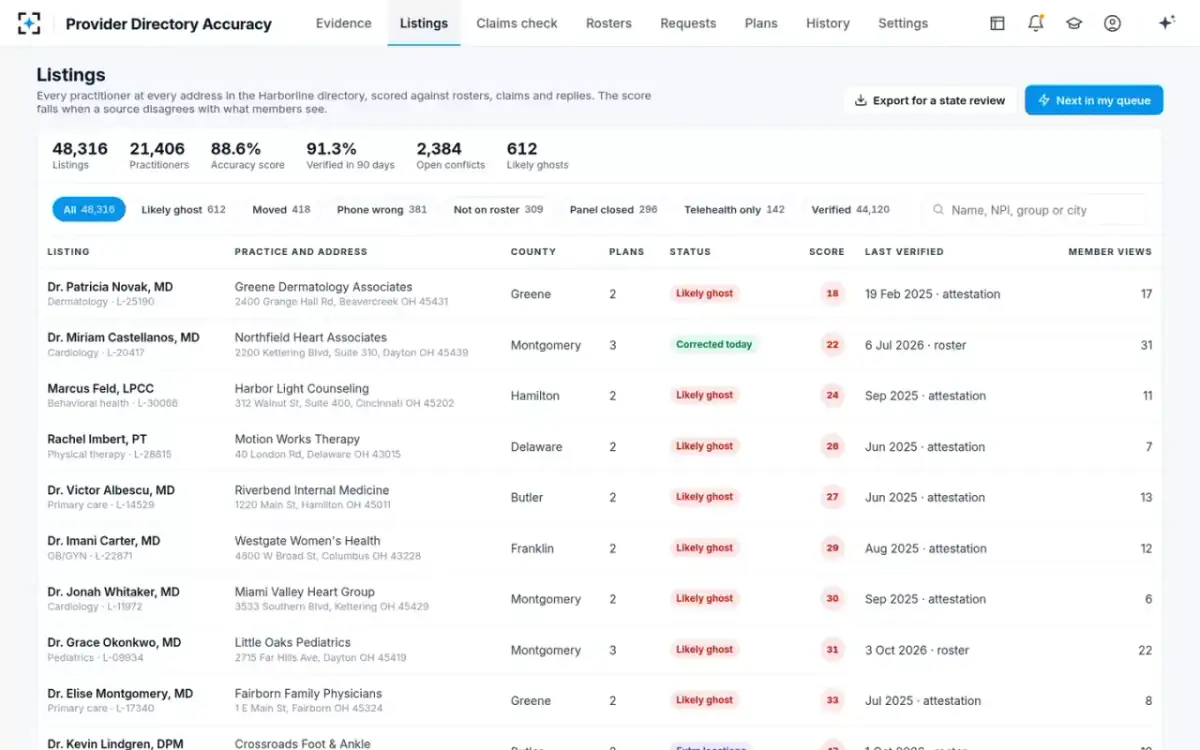
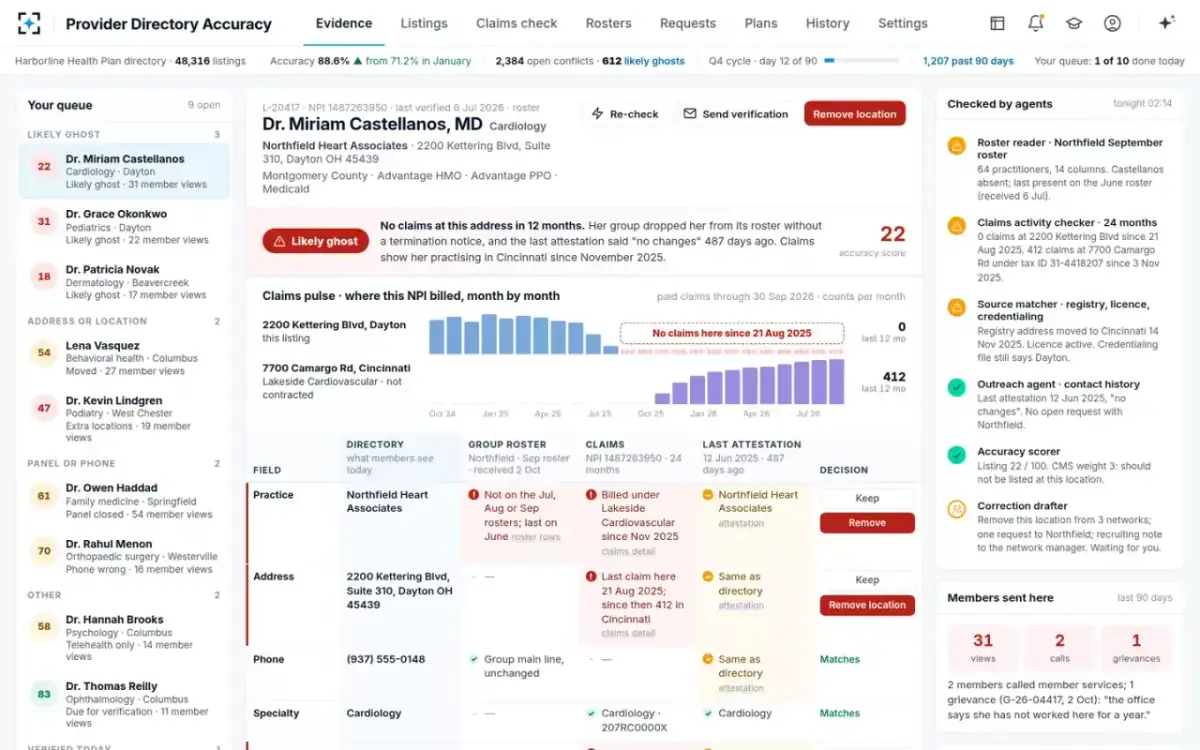
Calls are the expensive part, so a plan should first remove the listings a call would fail. Provider Directory Accuracy does that continuously: it flags listings with no claims at the address, numbers that offices have reported changed, and panels whose new-patient visits stopped, using visit codes 99202 to 99205 over a window the plan sets. Finding ghost networks in your own claims explains the claims test; measuring provider directory accuracy covers sample design.
Every listing in the four survey types, filtered by the conflict a shopper would hit
A listing the shopper would fail, caught from claims first
The provider directory requirements by program show how the Medicaid survey sits beside the commercial 90-day cycle and the Medicare Advantage accuracy score.
Questions people ask
Does the secret shopper requirement apply to CHIP?
Yes. CMS applied the same requirement to separate CHIP managed care through a parallel CHIP regulation and estimated the state burden for 32 CHIP states alongside 44 Medicaid states. The provider types, data points and timing follow the Medicaid rule.
Are secret shopper results public?
Yes. States must report the results to CMS and post them on the state's managed care website within 30 calendar days of submission. Plans should expect members, advocates and competitors to read them.
Does the survey test paper directories?
No. CMS limited it to the most current electronic directory, reasoning that paper use is dwindling and that paper directories are usually produced from the electronic files. Paper directories still have their own update schedule.
Can a state start secret shopper surveys before 2028?
Yes. CMS said states can comply sooner and encouraged them to, particularly for directory accuracy. A plan in a state that starts early may face its first survey well before its contract's first rating period after 9 July 2028.
Is there a pass mark for directory accuracy?
Not in federal rules. The 90% compliance standard applies to appointment availability; directory errors are reported, corrected and published, and feed the state's assessment of network adequacy. States may set their own targets in plan contracts.