Provider directory requirements are the federal and state rules on what a health plan's list of network providers must contain, how often it must be checked and how fast it must change. They differ by program. Commercial plans must verify every listing at least every 90 days and update within 2 business days under the No Surprises Act. Medicare Advantage plans must update within 30 days today, send their directory data to CMS for Medicare Plan Finder since 1 January 2026, and take on a 90-day cycle in 2028. Medicaid managed care plans must update electronic directories within 30 calendar days and, from rating periods starting on or after 9 July 2028, face annual secret shopper surveys. The work is hard because one doctor usually sits in all three networks. Provider Directory Accuracy, a Botminds solution, checks every listing against rosters, claims and replies and runs each program's clock.
Provider directory requirements side by side, as of October 2026
| Duty | Commercial (No Surprises Act) | Medicare Advantage today | Medicare Advantage from 2028 | Medicaid managed care |
|---|---|---|---|---|
| Verify each listing | At least every 90 days | No fixed cycle; attest to CMS at least annually | At least every 90 days; 12 months for hospitals and some facilities (proposed) | No fixed cycle; state secret shoppers from 2028 |
| Update after new information | Within 2 business days | Within 30 days | Within 30 days; remove a departed provider within 5 business days | Electronic: 30 calendar days. Paper: monthly, or quarterly with a mobile-enabled directory |
| A listing that cannot be verified | A removal procedure, after a period the plan sets | Not specified | Flag: information "may not be up to date" | Not specified |
| Member asks about network status | Written answer within 1 business day, kept 2 years | Not specified | Not specified | Not specified |
| Member relied on a wrong listing | In-network cost sharing | Not specified | Lesser of in-network or otherwise applicable cost sharing | Not specified federally |
| Accuracy test | None set | CMS reviews (2016–18, 2022–24) | Annual sample, score reported; public from 2029 | Annual independent secret shopper survey |
What are the provider directory requirements?
Every federal program requires an accurate public directory; they differ on how accuracy is enforced. The commercial rules are about speed: a 90-day verification cycle and a 2-business-day update. The Medicare Advantage rules have been about publication and, from 2028, add speed and measurement. The Medicaid rules are about content and independent testing. States add their own, and the No Surprises Act says plainly that nothing in it preempts "any provision of State law relating to health care provider directories" (42 U.S.C. 300gg-115(a)(7)).
The sections below take each program in turn, then the contents, the clocks and the state layer. Dates are given as of 27 October 2026; two of the rules described are proposals or have not yet started.
Commercial plans: the No Surprises Act clocks
For plan years beginning on or after 1 January 2022, every group health plan and health insurance issuer offering group or individual coverage must run three processes (42 U.S.C. 300gg-115):
- a verification process under which, "not less frequently than once every 90 days", the plan verifies and updates the information for every provider and facility in its public database, with "a procedure for the removal" of a provider it has been unable to verify "during a period specified by the plan or issuer", and an update "within 2 business days" of receiving information from a provider;
- a response protocol: when a member asks by phone whether a provider is in network, a written answer "as soon as practicable and in no case later than 1 business day after such call is received", kept in the member's file for at least 2 years;
- a public database listing each provider and facility with a contractual relationship, with name, address, specialty, telephone number and digital contact information; a print directory must say it was accurate as of its publication date and point members to the database.
The Departments of Labor, Health and Human Services and the Treasury said in August 2021 that they would write rules but "rulemaking will not be issued until after January 1, 2022", and that until then plans should use "a good faith, reasonable interpretation of the statute" (FAQs Part 49). A search of the Federal Register on 27 October 2026 found no final rule implementing these directory provisions; the statute and that guidance are what apply.
What are the Medicare Advantage provider directory requirements today?
Today, a Medicare Advantage plan must update its online directory "within 30 days of receiving information requiring update", update hardcopy directories within 30 days (addenda count), send the directory to current enrollees by 15 October each year and to any enrollee within three business days of a request (42 CFR 422.2267(e)(11)). Its Provider Directory API, required since 1 January 2021, must be updated no later than 30 calendar days after the plan receives new information (42 CFR 422.120).
Since 1 January 2026, plans must also make their directory data available to CMS for publication on Medicare Plan Finder, update it "within 30 days of the date an MA organization becomes aware of changes", and "attest at least annually" that it is accurate (CMS-4208-F2, September 2025). CMS noted that the applicability date "does not mean that the data will be available on Medicare Plan Finder (MPF) for use by the public by January 1, 2026". It declined to make plans attest that directory data matched their network adequacy submissions, keeping directory accuracy and network adequacy as separate duties.
Medicare Advantage from 2028: the REAL Health Providers Act
The REAL Health Providers Act, enacted on 3 February 2026 as section 6220 of the Consolidated Appropriations Act, 2026, adds four duties for plan year 2028: verify each listing at least every 90 days (hospitals and some facilities at least every 12 months), mark a listing that cannot be verified as one whose information "may not be up to date", remove a provider who has left the network within 5 business days, and run an annual accuracy analysis whose score CMS publishes from 2029. Members who rely on a wrong listing get cost-sharing protection. CMS proposed its implementing rules on 20 October 2026, with comments due 15 December 2026 (CMS-4214-P). The REAL Health Providers Act guide separates what the statute requires from what CMS has proposed.
When each program's directory rules bite, 2022 to 2029
- 90-day verification, 2-business-day updates2022–2029
- 30-day updates2022–25
- Plan Finder2026–27
- REAL Act2028
- Score2029
- 30-day updates2022 to mid-2028
- Shoppersmid-2028 on
What are the Medicaid provider directory requirements?
Medicaid managed care plans must publish a searchable electronic directory and a paper one on request, covering physicians including specialists, hospitals, pharmacies, mental health and substance use disorder providers and, where covered, long-term services and supports providers. An electronic directory "must be updated no later than 30 calendar days" after the plan receives updated information; a paper directory monthly, or quarterly if the plan has a mobile-enabled electronic directory; and the directory must be available as a machine-readable file (42 CFR 438.10(h)).
The 2024 access rule added independent testing. States must contract an entity independent of the state agency and the plans to run annual secret shopper surveys of directory accuracy for primary care, obstetrics and gynaecology, outpatient mental health and substance use disorder providers and one state-chosen type, checking active network status, street address, phone number and whether the provider accepts new enrollees. Errors go to the state within 3 business days and on to the plan within 3 more, and the plan must use them to correct its directory within its normal timeframes (42 CFR 438.68(f)). How the Medicaid secret shopper survey is scored works through the test.
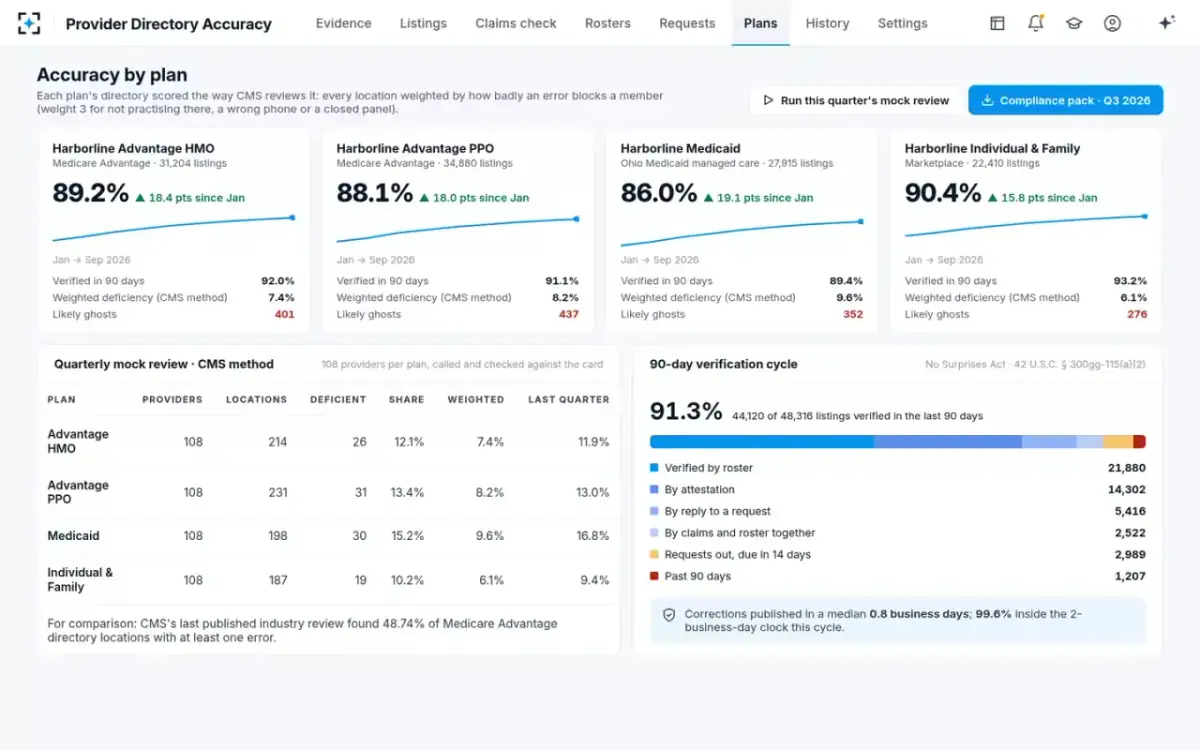
One directory, four plans, each measured on its own
What must a provider directory include?
The core is the same everywhere: who, where, how to reach them and what they do. The programs then add fields.
What each program requires a listing to show
| Field | Commercial (NSA) | Medicare Advantage (proposed for 2028) | Medicaid managed care | Marketplace plans (QHP) |
|---|---|---|---|---|
| Name and group | Name | Name | Name and group affiliation | Medical group |
| Address | Yes | Primary office or facility addresses | Street addresses | Location |
| Phone and digital contact | Phone and digital contact information | Contact information, including phone | Phone; website as appropriate | Contact information |
| Specialty | Yes | Yes | As appropriate | Yes |
| Accepting new patients | Not in the definition | Yes | Yes | Yes |
| Accessibility and telehealth | Not in the definition | Both | Both | Not specified |
| Languages and culture | Not in the definition | Cultural and linguistic capabilities | Including American Sign Language | Not specified |
| Ownership and affiliations | No | Common ownership or control with the plan | No | Institutional affiliations |
Marketplace issuers have had to publish "an up-to-date, accurate, and complete provider directory" since plan years beginning on or after 1 January 2016, visible without creating an account or entering a policy number, and, on the federally facilitated exchange, to submit the data to HHS in its format (45 CFR 156.230). Those issuers also fall under the No Surprises Act's clocks.
How often must a provider directory be updated?
Within 2 business days of a provider's information for commercial plans; within 30 days for Medicare Advantage, with removals of departed providers due within 5 business days from 2028; within 30 calendar days for Medicaid electronic directories. A plan publishing one listing to all three should work to the fastest clock, because the member sees one address whichever plan they hold.
Verification is a separate clock. The 90-day cycle asks the plan to confirm each listing whether or not anything has been reported, and it is the harder of the two to meet: it needs a source for every listing every quarter, not just a process for the ones that change. Accuracy measurement is a third clock, annual, and how to measure directory accuracy explains how CMS proposes to score it.
A doctor in three networks is one address on one screen. The member does not know which rulebook applies, so the directory has to meet the fastest one.
Do provider directory rules apply to employer plans?
Yes. The No Surprises Act's directory duties were written into three laws at once: the Public Health Service Act for insurers, ERISA section 720 for employer group health plans and Internal Revenue Code section 9820, as the Departments' 2021 guidance lists (FAQs Part 49). A self-funded employer plan therefore owes the 90-day verification, the 2-business-day update, the 1-business-day answer and the cost-sharing protection, usually delivered through its third-party administrator's network and directory.
State law on top: California as an example
States set their own directory rules for the plans they license, and some are stricter than federal law. California's statute for health care service plans requires the online directory to be updated "at least weekly", a printed directory at least quarterly, an annual review of the whole directory, contact with every individual provider not in a group at least every six months, and investigation of any reported inaccuracy within 30 business days. A plan may delay payment for up to a month to a provider who ignores its verification requests, and the regulator may require in-network coverage for an enrollee who relied on a materially inaccurate directory (Cal. Health & Safety Code § 1367.27, text as last amended in 2016).
A plan operating in several states needs each state's rules in its settings, not in a binder. The weekly update in California, for example, is slower than the federal 2-business-day clock for the same commercial listing, so the federal clock governs; the six-month contact rule has no federal equivalent and adds outreach.
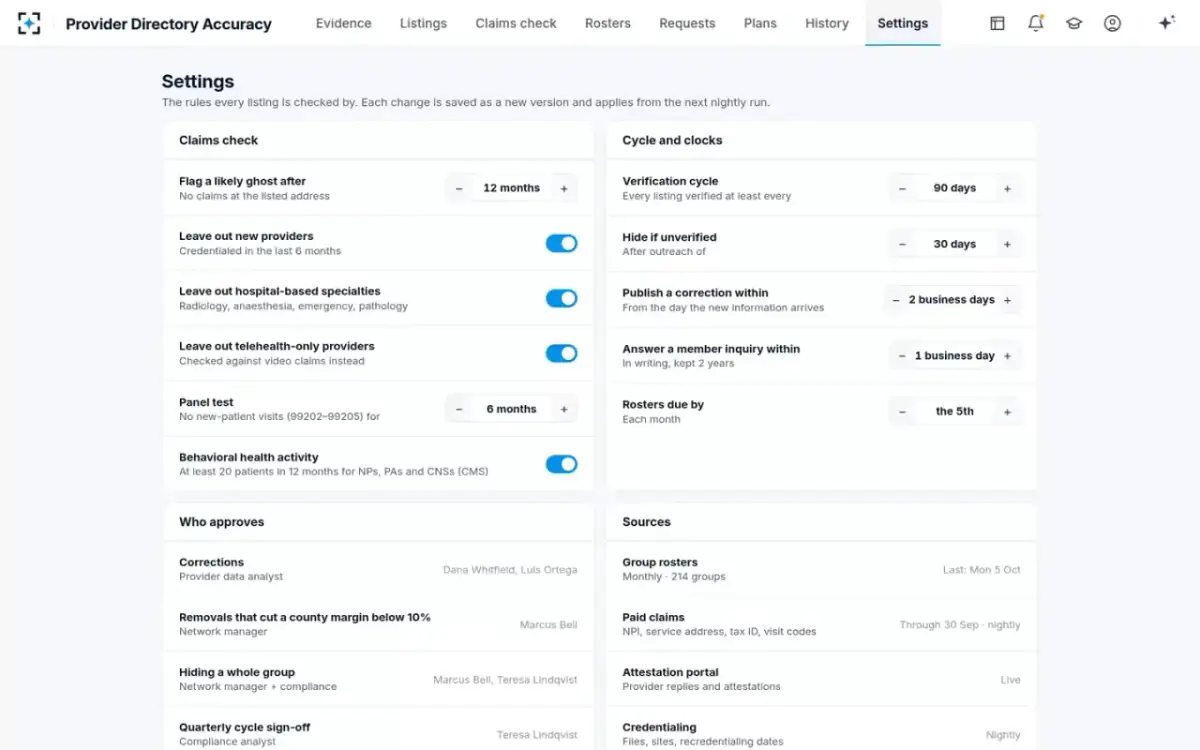
Clocks and thresholds as settings, versioned
One directory, three rulebooks: running them together
Seven rules for a directory that serves several programs
- Run each listing on its fastest clock
2 business days if it appears in any commercial network.
- Verify on a 90-day cycle everywhere
Required for commercial listings now and Medicare Advantage from 2028; cheaper as one cycle than three.
- Handle unverifiable listings by program
A removal procedure for commercial plans; a "may not be up to date" flag for Medicare Advantage from 2028.
- Answer network questions in writing within 1 business day
And keep the answer 2 years: the commercial rule, and the evidence for any later cost-sharing claim.
- Keep a daily copy of the directory
CMS proposes a 10-year daily archive for Medicare Advantage; it also settles commercial disputes.
- Carry every field each program needs
Accessibility, telehealth, languages and, for Medicare Advantage, common ownership if finalised.
- Layer state rules as settings
Weekly updates, six-month contact cycles and payment delays where state law provides them.
Questions people ask
What is the 90-day provider directory verification?
It is the No Surprises Act duty, for commercial plan years from 2022, to verify and update every provider's directory information at least once every 90 days. The REAL Health Providers Act sets the same cycle for Medicare Advantage from 2028, with up to 12 months allowed for hospitals and facilities CMS names.
Can a plan remove a provider it cannot verify?
For commercial plans, the No Surprises Act requires a procedure for removing providers the plan has been unable to verify, after a period the plan sets. For Medicare Advantage from 2028, the statute instead requires a notice that the provider's information may not be up to date; removal is for providers the plan determines have left the network.
What must a print directory say?
Under the No Surprises Act, a print directory must state that its information was accurate as of the date of publication and tell members to check the online database or contact the plan for current information. CMS has proposed a similar disclaimer, and quarterly addenda for members who asked for paper, for Medicare Advantage.
Are there federal regulations for the No Surprises Act directory rules?
Not yet. In August 2021 the Departments said they would write rules after 1 January 2022 and asked plans to apply a good-faith, reasonable reading of the statute meanwhile. A Federal Register search on 27 October 2026 found no final directory rule, so the statute and that guidance govern.
What is Medicare Plan Finder provider directory data?
From 1 January 2026, Medicare Advantage plans must give CMS their directory data for publication on Medicare Plan Finder, update it within 30 days of learning of a change and attest at least annually that it is accurate. CMS said the public display would follow a period of testing.