A provider data management specialist keeps a health plan's provider directory true: every practitioner, at every address, with the right phone, specialty, network and new-patient status. The work is hard because the truth lives outside the plan. Doctors leave groups, practices move and panels close, and the plan hears about it late, if at all, while federal law gives it 90 days to verify each listing and 2 business days to publish what a provider reports. Most specialists spend their week reconciling rosters, chasing offices and logging changes. Provider Directory Accuracy, a Botminds solution, hands the reading, matching and chasing to agents and leaves the specialist the decisions.
This guide is for the specialist and the manager who staffs the team: what the role is, which rules set its pace, how many listings one person can really carry, and where the hours go.
Four seats around one listing, before and after agents do the reading
Today
Works hundreds of conflicts a week on whatever the office last said, re-keying roster rows and calling the same practices again.
With agents
Opens each conflict on one card, roster beside claims beside the last reply, with a correction already drafted.
Still theirs: Every change to what members see.
Today
Phones a group five times about five listings and chases late rosters by hand.
With agents
Sends one request per group with the evidence attached; follow-ups go out on a schedule.
Still theirs: The relationship with the practice manager.
Today
Learns a specialist was removed after the county count has already dropped.
With agents
Sees each proposed removal with its effect on the county count, and decides the ones that cut the margin.
Still theirs: Network adequacy and recruiting.
Today
Pieces together who verified what, and when, before a state or CMS review.
With agents
Signs the quarter from one history of every change, its evidence and its approver.
Still theirs: The attestation and the answer to the regulator.
What does a provider data management specialist do?
A provider data management specialist maintains the plan's record of who is in its network and how members can reach them, and makes the public directory match it. In practice that means five recurring jobs: loading and comparing group rosters, sending and reading verification requests, working the conflicts the two throw up, publishing corrections inside the deadline, and keeping the log a regulator will ask for.
The record is wider than most outsiders expect. A Medicaid managed care directory must show, for each network provider, the name and group affiliation, street addresses, telephone numbers, website, specialty, whether the provider accepts new enrollees, cultural and linguistic capabilities, physical accessibility and whether services are offered by telehealth (42 CFR 438.10(h)). Every one of those fields can go stale on its own schedule, and a provider who practises at three addresses is three listings, not one.
The title varies. Plans call the same seat provider data analyst, provider data coordinator or directory specialist, and in smaller plans it is folded into credentialing or provider relations. What defines it is the queue: a list of listings where two sources disagree and someone has to decide which one is true.
The clocks a provider data specialist works against
The pace of the job is set by statute, and the clocks differ by line of business. For commercial group and individual coverage, the No Surprises Act requires a process under which, "not less frequently than once every 90 days", the plan verifies and updates each provider's directory information, an update "within 2 business days" of receiving information from a provider, and a written answer to a member who phones about network status "in no case later than 1 business day after such call is received", kept for at least 2 years (42 U.S.C. 300gg-115). These duties have applied for plan years beginning on or after 1 January 2022.
Medicare Advantage directories must be updated online "within 30 days of receiving information requiring update" (42 CFR 422.2267(e)(11)), and Medicaid managed care electronic directories no later than 30 calendar days after the plan receives updated information. From contract year 2028 the REAL Health Providers Act adds a 90-day verification cycle and a 5-business-day removal for Medicare Advantage; CMS proposed its rules for those duties on 20 October 2026 (CMS-4214-P), and they are not yet final. Provider directory requirements by program sets the three rulebooks side by side.
A specialist who works more than one line of business works to the tightest clock that applies to the listing. A cardiologist in a plan's commercial, Medicare Advantage and Medicaid networks is, for practical purposes, on the 2-business-day clock everywhere, because the plan publishes one address for her.
How many listings can one provider data analyst verify?
It depends less on the number of listings than on how many are in conflict, because a clean listing confirmed by a roster takes seconds and a conflicted one takes days. The model below prices a quarter for a fictional plan with 40,000 listings, worked by hand. Every input is our assumption, chosen to be ordinary rather than dramatic, and a manager should replace each with the team's own figures.
Where a quarter's hours go for 40,000 listings, by hand
Two things follow. First, the conflict rate, not the directory size, sets the headcount: halving the time a conflict takes saves more than any amount of roster automation. Second, the hours are spent mostly on finding things out, not on deciding. In the 45 minutes a conflict takes by hand, the decision itself, remove, move or keep, is a minute or two; the rest is pulling the roster history, querying claims, looking up the registry and the licence board, and calling the office.
Where the time goes on one conflicted listing
Hours tell one story; calendar days tell another. A conflicted listing sits open while the office is chased, and a member can be sent to it every day it stays wrong. The split below is Botminds' estimate for one listing in conflict, worked by hand and with Provider Directory Accuracy.
Most of a conflict's life is waiting on the office
By hand: about 22 days
- Chasing the office · 64%
- Roster against directory · 14%
- Claims, registry, licence, credentialing · 13%
- Drafting and publishing · 9%
With agents: about 5.5 days
- Waiting on the office · 73%
- Roster against directory · 9%
- Claims, registry, licence, credentialing · 4%
- Drafting and publishing · 14%
The office still has to answer, so waiting remains the largest share. What changes is that the evidence is assembled before the request goes out, which is why the request can ask one precise question ("our claims show no visits at this address since August; has she left?") instead of "please confirm your information".
What is a provider roster, and why does it break?
A provider roster is the list a contracted group sends the plan of the practitioners who work for it, usually monthly, with addresses, specialties and start and end dates. For a large group it is the only practical way to keep hundreds of listings current. It is also where most silent errors begin.
Every group sends its own layout, so the specialist's first job is translation: a 14-column spreadsheet from one group, a four-page PDF from another, an emailed table from a third. The harder problem is absence. A departure is often not a row marked "terminated" but a row that stops appearing, and a specialist comparing two files by eye will miss a missing row far more often than a changed one. CMS named a second habit in its 2018 review: "group practices continue to provide data at the group level rather than at the provider level", listing a practitioner at every office the group has "even if that specific provider rarely or never sees patients at that location" (CMS Online Provider Directory Review, round 3).
A roster read row by row, departures included
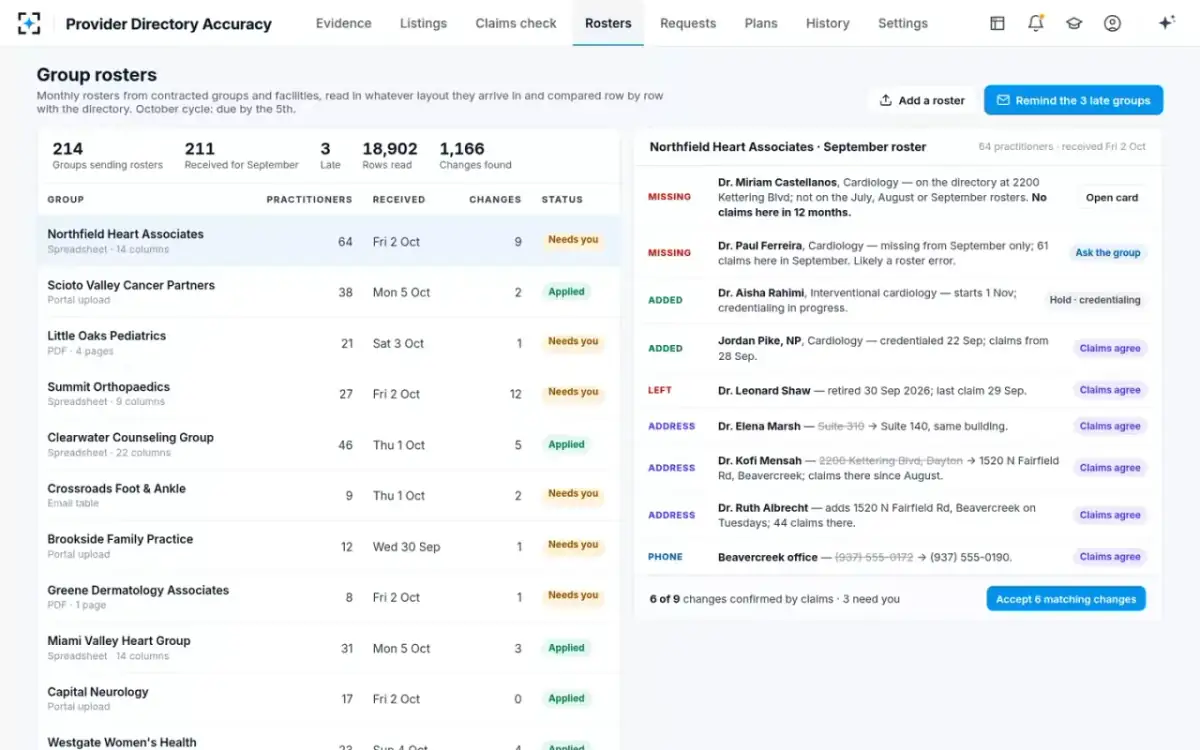
Six of the nine changes are confirmed by claims at the new address; the three that are not go to a person.
Why "no changes" is the most expensive answer a specialist gets
An attestation that comes back "no changes" closes a task without proving anything. CMS found in its reviews that "in some cases, MAOs contacted providers or provider groups and the providers themselves had validated information that was subsequently found to be incorrect when CMS directly called the office", and that some directories had been out of date "including cases where providers had been retired or deceased for years" (CMS, 2018).
The law puts duties on providers too. Since 2022, providers must have business processes to send plans directory information when a network agreement begins or ends, when there are "material changes", and at other times including on the plan's request (42 U.S.C. 300gg-139). Individual providers must also tell the national registry of changes to their required data "within 30 days of the change" (45 CFR 162.410(a)(4)). None of that shifts the plan's own duty, which is why the better teams treat a reply as one source among several rather than as the answer.
A reply from the office is a source, not a verdict. The listing is verified when the reply, the roster and the claims agree.
How do plans update provider directories?
Plans update directories from four streams: rosters from groups, attestations and replies from individual practices, reports of errors from members and staff, and the plan's own data, chiefly claims and credentialing. California spells out a cadence most plans would recognise. Its statute for health care service plans requires the online directory to be updated "at least weekly", every individual provider not in a group to be contacted "at least once every six months", and an affirmative response; a provider who does not respond within 30 business days gets 15 business days of verification by the plan, then 10 business days' notice before removal (Cal. Health & Safety Code § 1367.27, text as last amended in 2016).
The fourth stream is the one most teams under-use. CMS's advice after its reviews was blunt: plans "must proactively reach out to providers for updated information on a routine basis". The specialist who can query paid claims by NPI and service address finds the listing that no roster or attestation will ever flag, the one where the doctor simply stopped seeing patients there. Finding ghost networks in your own claims sets out that test.
The sources a specialist reconciles, and the question each answers
| Source | What it is good for | Where it misleads |
|---|---|---|
| Group roster | Who the group says works for it, and where | Departures appear as silence; group-level addresses |
| Attestation or reply | What the office confirms today | "No changes" sent without checking |
| Paid claims | Where the NPI actually billed, month by month | Salaried or low-volume providers; new starters |
| Credentialing file | Licence, sites and recredentialing dates | Lags moves; describes sites, not schedules |
| National provider registry | Practice address and taxonomy the provider reported | Self-reported; no network status |
| Member and staff reports | Errors someone has already hit | Arrive only after the harm |
What changes when agents do the reading
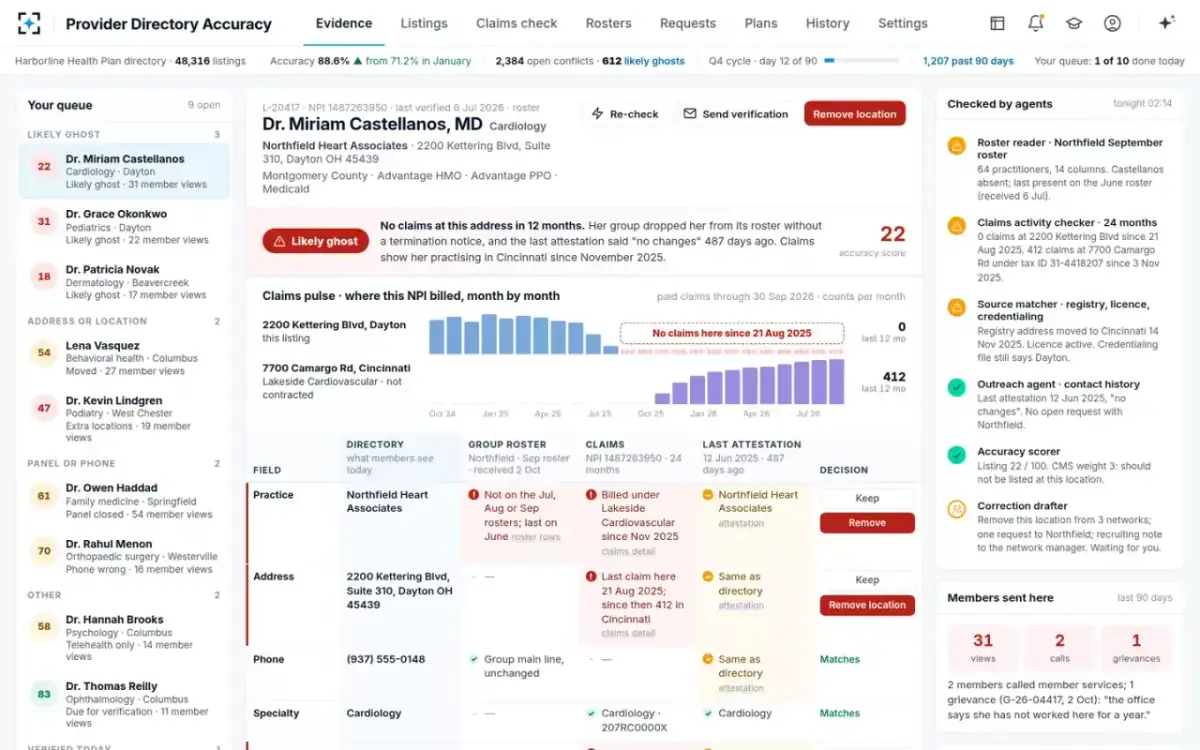
In Provider Directory Accuracy, six agents take the mechanical part of the job: a roster reader, a claims activity checker, a source matcher for the registry, licence boards and credentialing, an outreach agent, an accuracy scorer and a correction drafter. Each listing in conflict arrives on one card with the directory beside the roster, the claims and the last attestation, and a drafted correction with its deadline. None of the agents publishes. The specialist approves each change; a removal that would cut a county's margin over the plan's network standard below 10% goes to the network manager.
One request per group, with the evidence, and a date for every reply
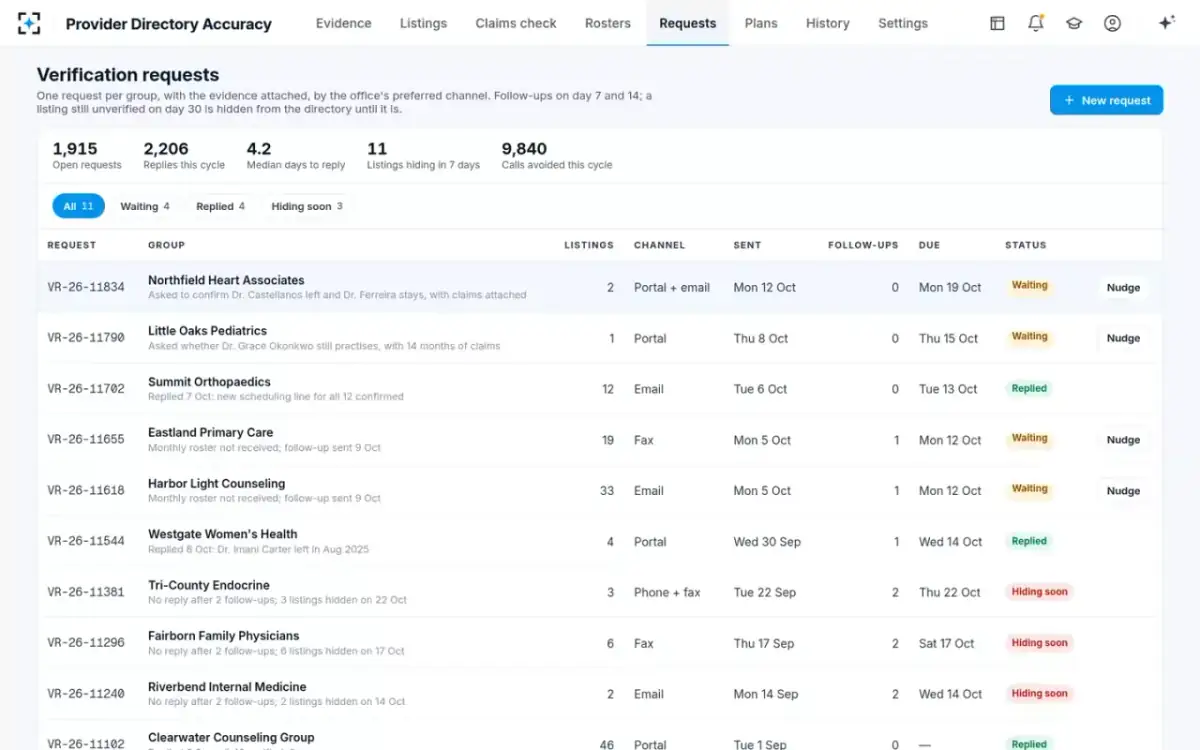
The specialist's week changes shape. Instead of starting from a spreadsheet of overdue attestations, it starts from the conflicts that matter most, sorted by how many members viewed the listing. On the fictional sample plan, corrections were published in a median of 0.8 business days, inside a 2-business-day setting that the plan chose; that is sample data, not a customer's result. What does not change is accountability: every change carries the name of the person who approved it.
The evidence card: one listing, four sources, one decision
What skills does provider data management require?
The role needs a data analyst's habits and a compliance officer's caution. The checklist below is what managers hiring into it, or moving someone into it, should look for.
Eight skills a provider data management specialist needs
- Reading identifiers
NPI, tax ID and taxonomy codes, and why one practitioner can have several addresses and one address many practitioners.
- Querying claims
Counting paid claims by NPI, service address and month, and knowing which providers bill under someone else.
- Normalising rosters
Turning a dozen layouts into one, and spotting the row that is missing rather than changed.
- Knowing the clocks
90 days, 2 business days and 1 business day for commercial plans; 30 days for Medicare Advantage and Medicaid; more from 2028.
- Separating credentialing from directory
A credentialed provider is qualified; a listed provider must also be seeing members at that address.
- Network adequacy awareness
What a removal does to the county count against the plan standard, and when to escalate.
- Writing to offices
One precise question with the evidence, not a request to "please confirm your details".
- Keeping the history
What changed, why, on what evidence, who approved it and when members saw it.
Managers weighing whether to add headcount, buy a service or adopt software can price the three side by side in provider data management companies, in-house or agents, and see the inputs any tool needs in the sources provider data management software must read.
Questions people ask
What is provider data management?
Provider data management is the work of keeping a plan's records about its network providers complete and current across directories, claims systems, credentialing and regulatory filings. The directory is its most visible output. Medicare Advantage plans have also had to submit directory data to CMS for publication online, with updates within 30 days, since 1 January 2026.
What tools do provider data specialists use?
Most work in a provider data system of record, a credentialing system, a claims data warehouse and spreadsheets for rosters, plus the public NPI Registry and state licence look-ups. The gap is usually between them: the specialist is the integration, copying values from one screen to another, and in the model above that copying is most of the hands-on time a conflict takes.
How long should a directory correction take?
For commercial plans, the No Surprises Act requires the update within 2 business days of receiving the provider's information. Medicare Advantage and Medicaid managed care allow 30 days today, and the REAL Health Providers Act sets 5 business days for removing a provider who has left a Medicare Advantage network from contract year 2028.
Is a provider data specialist the same as a credentialing specialist?
No, though small plans often combine them. Credentialing establishes that a provider is qualified to join the network; directory work establishes where, and whether, the provider is seeing members now. CMS's 2018 review warned that leaning on credentialing services and vendors had not proved a reliable way to keep a directory accurate.
What is a provider attestation?
It is a provider's confirmation that the information the plan holds is current, or a correction to it. California requires an affirmative response and starts a removal process after 30 business days of silence. A "no changes" attestation is evidence, but CMS found provider-confirmed information that was wrong when it called the office.