A network status inquiry is a member's request, by phone or online, to know whether a provider or facility has a contract with the member's plan, and for group and individual commercial coverage federal law sets how the plan must answer it: in writing, electronically or on paper as the member asks, no later than one business day after the call, with the communication kept in the member's file for at least two years. The answer also carries liability. If the plan's directory or its answer said a provider was in network when it was not, the plan may charge no more than in-network cost sharing and must count it toward the in-network deductible and out-of-pocket maximum. Benefits Inquiry Automation is Botminds' software for member and broker service: its agents answer coverage, cost, approval and network questions from the plan's own documents and directory, and every network answer shows when the directory entry behind it was last verified.
This guide is for the leaders who own the inquiry line: member services, provider data, compliance and the operations analysts who measure them. Examples use a fictional sample plan, Kestrel Health, as it runs through the solution. The rules come from the U.S. Code, the Code of Federal Regulations and the Departments' guidance, linked where they appear.
The clocks and the exposure behind one network answer
1day
business day to answer a network status call in writing
2yrs
the written answer stays in the member’s file
90days
longest a commercial plan may go between directory verifications
48.7%
of Medicare Advantage directory locations CMS reviewed had at least one inaccuracy
What the law requires when a member makes a network status inquiry
Section 116 of the No Surprises Act requires every group health plan and every issuer of group or individual coverage to run three things: a directory verification process, a public provider database, and a response protocol for network questions. The protocol applies to a member "who requests information through a telephone call or electronic, web-based, or Internet-based means on whether a health care provider or health care facility has a contractual relationship" with the plan (42 U.S.C. 300gg-115(a)(3)).
For a request by phone, the statute is precise. The plan "responds to such individual as soon as practicable and in no case later than 1 business day after such call is received, through a written electronic or print (as requested by such individual) communication", and "retains such communication in such individual's file for at least 2 years following such response." A spoken "yes, Dr. Park is in network" ends the call; it does not meet the protocol.
The Departments' joint guidance reads the protocol as covering both channels: plans must establish "a protocol for responding to requests by telephone and electronic communication ... about a provider's network participation status" (FAQs Part 49). Most plans therefore treat a chat or portal question the same way as a call, which is the safer design, since one written-answer path is easier to audit than two.
What does a plan owe if its answer was wrong?
In-network cost sharing, counted toward the in-network deductible and out-of-pocket maximum. The protection applies when a member is treated by a non-participating provider for a service the plan would otherwise cover, and either the plan's database, directory or response protocol said the provider was participating, or the member asked through the protocol "and was informed through such protocol that the provider was such a participating provider" (300gg-115(b)(2)).
That makes the inquiry line the plan's own warranty desk. Every written answer is a promise the plan has to honour at claim time, and the difference between the in-network and out-of-network share is a cost the plan absorbs, because the statute protects the member, not the plan's contract with the provider. On the fictional sample plan, an open MRI site 2.2 miles from the member is out of network with a $3,000 out-of-network deductible; a wrong answer that sent a member there would leave the plan paying as if it were in network.
The Departments made reliance the enforcement anchor. In their August 2021 guidance they said that, until rules are issued, plans should apply "a good faith, reasonable interpretation of the statute", and that they "will not deem a plan or issuer to be out of compliance with provider directory requirements as long as" it holds reliance claims to in-network cost sharing and counts them toward the deductible and out-of-pocket maximum (FAQs Part 49, Q8). The statute also leaves state directory laws in force, so an insured plan answers to its state regulator as well.
Network status inquiry rules by line of business
The one-business-day written answer is a commercial-market rule; Medicare Advantage and Medicaid managed care set their own directory clocks and notice duties. A plan that runs all three from one service floor needs the clocks as settings by product, not as one script.
Network status duties a plan's inquiry line works under
| Rule | Applies to | What it requires |
|---|---|---|
| Answer a network question in writing | Group and individual coverage | No later than 1 business day after the call; kept in the member’s file at least 2 years |
| Verify the directory | Group and individual coverage | At least every 90 days; a removal procedure for providers the plan cannot verify; database updated within 2 business days of a provider’s change |
| Honour a wrong answer | Group and individual coverage | In-network cost sharing, counted toward the in-network deductible and out-of-pocket maximum |
| Continuity of care after a contract ends | Group and individual coverage | Notice to each continuing care patient; in-network terms for up to 90 days |
| Notice of a terminated provider | Medicare Advantage | Primary care and behavioral health: written notice and one call attempt at least 45 calendar days before; other specialties: written notice at least 30 days before |
| Directory data for Medicare Plan Finder | Medicare Advantage | From plan year 2026: updated within 30 days of a change; attested at least annually |
| Electronic directory updates | Medicaid managed care | No later than 30 calendar days after the plan receives updated provider information |
The full program-by-program comparison, including the Medicare Advantage rules proposed for 2028, sits with the directory teams' guide to provider directory requirements. For the inquiry line the practical point is narrower: the representative must know which product the member is in before reading the directory, because the clock, the notice and the protection differ.
What must a representative verify beyond the directory listing?
Five facts, not one. A directory lookup answers whether a provider's name appears; a network answer the plan can stand behind confirms the plan and network, the location, the date of service, the provider's participation for the service in question, and how recently the entry was verified. The statute defines directory information as "the name, address, specialty, telephone number, and digital contact information" of each provider (300gg-115(a)(6)), and each of those fields fails in its own way.
Five checks that turn a directory lookup into a network answer
| Check | Why the listing alone is not enough | What goes in the written answer |
|---|---|---|
| Plan and network, not the insurer | One issuer sells products on different networks; a provider can be in one and not another | The member’s plan and network by name |
| The location | A provider can participate at one office and not another; CMS’s most common error was a provider not at the listed location | The address the member will visit |
| The date of service | A contract can end before an appointment months away | Status as of the date of service, and any known end date |
| Everyone involved in a procedure | An in-network surgeon can operate at a facility, or with anesthesia and radiology, that is not | Each provider and the facility asked about, one by one |
| When the entry was last verified | An entry verified last week and one verified four months ago look identical | The verification date; an entry past 90 days sent for verification |
Two of the five need a deliberate step. The procedure check needs one because the member usually asks about one surgeon; the facility and the clinicians the surgeon brings are separate contracts. The verification date needs one because a directory screen that does not display it gives the representative no way to see it, so an answer resting on a stale entry looks exactly like one resting on a fresh entry.
How accurate are the directories the answers rest on?
Less accurate than a written warranty assumes. CMS's third round of Medicare Advantage directory reviews found that "48.74% of the provider directory locations listed had at least one inaccuracy", with individual organizations ranging from 4.63% to 93.02%, and inaccuracies most likely to block access to care at 41.75% of locations (CMS, Round 3).
Commercial directories show the same pattern in recent research. A secret-shopper study published in October 2026 placed 5,822 calls to psychiatrists and psychologists listed by the largest commercial carriers in five states; of the 2,252 calls that reached a definitive outcome, "Network directory inaccuracies affected 55.6%", and 23.6% produced an appointment with the listed clinician (Haeder et al., 2026).
In one commercial directory study, contact errors far outnumbered network status errors
For the inquiry line, the split is the finding. In that study the network flag itself was rarely wrong; the address, phone number and specialty were. A member told "in network" who then cannot reach the provider at the listed office, or finds the provider does not offer the service, calls back. That is why the five checks above go beyond the participation flag, and why a plan should measure repeat network calls as closely as it measures the answers themselves.
The written answer: what goes in the member's file
The written answer is evidence for both sides: the member's proof of reliance and the plan's proof of what it said. It should be specific enough that, two years later, a claims examiner or a regulator can tell exactly which provider, location, network and date the plan confirmed, and on what directory entry.
What a network status answer should carry, and keep for two years
- The member, the plan and the network by name
The protection attaches to the plan the member is in, not to the issuer.
- Each provider and facility asked about, with the location
One line per provider; a procedure usually means several.
- The status as of the date of service
With any known contract end date, and the continuity-of-care right where it applies.
- The date the directory entry was last verified
An entry past 90 days is flagged and sent for verification the same day.
- The channel the member asked for, and the time sent
Written electronic or print, within one business day of the call.
- A pointer to the directory entry as it stood
So a reliance claim can be matched to what the plan actually said.
- Retention of at least two years in the member’s file
The statutory minimum; many plans keep it with the call summary.
Saving the answer is also how the plan connects the inquiry line to claims. When a claim from a non-participating provider arrives, a claims examiner who can find the plan's earlier written answer can apply in-network cost sharing without a grievance, and the member does not have to prove what a representative said on the phone.
How Benefits Inquiry Automation answers a network status inquiry
Benefits Inquiry Automation answers the network question inside the same answer as coverage, cost and prior approval, because members rarely ask only one. Its approval and network checker reads the directory entry for the member's plan, the site and the date of service, returns the status with the date the entry was last verified, and flags any entry older than 90 days. The representative sees one answer, saves it to the member's file with its citations, and, where consent to texts is on file, sends it in writing while the member is still on the line.
One network status inquiry in Benefits Inquiry Automation, from question to written answer
Agent
Question readerTurns the member’s words into the service, the provider, the site and the date of service, for the member’s plan year.
Agent
Approval and network checkerReads the directory entry for the plan, site and date; returns the status and the date last verified; flags entries older than 90 days; checks whether the service needs prior approval.
Never: Says a service is approved
A person decides
Member service representativeConfirms the answer with the member, adds any other provider or facility involved, and sends it in the written form the member asks for.
Agent
Request to verifySends a stale entry to the provider data team for verification the same day.
A person decides
Service team leadReviews flagged answers, notes the member’s protection where an entry proves wrong, and coaches.
A network answer with its evidence: the site, the status and the date verified
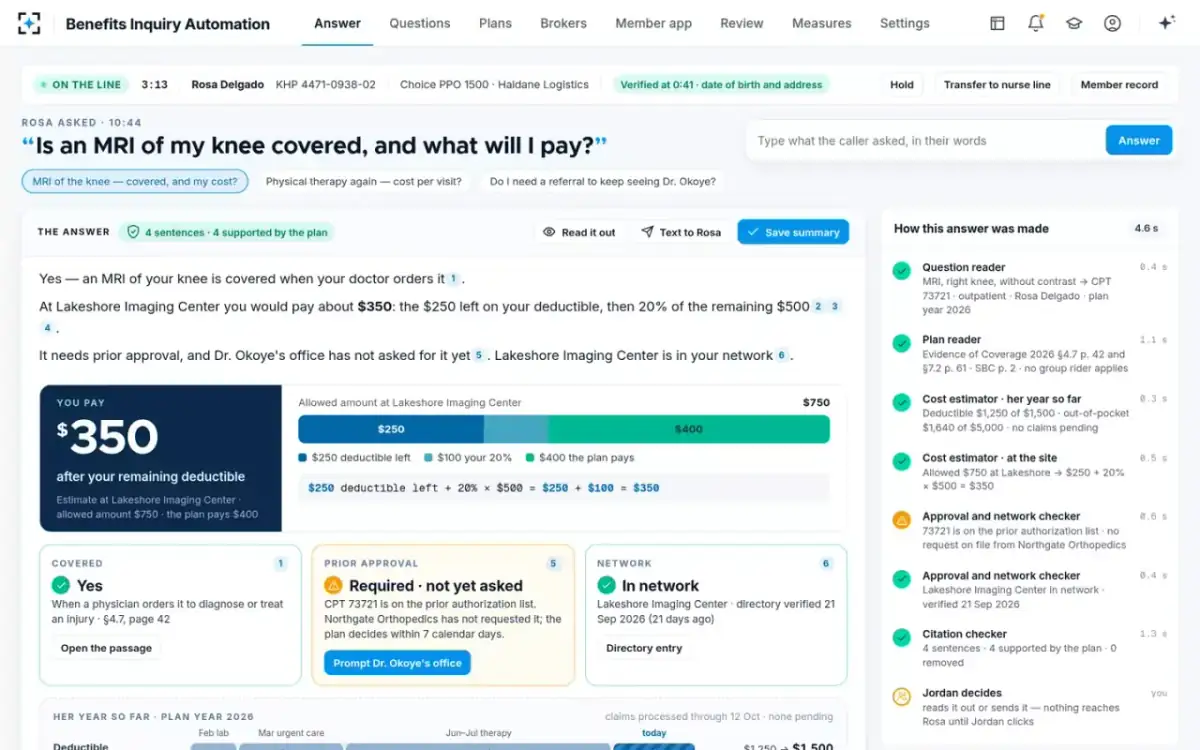
The solution does not edit the directory. It reads it, dates it and routes stale entries to the team that owns provider data; correcting the entry stays with that team. How the same answer handles coverage and cost is shown in a day in the health insurance call center.
Measuring the network inquiry line
A plan cannot manage reliance cost it does not count. Four measures tell a member services leader whether network answers are getting safer: the share answered in writing within one business day, the share resting on an entry verified within 90 days, the reliance claims paid at in-network cost and what they cost, and the repeat calls about the same provider within a week. The last connects directly to first call resolution, because a network answer that sends a member to a wrong address comes back as a second call.
Network questions were one in eight on a sample plan's 30 days
A stale entry caught the same morning, with the member's protection noted
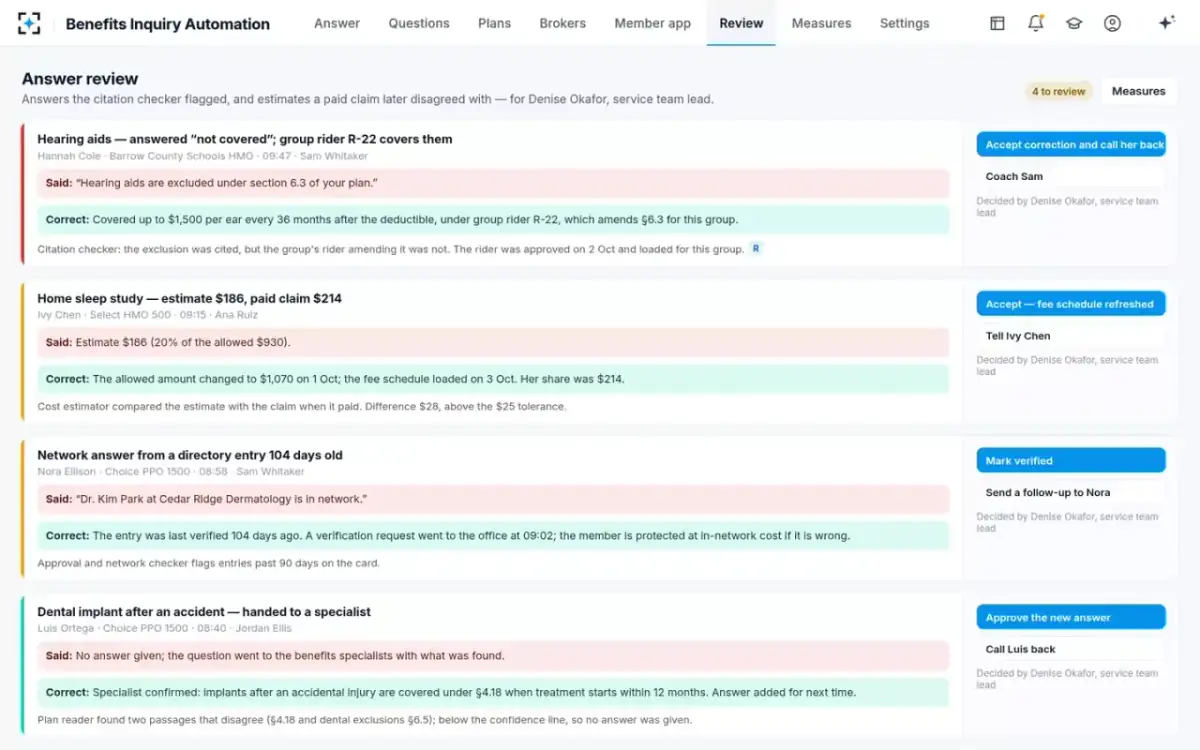
When a provider leaves the network mid-year
A network status inquiry about a provider whose contract is ending is also a continuity-of-care moment. For commercial coverage, the plan must notify each continuing care patient "on a timely basis of such termination and such individual's right to elect continued transitional care", and allow care to continue "under the same terms and conditions" for up to 90 days or until the patient is no longer a continuing care patient (42 U.S.C. 300gg-113).
Medicare Advantage sets its own notice: for a primary care or behavioral health provider, written notice and one attempt by phone at least 45 calendar days before the termination, to enrollees assigned to that provider or seen within the past three years (42 CFR 422.111(e)). A representative who sees a known end date on the directory entry should give it in the answer and ask whether the member is in active treatment, because the right answer then is not just "in network until 31 December".
Questions people ask
How fast must a health plan answer a network status inquiry?
For group and individual commercial coverage, no later than one business day after a phone request, in writing, electronically or on paper as the member asks, under 42 U.S.C. 300gg-115(a)(3). The Departments' guidance applies the protocol to electronic requests too.
How long must a plan keep the network status answer?
At least two years in the member's file, by statute. Plans commonly keep it with the call summary, so a claims examiner can find it when a reliance claim arrives.
What happens if the plan's directory said a provider was in network and it was not?
The plan may charge no more than in-network cost sharing for a service it would otherwise cover, and must apply the in-network deductible and out-of-pocket maximum. In their August 2021 FAQs the Departments made honouring that protection the condition for treating a plan as compliant pending rules.
Does the one-business-day rule apply to Medicare Advantage?
No. It is a commercial-market rule for group and individual coverage. Medicare Advantage plans work under 42 CFR 422.111, including termination notices of 45 or 30 days and, from plan year 2026, directory data updated within 30 days of a change.
How often must a commercial plan verify its directory?
At least once every 90 days, with a procedure to remove providers it cannot verify and updates within two business days of receiving a provider's change. An answer resting on an entry older than 90 days is the one most worth flagging.
Can an answer be accurate on network status and still fail the member?
Yes. In a 2026 study of commercial mental health directories, network status errors were 1.6% of evaluable calls but contact information errors were 31.0%, so a correct "in network" can still send a member to a wrong number or office.