The difference between an evidence of coverage and a summary of benefits is the difference between a contract and its summary. The evidence of coverage, called a certificate of coverage or policy by some plans, sets out every covered service, condition, limit, exclusion and procedure, and it governs. The summary of benefits and coverage is a document of no more than four double-sided pages, in a federal template, that lets a member compare plans and see typical costs, and it must say that the plan document governs. For people with Medicare Advantage the pair is the evidence of coverage and the plan's summary of benefits. Botminds' Benefits Inquiry Automation answers members' coverage questions from both, cited by section and page, so knowing which document answers what is the first thing a representative and the solution have to get right.
The rules here are quoted from the Code of Federal Regulations; the plan examples come from a fictional sample health plan, Kestrel Health, as it runs through the solution.
Evidence of coverage and summary of benefits and coverage, row by row
Evidence of coverage: The contract: the full terms of the coverage for the member’s group and plan year
Summary of benefits and coverage: A uniform summary for comparing plans; it states that it is only a summary
Evidence of coverage: The plan’s own document; the sample plan’s runs to 118 pages
Summary of benefits and coverage: A federal template, no more than four double-sided pages, print no smaller than 12-point
Evidence of coverage: Covered services, conditions, limits, exclusions, prior authorization rules and how to appeal
Summary of benefits and coverage: Cost sharing by category of benefit, with the main exceptions and limitations
Evidence of coverage: Rarely
Summary of benefits and coverage: Required coverage examples, such as having a baby or managing a chronic condition
Evidence of coverage: Amended by riders and change notices, which must be read with it
Summary of benefits and coverage: Updated, or a notice sent at least 60 days ahead, when a mid-year change affects its content
Evidence of coverage: “Is this specific service covered, and on what conditions?”
Summary of benefits and coverage: “What do I pay for a specialist visit compared with another plan?”
What is the difference between evidence of coverage and summary of benefits?
The evidence of coverage answers "what exactly does my plan cover, and on what terms"; the summary answers "roughly what will this plan cost me, and how does it compare". Federal law shapes the summary tightly and leaves the evidence of coverage largely to the plan, its regulator and, for Medicare Advantage, CMS's disclosure rules.
The summary's content list makes its purpose plain. It must contain uniform definitions of standard terms, a description of coverage and cost sharing "for each category of benefits", the exceptions, reductions and limitations, the deductible, coinsurance and copayment provisions, renewability, coverage examples, a statement about minimum essential coverage, contact information, and addresses for the network list, the formulary, the uniform glossary and, for issuers, the actual policy or certificate (45 CFR 147.200(a)(2)). It points to the contract; it does not replace it.
What is an evidence of coverage?
An evidence of coverage is the plan document that describes the member's coverage in full: who is covered, what services are covered and under what conditions, cost sharing, limits, exclusions, prior authorization and review rules, how to get emergency care, and how to file grievances and appeals. In commercial insurance it is the certificate a member of an insured group receives, or the individual policy. In a self-funded employer plan the equivalent is the plan document and its summary plan description.
Medicare Advantage defines the content by regulation. A plan must give each enrollee, at enrollment and at least annually "by the first day of the annual coordinated election period", a description that includes the service area, the benefits with "applicable conditions and limitations, premiums and cost-sharing", access to providers, out-of-area and emergency coverage, supplemental benefits, "prior authorization rules and other review requirements", all grievance and appeal rights, and disenrollment rights (42 CFR 422.111). It must also post the evidence of coverage on its website.
What is a summary of benefits and coverage?
The summary of benefits and coverage, often shortened to SBC, is the Affordable Care Act's standard comparison document for group and individual health coverage. It must use a uniform format and "terminology understandable by the average plan enrollee", run to no more than four double-sided pages and use no print smaller than 12-point. Its coverage examples simulate how the plan would process claims for a sample treatment plan, so a member sees an estimate of what she might pay for a common scenario.
Medicare Advantage plans issue their own summary of benefits rather than the commercial SBC; the regulation refers to hard copies of "the Summary of Benefits" when CMS determines that is in the beneficiary's interest. Both serve the same role: comparison, not contract.
Which document is legally binding?
The plan document is: the policy, certificate or evidence of coverage, and for a self-funded employer plan the plan document itself. The SBC is required to say so in its own text, which settles any dispute between the two in favor of the contract.
A statement that the SBC is only a summary and that the plan document, policy, certificate, or contract of insurance should be consulted to determine the governing contractual provisions of the coverage.
45 CFR 147.200(a)(2)(i)(H), required content of every SBC
That does not make the summary unimportant. It is a federal disclosure with its own penalty: an issuer or non-federal governmental plan that willfully fails to provide it faces a fine of not more than $1,000, adjusted annually, for each failure, and each covered individual counts as a separate failure. It is simply the wrong document to settle whether a particular service, on a particular date, is covered.
When do members receive the evidence of coverage?
Medicare Advantage members receive it at enrollment and then each year by the first day of the annual coordinated election period, and plans must post it online. Commercial members receive the SBC on a federal schedule and the certificate or plan document under state law and the plan's terms; employer plan participants receive a summary plan description under ERISA.
When members must receive each document
| Document | Coverage | Deadline |
|---|---|---|
| Summary of benefits and coverage | Group and individual | With written application materials; again by the first day of coverage if anything changed; at automatic renewal no later than 30 days before the new plan year |
| Summary of benefits and coverage, on request | Group and individual | As soon as practicable, no later than 7 business days after the request |
| Notice of a mid-year change | Group and individual | At least 60 days before a material modification that affects the SBC takes effect, unless it comes with a renewal |
| Evidence of coverage | Medicare Advantage | At enrollment, and at least annually by the first day of the annual coordinated election period |
| Notice of plan changes | Medicare Advantage | For 1 January changes, at least 15 days before the annual coordinated election period begins; other changes at least 30 days before they take effect |
| Summary of a material reduction in benefits | ERISA group health plans | No later than 60 days after the change is adopted; other plan changes within 210 days after the end of the plan year |
The summary plan description, the rider and the change notice
Three more documents change what the evidence of coverage means, and a representative who reads it alone will sometimes be wrong. For employer plans, the summary plan description must describe cost sharing, annual or lifetime limits, preventive coverage, network rules and whether out-of-network services are covered, emergency care conditions, and "any provisions requiring preauthorizations or utilization review as a condition to obtaining a benefit or service under the plan" (29 CFR 2520.102-3(j)(3)). Searches for "evidence of coverage vs summary plan description" are usually asking which of these governs for an employer plan; the answer is the plan document, of which the SPD is the participant's summary.
A rider amends the evidence of coverage for one group. In the sample plan, the general document excludes hearing aids in section 6.3, while rider R-22, for one employer only, covers them up to $1,500 per ear every 36 months. A representative who cites section 6.3 to a member of that employer has quoted the contract correctly and still given the wrong answer.
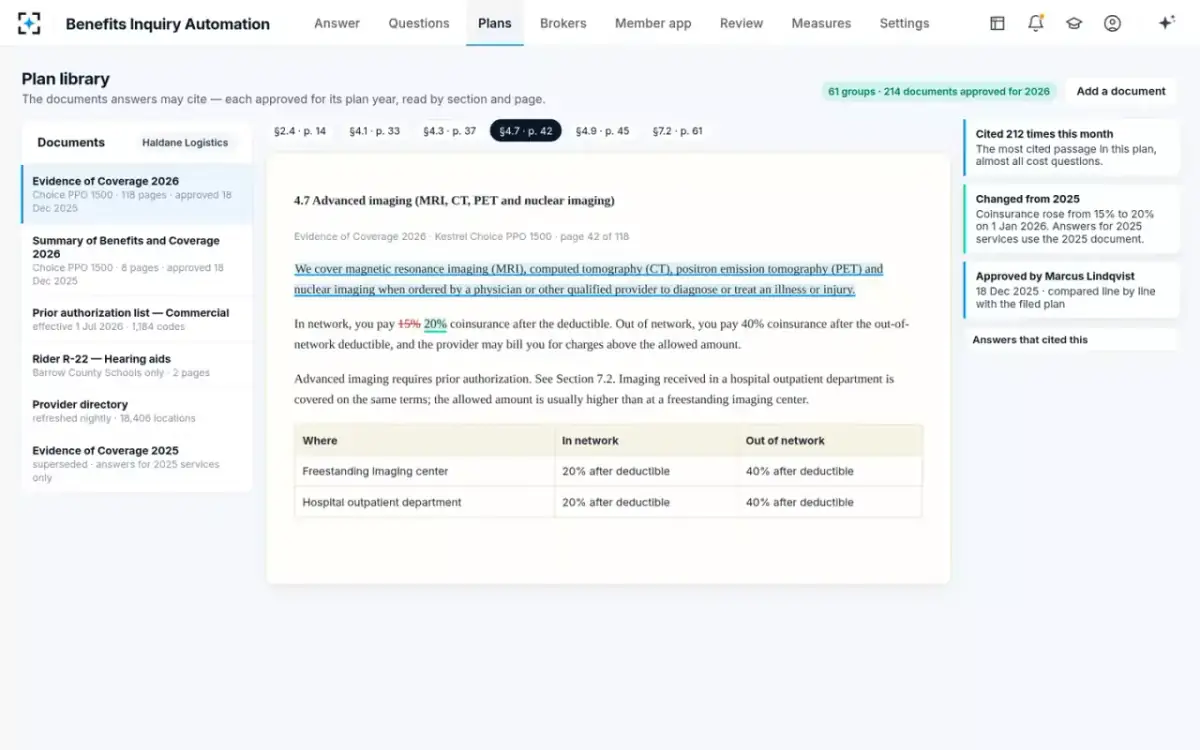
A change notice amends it in time. The sample plan's in-network coinsurance for advanced imaging rose from 15% to 20% on 1 January 2026, so a scan in December 2025 and one in January 2026 are answered from different editions. Which edition applies is decided by the date of service, not the date of the call.
What is the uniform glossary?
The uniform glossary is a federal list of standard definitions that every group and individual plan must make available, on paper or electronically as requested, within seven business days of a request. It covers terms such as allowed amount, balance billing, coinsurance, copayment, deductible, excluded services, grievance, in-network and out-of-network coinsurance, medically necessary, network, out-of-pocket limit, preauthorization, premium and urgent care (45 CFR 147.200(c)). Every SBC must give the internet address for it and a phone number for a paper copy.
The glossary matters because members struggle with exactly these words. In KFF's 2023 survey, a quarter of insured adults said they have difficulty understanding terms such as "deductible", "coinsurance", "prior authorization" or "allowed amount".
What insured adults find hard to understand about their coverage
Which document a representative should cite
Cite the document that governs the question, for the member's group and the plan year of the date of service, and say which one it is. The SBC is excellent for comparison and for a member choosing a plan; the evidence of coverage, as amended by any rider, settles coverage.
The question, and the document that answers it
| Member’s question | Cite | Why not the other |
|---|---|---|
| Is this specific service covered? | Evidence of coverage, with any rider for her group | The SBC summarizes categories and the main exceptions only |
| What is my copay for a specialist? | Either; the SBC is quicker to read out, the evidence of coverage is the authority | They should agree; if not, the evidence of coverage governs |
| Which of my employer’s plans is cheaper for a baby? | The SBCs’ coverage examples, side by side | The evidence of coverage has no standard example to compare |
| Does it need prior approval? | Evidence of coverage, and the current prior authorization list | The SBC may only flag that preauthorization applies |
| What will I pay at this site, this month? | Evidence of coverage for the cost-sharing rule, plus her accumulators and the allowed amount | Neither document knows her year so far or the site’s price |
The last row is the one most members actually ask. Turning a cost-sharing rule into a dollar figure takes the member's running totals, which accumulators in health insurance explains, and the order in which deductible, coinsurance and out-of-pocket maximum apply.
How Benefits Inquiry Automation keeps the right edition
Benefits Inquiry Automation answers only from documents a benefits configuration analyst has approved, for the plan year of the date of service. Each plan year's evidence of coverage, SBC, riders and prior authorization list is loaded, compared line by line with the filed plan, and approved before any answer may cite it; a superseded document answers only for its own year's services.
The plan library: each document approved for its plan year, with what changed
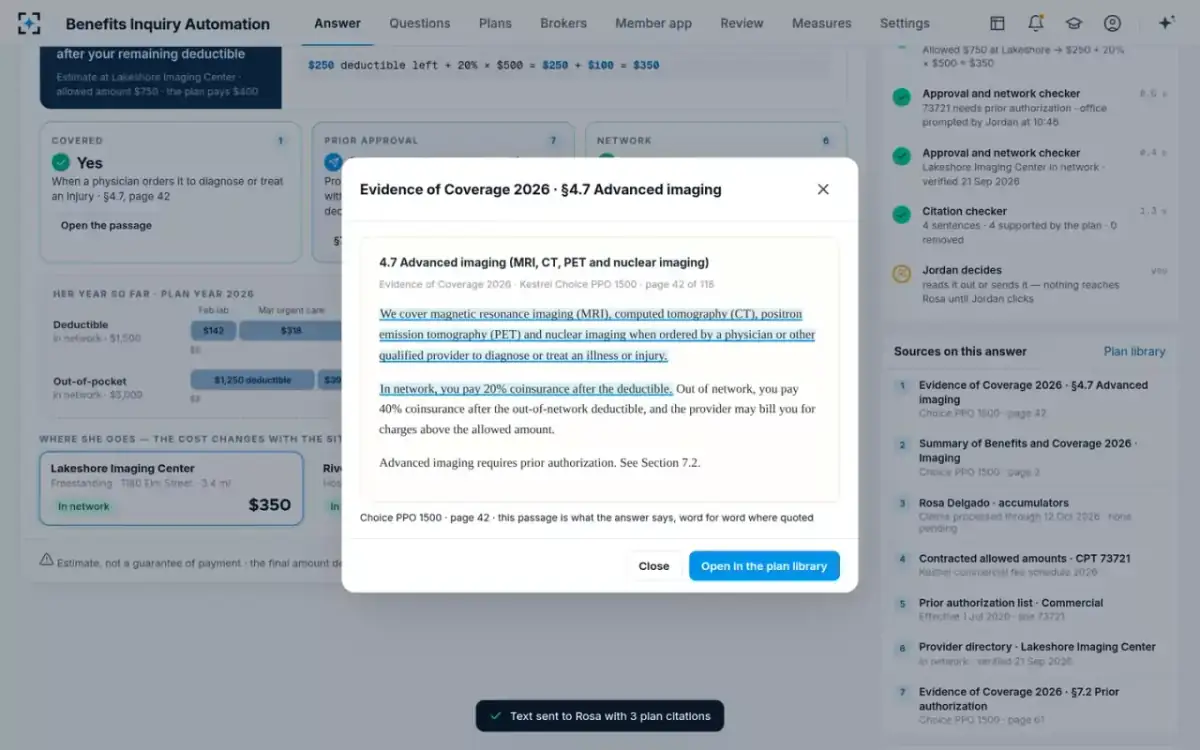
When a representative opens a citation, the passage appears with the cited sentences highlighted and its section and page, so she can read the contract's own words to the member. The citation checker reads each sentence of an answer against its passage before the representative sees it, and flags a group rider that should have been cited, which is how the sample plan's hearing-aid answer was caught.
Every sentence opens the passage behind it
Questions people ask
Where can I find my plan's evidence of coverage?
Medicare Advantage plans must post the evidence of coverage on their website and send it at enrollment and each year. For commercial coverage, the SBC must give an internet address where an issuer's actual policy or group certificate can be reviewed and obtained; employer plan participants can ask the plan administrator for the plan document and summary plan description.
Is the summary of benefits the same as the explanation of benefits?
No. The summary of benefits describes the plan before care; an explanation of benefits describes a claim after it, showing what was billed, what the plan allowed and paid, and what the member owes. Medicare Advantage EOBs must also show year-to-date totals, including the amount the enrollee has incurred toward the deductible and the out-of-pocket maximum.
What happens if the SBC and the evidence of coverage disagree?
The plan document governs, because the SBC must state that it is only a summary and that the policy, certificate or contract determines the governing provisions. A disagreement is still worth reporting to the plan, since a mid-year change that affects the SBC's content requires notice at least 60 days before it takes effect.
How long is a summary of benefits and coverage?
No more than four double-sided pages, with print no smaller than 12-point, in the uniform format the Departments specify. It must include coverage examples, and the Secretary may require up to six of them.
Does a Medicare Advantage plan send an annual notice of changes?
Plans must notify all enrollees of changes that take effect on 1 January at least 15 days before the annual coordinated election period begins, and of other changes at least 30 days before they take effect. The evidence of coverage itself must reach enrollees by the first day of the annual coordinated election period.