Coordination of benefits rules decide the order in which two or more health plans pay for the same care, and how much the second plan pays after the first. For most commercial coverage they come from state regulations built on the National Association of Insurance Commissioners' model, and for people with Medicare from federal Medicare secondary payer law. They matter on the service line because a cost answer can quote the member's plan perfectly and still be wrong: if another plan pays first, what she owes depends on both. Botminds' Benefits Inquiry Automation answers from the member's own approved plan documents and eligibility data, so this guide sets out what that data has to say about other coverage before any cost is quoted.
The worked examples use fictional members and plans; the rules are quoted from the NAIC model regulation, the Code of Federal Regulations and the U.S. Code, linked where they appear.
Which insurance is primary: the order the NAIC model applies, first rule that fits wins
| Situation | Pays first | Pays second |
|---|---|---|
| A plan with no coordination provision, or one that conflicts with the model | That plan, in most cases | The plan that complies |
| Covered as an employee or subscriber on one plan and as a dependant on another | The plan covering her as the employee or subscriber | The plan covering her as a dependant |
| A child of married or cohabiting parents, both covering the child | The plan of the parent whose birthday comes earlier in the calendar year | The other parent’s plan |
| A child of separated parents, with no court decree on health costs | Custodial parent’s plan, then that parent’s spouse’s | Non-custodial parent’s plan, then that parent’s spouse’s |
| Covered as an active employee on one plan and as a retiree or laid-off employee on another | The active-employee plan | The retiree plan |
| Covered by COBRA or state continuation and by another plan as employee or dependant | The other plan | The continuation coverage |
| None of the above decides it | The plan that has covered the person longer | The newer plan |
What are coordination of benefits rules?
Coordination of benefits rules are two sets of instructions: an order of benefit determination that names the primary and secondary plan, and a method by which the secondary plan works out what it pays. The NAIC model states their purpose plainly: to "establish a uniform order of benefit determination under which plans pay claims", to reduce duplicate payment by letting the plans that do not pay first reduce their benefits, and to process claims more efficiently.
The primary plan is told to ignore the other coverage entirely: it "shall pay or provide its benefits as if the secondary plan or plans did not exist" (NAIC model, Section 6.A). Only the secondary plan coordinates. That asymmetry is useful on the phone: if the member's plan is primary, the cost answer is the ordinary one; if it is secondary, the answer needs the other plan's payment first.
Who writes the rules depends on the coverage. Insured group and individual plans follow the coordination rules of the state that regulates them, and the NAIC model is the uniform template the state regulators' association wrote for those rules. Medicare follows federal law that overrides plan language. Medicaid pays after other coverage under its own federal rules. A self-funded employer plan writes its coordination terms into its plan document, which is one more reason a service team should cite the member's own document, not a general rule.
Which insurance is primary when you have two plans?
The plan that covers you as the employee, member or subscriber pays before a plan that covers you as someone's dependant. That first rule settles most two-plan households: a married couple who each carry family coverage through their own employers are each primary on their own plan and secondary on the spouse's.
The model then works down a ladder, and the first rule that fits decides. Active employment beats retiree or laid-off coverage. Coverage as an employee or dependant beats COBRA or state continuation coverage of the same person. If nothing else applies, the plan that has covered the person longer pays first, counting two successive plans as one if the person was eligible under the second within 24 hours of the first ending. If even that fails, the plans split the allowable expenses equally.
One provision changes an answer more often than people expect. A plan whose own coordination provision does not follow the model is generally treated as primary, unless both plans' provisions say the complying plan is primary. The model's drafting note gives the common example: automobile "med pay" coverage normally has no coordination provision, so unless state law says otherwise it is primary.
What is the birthday rule?
The birthday rule decides which parent's plan pays first for a child covered by both: the plan of the parent whose birthday falls earlier in the calendar year is primary. Only month and day count, never the year, so a parent born on 12 March is primary over one born on 30 August whatever their ages. If both parents share a birthday, the plan that has covered a parent longer is primary.
The rule applies when the parents are married or living together, "whether or not they have ever been married". For separated or divorced parents a court decree that makes one parent responsible for the child's health care expenses or coverage governs, once that parent's plan knows of it; without a decree the order runs custodial parent, custodial parent's spouse, non-custodial parent, then non-custodial parent's spouse. Since the Affordable Care Act extended dependant coverage to age 26, the model also covers an adult child who has coverage through both parents and a spouse.
How does Medicare coordinate with employer coverage?
Federal law, not the plans, decides the order when one of the payers is Medicare, and the deciding question is usually the size of the employer and whether the coverage comes from current employment. Medicare is secondary to an employer group health plan for a beneficiary aged 65 or older who is covered "by virtue of the individual's current employment status" with an employer of at least 20 employees, or as the spouse of such an employee (42 CFR 411.172).
When Medicare pays second to employer coverage
| Beneficiary | Employer coverage pays first when | Rule |
|---|---|---|
| Aged 65 or older, entitled on the basis of age | Covered through her own or her spouse’s current employment, by an employer with at least 20 employees | 42 CFR 411.172; 411.170 |
| Under 65, entitled on the basis of disability | Covered through her own or a family member’s current employment under a large group health plan: an employer that normally employed at least 100 employees | 42 U.S.C. 1395y(b)(1)(B); 26 U.S.C. 5000(b)(2) |
| Entitled on the basis of end-stage renal disease | During a coordination period of 30 months, for items and services from 5 August 1997 | 42 U.S.C. 1395y(b)(1)(C), as amended by Pub. L. 105-33 |
| Injury covered by workers’ compensation, liability or no-fault insurance | Medicare does not pay to the extent that coverage has paid or can reasonably be expected to pay | 42 CFR 411.20 |
Medicare enforces its order afterwards. When CMS learns that Medicare paid first by mistake, it acts to recover the payment, and where an employer group health plan should have been primary, CMS's Commercial Repayment Center "will seek recovery from the Employer and GHP" (CMS, Coordination of Benefits & Recovery). For a plan, the expensive version of a coordination error is not the member's confusion; it is a recovery demand months later.
Is Medicaid primary or secondary?
Medicaid pays after other coverage. When a state Medicaid agency knows at the time a claim is filed that a third party is probably liable, it generally "must reject the claim and return it to the provider for a determination of the amount of liability", then pays only to the extent its own payment schedule exceeds the third party's payment (42 CFR 433.139). Preventive pediatric services and some child-support cases are paid first and recovered later.
For a commercial plan's representative, the practical consequence is that a member with both employer coverage and Medicaid is usually calling the primary plan, and her cost answer is the ordinary one. The Medicaid side matters when the member then asks what she will owe after Medicaid, which is a question for the state program, not for the commercial plan's documents.
How the secondary plan works out what it pays
Under the NAIC model, the secondary plan first calculates what it would have paid had it been the only plan, then applies that amount to any allowable expense the primary plan left unpaid, never paying more in total than 100% of the allowable expense. It also credits its own deductible with whatever it would have credited without the other coverage. That last clause is the one members notice later in the year.
Take a fictional household. Theo Banerjee is covered as an employee on his own plan and as a dependant on his wife Mira's. For a $1,000 outpatient procedure that both plans allow at $1,000, Theo's own plan is primary: his deductible is already met, so it pays 80%, $800, and leaves $200. Mira's plan is secondary, and its $500 deductible has not been met for Theo.
One $1,000 claim, the secondary plan's arithmetic
If Mira's plan were Theo's only plan: $1,000
As Theo's secondary plan: $1,000, of which the primary plan paid $800
If Mira's plan were Theo's only plan: Theo pays the first $500
As Theo's secondary plan: $500 credited to Mira’s plan’s deductible for Theo, as if it had applied
If Mira's plan were Theo's only plan: 80% of the remaining $500 = $400
As Theo's secondary plan: The same $400 is the most it will pay
If Mira's plan were Theo's only plan: $400
As Theo's secondary plan: $200, the unpaid balance, because $400 exceeds it
If Mira's plan were Theo's only plan: $600
As Theo's secondary plan: $0
Two quirks catch representatives. First, the secondary plan's deductible fills even when it pays little, so Theo's next claim under Mira's plan may face no deductible at all. Second, when every plan covering a person is a high-deductible health plan and the person intends to contribute to a health savings account, the model removes the primary plan's deductible from the allowable expense, so the secondary plan cannot fill it. A cost answer that does not know a member is secondary gets both wrong.
What happens if coordination of benefits is wrong?
Someone pays and someone recovers. If two plans each claim to be secondary, the model gives them 30 calendar days after receiving all the information needed to pay the claim; if they still cannot agree, they "shall immediately pay the claim in equal shares" and settle their relative liability afterwards. If a plan that does not follow the model fails to send information within a reasonable time, the complying plan assumes the other plan's benefits match its own and pays accordingly, adjusting if it learns the real benefits within two years.
For the member the error usually surfaces as a bill. A cost quoted as if her plan were primary, when it is secondary, can be too high or too low, and a claim denied while the plans sort out order can look like a coverage denial. That is why the model makes plans tell members, on every explanation of benefits, to file with every plan:
If you are covered by more than one health benefit plan, you should file all your claims with each plan.
NAIC Coordination of Benefits Model Regulation, Section 8
The checks before a representative quotes a cost
A coordination error is a data problem before it is a judgment problem: the representative's screen has to know the member has other coverage, and in what capacity. These checks catch it before anyone speaks.
Six coordination checks before quoting a member's cost
- Is other coverage on file, and when was it last confirmed?
Eligibility data should carry other coverage and its source. Old information is a reason to ask the member, not to assume none.
- In what capacity is she covered on each plan?
Employee, dependant, retiree or continuation coverage decides the order before anything else.
- For a child, whose birthday comes first, and is there a decree?
Month and day only. A court decree assigning health costs overrides the birthday rule once the plan knows of it.
- Is Medicare involved, and on what basis?
Age, disability or end-stage renal disease, and the employer’s size, decide Medicare’s order under federal law.
- If this plan is secondary, what did the primary plan pay?
Without the primary payment the honest answer is the method, not a number.
- Does the plan document say anything different?
A self-funded plan’s own coordination terms govern; cite them rather than the model.
Where Benefits Inquiry Automation fits when a member has two plans
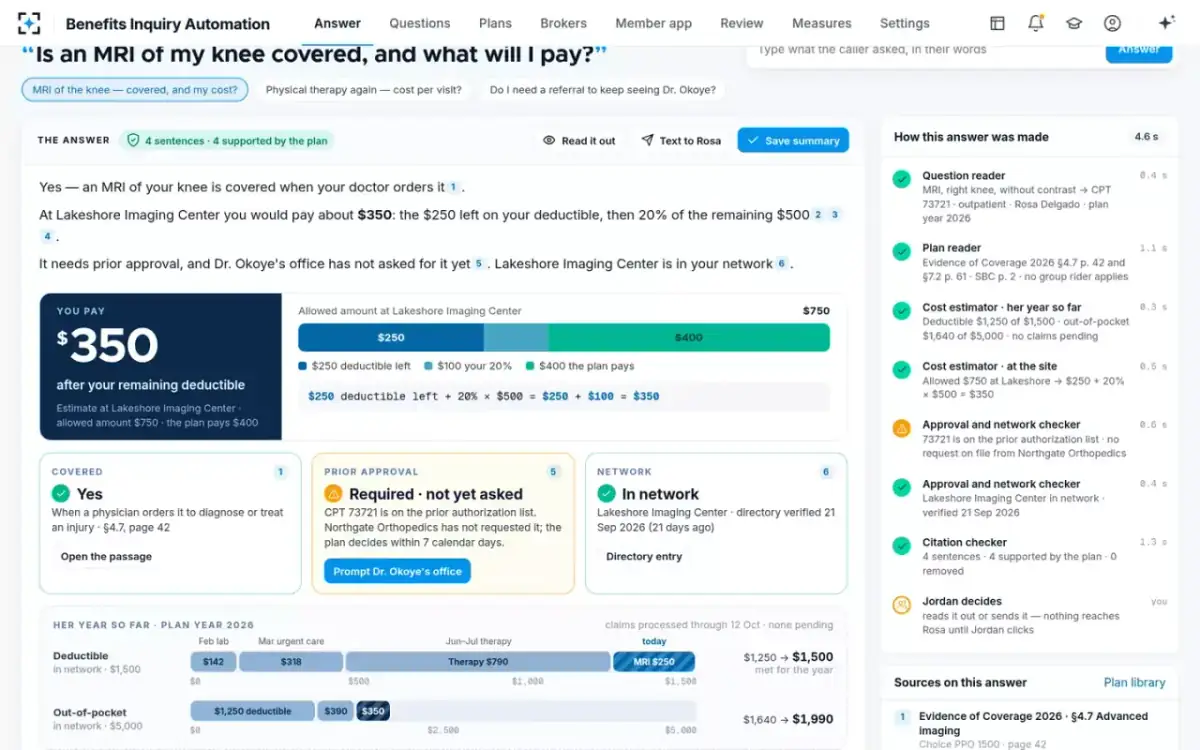
Benefits Inquiry Automation answers from the member's own plan documents, approved for her group and plan year, and from the eligibility and accumulator data the plan already holds. Its cost estimator works out her share from her deductible and out-of-pocket totals and the allowed amount at the site she chooses, shows the arithmetic and labels the result an estimate. When the plan's own passages disagree, or the answer falls below the confidence line, it hands the question to a person with what it found rather than guessing.
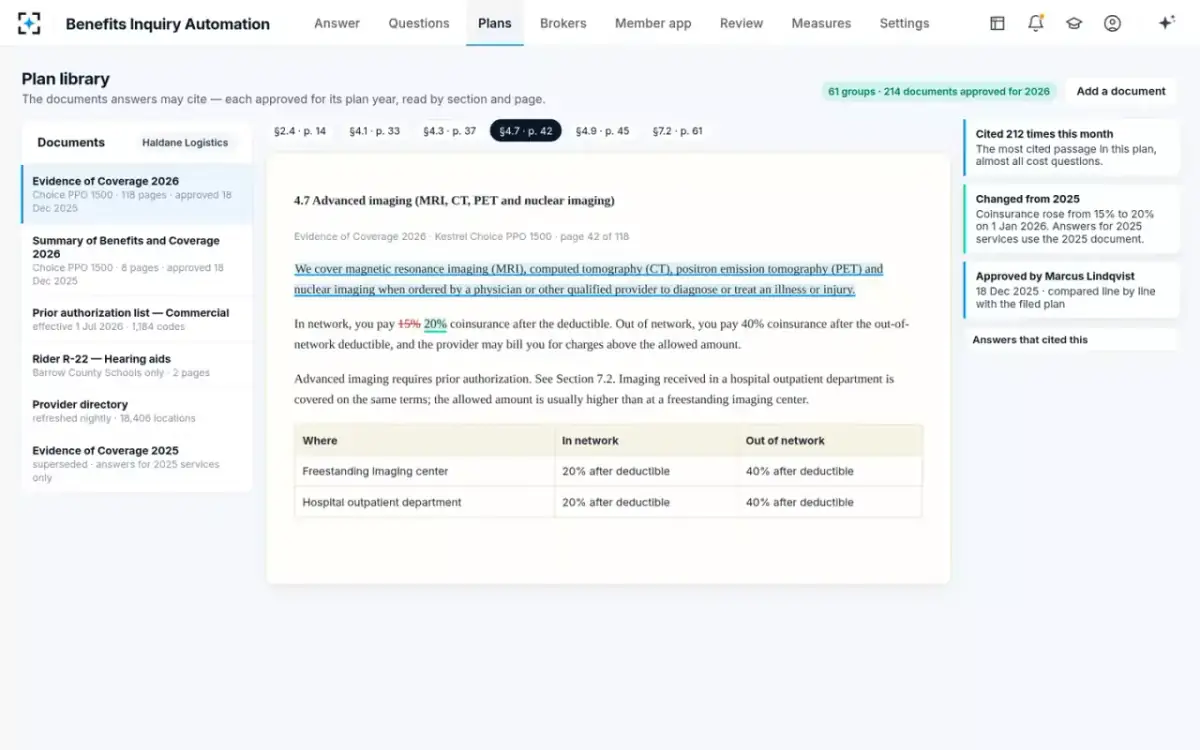
That design is what coordination needs: the coordination terms are passages in the plan document like any other, so they can be cited, and other coverage is a field in the eligibility data the estimator reads. A plan deploying it should make sure that field is current and that its coordination terms are among the approved passages, because the solution, like a representative, cannot coordinate with coverage it has not been told about. How the document library is kept, edition by edition, is shown in evidence of coverage vs summary of benefits, and how the deductible credit moves through a year is in accumulators in health insurance.
The plan library: only approved passages, by group and plan year, can be cited
A cost answer only after the member's year and the site are known
Questions people ask
Who decides which plan pays first?
The rules do, not the member or the plans' preference. For insured commercial plans, the state's coordination of benefits regulation sets the order, and the NAIC model is its template; for Medicare, federal secondary payer law does; for Medicaid, federal third-party liability rules make it pay after other coverage. A self-funded employer plan follows its own plan document.
How do you update coordination of benefits information?
Tell each plan about the other coverage, in whatever way it asks, and file claims with each plan, as the NAIC model's explanation-of-benefits notice advises. For people with Medicare, CMS's Benefits Coordination & Recovery Center collects and manages information about other insurance that should pay before Medicare.
Does the birthday rule use the parents' age?
No. The NAIC model defines "birthday" as month and day in a calendar year, not including the year. A parent born on 2 February is primary over one born on 9 June regardless of who is older; if both share a birthday, the plan that has covered a parent longer pays first.
Is my spouse's plan primary for me?
Usually not. Your own plan, which covers you as the employee or subscriber, pays first, and your spouse's plan, which covers you as a dependant, pays second. The main exception involves Medicare, where federal secondary payer rules can reverse the order for a retiree who is also a dependant on an active employee's plan.
Can a secondary plan pay nothing at all?
Yes. Under the model's method the secondary plan pays the lesser of what it would have paid alone and the allowable expense the primary plan left unpaid. If the primary plan paid the allowable expense in full, or the secondary plan's own deductible would have absorbed the remainder, the secondary payment can be zero, though the secondary plan still credits its deductible.