A first call resolution rate is the percentage of members whose question is fully answered on their first contact, with no further contact about the same question within a set window. In a health plan the definition needs two additions to be honest: the window has to cover every channel the member might use next, and "resolved" has to mean the answer was right, which for a cost question means it matched what the claim later paid. Measured that way, first call resolution is the number that connects member service to grievances, appeals and complaint volumes. Botminds' Benefits Inquiry Automation reports it as callbacks on the same question within 7 days and checks every cost estimate against the paid claim, and its sample figures carry the worked example below.
The sample figures come from the solution's preview for a fictional 400,000-member plan; they are not a customer's measured result. The research figures come from KFF and the Federal Register, linked where they appear.
When an insurance problem does get resolved, how long it takes
What is first call resolution?
First call resolution means the member's need was met on the first contact, so she did not have to call, message or visit again about the same thing. It is a member-side measure: the question is whether she came back, not whether the representative thought the call went well.
The figure above shows why it matters more in health insurance than in most service lines. Fewer than three in ten resolved insurance problems were settled the same day in KFF's survey, and almost half took a week or more. Each extra day is usually another contact: a call back about the bill, a message about the prior authorization, a visit to the website to check the directory again. Among insured adults whose problem was not resolved, 54% said they had given up trying (KFF). A first call resolution rate that counts only the contacts that came back misses the members who stopped asking.
How is first call resolution rate calculated?
The calculation is simple; the definitions inside it are where plans differ. A defensible version for a health plan reads:
First call resolution rate = 1 − (members who contacted the plan again about the same question within 7 days ÷ members who contacted the plan about that question).
Each term needs a decision. "Again" should include every channel, because a member who calls, is told to check the app and then messages the plan has not been resolved. "The same question" needs a topic code that survives the channel switch, which in practice means the call summary has to say what was asked, not only what was done. "Within 7 days" is a choice: a shorter window flatters the rate, and a longer one starts to count new questions. Benefits Inquiry Automation's sample measure uses 7 days, the same member and the same question.
Two further adjustments separate a real rate from a flattering one. Transfers should not count as resolutions, because the member's need was not met on that contact. And for a cost answer, a second check matters more than any window: when the claim pays, did the member's share match the estimate? A member told $186 who later pays $214 may never call back within 7 days, but she was not resolved.
What is a good first call resolution rate?
There is no published benchmark for health plans from a source this guide would rely on, and benchmarks across industries mix definitions so freely that they compare different things. A good rate is the one that is rising on a fixed definition, measured against your own baseline. The honest starting point is to measure the current repeat-contact rate for one high-volume question type, such as "is it covered and what will I pay", for a month, with the definition above.
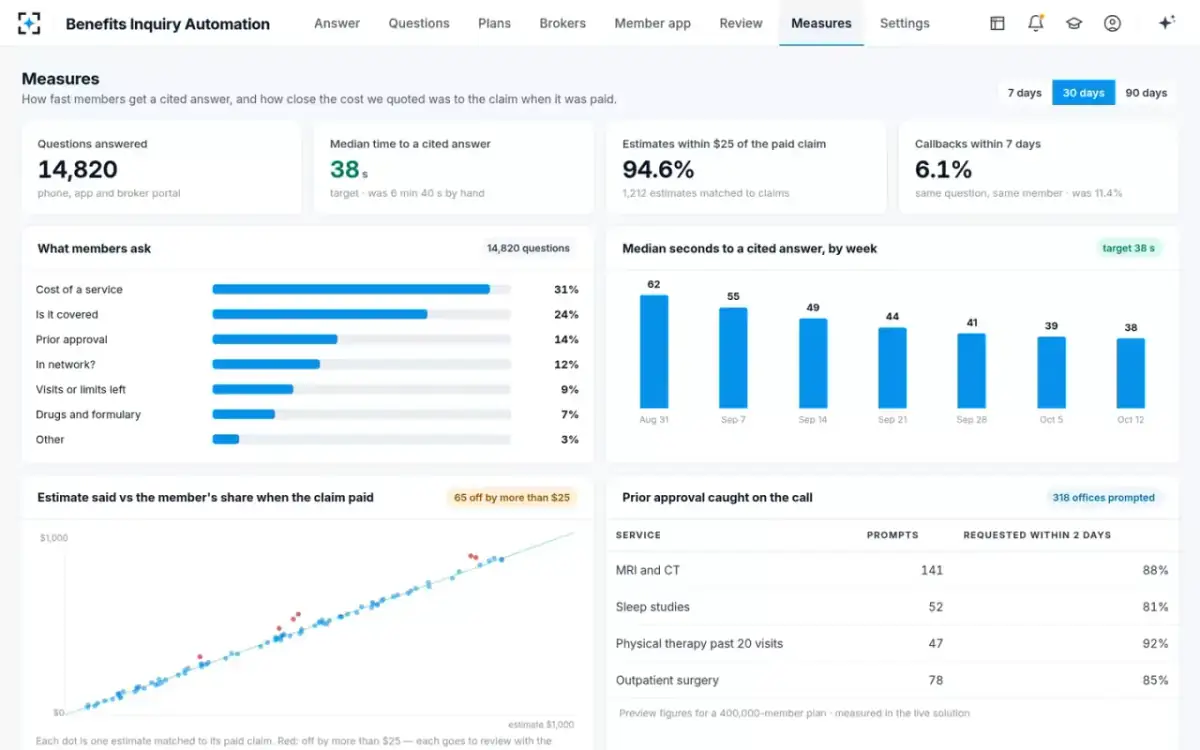
The sample plan's preview shows the shape to look for rather than a target to copy. Before the solution, 11.4% of members called back about the same question within 7 days; with it, 6.1%. In the same 30 days, 94.6% of 1,212 cost estimates matched to paid claims were within $25 of the member's share. The two figures belong together: a falling callback rate with no accuracy check could mean members are being answered quickly and wrongly.
What causes repeat calls to a health plan?
Repeat calls come from answers that were incomplete, wrong or not believed. Incomplete answers are the commonest: a coinsurance percentage instead of a dollar figure, "it needs prior approval" without saying whether the office has asked, "in network" without saying when the listing was checked. Each leaves the member a second question she will have to ask later.
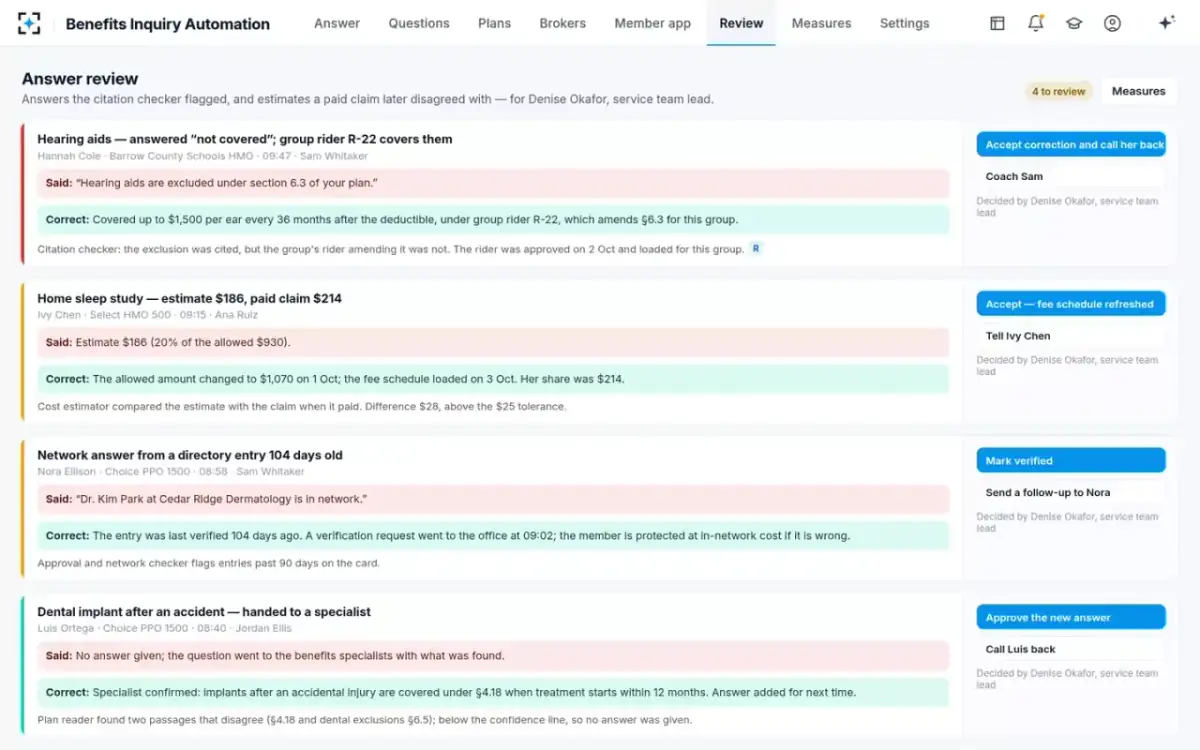
Wrong answers repeat more expensively, because they return as bills. KFF found 27% of insured adults had insurance pay less than expected for a bill in the past year, and 28% of those with an insurance problem said they ended up paying more than they expected as a direct result (KFF). The sample plan's review queue shows four ordinary causes in one morning: a rider missed, a fee schedule changed after the estimate, a directory entry 104 days old, which the guide to network status inquiries takes up, and two plan passages that disagreed.
How insured adults' biggest insurance problem ended
Insured adults with an insurance problem in the past year
- Resolved to their satisfaction · 50%
- Resolved, unsatisfied · 28%
- Not resolved · 19%
- Not stated · 3%
Unbelieved answers are the third cause. A member told "about $350" with no arithmetic has no way to check it and often calls again to hear it from someone else. An answer that shows the deductible left, the coinsurance and what the plan pays, and cites the plan passage, gives her something to keep. That is also why the solution texts the answer, with its plan sections, where consent to texts is on file.
How does first call resolution affect costs?
Every repeat contact costs a representative's time, and some become grievances, appeals or regulator complaints that cost far more. The representative time is the part a plan can price from its own data; the rest it should track as counts. A simple model has four terms.
What repeat calls on benefit questions cost a plan each month
Repeat contacts
Benefit questions × repeat-contact rate
From your own contact data, on the fixed definition: same member, same question, any channel, 7 days.
Service analytics
Representative time
Repeat contacts × minutes per contact × loaded cost per minute
The Departments assumed 9 to 10 minutes and $46.50 an hour for a phone price request in the 2026 Transparency in Coverage rule; use your own.
Finance
Downstream cases
Grievances, appeals and complaints that began as a benefit answer × cost per case
Count them first; pricing them needs your own case-handling costs.
Grievance and appeals
Accuracy misses
Estimates outside tolerance when the claim paid × call-back and correction time
The cost of being fast and wrong, which a callback rate alone hides.
Service team lead
Worked on the sample plan's preview figures, the representative-time term is modest and easy to check. Of 14,820 questions in 30 days, a callback rate falling from 11.4% to 6.1% means about 785 fewer repeat contacts. At the Departments' 9 minutes and $46.50 an hour, that is roughly 118 representative hours and about $5,500 a month. The arithmetic is ours, on fictional sample data, and every input should be replaced with the plan's own.
The larger value sits in the other terms and should be argued with counts, not invented dollars. Fewer wrong cost answers mean fewer surprise bills, and fewer surprise bills mean fewer grievances and appeals to handle. The sample plan also prompted 318 doctors' offices for prior approval on the call in 30 days; between 81% and 92% of them, depending on the service, submitted the request within two days, which is a repeat call about a missing approval that never had to happen.
Measures that cannot be gamed
Any single service measure can be improved by making something else worse, so a health plan should report them as a set, each with the guard that keeps the others honest.
A first call resolution scorecard for a health plan's benefits line
| Measure | Definition | How it is gamed | The guard |
|---|---|---|---|
| First call resolution | No contact from the same member about the same question within 7 days, any channel | Count only phone; mark transfers resolved; shorten the window | Cross-channel topic codes from the call summary; a fixed window |
| Estimate accuracy | Share of cost estimates within a set tolerance of the member’s share when the claim paid | Stop giving estimates; widen the tolerance | Report the share of cost questions answered with a number |
| Cited answers | Share of answer sentences supported by a passage in the member’s own approved plan | Cite something, anything | Check each sentence against its passage, numbers included |
| Time to a cited answer | Median seconds from the question to an answer the representative can read out | Answer before checking | Pair with accuracy and citations, never alone |
| Hand-offs | Questions passed to a specialist or a nurse line | Hand off everything hard; or nothing | Review a sample of hand-offs and of answers that should have been handed off |
Average handle time is left out on purpose. It is useful for staffing, and the levers that reduce it in an insurance contact center are covered in average handle time at an insurance company. As a quality measure it pushes the wrong way: the fastest call is the one that skips the approval check.
What call center KPIs matter for health plans?
Two kinds: the ones regulators set and the ones a plan sets for itself. For Medicare Advantage, the regulator's are specific: average hold time of no more than 2 minutes, 80% of calls answered within 30 seconds after the recorded greeting, a disconnect rate no higher than 5%, interpreters on 80% of calls that need one within 8 minutes and TTY callers reaching a representative within 7 minutes on 80% of calls (42 CFR 422.111(h)). For commercial plans, the federal clocks are on specific answers: a written response within 1 business day to a phone question about whether a provider is in network (42 U.S.C. 300gg-115), and, from plan years beginning on or after 1 January 2027, a cost estimate by phone at the time of the request.
The plan's own KPIs should then measure whether the answers were right: first call resolution on the definition above, estimate accuracy against paid claims, the share of answers cited to the member's own plan, and the hand-off rate. The regulatory set says the member reached someone; the plan's set says the member got what she needed. How the federal service rules fit into a representative's day is laid out in a day in the health insurance call center.
How Benefits Inquiry Automation reports it
The solution's measures screen puts the set on one page for the service team lead: questions answered across phone, app and broker portal; median time to a cited answer against the 38-second design target; estimates within the tolerance of the paid claim, with each miss plotted and sent to review; callbacks within 7 days on the same question; what members ask; and prior approvals caught on the call. In the sample preview, cost of a service was 31% of questions and "is it covered" 24%, so the measures concentrate where the volume is.
Speed, accuracy against the paid claim and callbacks, on one screen
Every miss has a reason attached, which turns the rate into coaching. In the sample review queue, the sleep-study estimate was $28 under the paid claim because the allowed amount changed on 1 October and the fee schedule was loaded on 3 October; the fix was a faster fee-schedule refresh, not a talk with the representative. A rider missed on a hearing-aid answer was the opposite: a coaching conversation and a call-back to the member.
Each miss arrives with its reason, so the fix goes to the right place
Questions people ask
Is first call resolution the same as first contact resolution?
The two terms are used interchangeably; "first contact" is the more accurate name once members use apps, chat and portals as well as the phone. Whichever name a plan uses, the window should count a return through any channel, or a member who calls and then messages will be counted as resolved.
How do health plans measure first call resolution?
Most track whether the same member contacts the plan again within a window, from contact records rather than from the representative's own disposition code. A stronger version adds a topic code from the call summary, so a second contact about a different question does not count against the first, and checks cost answers against the paid claim.
Should a transferred call count as resolved?
No. The member's need was not met on that contact, and counting transfers rewards handing off hard questions. Transfers to a nurse line for urgent symptoms are the right outcome, so report them separately as hand-offs rather than as failures or successes.
What window should a first call resolution rate use?
Seven days is a practical default for benefit questions: long enough to catch the member who calls back after talking to her doctor's office, short enough not to count a new question. Whatever the window, keep it fixed, because changing it moves the rate more than any improvement does.
Does a higher first call resolution rate reduce grievances and appeals?
It should, if resolution means a right answer. KFF found that 28% of insured adults with an insurance problem paid more than they expected as a direct result, and wrong cost answers are a common start of complaints. A plan can test the link on its own data by tracing grievances and appeals back to the benefit call that preceded them.