Accumulators in health insurance are the running totals a plan keeps for each member and family during the plan year: how much has been paid toward the deductible, how much toward the out-of-pocket maximum, and how many visits or days have been used against any limit. They are what turn a plan's rules into a member's actual cost, because "20% after the deductible" means nothing until you know how much of the deductible is left. They are also always slightly behind, since they move only when a claim is processed, not when care happens. Botminds' Benefits Inquiry Automation reads the member's accumulators and checks for pending claims before it gives any cost, and declines to estimate when a claim in process would change the answer.
The family example below is fictional; the rules are quoted from the Code of Federal Regulations and the U.S. Code, and the screens show a fictional sample plan, Kestrel Health, in the solution.
One claim's path into the running total: when the deductible on screen is out of date
- Care given; no claim yet2–12 Sep · no claim
- Claim received, pending until processed on 25 September12–25 Sep · pending, then processed
What are accumulators in health insurance?
They are the plan's counters for cost sharing and benefit limits. Every processed claim adds the member's share to the right counters: the deductible counter while the deductible is open, the out-of-pocket counter for every covered in-network dollar she pays, and a visit counter where the plan limits a service. A cost estimate is then a calculation on those counters: what is left of the deductible, then coinsurance, capped by what is left of the out-of-pocket maximum.
Federal price-transparency rules give the term a legal definition. "Accumulated amounts" means the financial responsibility a member "has incurred at the time a request for cost-sharing information is made, with respect to a deductible or out-of-pocket limit", including what the whole family has incurred toward a family limit, and it covers limits on visits, days or units too (45 CFR 147.210).
Accumulated amounts include any expense that counts toward a deductible or out-of-pocket limit (such as a copayment or coinsurance), but exclude any expense that does not count toward a deductible or out-of-pocket limit (such as any premium payment, out-of-pocket expense for out-of-network services, or amount for items or services not covered under the group health plan or health insurance coverage)
45 CFR 147.210(a)(2)(i)(A), definition of accumulated amounts
Six running totals a plan may keep for one member
Individual deductible
What one person has paid toward her own deductible this plan year
In an embedded design, each person’s own amount; once met, coinsurance starts for her even if the family total is not met
Family deductible
What all covered family members together have paid toward the family amount
Aggregate designs have only this one; embedded designs track both
Out-of-pocket, individual and family
Deductible, copays and coinsurance for covered in-network care, per person and together
When it is reached, the plan pays 100% of covered in-network care for the rest of the plan year
Out-of-network
A separate deductible and limit where the plan covers out-of-network care
Out-of-network spending usually does not count toward the in-network totals
Prescription drugs
A separate drug deductible, where the plan has one
Often kept by a pharmacy benefit manager, so two systems must agree
Visit and day limits
Visits, days or units used toward a cumulative limit, such as 20 therapy visits a year
Federal price-tool rules count these as accumulated amounts too
What is a deductible accumulator?
A deductible accumulator is the counter of how much a member, or her family, has paid toward the deductible this plan year. When it reaches the deductible amount, the plan's coinsurance or copays begin for the services the deductible applies to. People also say "deductible accumulator report" for a statement of that counter, claim by claim, which is what a representative needs to answer "why haven't I met my deductible yet?"
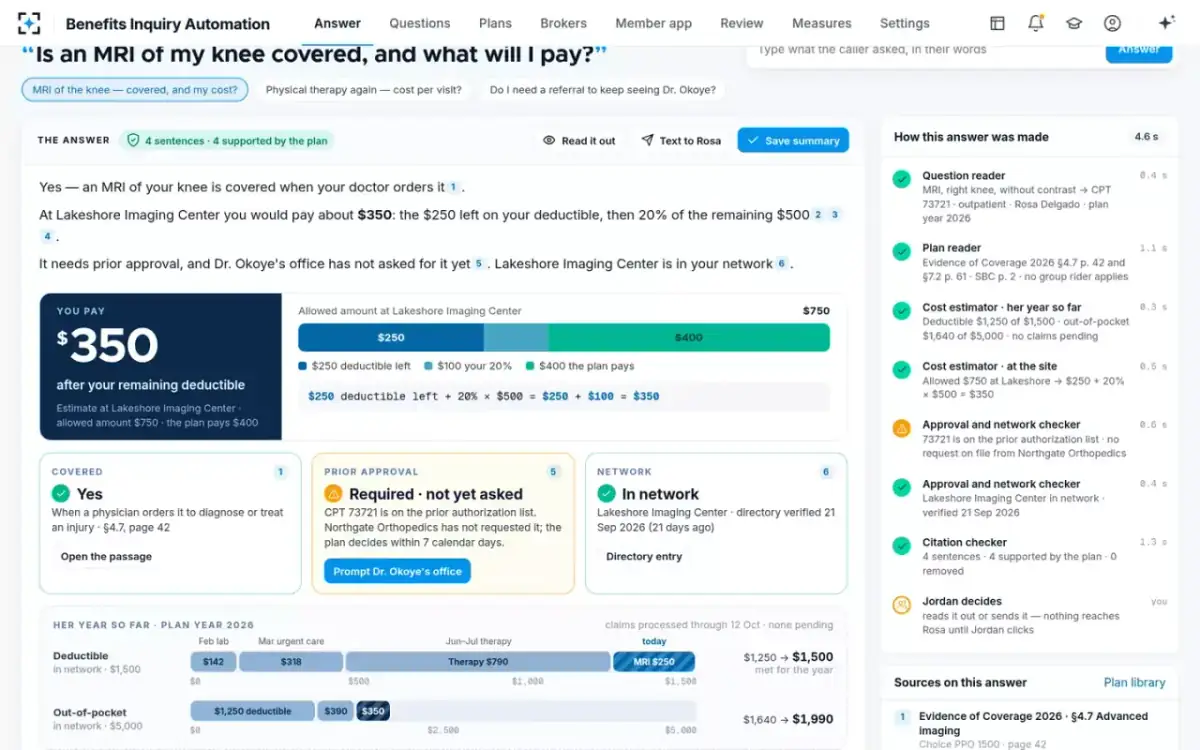
The same counter is the first number a cost estimate uses. In the sample plan, a member who has met $1,250 of a $1,500 deductible pays the remaining $250 of a $750 MRI, then 20% of the other $500: $350. Had the counter been out of date by one $250 claim, the answer would have been $150, and the quoted one $350.
Why is my deductible not updated?
Because accumulators move when claims are processed, not when care happens. A doctor's office may take days or weeks to bill, the plan then processes the claim, and only then does the member's share land in her totals. Until that happens, the deductible she sees online and the one a representative sees are both too low by the amount of any care still in the pipeline.
Three other causes are common. A claim can be processed to a different counter than the member expects: an office visit paid with a copay may not count toward the deductible at all. Prescription drug spending may sit in a pharmacy benefit manager's system and reach the medical totals later, or never, if the plan keeps a separate drug deductible. And a claim from an out-of-network provider usually counts toward a separate out-of-network total, not the in-network deductible.
How long do claims take to update accumulators?
There is no single federal deadline for commercial plans; it depends on how quickly the provider bills and the plan processes. Medicare Advantage has two rules that bound the member's view. Processed claims data, including enrollee cost sharing, must be available through the plan's Patient Access API "no later than one (1) business day after a claim is processed" (42 CFR 422.119). And the plan's explanation of benefits must show year-to-date totals, including "the amount an enrollee has incurred toward the MOOP limit" and toward the deductible, sent monthly or quarterly with per-claim notices (42 CFR 422.111(k)).
Neither rule speeds up the provider's billing, which is the longest part of the lag in the example above. That is why a representative's best evidence is not the total but the list of claims behind it and the date through which claims have been processed. The sample plan's screens print exactly that: "claims processed through 12 Oct, none pending".
How are family and individual accumulators tracked?
Plans track one of two designs. In an aggregate design, all family members' expenses count toward one family deductible, and nobody's coinsurance starts until it is met. In an embedded design, each person has an individual amount inside the family amount: a person who meets her own individual amount starts coinsurance, and the family total caps everyone. KFF's employer survey describes the second as a separate amount for each family member, "typically with a limit on the number of family members required to reach that amount" (KFF).
Take the fictional Ortiz family on an embedded plan with a $1,500 individual and $3,000 family deductible. By September their daughter Lucía has met her $1,500 after a broken wrist, so she pays coinsurance; Elena has paid $900 and Marco $0. The family total is $2,400, so Elena's next $600 of covered care brings it to $3,000 and meets the family deductible for everyone: from then on Marco's care starts at coinsurance without his ever paying a deductible dollar. The federal price-tool definition requires both views: the individual's own total and what all family members "have incurred, in aggregate".
Where federal rules require the running total
Federal law now asks plans to show members their accumulators in several places, which is why a service line cannot treat them as a back-office number.
Federal rules that require or depend on a member's accumulated amounts
| Rule | Applies to | What it requires |
|---|---|---|
| Price estimates to enrollees | Non-grandfathered group and individual coverage | Accumulated amounts toward the deductible and out-of-pocket limit, accurate at the time of the request, in the online tool, on paper and, from plan years beginning on or after 1 January 2027, by phone |
| Explanation of benefits | Medicare Advantage | Year-to-date totals, including amounts incurred toward the deductible and the maximum out-of-pocket limit |
| Patient Access API | Medicare Advantage | Processed claims data with enrollee cost sharing within 1 business day after a claim is processed |
| Emergency and certain out-of-network care | Group and individual coverage | The member’s cost sharing counts toward in-network deductibles and out-of-pocket maximums as if the care were in network |
| Coordination of benefits | Plans following the NAIC model | A secondary plan credits its own deductible with what it would have credited without the other coverage |
The last two rows are where accumulators most often go wrong in practice. An out-of-network emergency claim routed to the out-of-network counter understates the member's in-network totals; a secondary plan that forgets the deductible credit overcharges her on the next claim. The second is explained in more depth in coordination of benefits rules.
What is a copay accumulator program?
A copay accumulator program is a plan or pharmacy benefit design under which drug manufacturer coupons or other third-party payments pay the member's cost at the pharmacy but do not count toward her deductible or out-of-pocket maximum. When the assistance runs out, the member discovers her deductible is still largely unmet. It is a pharmacy-side use of the same word, and the rules on it are a matter for state law and federal benefit rules rather than for the service line.
What the service line must know is whether the plan counts that assistance. Federal price-transparency rules require every cost estimate to include "a statement disclosing whether the plan counts copayment assistance and other third-party payments in the calculation of" the member's deductible and out-of-pocket maximum (45 CFR 147.211(b)(1)(vii)(D)). A representative who cannot answer that question cannot give a compliant estimate for a specialty drug.
How do accumulators reset each year?
They return to zero at the start of each plan year, which for many employer plans is not 1 January; KFF notes that many firms have plan years that do not align with the calendar year. Visit limits usually reset on the same date, though the plan document may define a different "defined time period" for a particular limit. Which year's totals a claim counts toward is set by the plan's terms, typically by the date of service rather than the date the claim was processed.
That last point produces some of the most confusing calls of the year. A member who had a procedure on 28 December and sees the claim processed in January may assume it counts toward the new year's deductible. The plan's documents say which year it belongs to, and the representative should cite them rather than guess.
Answering a cost question while a claim is pending
The answer to a cost question depends on whether the accumulators are complete. If a claim is pending that would change them, any number is a guess, and a confident guess is worse than a clear "it may change". These checks separate the two cases.
Five checks before quoting a cost from the running totals
- Through what date are claims processed?
Say it out loud: “claims processed through 12 October”. It tells the member what the total includes.
- Is anything pending that would change the totals?
If yes, say the cost may change and offer a call-back when the claim is final, rather than quoting a number.
- Has the member had care the plan has not seen yet?
Ask. A visit last week with no claim yet is the commonest reason a quoted cost is too high.
- Which counter does this service hit?
Medical or drug deductible, in- or out-of-network, individual or family, and any visit limit.
- Does the plan count copay assistance?
For specialty drugs the estimate must say whether it does.
How Benefits Inquiry Automation reads the running total
Benefits Inquiry Automation's cost estimator reads the member's deductible and out-of-pocket totals and checks for pending claims before it works out any cost; with the plan's "pending claims" setting on, it gives no estimate while a pending claim would change the accumulators. The answer shows the totals it used, claim by claim, and the date through which claims were processed, so the member can see what is and is not included.
The running total behind the cost, claim by claim
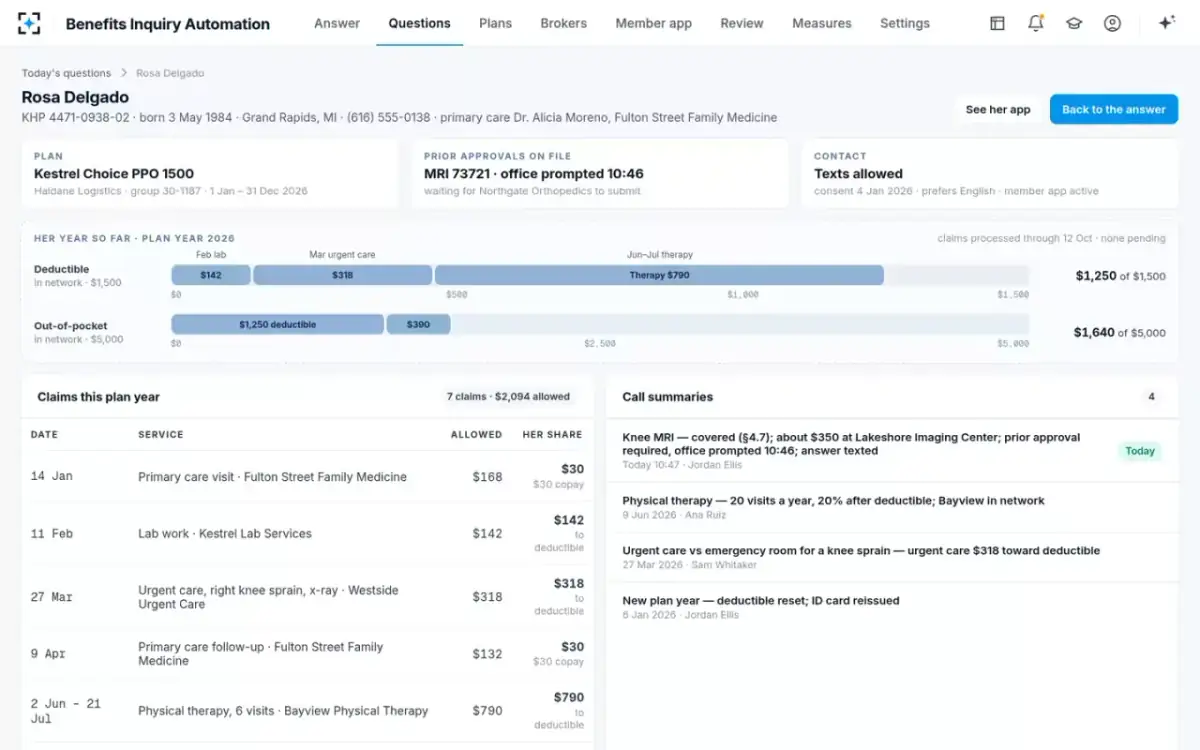
The member's file shows the same totals with the claims list behind them, so a representative answering "why is my deductible not met?" can read the dates and amounts rather than a single number. In the sample plan the deductible's $1,250 comes from a $142 lab, a $318 urgent care visit and $790 of physical therapy; two $30 primary care copays appear in the claims list and did not count toward it.
The member's file: the totals and the claims behind them
Questions people ask
What is an embedded deductible?
An embedded deductible is an individual deductible inside a family deductible: each person's coinsurance starts when she meets her own amount, even if the family amount is not yet met, and the family amount caps the total. The alternative, an aggregate or non-embedded deductible, has only the family amount, so nobody's coinsurance starts until the family total is reached.
Do visit limits count as accumulators?
Yes. Federal price-transparency rules define accumulated amounts to include progress toward a cumulative treatment limitation, such as a limit on the number of visits, days, units or hours covered in a defined period. A member asking how many physical therapy visits she has left is asking about an accumulator.
Do out-of-network costs count toward my accumulators?
Usually only toward separate out-of-network totals. The federal definition of accumulated amounts excludes out-of-pocket expense for out-of-network services, premiums and non-covered items. The exceptions are emergency care and certain out-of-network services at in-network facilities, which the No Surprises Act counts toward the in-network deductible and out-of-pocket maximum.
Where can I see my accumulators?
In the plan's online cost tool, which must show accumulated amounts accurate at the time of the request, and on explanation of benefits statements; Medicare Advantage statements must show year-to-date amounts toward the deductible and the out-of-pocket maximum. From plan years beginning on or after 1 January 2027, commercial plans must also give cost estimates using those amounts by phone.
Why does my portal show a different deductible than my bill suggests?
Usually because a claim is still being processed, or because the bill's service counts toward a different total, such as a separate drug or out-of-network deductible. Ask the plan through what date claims have been processed and whether anything is pending; the answer explains most differences.