AI and health insurance overlap in three places: deciding claims and prior authorizations, which is regulated and contested; detecting fraud; and answering members' and brokers' questions about what their plan covers and what they will pay. The third is where AI can help most and harm most quietly, because a benefits answer that sounds fluent can rest on an assumption nobody checked: last year's document, another employer's rider, the wrong site's price or a deductible that a pending claim is about to change. Botminds' Benefits Inquiry Automation is built on the opposite habit. Its agents read the member's own plan, accumulators, approval list and directory, ask when a fact is ambiguous, cite every sentence, and leave every decision that reaches the member to the representative.
This guide is for member experience and contact-center leaders deciding whether, and how, to put AI on their benefits line. Where it uses examples, they come from a fictional sample health plan, Kestrel Health, as it runs through the solution.
Five agents and one representative: who does what on a Benefits Inquiry Automation answer
Agent
Question readerTurns the caller’s words into a service, a procedure code, a setting, the member and the plan year. If two members or two services could match, it asks the representative.
Never: Guesses a member, or rewrites the question the caller asked
Agent
Plan readerFinds the passage that governs the service for this member’s group and date of service, riders included, and quotes it with section and page. If passages disagree, it says so and stops.
Never: Answers from another plan year, another group’s rider, or a document nobody approved
Agent
Cost estimatorWorks out her share from the deductible and out-of-pocket met so far and the allowed amount at the chosen site, showing each step.
Never: Presents an estimate as a promise, or estimates while a pending claim would change it
Agent
Approval and network checkerReads the prior authorization list and requests on file, and the directory entry with the date it was last verified.
Never: Says a service is approved
Agent
Citation checkerReads every sentence against its passage, numbers included; removes what the plan does not say and flags a group rider that was not cited.
Never: Adds a source of its own
A person decides
Member service representativeReads the answer out, sends it, prompts the doctor’s office or hands the call to a specialist.
Never: Nothing reaches the member or the office until she clicks
How is AI used in health insurance member services?
In member service, AI is used to find the governing plan passage, work out a member's cost, check approval and network status, draft call summaries and answer members directly in an app or chat. The common thread is reading: plan documents are long, versioned by group and year, and amended by riders, and a representative on a live call cannot read them at the speed the caller expects.
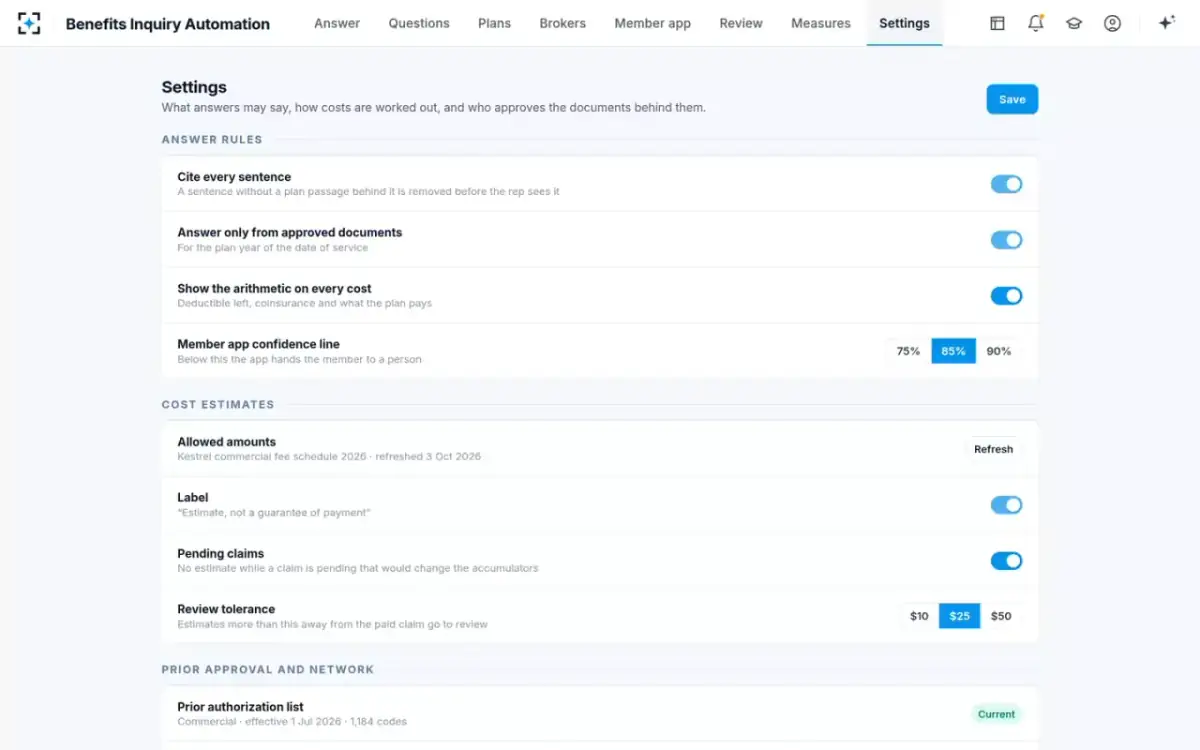
The uses differ in risk. A drafted call summary that a representative edits before saving is low risk. A cost estimate read to a member is higher, because members make care decisions on it. An answer given to a member in an app with no representative in the loop is highest, and it is the use most worth designing hand-offs for: the sample plan's member app hands a member to a person below 85% confidence, when urgent symptoms are mentioned, and when a pending claim would change the cost.
What AI should not do on the service line is decide. Whether a service is medically necessary, whether a prior authorization is granted and whether a claim pays are decisions with their own reviewers, clocks and appeal rights. A member-service tool that blurs into those decisions has stopped being a reading tool.
Can AI answer health insurance questions correctly?
Yes, when it answers from the member's own documents and data and can show where each sentence came from; no, when it answers from general knowledge of how insurance usually works. Coverage is contractual. The same MRI is covered at 20% coinsurance after the deductible in one plan, 10% in another, and a fixed copay in a third, and the employer's rider can change all three.
The research base is thin, and mostly about decisions rather than service. A systematic review published in September 2026 found only 16 eligible studies of AI in prior authorization out of 3,417 records screened; most reported technical scores such as accuracy and F1, few showed operational gains, and most carried a high risk of analysis bias (J Manag Care Spec Pharm, 2026). A plan buying AI for member questions should expect to measure accuracy itself, against its own paid claims, rather than inherit a benchmark.
Six assumptions behind a wrong benefits answer
Most wrong benefits answers are not wild; they are right for a slightly different member, plan or date. That makes them hard to spot, because they sound exactly like right answers. Each one has a question that settles it, and an AI that asks that question, of the data or of the representative, avoids the error.
What a fluent answer silently assumes, and the question that settles it
| Silent assumption | How it goes wrong | The question that settles it |
|---|---|---|
| Which member | Two members share a name, or a dependant is on the line | Which member, by ID and date of birth? If two could match, ask the representative |
| Which plan year | The answer cites last year’s evidence of coverage; in the sample plan coinsurance rose from 15% to 20% on 1 January 2026 | What is the date of service, and which approved edition covers it? |
| Which group rider | The exclusion is cited but the employer’s rider amending it is not | Does any rider for this group amend the passage? |
| Her year so far | A pending claim is about to use up the rest of her deductible | Are claims processed to date, and is anything pending that would change the totals? |
| Which site | The same scan is $350 at a freestanding center and $636 at a hospital outpatient department in the sample | Where will the service happen, and what is the allowed amount there? |
| Preventive or diagnostic | A screening billed as diagnostic carries cost sharing | Is this a preventive service, or a test for a symptom? |
The last row is the federal rule teaching the same habit. Under the Transparency in Coverage regulation, if a plan "cannot determine whether the request is for preventive or non-preventive purposes", its tool must show the non-preventive cost sharing, or let the member specify with terms such as "preventive" or "diagnostic" (45 CFR 147.211(b)(1)(i)(B)). The regulation itself prefers asking to guessing.
The agents that ask before they answer
Benefits Inquiry Automation splits the work so that each agent owns one kind of question and has its own list of things it never does. The question reader is the one that asks: when "my knee MRI" could mean two codes, or "my daughter" could mean two dependants, it puts the choice to the representative rather than picking. The plan reader is the one that stops: if two passages disagree, as a dental-implant benefit and a dental exclusion did in the sample plan, it hands the question to a benefits specialist instead of choosing.
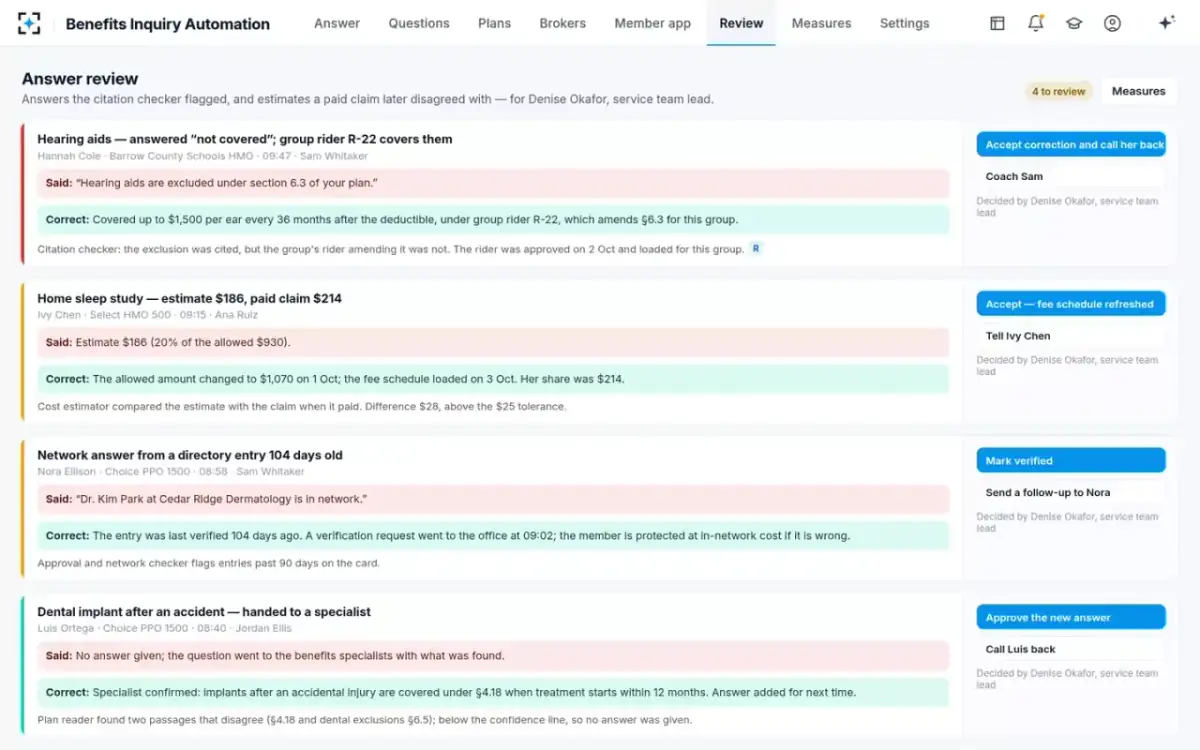
The citation checker is the safeguard that fluency needs. It reads each sentence of the answer against the passage it cites, including every number, and removes any sentence the plan does not support before the representative sees it; the removal is logged. It also flags a missing rider for the group, which catches the error a careful human makes most often: citing the exclusion and missing the amendment.
The citation checker's catch: an exclusion cited, the group's rider missed
Can AI tell a member what they will pay?
It can give an estimate, if it reads the member's accumulators, the allowed amount at the site and the plan's cost-sharing rule, shows the arithmetic, and labels the result as an estimate. Federal law already requires plans to give enrollees exactly this kind of estimate through a self-service tool, and from plan years beginning on or after 1 January 2027, by phone too. The same rule requires plain-language statements that actual charges may differ and that an estimate does not guarantee payment (45 CFR 147.211(b)(1)(vii)).
The sample answer shows the shape: $250 left on the deductible plus 20% of the remaining $500 equals $350 at the freestanding site, with the plan paying $400. Every term is visible, so a member who later sees a different bill can see which term changed. The solution refuses to estimate while a pending claim would change the accumulators, and compares each estimate with the member's share when the claim pays; anything off by more than the plan's tolerance goes to the team lead.
The harder discipline is what to leave out. An AI that rounds an estimate into "about $300" or drops the label to sound friendlier has turned an estimate into a promise. How the deductible, coinsurance and out-of-pocket maximum combine is worked through in accumulators in health insurance.
Should AI tell a member a service is covered or approved?
Covered, yes, with the passage cited; approved, no. "Covered" is a statement about the contract: the plan pays for this service under these conditions. "Approved" is a decision about this member's request, made by the plan's reviewers on the clinical information the ordering office sends. Collapsing the two is the most expensive mistake a service line can make, because a member who hears "approved" schedules the procedure.
The sample answer handles it in two halves. It says the MRI is covered under section 4.7 when a physician orders it, that it needs prior approval, and that the ordering office has not asked yet. The representative can then send the office a pre-filled prompt with the member, plan, procedure code, diagnosis on the order, site and rule, and the office submits the request. Nothing is decided on the service line.
The rules the agents work under are the plan's settings
How is AI regulated in health insurance?
There is no federal rule written specifically for AI that answers member benefit questions; the binding rules are the ones that govern the answer itself. Price estimates must meet the Transparency in Coverage content and accuracy rules. Disclosures must protect privacy and verify the caller. And where Section 1557 applies, language access rules reach machine translation directly.
If a covered entity uses machine translation when the underlying text is critical to the rights, benefits, or meaningful access of an individual with limited English proficiency, when accuracy is essential, or when the source documents or materials contain complex, non-literal or technical language, the translation must be reviewed by a qualified human translator.
45 CFR 92.201(c)(3), Section 1557 nondiscrimination rule
A benefits answer translated by a model into Spanish or Vietnamese is, on most readings, text "critical to the rights, benefits" of the member. Section 1557 also has a rule on "patient care decision support tools", with compliance due within 300 days of 5 July 2024; it is defined around tools that support "clinical decision-making" (45 CFR 92.4), which is the territory of utilization review rather than benefits answers, but a plan using one model for both should read it (45 CFR 92.210).
In Medicare Advantage, CMS proposed specific AI guardrails and then, in its April 2025 final rule for contract year 2026, chose not to finalize them, saying it would keep considering future rulemaking (90 FR 15792). At the state level, the National Association of Insurance Commissioners' model bulletin on insurers' use of AI systems has been adopted in 29 jurisdictions as of 8 October 2026, and what the NAIC AI bulletin requires of insurance companies is set out in its own guide. A member-service tool falls inside an insurer's AI program under that bulletin, so its inventory, testing and oversight belong in the same governance as the rest.
What to ask before buying AI for member questions
A demonstration on a vendor's sample plan proves little; the questions below are designed to be run on your own documents, with your own hard cases. The strongest test is a question whose right answer changed this year.
Eight tests for AI that answers health plan members’ benefit questions
- Ask about a benefit a rider changes
Pick a group whose rider amends an exclusion. The answer should cite the rider, not only the exclusion.
- Ask across a plan-year boundary
A service in December and the same service in January should cite different editions if the benefit changed.
- Ask with a claim pending
The right answer is that the cost may change, with an offer to call back, not a confident number.
- Ask about the same service at two sites
A freestanding and a hospital outpatient price should both appear, each with its arithmetic.
- Ask an ambiguous question
“Is my daughter’s therapy covered?” with two dependants should produce a question back, not a pick.
- Open every citation
Each should open to the highlighted passage with section, page and edition. A section number alone is not a citation.
- Ask whether a service is approved
The answer should say whether approval is required and whether a request is on file, never that it is approved.
- Compare estimates with paid claims
Ask how the tool measures estimates against the member’s share when the claim pays, and who sees the misses.
Where Benefits Inquiry Automation fits on the service line, and where it does not
Benefits Inquiry Automation fits a plan that wants representatives, brokers' service staff and members to get the same cited answer to coverage, cost, approval and network questions, and that is willing to approve its plan documents and riders by plan year before answers may cite them. It reads the systems a plan already runs, plan documents, eligibility and accumulators, fee schedules, the prior authorization list and requests on file, the directory and the member's file, and it works on the phone line, in the member app and in the broker portal.
It does not decide claims, prior authorizations, medical necessity, grievances or appeals. It does not replace the telephony platform or the customer relationship system. It does not answer when the plan's own passages disagree or when the confidence line is not met; it hands the question to a person with what it found. And its cost answers are only as current as the accumulators it reads, which is why it declines to estimate while a pending claim would change them. How it compares with a general-purpose chat assistant is tested question by question in health insurance chatbot or cited answer.
Questions people ask
What are the risks of AI in member services?
The main risk is a confident answer from the wrong document: last year's edition, another group's rider or a general rule that this plan does not follow. Others are estimates that drop their caveats, machine translation of critical text without human review, which Section 1557 rules require where they apply, and disclosure to an unverified caller. Each is controlled by citing the passage, labelling estimates and keeping a person on every send.
How do health plans use AI in call centers?
To find the governing passage, estimate the member's cost, check prior authorization and directory status, and draft call summaries while the representative is still on the line. From plan years beginning on or after 1 January 2027, commercial plans must give enrollees cost estimates by phone that are accurate at the time of the request, which makes fast access to accumulators and prices a requirement rather than a convenience.
Is AI allowed to deny health insurance claims?
That question belongs to claims and utilization review, not member service, and the rules there are specific: in Medicare Advantage, an adverse medical necessity decision must be reviewed by a physician or other appropriate professional before it is issued. CMS proposed AI-specific guardrails for Medicare Advantage and did not finalize them in April 2025. Benefits Inquiry Automation makes no coverage decisions at all.
Does an AI benefits answer count as an official plan communication?
Whatever the member hears from the plan's representative or app is the plan speaking, whoever drafted it. That is why the solution labels every cost as an estimate, cites the passage behind every sentence and requires the representative to click before anything is sent, saved or read out.
Can AI answer broker questions about a group's plans?
Yes, at group level. In the sample plan a broker asked which of an employer's three plans cover bariatric surgery and what an employee would pay; the answer compared all three, with every cell cited, using a typical allowed amount rather than any employee's data. Brokers see group-level answers only, never a member's personal data.