A health insurance call center is the team that answers members, brokers and doctors' offices when they ask a health plan whether a service is covered, what the member will pay, whether it needs prior approval and whether a provider is in network. The work is hard because the answer is never on one screen: it sits in the evidence of coverage for the member's group and plan year, in any rider, in her deductible and out-of-pocket totals so far, in the contracted price at the site she picks, in the prior authorization list and in the provider directory. Botminds' Benefits Inquiry Automation exists to read those six places in seconds and put one cited answer in front of the representative, so the minutes on the phone go to the member rather than to the search.
The examples below come from a fictional sample health plan, Kestrel Health, and its fictional members and employers, as they run through the solution. The research figures come from federal rules, KFF and peer-reviewed work, linked where they appear.
Four people in a health plan call center, before and with Benefits Inquiry Automation
Today
Reads the member her plan’s coinsurance, then needs three screens and a calculator to say what she will actually owe.
With agents
Reads out a cited answer with her own cost, prompts the doctor’s office about approval and saves the call summary while she is still on the line.
Still theirs: What is said, and when to hand the call to a nurse or a specialist
Today
Hears about a wrong cost quote weeks later, when it returns as a complaint or an appeal.
With agents
Sees the same morning every answer the citation check flagged and every estimate a paid claim disagreed with.
Still theirs: Corrections, coaching and call-backs
Today
Opens each of a group’s plan documents one at a time to answer a broker’s question.
With agents
Sends every plan the group offers side by side, each cell cited, with no member’s data.
Still theirs: What goes to the broker
Today
Knows that a fast answer is still wrong if the group’s rider was never loaded.
With agents
Approves each plan year’s documents and riders before any answer may cite them.
Still theirs: Which documents answers may cite
What does a health insurance call center representative do?
A member service representative verifies who is calling, finds the member's plan, answers a benefit question from that plan's own documents and writes a summary of the call. The first step is a legal one: under the HIPAA Privacy Rule a covered entity must "verify the identity of a person requesting protected health information and the authority of any such person to have access" when that identity or authority is not already known (45 CFR 164.514(h)). A spouse calling about a husband's claim is a different call from the husband calling about his own.
After that, the representative is doing four jobs at once. A coverage clerk, reading the governing passage. An estimator, working out the member's share from her year so far. A router, checking whether prior approval is needed and whether the ordering office has asked. And a network checker, confirming the site is in network on the date of service. A good call also ends with a written summary that the next representative can trust, which is what stops the member being asked to tell her story twice.
Representatives do not decide claims, approve services or interpret medical necessity. Those belong to claims examiners, utilization management nurses and physicians. The line matters on the phone: a representative who says "you're approved" when the plan has only confirmed that an approval is required has made a promise the plan may not keep.
Why do members call their health plan?
Members call because something about their coverage surprised them or is about to. In KFF's 2023 national survey of 3,605 insured adults, 58% said they had a problem using their insurance in the previous 12 months, and among those with a problem, 53% contacted their insurer to resolve it and 49% looked at its website or documents (KFF). The problems themselves read like a call center's queue.
What insured adults say went wrong with their health insurance in the past year
Two of the six are cost surprises, two are network problems and one is prior approval: the same five subjects that dominate a benefits line. KFF also found that understanding is the root of many calls. Thirty-six percent of insured adults find it at least somewhat difficult to understand what their insurance will and will not cover, and 30% find it difficult to understand what they will owe out of pocket. The call is often the member's attempt to have a person read the plan for her.
The calls do not always end well. Half of consumers with a problem said it was resolved to their satisfaction; of those whose problem was resolved either way, 17% said it took more than a month. That is the argument for answering correctly the first time, which first call resolution in health plans turns into a measure.
One coverage question, six places to look
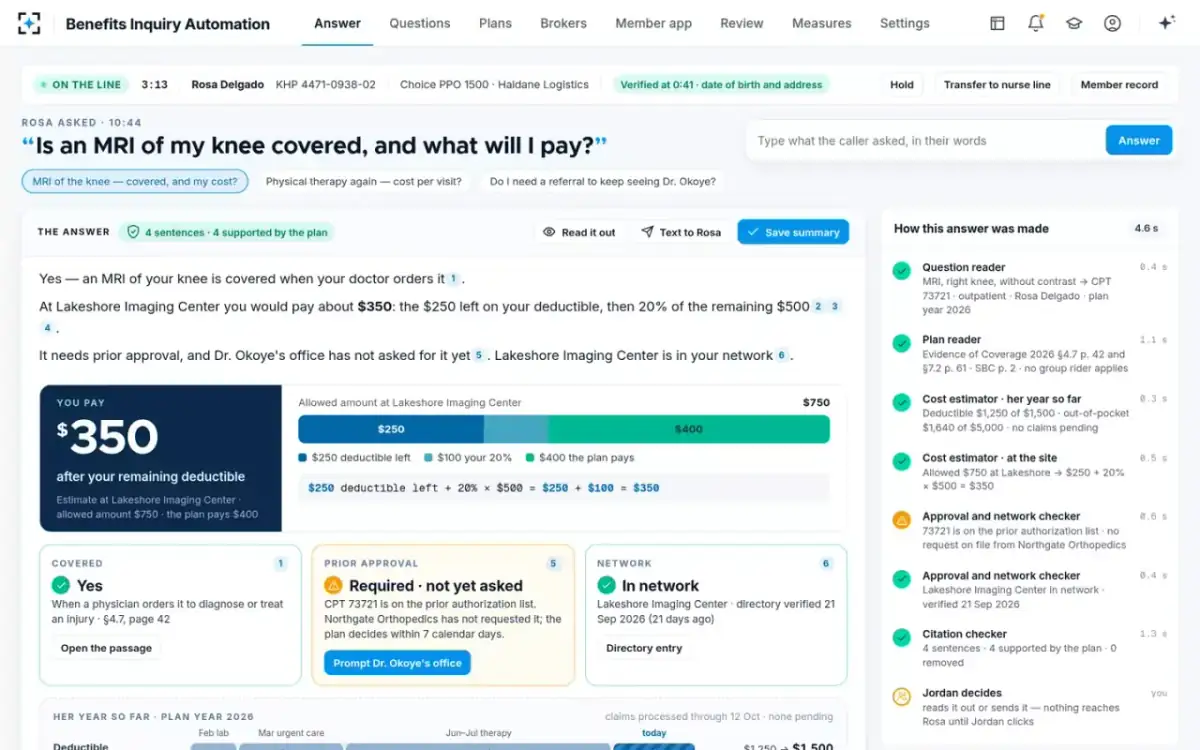
A single plain question, "is an MRI of my knee covered, and what will I pay?", needs six lookups before a representative can answer it honestly. In the sample plan, member Rosa Delgado is on Choice PPO 1500 through her employer, Haldane Logistics. The representative has to find:
- The governing passage for her group and the plan year of the date of service, not last year's evidence of coverage and not another group's version.
- Any rider that amends that passage for her employer.
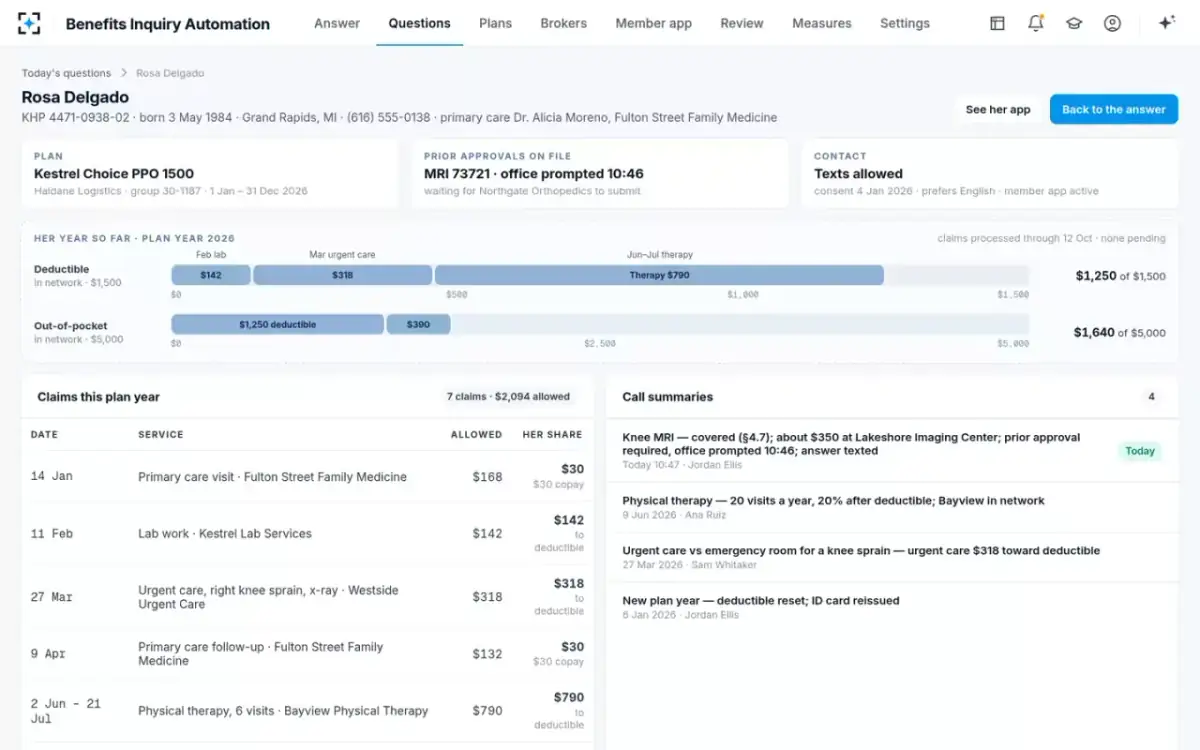
- Her accumulators: how much of her deductible and out-of-pocket maximum she has met, and whether a pending claim is about to change them.
- The allowed amount at the site she picks, because the same MRI costs the plan, and her, different amounts at a freestanding center and a hospital outpatient department.
- The prior authorization list, and whether the ordering office has already asked.
- The directory entry for the site, and when it was last verified.
Miss any one and the answer can still sound right. Read only the coinsurance and the member hears "20%" when she will pay $350. Skip the rider and a covered service becomes "excluded". Skip the approval check and the scan happens without one. Each mistake comes back later as a surprise bill, a repeat call, a grievance or an appeal.
The same question answered from all six places at once
How long does a member services call take?
No public source measures handle times across health plan call centers, so the answer is an estimate built from the steps. The federal Departments made one when they required price estimates by phone: in the proposed rules they estimated 9 to 10 minutes for a representative to give a member the requested cost information and complete post-call documentation, and a commenter told them real calls are "likely to be longer and more complex than estimated" (Transparency in Coverage final rule, 2026).
Where one coverage-and-cost call's minutes go, by hand and with Benefits Inquiry Automation
- Verify, open plan1
- Find the passage2
- Work out her cost2
- Approval, directory1.5
- Explain1.5
- Summary0.5
- Verify, open plan1
- Read passage, cost, checks1.3
- Explain, summary1.7
The shape matters more than the total. By hand, five and a half of the eight and a half minutes are hunting: the passage, the arithmetic, the approval list and the directory. Those minutes are also where the errors live, because they are done under pressure with the member listening. The minute and a half spent explaining is the part a member values, and it does not shrink. A plan that automates the explanation and keeps the hunting has automated the wrong half.
The service rules a health plan call center runs on
Federal rules set the floor for how fast and how fully a plan must answer, and the floor differs by line of business. Medicare Advantage has the most specific call center standards; commercial plans have document and price-disclosure clocks; every plan has privacy and, where Section 1557 applies, language access duties.
Federal service rules a health plan call center has to meet, by line of business
| Rule | Applies to | What it requires |
|---|---|---|
| Opening hours | Medicare Advantage | A toll-free call center open at least 8 a.m. to 8 p.m.; from 1 April to 30 September it may close weekends and federal holidays if messages are returned within one business day |
| Hold time and answer speed | Medicare Advantage | Average hold of no more than 2 minutes; 80% of calls answered within 30 seconds after the recorded greeting; disconnect rate no higher than 5% |
| Interpreters and TTY | Medicare Advantage | An interpreter on 80% of calls that need one within 8 minutes, at no cost; a representative within 7 minutes on 80% of TTY calls |
| Price estimate by phone | Non-grandfathered group and individual coverage | From plan years beginning on or after 1 January 2027: the cost-sharing estimate the online tool gives, on request, by phone, accurate and provided at the time of the request; at least 20 providers a day |
| Summary of benefits and coverage | Group and individual coverage | Sent on request as soon as practicable and no later than 7 business days |
| Is this provider in network? | Group and individual coverage | A written answer within 1 business day of a phone request, kept for at least 2 years |
| Verify the caller | All HIPAA covered entities | Verify identity and authority before disclosing protected health information |
| Interpreters and machine translation | Covered entities under Section 1557 | A qualified interpreter; machine translation of critical text reviewed by a qualified human translator |
The 2027 phone rule is the one most service leaders will feel. The Departments wrote that plans "will need to make operational changes and train customer service representatives" and estimated, for each issuer or administrator, a one-time eight-hour session to train 20 representatives and two supervisors. A representative who must give an estimate that is accurate when she gives it needs the member's accumulators and the site's price in front of her, not a coinsurance percentage.
Such information must be accurate at the time of the request and must be provided at the time of the request.
45 CFR 147.211(b)(2)(iii), as finalized 6 October 2026
What systems do member service representatives use?
A representative typically works across six systems on one call, and none of them was built to answer a member's question on its own. A telephony and customer relationship platform holds the call and the notes. An eligibility system says who the member is, which group and plan she belongs to and her deductible and out-of-pocket totals. The plan documents, evidence of coverage, summary of benefits and coverage, riders and formulary, sit in a document library or as PDFs. Contracted prices sit in fee schedules, the prior authorization list and requests on file sit in the utilization management system, and network status sits in the provider directory.
The member already carries part of the answer. Since the No Surprises Act, a plan's physical or electronic ID card must show any deductible, any out-of-pocket maximum and a phone number and website for consumer assistance, so members increasingly call with the numbers in hand and ask why their bill does not match. The running totals behind that gap are covered in accumulators in health insurance.
Training follows the systems. New representatives learn the plan documents group by group, how riders amend them, how to read accumulators, the prior authorization process, how to verify a caller and how to bring in an interpreter or TTY relay. The slowest part to learn is the one no system shows: which document governs which question, and which edition applies to the date of service.
What changes when the agents read the plan first
With Benefits Inquiry Automation, six agents do the hunting in parallel while the representative stays on the line. A question reader turns the caller's words into a service, a procedure code, a setting and the plan year; if two members or two services could match, it asks the representative rather than choosing. A plan reader finds the governing passage for the member's group and date of service, riders included, and quotes it with section and page. A cost estimator works out her share from her accumulators and the allowed amount at the chosen site and shows the arithmetic. An approval and network checker reads the prior authorization list, any request on file and the directory entry with its verification date. A citation checker reads every sentence against its passage and removes what the plan does not say. A call summary writer drafts the summary and, where consent is on file, the text to the member.
The representative keeps every decision that reaches the member. Nothing is read out, texted, saved or sent to a doctor's office until she clicks, and the agents never say a service is approved: when the office has not asked, the representative can send it a pre-filled prompt, and the office submits the request.
The member's file after the call: her plan, her year and the summary
What a team lead sees the next morning
A service team lead's quality problem is latency: a wrong cost quote surfaces as a complaint weeks after the call, long after anyone remembers it. The solution moves that to the same morning by putting two kinds of answers in front of the lead: those the citation checker flagged, and estimates that a paid claim later disagreed with by more than the plan's tolerance, $25 in the sample settings.
In the sample plan's queue that morning there are four. A hearing-aid question answered "excluded" from the plan's exclusions section, when the employer's group rider covers $1,500 per ear every 36 months. A sleep-study estimate $28 below the paid claim because the allowed amount changed on 1 October and the fee schedule was loaded on 3 October. A network answer that rested on a directory entry 104 days old. And a dental-implant question the plan reader declined to answer because two passages disagreed, handed to a benefits specialist instead. Each comes with what was said and what is correct, and the lead decides: accept the correction and call back, coach, or approve a new answer for next time.
Answers that need a second look, with what was said and what is correct
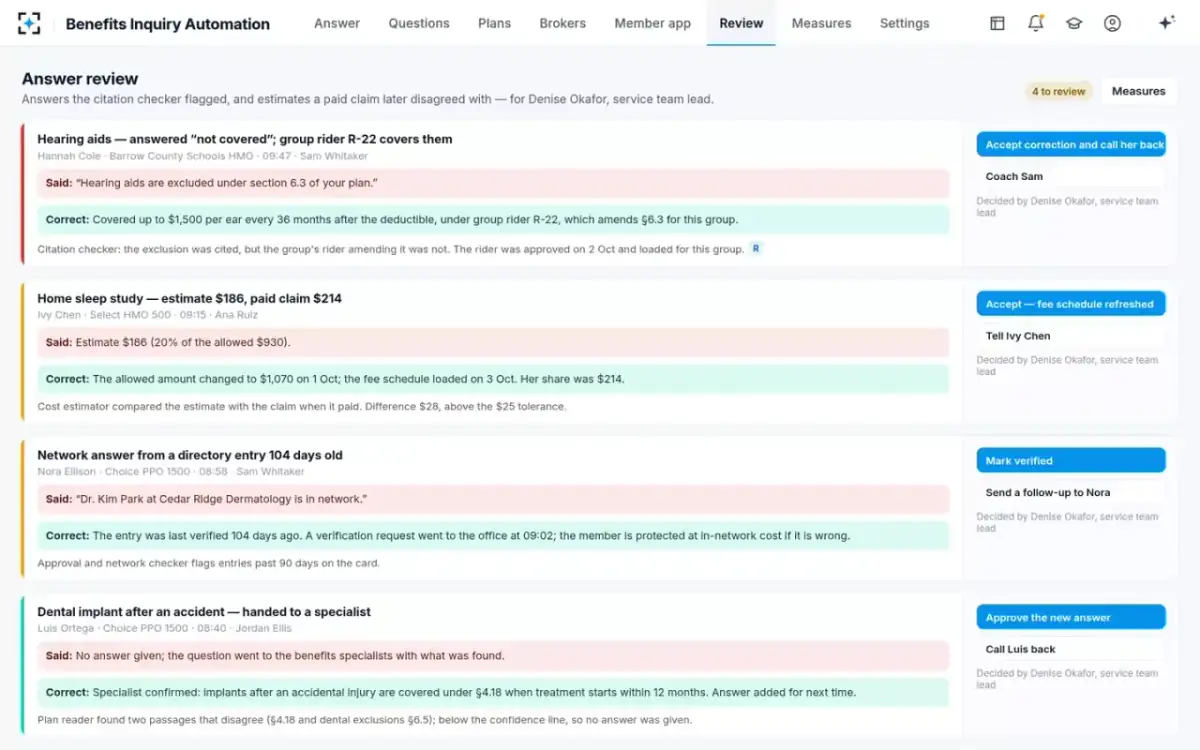
The network row is worth a second look. Federal law requires commercial plans to verify directory information at least every 90 days and protects a member who relied on a wrong listing, and the representative's side of that duty is covered in how a plan answers a network status inquiry.
Questions people ask
What questions do health insurance call centers get most?
Cost, coverage, prior approval and network status, in roughly that order, plus claims that paid differently than expected. In the sample plan's preview figures, cost of a service was 31% of 14,820 questions in 30 days and "is it covered" 24%. KFF's 2023 survey found 27% of insured adults had insurance pay less than expected for a bill in the past year.
What are the Medicare Advantage call center requirements?
Under 42 CFR 422.111(h), a Medicare Advantage plan's toll-free call center must be open at least 8 a.m. to 8 p.m., keep average hold time to 2 minutes or less, answer 80% of calls within 30 seconds of the recorded greeting and keep disconnects at 5% or less. Interpreters must reach 80% of callers who need one within 8 minutes, and TTY callers must reach a representative within 7 minutes on 80% of calls.
Do health plans have to give cost estimates over the phone?
Yes, for non-grandfathered group and individual coverage, from plan years beginning on or after 1 January 2027. The Transparency in Coverage final rule of 6 October 2026 requires the same cost-sharing estimate the online tool gives, on request, through the phone number on the ID card, accurate and provided at the time of the request. A plan may limit a caller to no fewer than 20 providers a day if it says so.
How are health plan call centers staffed?
Around the federal hours and service levels first, then around the plan's own arrival pattern. Medicare Advantage centers may close weekends and federal holidays only from 1 April to 30 September; from 1 October to 31 March only Thanksgiving and Christmas may be skipped, so the enrollment season has to be staffed seven days a week. No public source reports health plans' staffing ratios, so each plan models its own from call arrivals, handle times and the service levels above.
What training do member services representatives need?
Plan documents by group and plan year, how riders amend them, accumulators and cost-sharing arithmetic, the prior authorization process, the directory and its limits, caller verification under HIPAA, and how to bring in an interpreter or TTY relay. For Medicare Advantage, interpreters must be available on 80% of calls that need one within 8 minutes, so the hand-off is a skill in itself.
Can a representative tell me a service is approved?
Only if the plan has decided the request, and representatives do not make that decision. A representative can say whether prior authorization is required and whether a request is on file. In Benefits Inquiry Automation the agents never say a service is approved; the ordering office submits the request and the plan decides it.