Call center automation software is any tool that takes work off representatives and members: routing and self-service menus, knowledge search, real-time suggestions, call summaries and answers given directly in an app or chat. For a health plan the category is only as useful as its answers to four questions, is it covered, what will I pay, does it need approval and is the provider in network, and those answers live in systems the plan already runs. Botminds' Benefits Inquiry Automation is built to attach to those systems rather than replace any of them: six agents read the plan documents, the member's accumulators, the contracted prices, the prior authorization list and the directory, and put one cited answer in front of the representative, the member or the broker.
This guide is for contact-center and IT leaders choosing such a tool. The examples come from a fictional sample health plan, Kestrel Health, as it runs through the solution; the rules are quoted from the Federal Register and the Code of Federal Regulations.
What federal rules put on a health plan's service line, 2026 and 2027
- Directory data to Plan Finder, 30-day updates2026
- Prior authorization status by API in 1 business day2027
- Cost estimates online and on paper2026
- The same estimate by phone, at the time of the request2027
What is call center automation software?
It is software that handles part of a contact center's work without a person: deciding where a call goes, answering a question, finding the right document, drafting the notes or suggesting what to say next. The tools sit in layers. A telephony or contact-center platform handles the call. A customer relationship system holds the member's history. Knowledge and assist tools sit on top and help the representative answer.
For a health plan, the answer layer is where value and risk concentrate. Routing a call faster does not help if the answer at the end of it cites last year's evidence of coverage. General-purpose assist tools for insurance contact centers are compared in contact center AI software; this guide is about the narrower job of answering benefit questions, which needs plan-specific data no general tool carries.
How does call center automation work in health insurance?
It works by reading, at the moment of the question, the same sources a careful representative would open, and assembling them into one answer. For "is a knee MRI covered and what will I pay?", that means the member's eligibility and group, the evidence of coverage for that group and plan year with any rider, her deductible and out-of-pocket totals and any pending claims, the allowed amount at the chosen site, the prior authorization list and any request on file, and the directory entry with its verification date.
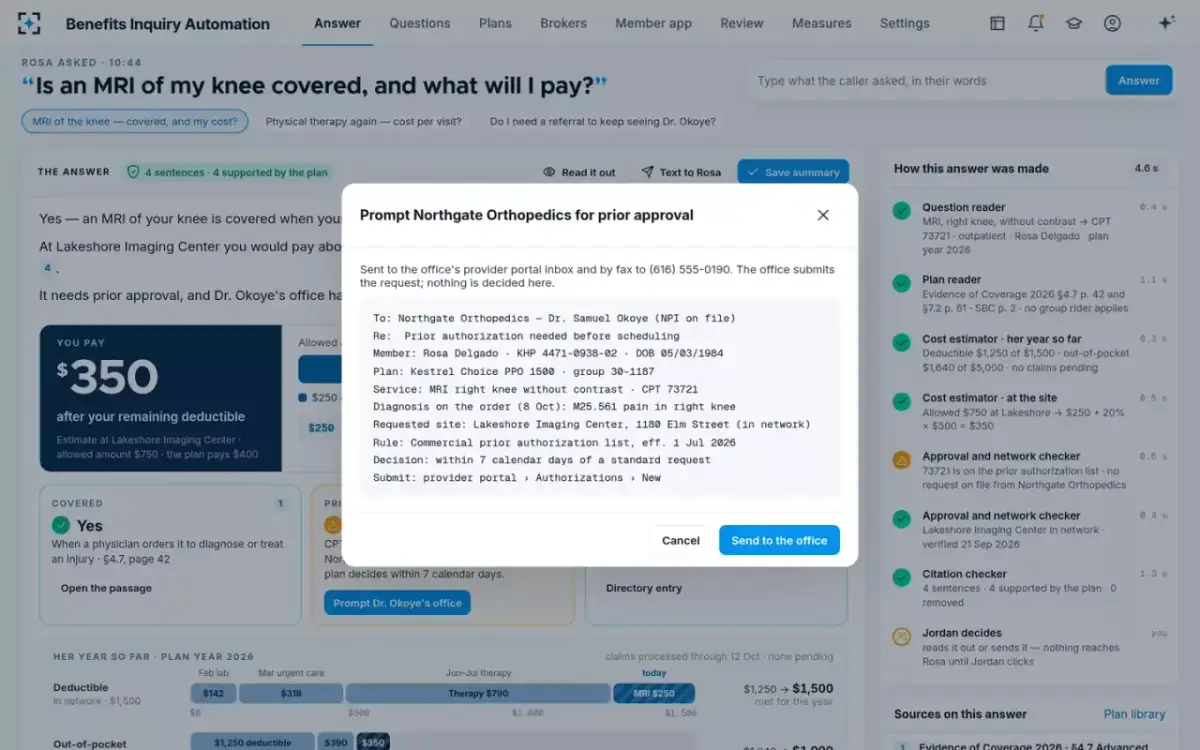
In Benefits Inquiry Automation, six agents divide that work: a question reader, a plan reader, a cost estimator, an approval and network checker, a citation checker and a call summary writer. In the sample plan the full answer took 4.6 seconds. The representative then reads it out, texts it or saves the summary; nothing reaches the member or a doctor's office until she clicks.
Can call center software answer benefit questions?
It can answer coverage, cost, approval and network questions if it reads the member's own plan and data and can show its sources; it should not answer questions that are decisions. The line runs between "is it covered and what does the plan say" and "will this claim be paid" or "is this request approved". The first is reading; the second belongs to claims and utilization review.
The cost answer has a legal shape already. Federal price-transparency rules require plans to give enrollees an estimate built from the negotiated rate, the member's "accumulated amounts" toward her deductible and out-of-pocket limit, and any prerequisite such as prior authorization, with statements that the estimate is not a guarantee (45 CFR 147.211). Software that answers cost questions should produce exactly those elements, and the solution's estimate shows each one with its arithmetic.
What integrations does call center automation need?
Six read connections and two write actions, and most already exist in some form because federal rules require the underlying data. The table lists what each answer needs and the rule that already defines the data.
Where Benefits Inquiry Automation attaches, and the federal rule that already shapes each source
| System the plan runs | What the answer needs from it | Rule that already defines the data |
|---|---|---|
| Plan documents | Evidence of coverage, summary of benefits and coverage, riders and formulary, by group and plan year | SBC content and timing, 45 CFR 147.200; Medicare Advantage plan descriptions, 42 CFR 422.111 |
| Eligibility and accumulators | Member, group and plan year; deductible and out-of-pocket met; pending claims | The HIPAA eligibility inquiry and response, 45 CFR 162.1201; “accumulated amounts” in 45 CFR 147.210–147.211 |
| Fee schedules | Contracted allowed amount for the service at each site | Negotiated rates in the enrollee price tool, 45 CFR 147.211(b)(1)(iii) |
| Prior authorization | The list of codes requiring approval, and requests on file | In Medicare Advantage, status available to enrollees within 1 business day from 2027, 42 CFR 422.119 |
| Provider directory | Network status on the date of service, and when the entry was last verified | Verification at least every 90 days, 42 U.S.C. 300gg-115; Medicare Advantage updates within 30 days, 42 CFR 422.111(m) |
| Member file and channels | Call summaries, texts, the member app and the broker portal | Caller verification before disclosure, 45 CFR 164.514(h) |
The plan-documents connection is the one that decides coverage answers, and which edition it must serve is explained in evidence of coverage vs summary of benefits. Two others decide the quality of every cost answer. Accumulators must be current, and the software must know when they are not: a claim in process can use up the rest of a deductible between the call and the visit. Fee schedules must be refreshed when they change; in the sample plan an allowed amount rose on 1 October, the schedule was loaded on 3 October, and an estimate in between came out $28 low, which the review queue caught when the claim paid.
The 2027 rule that puts price answers on the phone
From plan years beginning on or after 1 January 2027, non-grandfathered group health plans and issuers must give the same cost-sharing estimate their online tool gives "via a telephone number indicated on any physical or electronic plan or insurance identification card", accurate and provided at the time of the request (Transparency in Coverage final rule). A plan may limit a caller to no fewer than 20 providers a day if it tells her so. The Departments said plans had been anticipating the phone method since 2021 and expected that much of the existing operations, systems and vendors behind the ID-card phone number could be used.
The rule changes the economics of the integration question. A representative cannot give an estimate that is accurate at the time of the request from a coinsurance table; she needs the member's accumulated amounts and the provider's negotiated rate on screen during the call. The Departments assumed no new full-time staff and estimated a one-time eight-hour training session for every 20 representatives; the representatives will still need the numbers in front of them.
The rule also settles who carries the risk. A plan "may satisfy the requirements" through a written agreement with a third party, but "if a group health plan or health insurance issuer chooses to enter into such an agreement and the party with which it contracts fails to provide the information", the plan or issuer violates the rule (45 CFR 147.211(b)(3)(ii)). Buying software does not move the obligation; it moves the work.
Does call center automation replace representatives?
Not for benefit questions. The minutes it removes are the hunting minutes: finding the passage, working out the cost, checking approval and the directory. The minutes it leaves are the ones members value, the explanation, the reassurance and the judgment about when to hand the call to a nurse line or a specialist. In Botminds' estimate for one coverage-and-cost call, the hunting falls from about five and a half minutes to about a minute and a quarter, while verifying the caller and explaining the answer stay the same.
Who owns each attach point when Benefits Inquiry Automation goes in
Today
Owns the phone platform, routing and service levels, and buys tools one channel at a time.
With agents
Adds an answer layer that every channel reads from, without changing the platform or the routing.
Still theirs: Service levels, staffing and which calls reach a person
Today
Fields one request per tool for eligibility, claims, fee schedule and directory access.
With agents
Connects the systems the plan already runs once, read-only, with the access rules the plan already uses.
Still theirs: Credentials, data access and where data may go
Today
Maintains plan documents and riders that the service line reads as PDFs.
With agents
Approves each plan year’s documents and riders before any answer may cite them, compared line by line with the filed plan.
Still theirs: Which documents answers may cite
Today
Learns about wrong answers from complaints.
With agents
Reviews flagged answers and estimates a paid claim disagreed with, the same morning.
Still theirs: Corrections, coaching, call-backs
Self-service is where automation does answer without a person, and the design question is the hand-off. The sample plan's member app is built around its hand-offs: under 85% confidence it hands the member to a representative with the question already written down, it offers the nurse line at once when urgent symptoms are mentioned, and it will not give a cost while a pending claim would change it. In the sample's 30 days, an estimated 71% of app questions were answered without a call, against a 75% design target.
What are the risks of call center automation?
The risks are the familiar service errors, made faster and at scale. Answering from the wrong edition or missing a group rider. Quoting a cost from stale accumulators. Calling a provider in network from an entry nobody has verified in months. Disclosing to a caller whose identity and authority were not verified. Sending a text without consent. And the subtlest: an automated answer that sounds more certain than the plan is, because the caveats were dropped for brevity.
Each risk has a control that should be visible in the product rather than promised in a contract, and the rules behind several of them are set out in AI and health insurance member questions. Benefits Inquiry Automation answers only from documents the benefits configuration analyst approved for the plan year of the date of service; it cites every sentence and removes any the plan does not support; it labels every cost "Estimate, not a guarantee of payment"; it flags directory entries older than 90 days; and it sends nothing until the representative clicks.
A write action that waits for the representative: the prior approval prompt
How long does call center automation take to implement?
The calendar is set less by the software than by the plan's documents and data. A benefit-answering tool cannot go live for a group until that group's documents and riders for the plan year are loaded and approved, and its cost answers cannot go live until the accumulator and fee-schedule feeds are current enough to trust. Connecting telephony is usually the easy part.
A sensible sequence starts narrow: one line of business, its highest-volume question types, and a sample of real member questions from recent calls. Run the answers beside representatives, compare estimates with paid claims, and widen the scope group by group as documents are approved. Botminds starts by running Benefits Inquiry Automation on a sample of the plan's own documents and questions, so the first evidence is on the plan's own hard cases, not a demonstration plan.
Questions to ask any call center automation vendor, before the demonstration
- Which of our systems does it read, and which does it replace?
The right answer for benefit questions is read, not replace: plan documents, eligibility and accumulators, fee schedules, prior authorization and directory.
- How does it know which document edition applies?
By group and plan year of the date of service, from documents someone at the plan approved.
- What does it do when a claim is pending?
Decline the estimate or say it may change, rather than quote stale accumulators.
- Can every sentence be traced to a passage?
Open a citation and see the highlighted text, section and page.
- What can it send, and who clicks?
Summaries, texts and office prompts should wait for a person; texts need consent on file.
- How is accuracy measured after go-live?
Against the member’s share when the claim pays, with misses routed to a team lead.
- Who is liable if it gives a wrong phone estimate?
The plan or issuer, under 45 CFR 147.211(b)(3); the contract should say how errors are found and fixed.
Where Benefits Inquiry Automation fits among your systems, and where it does not
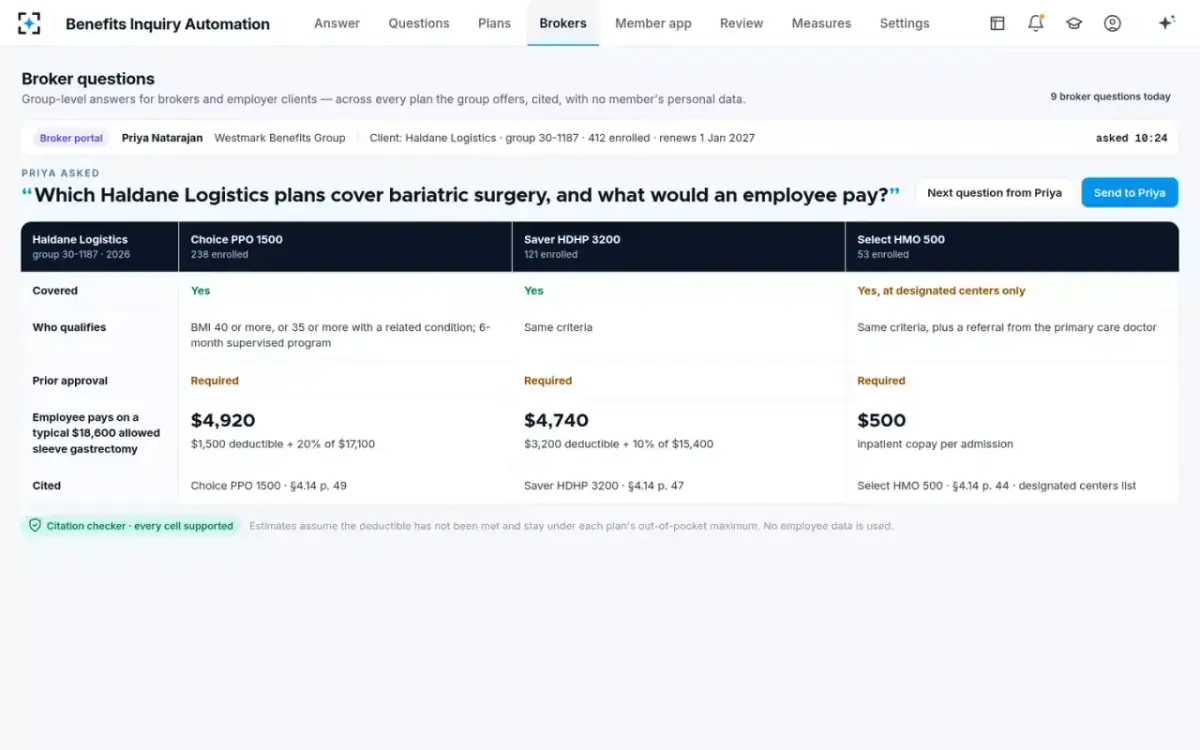
It fits a plan whose representatives, broker service staff and members ask the same coverage, cost, approval and network questions across phone, app and broker portal, and that wants one cited answer behind all three. It reads the systems the plan already runs, writes only when a person clicks, and reports speed and accuracy against paid claims to the service team lead. Brokers get group-level comparisons across every plan a group offers, every cell cited and no member's data.
One answer layer, three channels: the broker view
It is not a contact-center platform, a routing engine or a customer relationship system, and it does not decide claims, prior authorizations, grievances or appeals. It will not answer when the plan's own passages disagree; it hands the question to a benefits specialist with what it found. And a plan that cannot yet approve its documents by group and plan year should start there, because no answer layer can be more current than the documents it is allowed to cite. How the measures look once it is running is shown in first call resolution rate in health plans.
Questions people ask
What does call center automation software cost for a health plan?
Pricing varies by vendor and scope, so the useful comparison is against the work it removes. The Departments, in the 2026 Transparency in Coverage rule, assumed 9 to 10 minutes and $46.50 an hour of representative time for a phone price request; a plan can price its own hunting minutes the same way and compare.
Does automation software need access to claims data?
For cost answers, it needs the accumulators that claims produce and to know whether any claim is pending, which is narrower than full claims access. For Medicare Advantage, the Patient Access API rule already requires adjudicated claims data, including enrollee cost sharing, to be available through the API no later than one business day after a claim is processed.
Can it work with our existing phone system?
It should, and the 2027 price rule assumes as much: it requires estimates through the phone number already printed on the member's ID card. Benefits Inquiry Automation works beside the representative's existing screens and channels, so routing and telephony stay as they are.
Is a member app answer held to the same rules as a phone answer?
The content rules for a cost estimate are the same whichever channel delivers it: the federal self-service tool, paper and phone methods all carry the same required elements. The difference is supervision, which is why the sample app hands a member to a person below its confidence line, on urgent symptoms and while a claim is pending.
What should a pilot measure?
Time to a cited answer, the share of answer sentences supported by the member's plan, callbacks on the same question within 7 days, and estimates against the member's share when the claim pays. Run it on the plan's own documents and recent questions, beside representatives, before widening it.