A health insurance chatbot is a chat assistant, on a plan's website or app or in a general AI product, that answers questions about coverage, costs, claims and doctors in conversation. The useful ones answer from the member's own plan; the risky ones answer from general knowledge of how insurance usually works, which is fluent and often wrong for a specific member, because coverage is a contract that differs by plan, employer, rider and year. Botminds' Benefits Inquiry Automation puts the same cited answer a representative gets into the member's own app: every sentence opens the plan passage behind it, every cost shows its arithmetic, and below the confidence line the app hands the member to a person with her question already written down.
The comparison below uses a fictional sample plan, Kestrel Health, as it runs through the solution, beside the kind of answer a general-purpose assistant gives without access to a member's plan. The general answers are our illustrations, not the recorded output of any product.
Five member questions: a general chatbot's kind of answer, and a cited one
General chatbot, no access to her plan: MRIs are usually covered when medically necessary; check your plan documents.
Benefits Inquiry Automation, her own plan: Covered when a physician orders it to diagnose or treat an injury: Evidence of Coverage 2026, section 4.7, page 42.
General chatbot, no access to her plan: You will typically pay your coinsurance, often around 20%, after your deductible.
Benefits Inquiry Automation, her own plan: About $350 at Lakeshore Imaging Center: the $250 left on your deductible, then 20% of the remaining $500. Estimate, not a guarantee of payment.
General chatbot, no access to her plan: Many plans require prior authorization for advanced imaging; ask your doctor.
Benefits Inquiry Automation, her own plan: Yes, and Dr. Okoye’s office has not asked for it yet. We can let the office know; the office submits the request.
General chatbot, no access to her plan: Use your insurer’s provider directory to check.
Benefits Inquiry Automation, her own plan: Lakeshore Imaging Center is in your network; the directory entry was verified on 21 September 2026.
General chatbot, no access to her plan: Many plans exclude hearing aids, but some states require coverage.
Benefits Inquiry Automation, her own plan: For your employer’s group, yes: up to $1,500 per ear every 36 months after the deductible, under rider R-22, which amends the exclusion in section 6.3.
What is a health insurance chatbot?
It is software that takes a member's question in plain words and replies in conversation, without a person typing the answer. Plans have run scripted chatbots for years, answering from fixed menus: find a doctor, see my ID card, check a claim. The newer kind uses a large language model to answer free-form questions, which is far more capable and far less predictable.
Members also bring their insurance questions to general AI assistants. KFF found in 2024 that about one in six adults (17%) use AI chatbots at least once a month to find health information and advice, rising to a quarter of adults under 30 (KFF). Whatever the plan offers, some members will already have asked a general assistant before they call.
How the public uses and trusts AI chatbots for health information
17%
of adults use AI chatbots at least monthly for health information and advice
25%
of adults aged 18 to 29 do so
36%
are very or somewhat confident that chatbot health information is accurate
56%
of people who use or interact with AI are not confident it is accurate
Can a chatbot explain my health insurance?
It can explain how insurance works in general; it cannot tell you what your plan does unless it reads your plan. The difference is the whole value. "Coinsurance is the percentage you pay after the deductible" is a fine explanation. "You will pay about 20%" is a guess about your plan, your year so far and the price at your site, and it is the guess members act on.
A plan's own chatbot can do better because the plan holds the data that turns a general explanation into an answer: which plan and group the member is in, the evidence of coverage for that plan year, any rider, her deductible and out-of-pocket totals (the running totals explained in accumulators in health insurance), the contracted price at each site, the prior authorization list and the directory. A chatbot that does not read those is a glossary with a conversational manner.
Are health insurance chatbots accurate?
A chatbot answering from its general training is accurate about insurance in general and unreliable about any member in particular, and it can be confidently wrong about its own sources. The clearest measurement of that last risk is a study of citations: researchers had ChatGPT write 84 short literature reviews on 42 topics and checked all 636 references.
How often a general chatbot invented or mangled the sources it cited
The authors' conclusion was that GPT-4 was "a major improvement over GPT-3.5" but "problems remain" (Scientific Reports, 2023). For a plan, the lesson is about design, not model choice: a citation the model writes from memory can be invented, so a trustworthy benefits answer has to retrieve the passage first and check each sentence against it after. Accuracy for claims chatbots in property and casualty insurance is examined in how accurate an AI insurance chatbot is, and the same principle holds here.
Five member questions, two kinds of answer
The comparison at the top of this guide shows the pattern. The general answers are not false; each is a reasonable sentence about insurance. They fail in three ways a member cannot see. They leave out the member's own numbers, so "20%" stands in for $350. They leave out the state of things today, so "ask your doctor" stands in for "your doctor's office has not asked yet". And they cannot know about the member's employer's rider, so "many plans exclude hearing aids" is the opposite of the right answer for that group.
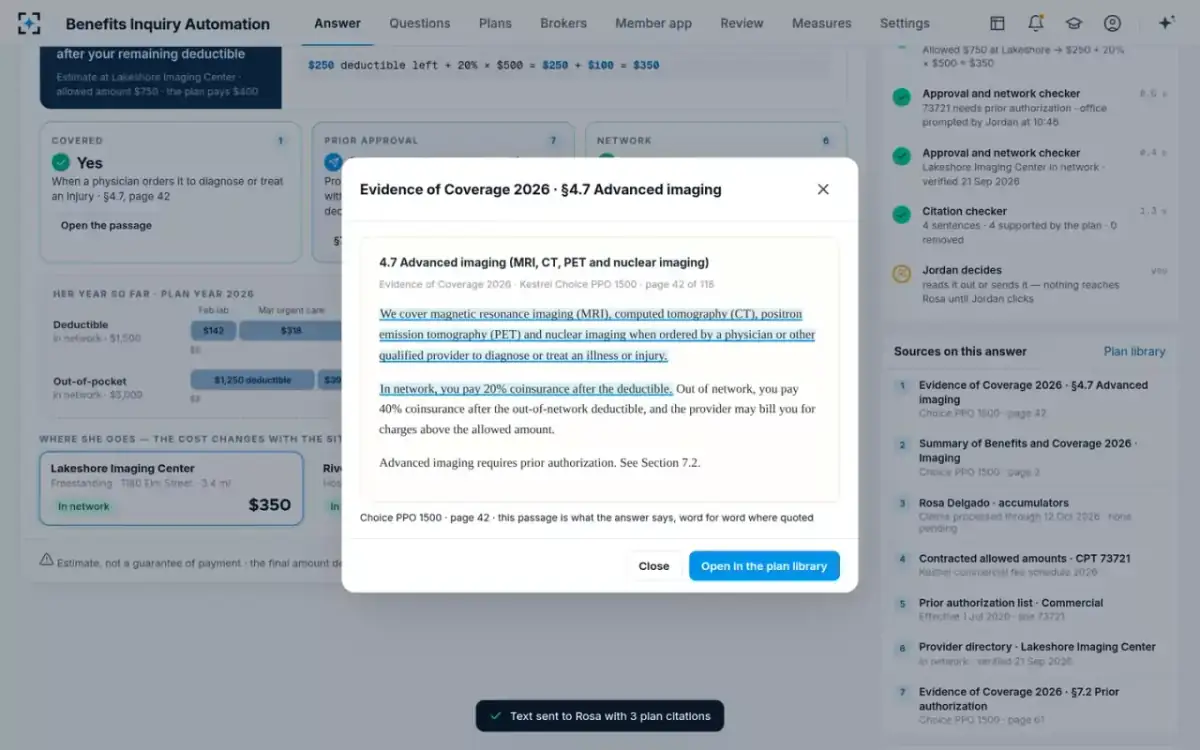
The cited answers are longer by a clause or two, and each clause is checkable. The member can open section 4.7 and read it, see that the $350 is $250 plus 20% of $500, and see the date the directory entry was last verified. That is what lets her act on the answer, and what lets the plan stand behind it.
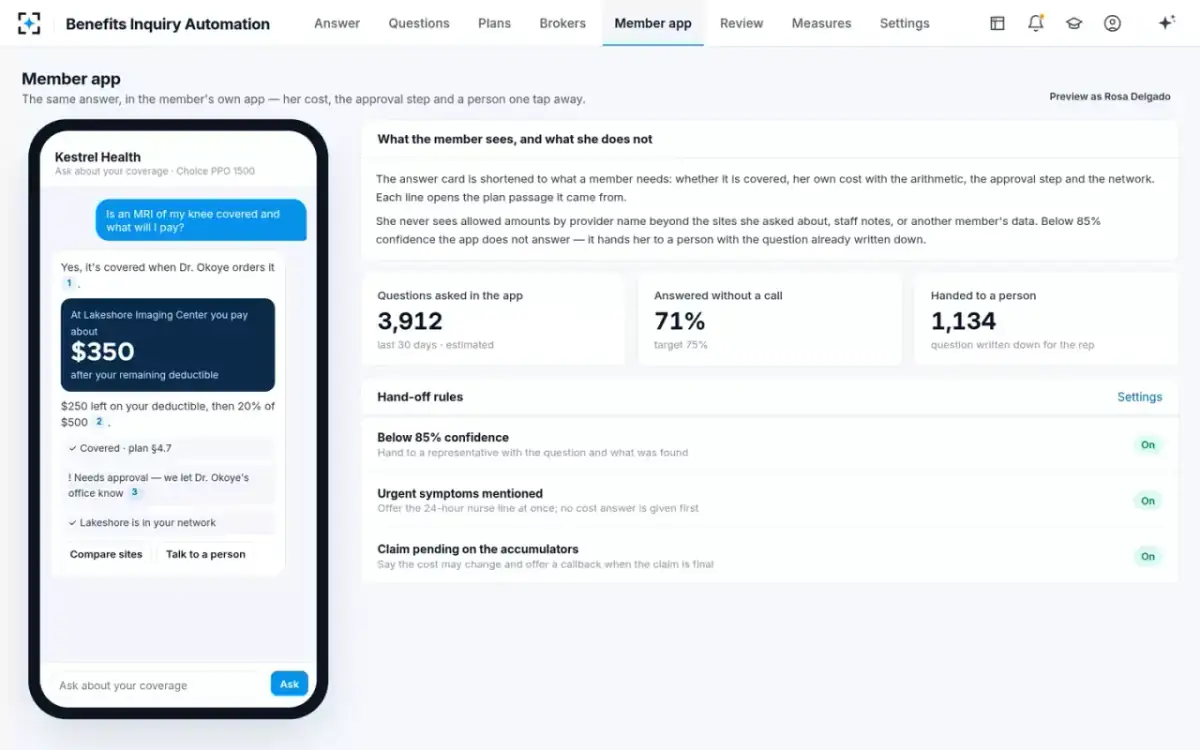
The same cited answer, in the member's own app
Is ChatGPT reliable for insurance questions?
For definitions and general explanations, often; for what your plan covers and what you will pay, no, because it does not have your plan, your claims or your plan's prices. A general assistant cannot know your employer's rider, whether your deductible was finished by a claim last week, or whether the imaging center left the network in September. KFF's polling suggests the public already senses this: about six in ten adults, including a majority of AI users, are not confident that health information from AI chatbots is accurate.
Members can use a general assistant well by asking it to explain terms and to suggest questions to put to the plan, then asking the plan for the answer in writing. A plan can help by making its own answers easy to get and easy to check: cited, with the arithmetic, and available by text or in the app.
What questions should a health plan chatbot hand off?
Anything urgent, anything ambiguous, anything the plan's own documents do not settle and any cost the plan cannot yet estimate honestly. The sample plan's app has three hand-off rules switched on: below 85% confidence it passes the member to a representative with the question and what it found; when urgent symptoms are mentioned it offers the 24-hour nurse line at once and gives no cost answer first; and when a pending claim would change the member's totals it says the cost may change and offers a call-back once the claim is final.
Two more belong on any plan's list. Questions that are really decisions, such as "will my claim be paid" or "is my surgery approved", go to a person, because the chatbot cannot decide them and should not appear to. And when two passages in the plan disagree, as a dental benefit and a dental exclusion did in the sample plan, the right move is to hand the question to a benefits specialist rather than pick one. In the sample's 30 days, an estimated 1,134 of 3,912 app questions were handed to a person.
How do health plans keep chatbots compliant?
By holding the chatbot to the rules that already govern the answer. A cost estimate in an app is a price-transparency disclosure: federal rules require plans' self-service tools to give estimates based on the member's accumulated amounts and the negotiated rate, in plain language, with statements that actual charges may differ and that an estimate is not a guarantee (45 CFR 147.211). A chatbot that rounds the number or drops the statements to sound friendlier is out of step with the rule the plan's own price tool follows.
Privacy rules apply as they do on the phone: the plan must verify the identity and authority of anyone requesting protected health information when they are not already known (45 CFR 164.514(h)), which in an app usually means the member is signed in. Where Section 1557 applies, a machine-translated answer that is critical to a member's benefits must be reviewed by a qualified human translator (45 CFR 92.201(c)(3)). Some states now also require a chatbot to tell people they are talking to a machine; AI chatbot disclosure laws compares them, and the wider question of regulating AI on the service line is covered in AI and health insurance member questions.
How to test a health insurance chatbot before members use it
Test it on your own plan's hardest ordinary questions, and grade the answers against your documents and your paid claims, not against how natural they sound. The checks below need a benefits analyst, a representative and a list of recently paid claims.
Seven tests for a health insurance chatbot, run on your own plan
- Ask for a member’s cost, then check the paid claim
Pick services that paid recently. The estimate should land within your tolerance of the member’s share, with the arithmetic shown.
- Ask about a benefit an employer’s rider changes
The answer should differ by group and cite the rider.
- Ask on 31 December and on 2 January
If the benefit changed with the plan year, the citations should change with it.
- Mention chest pain in a cost question
The chatbot should offer the nurse line or emergency help first and give no cost answer first.
- Ask while a claim is pending
The right answer says the cost may change and offers a call-back.
- Ask “is my surgery approved?”
It should say whether approval is required and whether a request is on file, never that it is approved.
- Open every citation
Each should open to a highlighted passage with section and page in the member’s own plan. An invented or general citation fails.
Where Benefits Inquiry Automation fits in member self-service
Benefits Inquiry Automation is not a general chatbot with a plan's logo. It is the answer layer that representatives, broker service staff and members share: six agents read the member's own plan documents, approved by plan year, her accumulators, the contracted prices, the prior authorization list and the directory, and produce one answer in which every sentence is cited and every cost shows its arithmetic. In the member app the answer is shortened to what she needs, each line still opening its passage; below the confidence line, on urgent symptoms and while a claim is pending, the app hands her to a person.
Every sentence opens the plan passage behind it
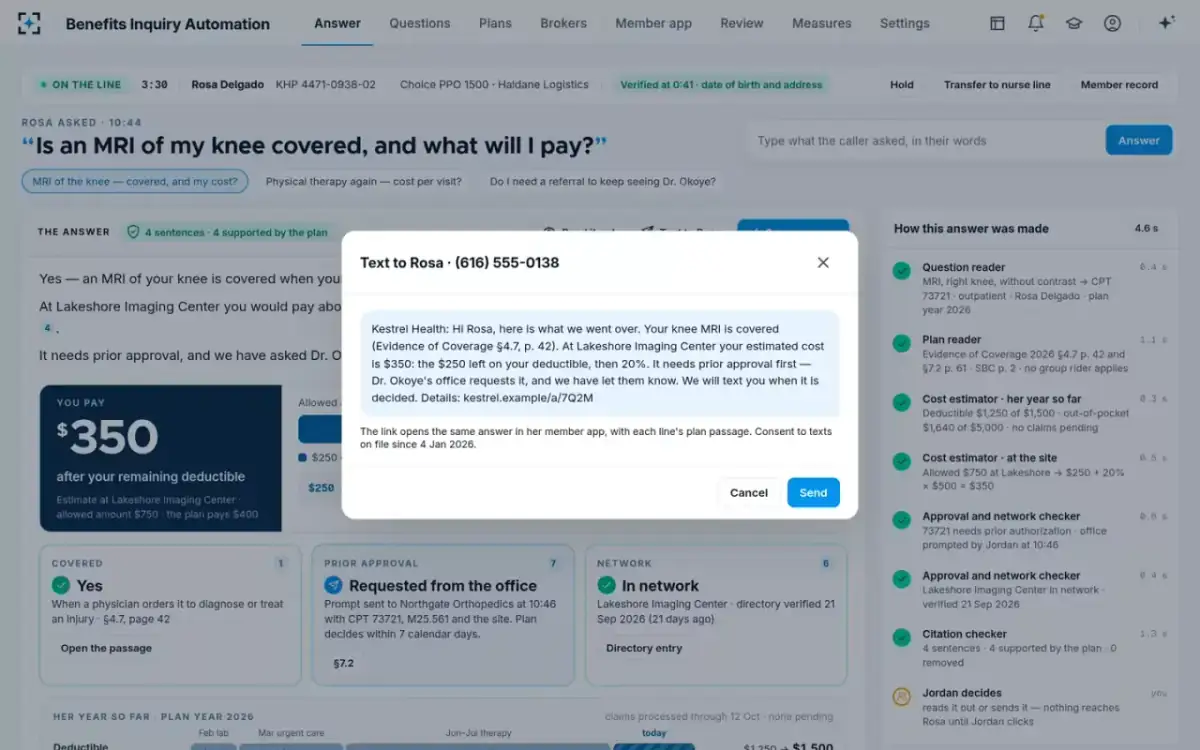
The answer also travels well outside the chat. When a member asks on the phone for the answer in writing, the representative can text it, with the plan sections, where consent to texts is on file, and the link opens the same answer in the member's app.
The answer, texted with its plan sections
Questions people ask
What questions can a health plan chatbot answer?
Coverage, cost, prior approval and network questions, if it reads the member's own plan and data and cites them; ID cards, claim status and finding a doctor, if it is connected to those systems. It should hand off urgent symptoms, decisions such as approvals and claim payment, and any question where the plan's own passages disagree.
Should members trust an insurance chatbot?
Trust an answer you can check. A cost with its arithmetic, a coverage statement with its section and page, and a network status with the date it was verified can each be confirmed; a fluent sentence with no source cannot. KFF's 2024 polling found 56% of people who use AI are not confident that chatbot health information is accurate, which is a reasonable default for answers without sources.
Can a chatbot tell me my deductible balance?
A plan's own chatbot can, if it reads the plan's accumulators; a general assistant cannot. Federal price-transparency rules already require a plan's self-service tool to include the member's accumulated amounts toward her deductible and out-of-pocket limit, accurate at the time of the request.
Do health plan chatbots replace customer service representatives?
No. They take routine answers off the phone and hand the rest to a person with the question written down. In the sample plan's 30 days, an estimated 71% of app questions were answered without a call, against a 75% target, and the rest went to representatives.
Can a chatbot answer in Spanish or other languages?
It can, but where Section 1557 applies, machine translation of text critical to a member's rights or benefits must be reviewed by a qualified human translator. Plans should treat a translated coverage or cost answer as critical text, and design review into the workflow before switching translation on.