When a producer's license lapses, an insurance appointment either terminates by operation of law or must be terminated by the carrier, and the carrier and agency take on three obligations at once. They must stop accepting new business from that producer in that state, because the NAIC's Producer Licensing Model Act lets regulators discipline anyone "knowingly accepting insurance business from an individual who is not licensed." They must not pay commission on business written without the license, while renewal commissions on business written while licensed may still be paid. And a carrier that ends the appointment must notify the state within 30 days of the termination and send the producer a copy within 15 days after that. The hard part is timing: the lapse happens on the state record before anyone at the carrier or agency notices, and every sale in between is a sale through an unlicensed producer. Botminds' Producer Licensing & Appointment Management reads the state record every morning, ages each license 180 days ahead and prepares each renewal, so the lapse is fixed before it happens.
This guide is written for carrier producer-compliance teams, agency principals and licensing leads. The rules are quoted from the NAIC model act and handbook and from state law, linked where they appear; the screens show the solution on a fictional sample agency.
After a lapse: the notice clocks under the NAIC model, drawn to scale
- Notify the commissioner within 30 days30 d
- Copy to the producer within 15 days of the notice15
- Producer may comment within 30 days of receipt30 d
- Reinstate without an exam, double the renewal fee0–12 months
What must a carrier do when a producer's license lapses?
Stop new business, hold new commission, and settle the appointment on the record. The model act's condition for staying licensed is simple: a license "shall remain in effect unless revoked or suspended" as long as the fee is paid and "education requirements for resident individual producers are met by the due date" (Model #218, §7B). Miss either and the license is not in effect, whatever the carrier's own systems still show.
The carrier's and agency's obligations when a producer's license lapses
| Obligation | What it requires | Rule |
|---|---|---|
| Stop accepting new business | No applications from the producer in that state for that line until the license is active | Model #218 §12A(12): discipline for knowingly accepting business from an unlicensed individual |
| Hold new commission | No commission for selling, soliciting or negotiating while unlicensed; the producer may not accept it either | §13A, §13B |
| Keep paying earned renewals | Renewal and deferred commissions on business written while licensed may be paid | §13C |
| Settle the appointment | Terminate it, or confirm the state has ended it for the expired license | §15; state appointment law |
| Notify the state | Within 30 days after the termination takes effect, in the state’s format | §15B (without cause) |
| Copy the producer | Within 15 days after notifying the state, to the last known address | §15D–E |
When does an insurance appointment terminate?
In some states automatically when the license expires; in others only when the carrier files a termination. New York's statute says a certificate of appointment is valid until it is terminated, the license is suspended or revoked, or "the license expires and is not renewed" (N.Y. Ins. Law §2112(c)(3)). Where NIPR bills appointment renewals, a lapsed license drops off the invoice; Connecticut's page says "For an appointment to be invoiced, appointees must have an active license. Active appointments on an inactive license will not be invoiced" (NIPR, Connecticut renewals).
Where the appointment does not end on its own, the carrier ends it, and the model act's two termination paths set the notice. A lapse for a missed fee or missed CE is not one of the disciplinary grounds in §12, so the carrier files under §15B, termination without cause, "within thirty (30) days following the effective date of the termination." A termination for one of the §12 reasons, such as a producer found to have sold while unlicensed, goes under §15A, and the copy to the producer must then go "by certified mail, return receipt requested" or by overnight delivery (Model #218, §15).
The distinction matters to the producer's record. The NAIC's uniform license application tells applicants: "You may EXCLUDE terminations due solely to noncompliance with continuing education requirements or failure to pay a renewal or late filing fee" (NAIC Uniform Application, background question 2). A carrier that files a lapse as a for-cause termination puts a finding on a producer's record that the facts do not support.
Commissions after a lapse: what to hold and what to keep paying
Hold commission on new business written without the license; keep paying renewals on business written while licensed. The model act states both halves. An insurer or producer "shall not pay a commission, service fee, brokerage or other valuable consideration to a person for selling, soliciting or negotiating insurance in this state if that person is required to be licensed under this Act and is not so licensed," and the person may not accept it (§13A–B). Renewal and other deferred commissions may still be paid to a person who was licensed at the time of the sale, solicitation or negotiation (§13C).
"The person's receipt of renewal or other deferred commissions does not result in any licensing requirement."
NAIC State Licensing Handbook, ch. 2, FAQ 7
The commission system therefore needs the license history by date, not the current status. A producer who lapsed on 30 November and reinstated on 15 January is owed renewals throughout, owed nothing on anything written in between, and owed new commission again from reinstatement. For the producer and agency, the cost of a lapse is the new business each week it lasts, and it scales with the book. Commission splits and the model's wording are traced further in commission split rules for insurance agents.
Commission and brokerage at stake for each week a producer cannot write, at the 2024 national ratio
Business written during a lapse: what regulators find
Regulators find these sales by matching policies to licenses on the sale date, which is what a carrier should do first. Kansas's 2020 consent order with one insurer recorded that over three years "170 policies were issued from 58 separate producers not licensed in Kansas at the time of sale," and that six of those producers were licensed only afterwards (Kansas Insurance Department, Docket 81589); the insurer neither admitted nor denied the allegations. A license that comes back next week does not reach back to cover a sale made this week.
The regulator's reach also outlasts the license. The model act keeps the commissioner's power to pursue a violation "even if the person's license or registration has been surrendered or has lapsed by operation of law" (§12E). For the carrier, the practical response to a found lapse is a dated list: every policy the producer bound in the state between the lapse and reinstatement, the commission paid on each, and what was done about it. What an examiner asks to see is in the insurance license compliance exam file.
Reinstatement: license first, appointment second, business third
The order is fixed: the license must be active before the appointment can be valid, and the appointment must be filed before the producer writes for that carrier again. The model act lets an individual producer reinstate "within twelve (12) months from the due date of the renewal fee" without an exam, at "a penalty in the amount of double the unpaid renewal fee" (§7C); Illinois enacted the same rule (215 ILCS 5/500-35(d)). States price the window differently: California's late renewal fee for a property and casualty broker-agent is $282 against a $188 renewal (CDI fee schedule), and Texas gives a producer short of CE 90 days to finish the hours at $50 an hour before it inactivates the license (TDI).
The appointment does not always come back with the license. Pennsylvania's rule is explicit: "If an appointment has been terminated on the records of the department, it may not be revived. The insurer shall issue a new appointment with a new effective date in the standard appointment format" (31 Pa. Code §37a.21(b)(7)). A new appointment starts a new filing clock, 15 days from the first application under the model, and every sale before it is filed is a sale through an unappointed producer; just in time appointment states explains where that window is allowed.
What a carrier should be able to show after a lapse
An examiner reviewing a lapse asks for a timeline, and the carrier should be able to produce it from its own files without asking the producer. The table lists what each part of the timeline rests on.
The evidence for one producer's lapse, and where it comes from
| Evidence | What it shows | Source |
|---|---|---|
| License history by date | Expiry, lapse and reinstatement dates, per state and line | NIPR producer record or the state lookup, captured on each date |
| Appointment filings | When the appointment was filed, renewed, terminated or re-filed | The carrier’s filings through NIPR, with confirmation numbers |
| Termination notice and producer copy | Filed within 30 days; copy sent within 15 | The filing record and the mailing record |
| Policies bound during the gap | Every application accepted from the producer between lapse and reinstatement | Policy system, matched to the license on each bind date |
| Commission records split by date | New commission held for the gap; renewals paid as earned | Commission system, with the hold and its release |
| Who decided each cure | The name and date on each hold, termination and re-appointment | Licensing and compliance sign-offs |
The weakest link is usually the second-to-last row. Commission systems pay on the current status of the producer, so a producer reinstated before the commission run is paid on business written during the gap unless the hold was entered by date. A sales match on the bind date catches the policies; only a date-aware hold catches the money.
Agency licenses: when the designated responsible producer leaves
An agency license can go inactive without any producer missing a renewal, because the model act requires a business entity to designate a licensed producer responsible for its compliance (§6B(2)). If that person leaves or loses their own license, every producer selling through the agency in that state is exposed. The NAIC recommends that states give the agency a reasonable number of days to name a replacement before the license goes inactive.
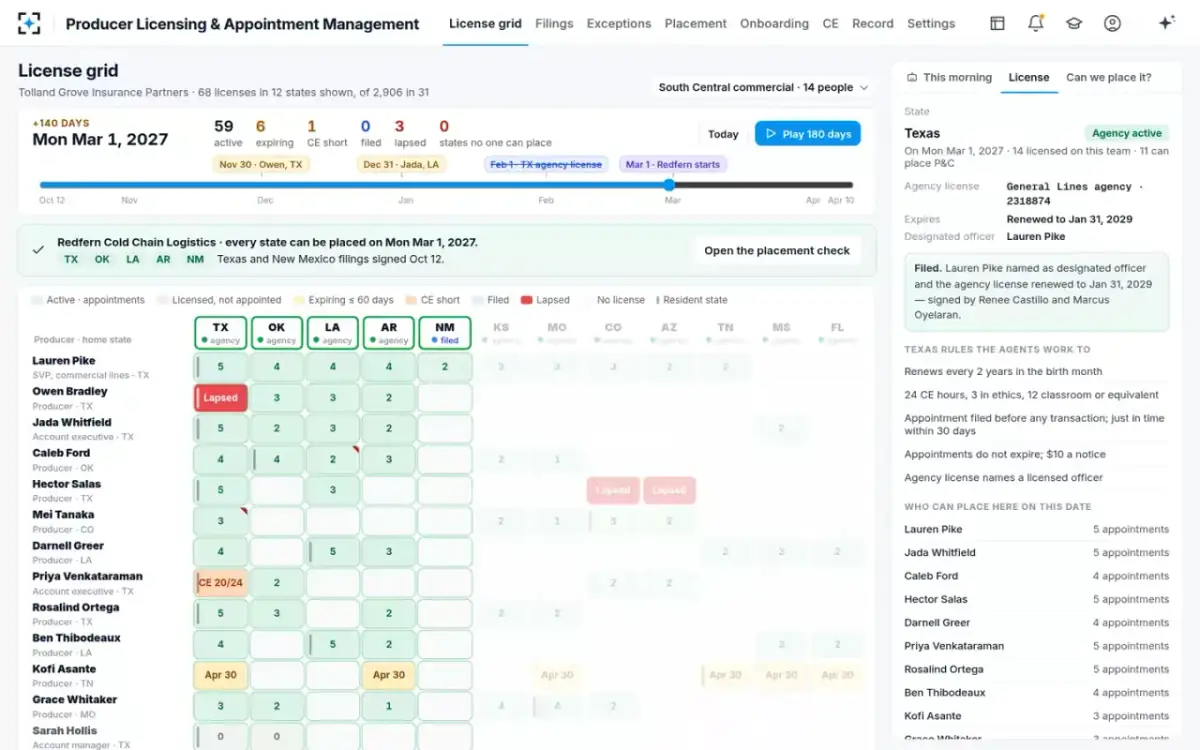
In the fictional sample agency, the grid turned the whole Texas column red months ahead of the day the agency's own license would lapse, because its designated officer had left. The Texas agency renewal and the officer change were prepared and held until a licensed officer was named; once the filings were signed on 12 October, the agency license showed renewed to 31 January 2029.
A lapse Producer Licensing & Appointment Management saw coming
How carriers and agencies prevent the lapse
Treat each renewal as a filing with dependencies and a lead time, and watch the state record rather than a copy of it. A renewal needs the fee, the CE posted to the state's transcript, the renewal application's answers and, for an agency, a designated responsible producer who is still there; Texas encourages licensees to finish CE at least 30 days before expiry so providers can report it in time.
Controls that keep producers off the lapse, and the carrier out of the exam report
- Read the date the state holds
From the NIPR producer record or the state lookup each day, not from a spreadsheet.
- Warn early enough to post CE
At 90, 60 and 30 days, with ethics hours tracked separately; they are often the last taken.
- Renew resident licenses first
Nonresident licenses rest on good standing at home.
- Watch the agency’s responsible producer
A departure can stop every producer in the state.
- Block new business on the lapse date
Match every bound policy to the license and appointment on its bind date.
- Split commissions by date
Hold new commission for the lapse period; keep paying renewals earned while licensed.
- File terminations on the right path
Without cause for a missed fee or CE, within 30 days; copy to the producer within 15.
- Reinstate in order
License, then a new appointment where the old one cannot be revived, then new business.
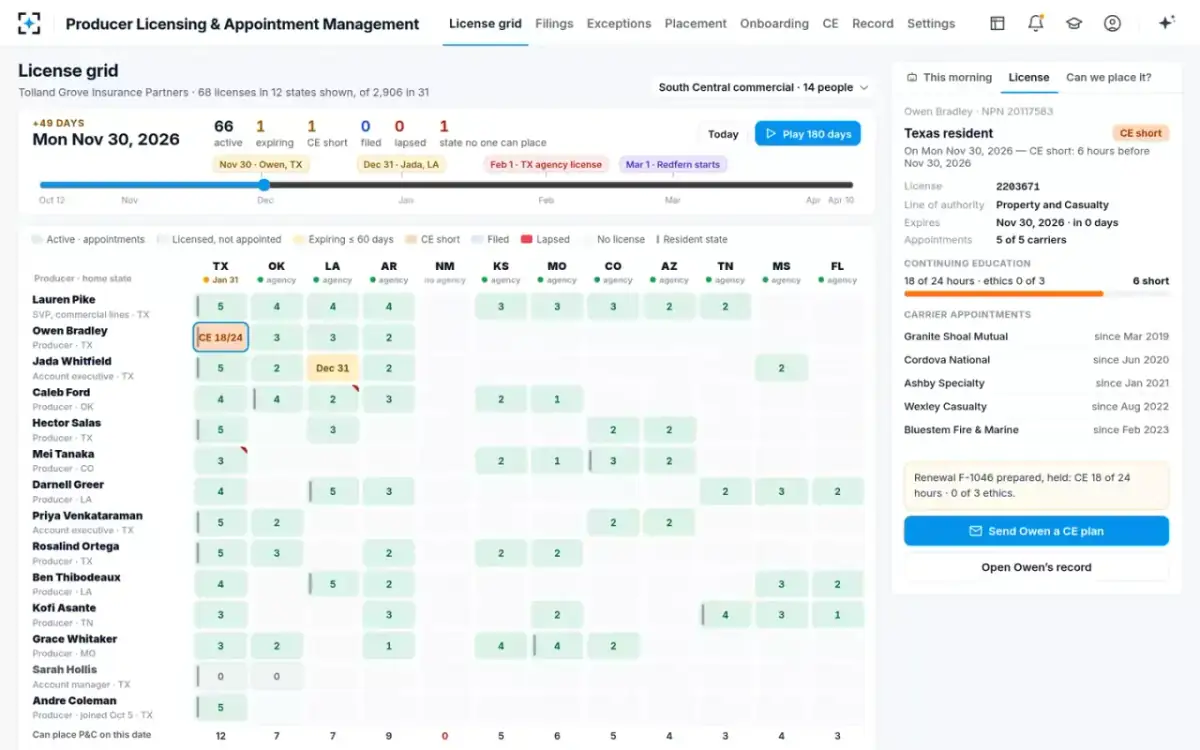
In the sample agency, the watcher flags a producer's Texas license 49 days before it expires, six CE hours short with no ethics hours posted. The renewal is prepared and held, a CE plan is one click away, and producer and licensing lead are warned at 90, 60 and 30 days by default; the 180-day look-ahead is the design target. Nothing is filed until a person signs.
49 days out: the renewal is prepared and held, and the gap is named
The difference between a license and an appointment, and who owns each, is set out in insurance license vs appointment. The whole series starts from Producer Licensing & Appointment Management.
Questions people ask
How long does a carrier have to report an appointment termination?
Under the NAIC model, 30 days after the termination takes effect, for cause or without, with a copy to the producer within 15 days of the notice. For cause, the copy goes by certified mail with return receipt or by overnight delivery. States adopt the model with variations.
Is a license lapse a termination for cause?
Not by itself. A missed renewal fee or missed CE is not among the model act's §12 grounds, so the carrier files it as a termination without cause. The NAIC's uniform application lets producers exclude such terminations when answering its background question on administrative actions.
Can a carrier pay commission to a producer whose license lapsed?
Not on business written while unlicensed: the model act bars paying or accepting commission for selling without a required license. Renewal and deferred commissions on business written while licensed may still be paid, and the NAIC handbook says receiving them creates no licensing requirement.
Does a reinstated license restore the appointment?
Not everywhere. Pennsylvania says a terminated appointment may not be revived and the insurer must issue a new one with a new effective date. Under the model, that new appointment must be filed within 15 days of the agency contract or the first application.
What happens to policies a producer wrote during a lapse?
They were sold by an unlicensed producer, and regulators treat them that way: Kansas's 2020 consent order counted 170 policies from 58 producers not licensed at the time of sale. The carrier should list every such policy with the commission paid and the cure taken, because the regulator's power reaches lapsed licenses too.
How long can a producer's license be lapsed before a new application is needed?
Under the NAIC model and in Illinois, 12 months from the renewal due date, at double the renewal fee and without an exam. In Texas a license short of CE is inactivated 90 days after expiry, after which the producer must apply for a new license.