Producer licensing is the work of keeping every person and entity that sells insurance for a carrier, MGA or agency licensed for the right lines in every state where they sell, appointed where states require it, current on continuing education, and provably so when a carrier or an examiner asks. The workload is producers times states times carriers: one producer in 12 states, appointed by five carriers, is 12 licenses and up to 60 appointments, each renewing on its own calendar, and nearly every filing has a deadline measured in days. A licensing team that tracks this from spreadsheets and state portals usually learns of a lapse after it has happened, and a sale through an unlicensed or unappointed producer is a regulatory finding and a commission problem at once. Botminds' Producer Licensing & Appointment Management reads the national producer database every morning, ages every license forward, prepares the filings and matches each sale to a license on its bind date; the licensing lead decides and signs.
This guide is written for the people who own producer licensing: heads of distribution compliance, licensing leads and the agency principals and carrier compliance officers who answer for it. The examples come from a fictional sample agency, Tolland Grove Insurance Partners in Dallas, as it runs through the solution. The rules and statistics come from the NAIC, state regulators and the National Insurance Producer Registry (NIPR), the NAIC's non-profit affiliate, linked where they appear.
The license grid every producer licensing team works inside
12.5M
individuals and entities licensed to provide insurance services in the US, 2022
9.5M
nonresident individual producer licenses, against 2.3 million resident ones
185.9M
transactions run through NIPR for states and industry in 2025, up 29%
9.2M
producer records in NIPR’s database at the end of 2025
What does producer licensing involve for a carrier or agency?
It involves three grids and the evidence for each. The NAIC's Producer Licensing Model Act (#218) starts from one rule: a person "shall not sell, solicit or negotiate insurance in this state for any class or classes of insurance unless the person is licensed for that line of authority" (Model #218, §3). A license is needed per state and per line, so the team tracks a grid of licenses. In states that require appointments, the carrier must file one within days of the producer's first sale for it, so there is a grid of appointments. And the agency is itself a licensed producer with a designated responsible licensed producer, so there is a third grid of entity licenses.
The tasks follow from the grids: license applications and renewals through NIPR, appointment and termination filings, CE tracking against each renewal, address and name changes, reports of actions against producers, and the reports carriers and examiners ask for. Almost every one has a statutory clock, which is what makes producer licensing a compliance function rather than an administrative one. What examiners ask to see is set out in the insurance license compliance exam file.
The statutory clocks a producer licensing team works to
Each filing carries its own deadline. The model act sets most of them, states adopt them with variations, and the team has to know which version applies where.
Producer licensing filings, and the deadline behind each one
| Filing | The clock under the NAIC model | Variations and details |
|---|---|---|
| File a carrier appointment | 15 days from the agency contract or the first application, whichever comes first (§14B) | Texas allows 30 days from the appointment’s effective date; Colorado has no appointments at all |
| Report a termination | 30 days after it takes effect; a copy to the producer within 15 days after that (§15) | For cause, the copy goes by certified mail or overnight carrier |
| Renew each license and match CE | By the renewal due date; 24 CE credits every two years, 3 in ethics (NAIC Uniform Licensing Standards) | Florida varies the hours with years licensed; New York’s statute sets 15 credit hours |
| Reinstate a lapsed license | Within 12 months of the renewal due date, at double the renewal fee, no exam (§7C) | Texas inactivates a license 90 days after expiry if CE is still short |
| Report an address change | Within 30 days of the change (§7F) | Texas wants an officer or partner to sign an agency’s change |
| Report actions against a producer | 30 days after an administrative action is final; 30 days after the first pretrial hearing in a prosecution (§17) | One NIPR filing can reach every state the producer holds a license in |
| Keep the agency license and its responsible producer | A business entity needs its own license and a designated licensed producer (§6B) | Texas: an officer or active partner must be individually licensed; officer changes within 30 days |
Two rows carry most of the risk. The termination clock runs from the date the relationship ends, not the date someone notices, so a producer who quietly stops writing for a carrier can put the carrier out of time with nobody on the licensing team told. And reporting actions against a producer is the producer's duty but lands on the team in practice; the NAIC's own handbook concedes "it can be difficult to ensure that all relevant states received the report" (State Licensing Handbook, ch. 15). Which clocks start when a license lapses is worked through in insurance appointment termination.
Why producer licensing workload grows with states and carriers
The workload is producers multiplied by the states each sells in, multiplied again by the carriers that appoint them. A ten-person agency that writes in 30 states has more licensing work than a 40-person agency that stays at home, which is why small, multi-state teams feel it most.
The national counts show the multiplier. In 2022 states issued 2.3 million resident licenses to individual producers and 9.5 million nonresident ones, about four nonresident licenses for every resident one (NAIC, Insurance Department Resources Report, our arithmetic). Each nonresident license is a separate renewal date and a separate fee, even where CE follows the home state under reciprocity.
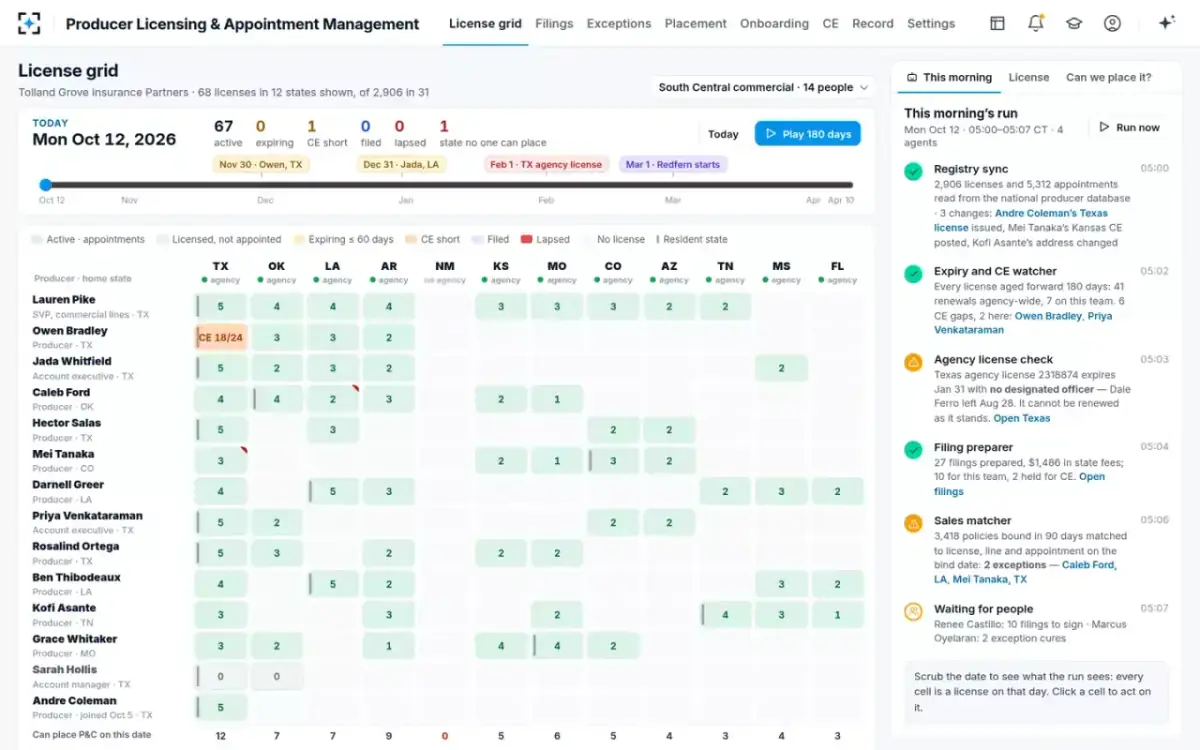
The fictional sample agency makes it concrete. Tolland Grove keeps 214 licensed people across 31 states, and the morning read in the solution finds 2,906 licenses and 5,312 carrier appointments on the national producer database: on average about 13.6 licenses and 25 appointments per person, each with its own expiry or renewal invoice. One regional team of 14 people holds 68 licenses in 12 states.
Producer Licensing & Appointment Management's grid: producers down the side, states across
How many producers can one licensing specialist manage?
No regulator, university or non-profit publishes a producers-per-specialist ratio, and a ratio would mislead, because a producer licensed in two states is a different load from one licensed in twenty. A better way to size the team is to count the events a roster generates in a year and price each in minutes.
A producer licensing workload count to run on your own roster
| Event a year | How to count it | The sample agency’s average per person |
|---|---|---|
| License renewals | Licenses held ÷ years in each state’s term (one to four years, NIPR says; two in Texas, Illinois and Pennsylvania) | About 6.8 (13.6 licenses ÷ 2) |
| CE checks | One per resident renewal, plus any nonresident state whose home-state CE is not accepted | At least 1 every two years |
| Appointment renewals | Appointments in states that invoice renewals, by each state’s cycle (annual or biennial) | Up to 25, depending on the states |
| New appointments and terminations | Carrier additions, producer moves and departures | Varies with hiring and turnover |
| Address, name and action reports | Each change, filed within 30 days in every state that licenses the person | 1 change × up to 14 states |
Multiply each count by the minutes your team spends on it today, and the hours fall out. Botminds' design estimate, for one producer licensed in several states, is about 11.5 hours a year by hand: three on expiry dates and CE, four on preparing and filing renewals, two on appointments and terminations, one on onboarding documents and one and a half on audit proof. At 214 producers that is roughly 2,460 hours a year, more than one full-time person before any exception is handled; the useful version is the one built from your own roster.
Where a producer's licensing hours go in a year, by hand
One producer, several states · about 11.5 hours (estimate)
- Renewals in state portals · 35%
- Expiry dates and CE · 26%
- Appointments, terminations · 17%
- Audit proof · 13%
- Onboarding papers · 9%
When is the producer licensing busy season?
The busy season follows the appointment renewal calendar, and it never quite ends. States that renew appointments send insurers an invoice once a year or once every two years through NIPR, and each invoice has a termination cut-off a week or more before it opens. An appointment not terminated by the cut-off is billed, and once the list is generated it cannot be changed.
When the appointment renewal invoices open on NIPR
| Months | Jurisdictions invoicing through NIPR | What to finish first |
|---|---|---|
| January to March | Rhode Island, New Mexico, Iowa, Kentucky (2026 cycle), Alabama and Wisconsin (2027), North Carolina from 3 February, North Dakota and DC from March 2027 | Terminations before each cut-off: Rhode Island 25 December, New Mexico 26 December |
| April to June | New Jersey, South Dakota, Connecticut (even years), Nebraska, Arkansas, Vermont, West Virginia from 8 June | Connecticut stops accepting terminations on 15 April |
| July to September | Louisiana business entities, Massachusetts, South Carolina (even years, from 1 September) | Massachusetts bills every appointment active on 1 July |
| October to December | Illinois (limited lines only) from 2 November, Oklahoma from 25 November, Louisiana individuals from 1 December | Oklahoma terminations by 14 November |
Each missed cut-off has a price: a year's or two years' renewal fee for an appointment nobody uses. What those fees come to per producer, state by state, is set out in insurance appointment fees by state. Individual license renewals add a flatter second peak, because the NAIC's standards say "the license term should be tied to the birth date or birth month" (State Licensing Handbook, ch. 14), which spreads renewals across a large roster and bunches them unpredictably for a small one.
Who on the producer licensing team must be licensed, and who signs what?
The people who file are usually exempt; the person who answers for the agency is not. The model act exempts officers and employees of insurers and producers whose work is administrative or clerical and who receive no commission on the policies written (Model #218, §4B(1)), but it requires a business entity to name a licensed producer responsible for its compliance (§6B(2)). An agency whose designated responsible producer leaves can lose the license every producer in that state sells under.
Four people around one license grid, before and with agents doing the reading
Today
Keeps 214 people legal in 31 states from spreadsheets and state portals, and learns of a lapse after it has happened.
With agents
Moves the grid 180 days forward to see what will lapse, and signs filings already prepared, with each state fee shown.
Still theirs: The signature on every producer renewal and appointment.
Today
Types the same producer number into the same portals for each renewal and appointment, and chases CE certificates.
With agents
Works a list of prepared filings, each with its form, fee, due date and the reason any is held.
Still theirs: The checking: does the prepared filing match the producer and the state?
Today
Hears about a sale through an unappointed producer when a carrier or a regulator asks.
With agents
Sees every bound policy checked on its bind date and decides each cure and any commission hold.
Still theirs: Cures, commission holds and the second signature on agency filings.
Today
Quotes a multi-state account, then finds a state no one on the team can place.
With agents
Knows before quoting which locations can be placed on the start date, and what would fix the rest.
Still theirs: Their own CE hours and their own license application.
Writing the split down matters most in small teams, where one person wears all three hats: the specialist prepares and checks, the licensing lead owns the calendar and signs, and the compliance officer decides what happens when a sale went through without the right license or appointment. In the sample, the agency's own Texas license was due to expire on 31 January with no designated officer, a gap the grid showed months ahead as a whole Texas column at risk.
The controls that keep producer licensing off the exam report
Four controls catch most licensing failures before an examiner does. A daily read of the state record, not a spreadsheet copy, so the team sees what the state sees. A forward look past the next appointment cut-off in every state, which can be three months ahead of the invoice itself; the sample agency's design target is 180 days. A match of every bound policy to the producer's license and appointment on its bind date. And a named signature on every filing, with nothing submitted until a person signs.
The sales match is the control most teams lack, because the policy system and the licensing records rarely meet. In the sample, the morning run matched 3,418 policies and raised 2 exceptions for the compliance officer, each a sale to be cured or a commission to hold. How a license layer reads NIPR and the agency system directly, without becoming another copy, is set out in insurance license management software.
Prepared filings, each with its form, fee, due date and the reason any is held
Where Producer Licensing & Appointment Management fits in licensing operations
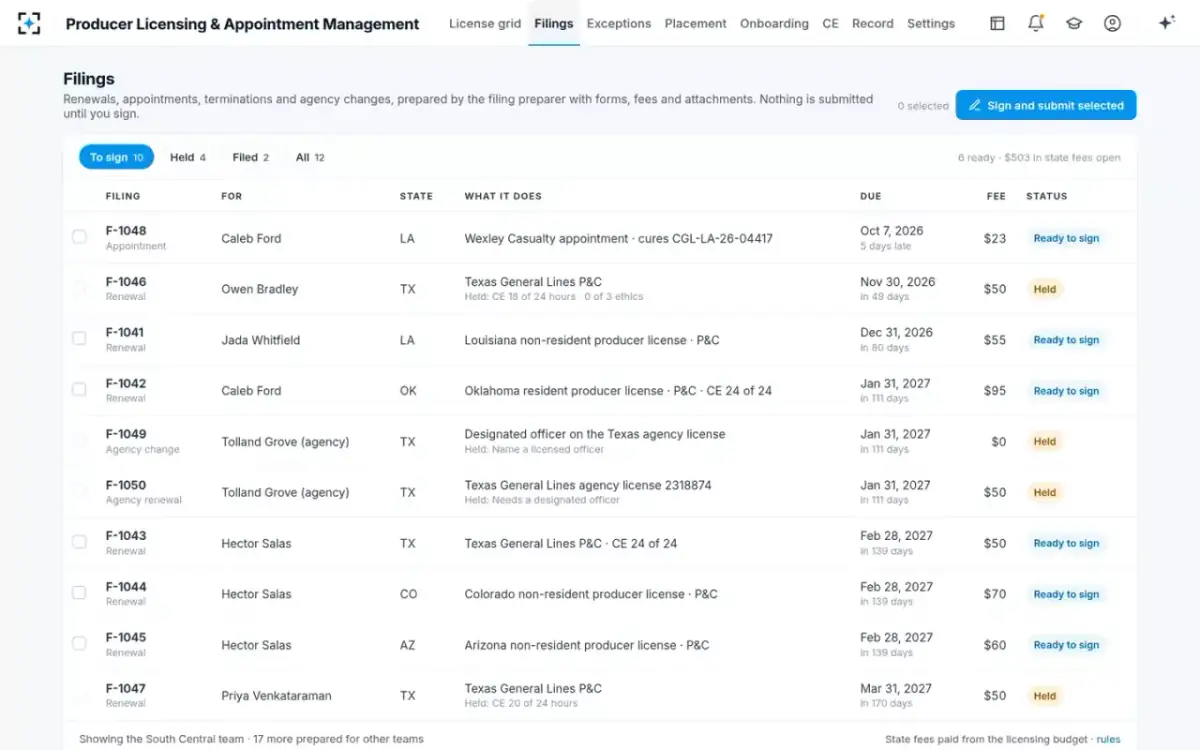
The reading and preparing are what the agents carry. A registry agent reads every license, line of authority and appointment each morning; a watcher ages each one forward and compares CE transcripts with each state's rule, warning at 90, 60 and 30 days; a filing agent prepares renewals, appointments, terminations and agency changes with the form and the state fee; a sales matcher checks each bound policy against the license on its bind date. Everything that carries legal weight stays with people: signing filings, naming an agency's responsible officer, deciding a cure or a commission hold.
In the sample, the licensing lead's Monday starts with ten filings for her team, six ready and the rest held with their reasons, plus two exceptions for the compliance officer; a Louisiana appointment is already five days late and goes to the top. The boundary between what the agents prepare and what people sign, filing by filing, is the subject of licensing compliance software, and the whole series starts from Producer Licensing & Appointment Management.
Questions people ask
What is producer licensing in insurance?
The state licensing of anyone who sells, solicits or negotiates insurance, per state and per line of authority, under laws modelled on the NAIC's Producer Licensing Model Act. For a carrier or agency it also covers appointments where states require them, continuing education, the agency's own entity license and the reports regulators require.
How far ahead should a producer licensing team look?
At least past the next appointment renewal cut-off in every state the roster touches, which can be three months before the invoice opens. The sample agency's design target is 180 days, so a CE shortfall, an agency license without a responsible officer or a new account in an unlicensed state shows up while there is time to fix it.
Who should own appointment terminations when a producer leaves?
The carrier must report the termination to the state within 30 days and send the producer a copy within 15 days after that, under the model act. The licensing team should own the trigger, because the producer's agency, not the carrier, usually knows first.
Do nonresident licenses need a letter of certification from the home state?
Generally no. The NAIC's uniform application says the state will rely on electronic verification of the resident license through the NAIC's State Producer Licensing Database instead of an original letter of certification. The resident license must still be active and in good standing for the lines requested.
What is a National Producer Number?
A unique NAIC identifier assigned during the licensing application process to individuals and business entities in the Producer Database. A licensing team uses it to pull one producer's licenses and appointments from every state at once.
How many licenses does a typical multi-state producer hold?
Nationally there were about four nonresident licenses for every resident license in 2022, from the NAIC's counts of 9.5 million and 2.3 million. In the fictional sample agency, the average person held about 13.6 licenses and 25 carrier appointments.