The toxicology report time frame — the stretch between a complete data package and a study report a study director will sign — runs to about eleven working days on a 28-day repeat-dose study, and almost none of it is scientific work. Reading the plan, re-keying tables, writing results, cross-checking every figure, chasing what is missing and reviewing the draft: six tasks, of which two are typing and one is checking the typing. Botminds' Preclinical Study Report Automation exists for that middle. It drafts all nine sections overnight from the signed study plan and the raw data export, inserts each number as a reference to the cell it came from, and lists what the package does not hold — leaving the study director's review and the waits on other people, which are the parts that should not compress.
Every day figure on this page comes from a working demonstration on an invented study — VLT-TOX-028, 28 days, subcutaneous, with invented people — and from the demonstration team's own estimates of how the manual work divides. They are not an industry average and not any laboratory's measured result. The regulatory and wage figures are published, and linked where they appear.
One 28-day report, from data received to a signed draft
11.2days
from data package to signed draft by hand, the demonstration team’s own baseline
1.4days
the design target with the six agents drafting and checking
9sections
drafted overnight from the signed plan and the export, on the sample study
166
numbers in the signed draft, each carrying its file, sheet and cell
How long does a toxicology study report take to write?
One to two weeks of working days for a standard repeat-dose report, once the data package is complete — and longer in elapsed time, because the package is rarely complete on the day the last animal is examined. The number varies with the study's size and the house template, but the shape of it is stable: a repeat-dose report has nine sections, ten to twenty tables and somewhere between 400 and 4,000 individual numbers, and the numbers are the work.
What makes the estimate hard to compare between laboratories is where people start the clock. Some count from the last in-life day, some from the pathology report, some from the day the data package is declared complete. The only comparable measure is the last one, and it is the one most groups do not record. A laboratory that wants a figure it can defend has to date-stamp two events — package complete, draft signed — and let a few studies run.
What happens after the in-life phase ends
The in-life phase ending is not the start of writing. Between the last dose and a complete package sit the terminal procedures and a queue of specialist work: necropsy and tissue collection, clinical pathology analyses, organ weights, histology processing, the pathologist's microscopic reading and peer review, the bioanalytical run and the toxicokinetic analysis. Each produces data the report needs, and several produce a signed contributing report that the final report rests on.
Those contributing reports are not a formality. The OECD principles require that "reports of Principal Investigators or scientists involved in the study should be signed and dated by them", and the GLP regulation requires the signed and dated reports of the individual scientists to be part of the final report. A draft written before the pathology is released is a draft that will be rewritten.
In the demonstration study, the package arrived on 5 October with the report due on 16 October, and two things were still outstanding: one week of food consumption that had never reached the export, and the recovery microscopic pathology, which study plan section 9.4 required. Both were found on the first pass rather than in the third week.
Why toxicology reports take so long: the eleven days, task by task
Split the 11.2 days across the six tasks and the picture is uncomfortable for anyone who assumes report writing is writing. Three days go on re-keying tables from the export and two on cross-checking those numbers against the raw data — five days of the eleven spent moving and verifying figures that already exist in a file, correctly, somewhere else.
Where 11.2 working days go, by hand
Data package to signed draft
- Reading the plan, checking the package against it · 1 d · 8.9%
- Re-keying tables from the export · 3 d · 26.8%
- Writing results, summary, conclusion · 3 d · 26.8%
- Cross-checking every number · 2 d · 17.9%
- Chasing missing data and contributing reports · 1 d · 8.9%
- Study director review, edits, signature · 1.2 d · 10.7%
Writing the results, summary and conclusion is three days, and only part of that is composition. Much of it is deciding how to phrase a change consistently across four places — the table legend, the results text, the summary and the conclusion — and then keeping those four places in agreement when a number moves. The last day and a fraction is the study director's: reading the draft against the data, editing, and signing. That day is the point of the whole exercise.
What delays a GLP study report: the waits nobody budgets
The eleven days assume nothing goes wrong. Two things usually do, and neither appears in a task list.
The first is a data query. A value is missing, or looks wrong, and the person who holds the record is on another study. The query itself takes minutes; the round trip takes days, and if the query is vague — "the week 4 food consumption looks odd" — it takes two round trips. In the demonstration the query was precise from the start: cell E5 of the male food consumption sheet, week 4, group 4, empty in the export of 5 October. The technician sent a corrected, versioned export; the original stayed in the record; the section was redrafted with the four-week mean of 25.3 against 26.6 g per animal per day in controls.
The round trip that was one reply, not three
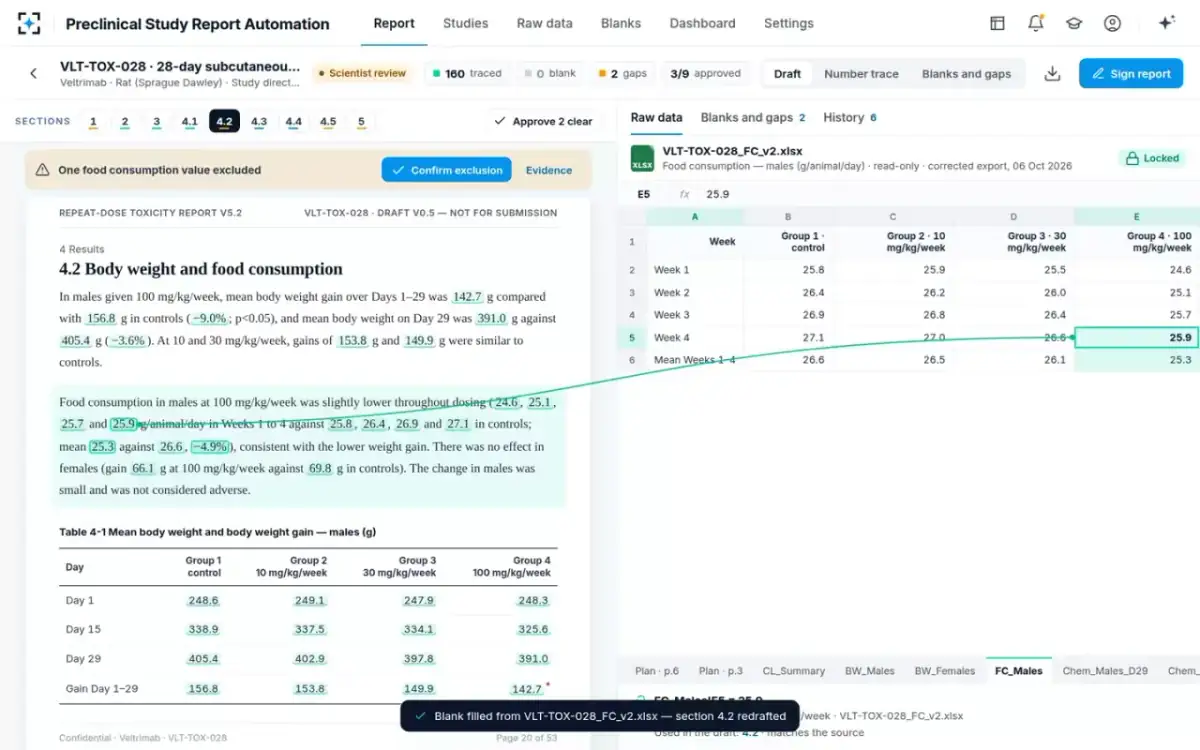
The second is a contributing report that has not been released. Histopathology is the usual one, and recovery histopathology more so, because it comes last. A draft conclusion written without it is provisional in a way that is easy to forget. Again in the demonstration: the recovery data arrived from the pathologist and three sections were rewritten — the histopathology section, the summary and the conclusion — because reversibility changed what the conclusion could say.
The honest way to plan is to treat both as certainties rather than risks, and to shorten them by making every question specific. A system that names the exact empty cell and quotes the plan clause behind a missing file turns a week of back-and-forth into one reply.
Where the report sits on an IND timeline
The report is on the critical path because the application cannot be assembled without it. For an investigational new drug application, 21 CFR 312.23(a)(8) requires "adequate information about pharmacological and toxicological studies of the drug involving laboratory animals or in vitro, on the basis of which the sponsor has concluded that it is reasonably safe to conduct the proposed clinical investigations" — including, for each study intended primarily to support the safety of the proposed trial, "a full tabulation of data suitable for detailed review", and an integrated summary of the toxicological effects.
What has to exist, and for how long the animals must have been dosed, is set by ICH M3(R2): "Repeated-dose toxicity studies in two species (one non-rodent) for a minimum duration of 2 weeks (Table 1) would generally support any clinical development trial up to 2 weeks in duration. Clinical trials of longer duration should be supported by repeated-dose toxicity studies of at least equivalent duration." Longer-term dosing needs six-month rodent and nine-month non-rodent studies.
The critical path a report sits on, and what each delay pushes
1
Last dose, terminal procedures
The in-life phase ends. Nothing can be written yet; the tissues have not been read.
2
Specialist work and contributing reports
Clinical pathology, histology processing, the microscopic reading and its peer review, bioanalysis and toxicokinetics — each signed and dated by the scientist responsible.
3
Writing the study report
Where the eleven days go. Every day here is a day the filing date moves, because nothing downstream can start.
4
Quality assurance audit and the unit's statement
The report is audited against the raw data and the required statement is prepared and signed.
5
Integrated summary and the application
The reports, the full tabulations and the integrated summary are assembled into the submission.
Two details in ICH M3(R2) are worth holding on to when a date is being promised. For serious or life-threatening indications, or case by case, the guideline lets clinical dosing extend beyond three months on complete chronic rodent data and the non-rodent study's in-life and necropsy data, but says "complete histopathology data from the non-rodent should be available within an additional 3 months" — a report deadline hiding inside a study design. And the guideline's own stated purpose is to "facilitate the timely conduct of clinical trials" while reducing animal use and other development resources, which is a reminder that the writing stage is not the only place where a week matters.
The wider context is the one every programme lead already lives with. The US translational sciences centre puts the whole journey plainly: "A new drug's journey from the lab to the medicine cabinet can take up to 15 years." Against fifteen years, five days of re-keying looks trivial; against a filing date that has been promised to a board, it does not.
Pricing the desk: who spends the hours
The time has a price, and it is easy to underestimate because the people doing it are expensive and doing something cheap. The Department of Labor's occupational data for medical scientists, the nearest published occupation, gives median wages for 2025 of "$49.72 hourly, $103,410 annual" across 181,000 employees, and lists among the occupation's work activities "prepare scientific or technical reports or presentations".
One report's writing desk, costed on a published median wage
Cost of a working day
$49.72 × 8 hours
Median hourly wage for medical scientists, 2025, from the Department of Labor’s occupational data. Wage only: no overhead, no benefits, no facility cost.
$397.76
One report, by hand
$397.76 × 11.2 days
The demonstration team’s manual baseline for a 28-day repeat-dose report.
$4,455
The five days of number-moving
$397.76 × 5 days
Re-keying tables (3 days) and cross-checking them (2 days) — the part that is not judgement.
$1,989
The same report at the design target
$397.76 × 1.4 days
The target with the agents drafting and checking, the study director still reviewing and signing.
$557
Multiply by a programme's report count and the proportion is the point, not the absolute. A group writing thirty reports a year spends something like 150 working days of qualified scientific time on re-keying and cross-checking. That is most of a person, doing work whose only output is that a number already recorded appears correctly somewhere else.
Two clocks: the same study by hand and with agents
The comparison below runs the same 28-day study twice. The upper lane is the manual baseline; the lower is the demonstration's target with the six agents doing the reading, building, drafting, gap-finding and checking. Only the green band at the end is largely the same work in both.
The same 28-day report, by hand and with the agents
- Plan1 d
- Re-keying tables3 d
- Writing3 d
- Cross-checking2 d
- Chasing1 d
- Review and signature1.2 d
- Reading plan and package
- Tables
- Drafting
- Checking
- Chasing
- Review and signature0.7 d
Read the lower lane carefully and the claim is narrower than the headline ratio suggests. Two of the 1.4 days' six bands — chasing and review — account for 1.2 of them. The machine work collapses to a rounding error; the human work, 2.2 days by hand, falls by less than half. That is the right shape for a claim about a GLP report, and a supplier whose chart shows the review band shrinking to nothing is promising something a study director should not accept.
Which days compress, and which do not
What a drafting system can take out of the clock, and what it cannot
Compresses: Every cell is built from its source under the house precision rules, so there is nothing to type.
Does not, and should not: —
Compresses: Every figure in the draft is re-read against the cell it cites before signature, and a mismatch stops the signature.
Does not, and should not: —
Compresses: The plan’s requirements are compared with the package on the first pass, so gaps surface on day one rather than in week two.
Does not, and should not: —
Compresses: The question is specific — a named cell, a quoted clause — so it is usually one round trip rather than three.
Does not, and should not: Somebody still has to find the record and send it. In the demonstration this band halves; it does not vanish.
Compresses: The dependency is visible from the first day, and the sections it feeds are known.
Does not, and should not: The pathologist reads the slides in the pathologist’s own time, and signs. Nothing should shorten that.
Compresses: Made easier: the draft sits beside the read-only export and any number can be traced in a click.
Does not, and should not: Still a scientist reading a document she will sign for. The demonstration target keeps more than half of it.
Compresses: The audit starts with the number-to-source trail and the list of blanks already prepared.
Does not, and should not: An independent unit auditing against the raw data, on its own schedule, with its own statement to sign.
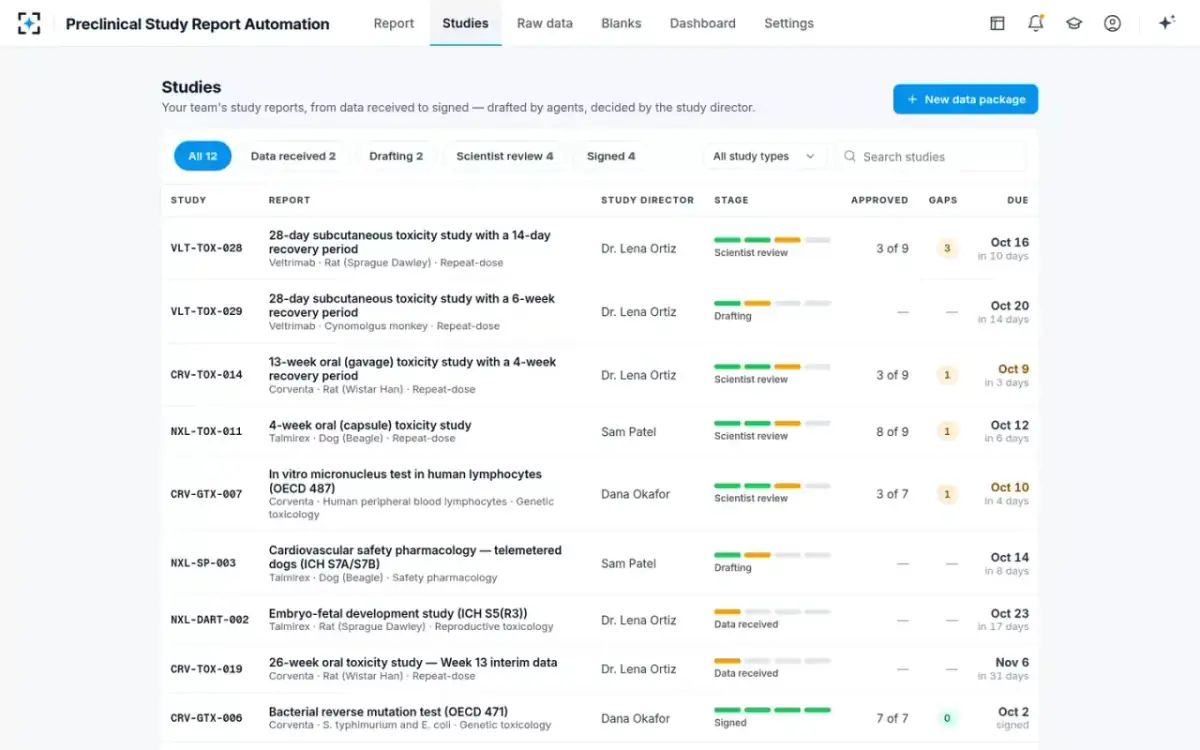
Every open report, from data received to signed
How to shorten the time from data to a signed report
Measure first, and measure the right interval. Most groups can produce a feeling about their report cycle time and not a number, which makes every improvement unprovable. The sequence below takes a quarter and costs almost nothing.
Five steps to a report cycle time you can defend
- Date-stamp two events per study
The day the data package was declared complete, and the day the draft was signed. Everything else is derived from these two.
- Split the interval into the six tasks
Reading the plan, building tables, writing, cross-checking, chasing, review. Ask the writers to record them roughly for five studies; precision is not the point, proportion is.
- Log every data query with its round trip
What was asked, of whom, when, and when it was answered. This is the band that hides in "writing".
- Log contributing reports as dependencies, not events
Record the date each was expected and the date it was released. A conclusion written before the recovery histopathology will be written twice.
- Re-measure on the same definition
After any change, compare the same interval on the same study type. A faster number produced by moving the start line is not an improvement.
Then attack the two bands that are not judgement. Re-keying disappears if the report's numbers are references into the export rather than characters typed from it; cross-checking disappears with it, because a reference cannot drift from its source. What is left — chasing, reviewing, auditing — is the work the regulation puts on named people, and the only honest way to shorten it is to make each question sharper.
Two sibling guides cover the parts this one skirts: what the re-keying actually costs in errors, and what to ask before buying, and how to pilot on your own closed studies. To put a package of your own through the six agents, start from Preclinical Study Report Automation.
Questions people ask
How long does a study director take to review a report?
About a day and a fraction on a 28-day repeat-dose report in the demonstration's baseline, and the agents change it least of any task — the design target keeps 0.7 of a day for review, edits and signature. It is the one band that should not compress much: the study director is reading a document she will sign for, and under the GLP regulation she is answerable for the interpretation, analysis, documentation and reporting of results.
How long before an IND do the toxicology reports have to be final?
There is no published interval, because the requirement is about content rather than timing: the application must contain adequate pharmacology and toxicology information, including an integrated summary and, for each study supporting the safety of the proposed trial, a full tabulation of data suitable for detailed review. In practice the reports must be signed early enough for the integrated summary to be written from them and the application assembled — which is why the writing stage sits on the critical path.
How much does a toxicology report cost to write?
On published median wages for medical scientists — $49.72 an hour in 2025 — eleven working days of one person's time is about $4,455 in wage alone, of which roughly $1,989 is re-keying and cross-checking. That is a floor: it excludes overhead and assumes a median wage for a role usually filled by someone paid more.
Does a shorter report cycle risk GLP compliance?
It depends entirely on which days are removed. Taking out re-keying and the checking of re-keying removes two sources of findings. Taking out the study director's review, the contributing scientists' releases or the quality assurance audit removes the controls the regulation requires. Any claim about speed should say which band it came from.
What is the single biggest cause of a late study report?
Often it is something missing that nobody knew was missing until late — an empty cell, an unsigned amendment, a contributing report that was never released. The cost is not the gap itself but the point in the schedule at which it is found. A first-pass comparison of what the plan requires against what the package holds moves that discovery to day one.
Can the clock start before the data package is complete?
Drafting can, and it changes what "complete" costs. In the demonstration the draft existed before the recovery histopathology arrived, with the missing item listed as a blocking gap and the conclusion marked as subject to it. When the data came in, three sections were redrafted and re-checked rather than written from scratch.