NOAEL and LOAEL are the two ends of the same judgement: the no observed adverse effect level is the highest dose tested at which nothing harmful was seen, and the lowest observed adverse effect level is the lowest dose at which something harmful was. The word doing the work in both is “adverse”, and it is a judgement about harm to the animal rather than a test a statistics package can run. That is why a study report's real job is not to announce a dose but to describe every test item-related change on its own merits — direction, size, significance — and say who decided. Preclinical Study Report Automation drafts those descriptions from the raw data with every number linked to its cell, and proposes the adversity call and the NOAEL for the study director to decide.
The worked example is an invented 28-day study in the solution: VLT-TOX-028, a humanised antibody given subcutaneously once a week to rats at 0, 10, 30 and 100 mg/kg/week with a 14-day recovery period. The compound, the study and the people are fictional sample data. The definitions and recommendations are quoted from FDA guidance and peer-reviewed sources, linked where they appear.
What is the difference between a NOAEL and a LOAEL?
One dose level, in the same study, separates them — and only adverse findings move the line. FDA's glossary for setting a first human dose defines the NOAEL as “the highest dose tested in an animal species that does not produce a significant increase in adverse effects in comparison to the control group”, and adds the sentence that causes most of the argument in a report: “adverse effects that are biologically significant, even if not statistically significant, should be considered in determining an NOAEL.” The LOAEL, in the same glossary, is “the lowest dose tested in an animal species with adverse effects”.
Two consequences follow. First, both are doses that were actually tested — neither is interpolated, so the spacing of the dose levels sets how precisely either can be stated. Second, a study can have a NOAEL and no LOAEL, if nothing at any dose was judged adverse, or a LOAEL and no NOAEL, if something was adverse at the lowest dose. Neither outcome is a failure of the study; both are findings about the dose range that was chosen.
The pair is also routinely confused with the maximum tolerated dose, and the guidance says so directly: the NOAEL “should also not be confused with lowest observed adverse effect level (LOAEL) or maximum tolerated dose (MTD). Both of the latter concepts are based on findings of adverse effects and are not generally used as benchmarks for establishing safe starting doses in adult healthy volunteers.”
NOEL, NOAEL, LOAEL and MTD, in one table
Four terms, four different questions, and one of them is about effects rather than harm.
The four dose terms a toxicology report uses, and what each one answers
| Term | FDA’s own definition | The question it answers | In the sample study |
|---|---|---|---|
| NOEL — no observed effect level | “The highest dose tested in an animal species with no detected effects.” | At what dose did nothing at all change, adverse or not? | Not what the report states: it describes the changes at 100 mg/kg/week, including globulin raised by the antibody itself — an effect, not a harm. |
| NOAEL — no observed adverse effect level | “The highest dose tested in an animal species that does not produce a significant increase in adverse effects in comparison to the control group.” | At what dose was nothing harmful seen? | Proposed at 100 mg/kg/week, the highest dose tested, once the recovery data was in — the study director’s call. |
| LOAEL — lowest observed adverse effect level | “The lowest dose tested in an animal species with adverse effects.” | At what dose did harm begin? | Not established: no finding at any dose was judged adverse in this study. |
| MTD — maximum tolerated dose | “In a toxicity study, the highest dose that does not produce unacceptable toxicity.” | How much can be given before toxicity is unacceptable? | Not reached. The MTD is not the benchmark for a first dose in healthy volunteers. |
The NOEL is the term most often meant when someone says “no effect”. FDA is explicit that it is not the NOAEL, because “some effects observed in the animal may be acceptable pharmacodynamic actions of the therapeutic and may not raise a safety concern” — a biologic that does exactly what it was designed to do has produced an effect, not a harm.
How is a NOAEL determined from the study's own data?
By looking at three families of finding, and then by people deciding. FDA names the families: “there are essentially three types of findings in nonclinical toxicology studies that can be used to determine the NOAEL: (1) overt toxicity (e.g., clinical signs, macro- and microscopic lesions); (2) surrogate markers of toxicity (e.g., serum liver enzyme levels); and (3) exaggerated pharmacodynamic effects.” A report that describes all three for each dose level and sex has given the reader what they need; one that reports only the statistics has not.
In the sample study, the findings at the top dose fell into the first two families and one of them was explicitly not harm. Males gained less weight over the dosing period; serum alanine aminotransferase was higher; liver weight was higher, both absolutely and relative to body weight; minimal to mild centrilobular hepatocellular hypertrophy was seen in four of ten males. Globulin was raised, which is the administered antibody itself. There was no degenerative correlate for the liver findings: nothing under the microscope to show the liver cells were being damaged rather than working harder.
Change against control at 100 mg/kg/week in the sample study
That combination — higher liver weight, higher ALT, hepatocellular hypertrophy, no degenerative correlate — is often read as adaptation rather than injury, but the ALT rise is exactly the kind of marker that has to be argued, not assumed. Making that call is a judgement a toxicologist and a pathologist make together, in the context of this compound and this species, and the report's job is to put the evidence for it on the page.
“Adverse” means harm to the animal — and who decides
The Society of Toxicologic Pathology's Scientific and Regulatory Policy Committee put the definition in one line: “adverse is a term indicating ‘harm’ to the test animal, while nonadverse indicates lack of harm”. Their recommendations add that test article-related effects “should be described on their own merits, and decisions to consider them as adverse or nonadverse should be justified”, and that markers of toxicity which are not in themselves adverse should ideally be discussed together with the causal toxicity.
On who decides, the committee is equally direct: “decisions defining adverse findings and the NOAEL in final study reports should combine the expertise of all contributing scientific disciplines.” Not the pathologist alone, not the study director alone, and certainly not a rule applied to a column of p-values.
“Adverse findings should be identified in subreports (clinical data, pathology data, etc.) if sufficient information is available, and/or in the final study report as individual or grouped findings, but study NOAELs should be established at the level of the overall study report.”
Kerlin et al., Toxicologic Pathology, 2016
That sentence settles an argument that otherwise runs for weeks. A pathologist may flag a finding as adverse in the pathology report; the study NOAEL is not theirs to set, because it depends on everything else the study saw. It also means a report that carries a NOAEL in a pathology appendix and a different one in the conclusion has a problem that is editorial on the surface and scientific underneath.
The profession knows this is unevenly done. The fourth ESTP international expert workshop on characterising adversity opened from the premise that “there is currently a need for better alignment regarding how nonclinical adversity is determined and characterized”. Anyone who has watched two toxicologists disagree about a 15% organ weight change will recognise the sentence.
Statistically significant is not the same as adverse
The two are independent, and a report that conflates them is wrong in both directions. FDA's definition says adverse effects that are biologically significant should be considered “even if not statistically significant” — so a finding can be adverse without a star beside it. The converse is just as common: in a study with ten animals per sex per group, a statistically significant difference in a variable with low biological variability may be of no consequence at all.
What a report should therefore avoid is the sentence that waves a finding away. The committee's recommendation names the habit: interpretations such as “not biologically relevant” or “not toxicologically important” should be avoided unless defined and supported by scientific rationale. The phrase is not forbidden; the unexplained use of it is.
The same finding, written two ways
Waved away: “Minor changes in liver weight and ALT at 100 mg/kg/week were not considered biologically relevant.”
Described on its merits: “At 100 mg/kg/week, absolute liver weight was 14.21 g against 12.84 g in controls, relative liver weight was 15% higher, and serum ALT was 53 against 38 U/L.”
Waved away: Nothing. The numbers are not given and the reasoning is not stated.
Described on its merits: Every figure, against the table and the raw data cell behind it.
Waved away: Not mentioned, or mentioned separately without being connected.
Described on its merits: “Minimal to mild centrilobular hepatocellular hypertrophy was present in 4 of 10 males, with no degenerative correlate.”
Waved away: Asserted, and attributed to nobody.
Described on its merits: Stated as a judgement, with the reasoning — an adaptive pattern without injury — and the disciplines that made it.
Waved away: Asks for the data, and the report goes back out.
Described on its merits: Agrees or disagrees with a stated case, which is a conversation about science.
Waved away: Leaves the dose statement resting on an assertion.
Described on its merits: Lets the dose statement rest on findings the reader has already seen.
Where the NOAEL belongs in the report, and where it does not
It belongs in the conclusion, and it has to be reachable from the results. The GLP regulation asks a final report to contain “a description of the transformations, calculations, or operations performed on the data, a summary and analysis of the data, and a statement of the conclusions drawn from the analysis” — conclusions drawn from the analysis, which means the dose statement is the last link in a chain the reader has already walked.
Three placements cause trouble. A NOAEL stated in the summary but not supported anywhere in the results leaves the reader nothing to check. A NOAEL in a contributing report that differs from the one in the conclusion sets two documents against each other. And a NOAEL in a data table with no explanatory text beside it invites the reader to carry the number away without its context — the committee's recommendation is that where NOAELs appear in data tables, their use should be “linked to explanatory text that places them in context”.
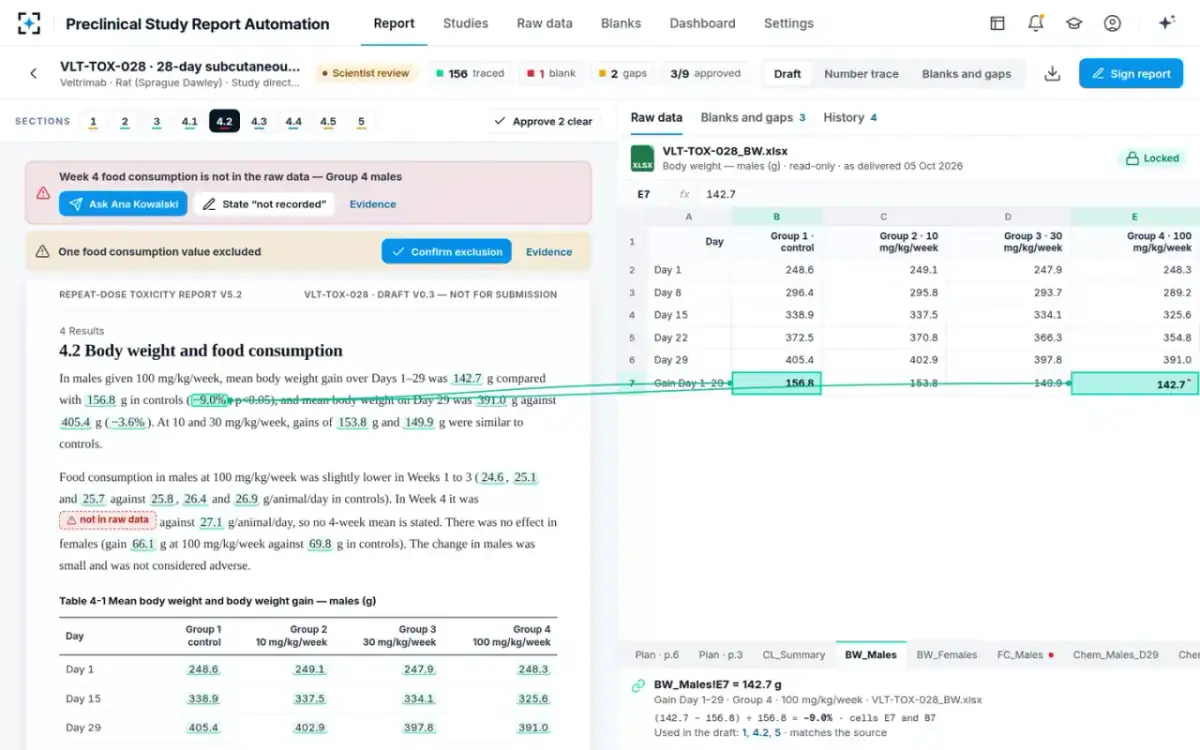
The practical test is whether a reader can get from the dose statement back to the cells. In the sample study the conclusion's figures are traced like every other number: pointing at the 9.0% fall in male body weight gain lights the two cells it was calculated from and lists the sections that use them — the summary, the results section and the conclusion. If the NOAEL changes, everything that depends on it is already known.
A dose statement whose numbers still know where they came from
What recovery data does to a proposed NOAEL
It can confirm a judgement, and occasionally it overturns one. Reversibility is one of the factors weighed when adverse findings are considered together, and in a study with a recovery period the proposed dose statement is provisional until the recovery animals have been read.
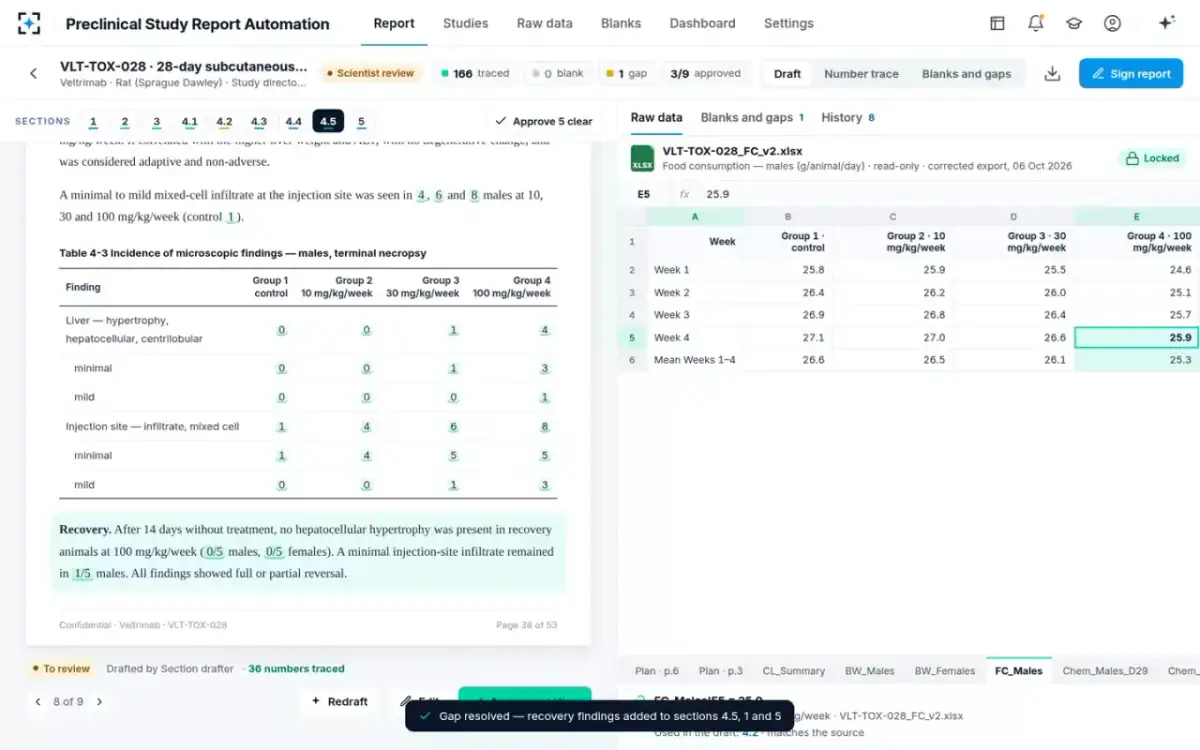
That is exactly how the sample study ran. Before the recovery histopathology arrived, the draft proposed a NOAEL of 100 mg/kg/week — the highest dose tested — “subject to the recovery data”, because the liver findings had no degenerative correlate but reversibility was unproven. The study plan required microscopic examination of the recovery groups, the file was not in the package, and the gap list marked it as blocking signature rather than letting the conclusion stand on an assumption. When the recovery data came in, signed by the study pathologist, there was no hepatocellular hypertrophy at 100 mg/kg/week after 14 days without treatment — none in five males, none in five females — with a minimal injection-site infiltrate in one of five males. Three sections were redrafted on it: the histopathology section, the summary and the conclusion.
Two honest notes about that outcome. A NOAEL at the highest dose tested is a real result, and it says as much about the dose range as about the compound: nothing harmful was seen up to the top dose, so the study did not find the top of the safe range. And the recovery data in this study supported the proposal; it is equally possible for recovery findings to show that a change was not adaptive after all, which is why the sequence is worth preserving. Waiting is cheaper than an amendment, as the guide to signatures and what changes after one sets out.
Recovery histopathology arrives, and three sections are redrafted
From the study's NOAEL to a first human dose
The NOAEL earns its importance downstream. FDA's method for a first-in-human trial in adult healthy volunteers converts the animal NOAEL to a human equivalent dose, picks the most appropriate species, and divides by a safety factor: “the MRSD for the clinical trial should be determined by dividing the HED derived from the animal NOAEL by the safety factor. The default safety factor that should normally be used is 10.” For body-surface-area scaling the guidance's table converts a rat dose to a human equivalent dose by dividing by 6.2.
From a study finding to a first human dose, and who owns each step
Agent
Section drafterDescribes every test item-related change by group and sex with direction, size and statistical significance, each number referenced to its source cell.
Never: Decides adversity
A person decides
Contributing disciplinesJudge adversity finding by finding — clinical pathology, pathology, toxicokinetics — and justify each decision.
Never: Set the study NOAEL from one discipline’s data
A person decides
Study directorEstablishes the study NOAEL at the level of the overall report, combining the disciplines’ expertise, and signs for it.
Never: Leaves the reasoning out of the report
A person decides
Clinical pharmacologistConverts the NOAEL of the most appropriate species to a human equivalent dose by the guidance’s method.
Never: Applies surface-area scaling where the guidance excludes it
A person decides
SponsorDivides by the safety factor — normally 10 — to set the maximum recommended starting dose, and explains any departure.
Never: Uses an MTD or a LOAEL as the benchmark for healthy volunteers
The sample study is a good illustration of why the arithmetic should not be done mechanically. Applying the rat factor to a NOAEL of 100 mg/kg/week would give a human equivalent dose of about 16 mg/kg, and a tenth of that as a starting dose. But the guidance lists exceptions that sit close to this compound: scaling on milligrams per square metre “is not recommended” for therapeutics given by alternative routes such as subcutaneous administration where the dose is limited by local toxicities, and large proteins given intravascularly — over 100,000 daltons — “should be normalized to mg/kg”. A humanised antibody is the kind of molecule the second exception has in mind, even though this one is given under the skin, and the injection-site finding in the recovery animals is the kind of local effect the first describes. Which method applies is a pharmacologist's judgement; the number a spreadsheet would produce here should not be trusted unexamined.
What drafting software may propose, and may not decide
The line is the same line the rule draws for everything else in a study report: software can do the reading and the arithmetic, and a named person owns the judgement. 21 CFR 58.33 makes the study director responsible for the interpretation, analysis, documentation and reporting of results, and the Scientific and Regulatory Policy Committee's recommendation puts the NOAEL decision in the combined expertise of the contributing disciplines. Neither leaves room for a dose statement that arrived by itself.
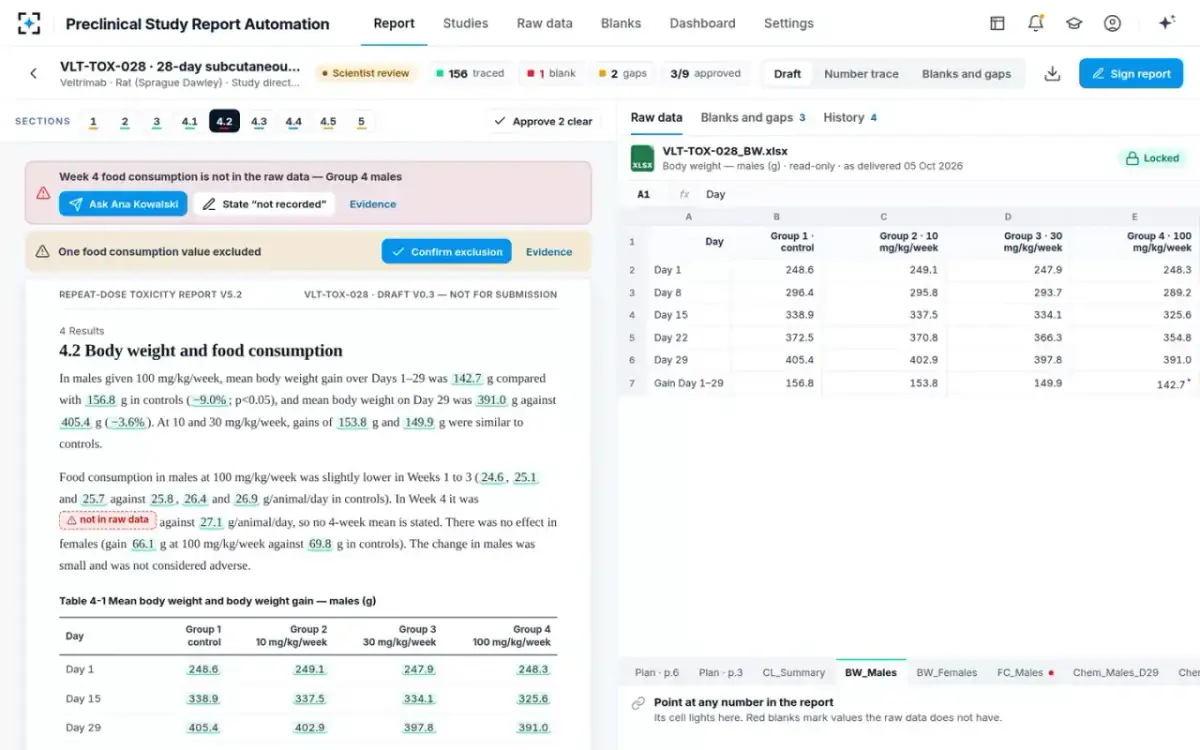
What is genuinely useful is everything up to that point. Describing each test item-related change by group and sex with its direction, size and significance is mechanical work done badly under time pressure, and it is the evidence the adversity discussion needs. So is noticing that a finding appears in one sex and not the other, that a change is dose-related or is not, and that the summary and the conclusion repeat the results exactly. In the solution the section drafter writes those descriptions and proposes adversity and the NOAEL explicitly as proposals, marked for the study director; the consistency checker re-reads every number against its source before the report can be signed. What happens when one of those numbers is simply not in the raw data is the other half of the same discipline.
The draft beside the raw data, with the conclusion still open
Six tests a NOAEL statement should pass before signature
- It names a dose that was actually tested
Both the NOAEL and the LOAEL are tested dose levels, so the spacing of the groups sets how precisely either can be stated.
- Every finding it rests on is described on its own merits
Direction, size and statistical significance by group and sex — not a summary adjective, and not a p-value alone.
- Adverse and nonadverse are both justified, not asserted
“Not biologically relevant” and “not toxicologically important” should be avoided unless defined and supported by scientific rationale.
- It was established at the level of the overall study report
A NOAEL in a contributing report that differs from the conclusion is two documents disagreeing about the same study.
- Reversibility has been addressed where there is a recovery phase
A proposal made before the recovery data is provisional; say so in those words rather than letting it read as final.
- Every number behind it can be reached from the raw data
The conclusion is drawn from the analysis, and the Quality Assurance review will compare the reported results with the raw data whatever the method.
To see findings described by group and sex from the raw data, with adversity and the dose statement offered as proposals, start from Preclinical Study Report Automation.
Questions people ask
What is a NOAEL in toxicology?
The highest dose tested in an animal species that does not produce a significant increase in adverse effects compared with the control group. FDA's guidance adds that effects which are biologically significant should be considered even when they are not statistically significant, so the NOAEL is a judgement about harm rather than a statistical cut-off. It is a dose that was actually tested, not an interpolated value.
Is NOAEL the same as NOEL?
No. The no observed effect level is the highest dose with no detected effects of any kind; the NOAEL allows effects that are not harmful. FDA explains the difference as the view “that some effects observed in the animal may be acceptable pharmacodynamic actions of the therapeutic and may not raise a safety concern” — in the sample study, an antibody raising globulin is an effect and not a harm.
Who decides the NOAEL in a study report?
The study director, on the combined expertise of the contributing disciplines. The Scientific and Regulatory Policy Committee recommends that decisions defining adverse findings and the NOAEL “combine the expertise of all contributing scientific disciplines”, and that study NOAELs be established at the level of the overall study report rather than in a single discipline's subreport. Under 21 CFR 58.33 the study director is responsible for the interpretation and reporting of results and signs for them.
Does recovery data change the NOAEL?
It can, and a proposal made before it is provisional. Reversibility is one of the factors weighed when adverse findings are considered, so a finding that persists after a treatment-free period reads differently from one that resolves. In the sample study the draft proposed a dose “subject to the recovery data”, and the recovery histopathology — no hypertrophy at the top dose after 14 days — is what the conclusion was finally redrafted on.
How is a NOAEL used to set the first human dose?
The animal NOAEL is converted to a human equivalent dose, the most appropriate species is chosen, and the result is divided by a safety factor that FDA says should normally be 10. Body-surface-area scaling is not used for every therapeutic: the guidance excludes alternative routes whose dose is limited by local toxicities, compartmental administration, and proteins over 100,000 daltons given intravascularly, which are normalised to milligrams per kilogram.
Can a NOAEL be the highest dose tested?
Yes, and it is a legitimate outcome rather than a failure of the study. It means nothing judged harmful was seen anywhere in the tested range, which is information about the dose range as much as about the compound — the study has not found the top of the safe range. The report should say that plainly, so a reader does not take the figure as a measured limit.