AI in toxicology usually means prediction — read-across, structure-based alerts, image analysis on slides. This page is about a duller use with a harder constraint: writing the study report. A repeat-dose report carries 400 to 4,000 numbers that already exist in a file, and the risk is not that a model writes clumsy prose; it is that it writes a number nobody recorded. Botminds' Preclinical Study Report Automation is built so that no number is typed at all: six narrow agents read the signed study plan and the raw data export, build every table cell from its source, draft each section with every figure inserted as a reference rather than typed, list what is missing, and re-check the whole draft before a study director signs it. What follows is what each of the six does, the line each one may not cross, and what FDA, EMA and the GLP regulation say about where the people stay.
The study, the compound and the people in the screens below are invented sample data from a working demonstration: VLT-TOX-028, a 28-day subcutaneous study of Veltrimab in rats, with a study director, a technician, a pathologist and a quality assurance auditor who do not exist. The regulatory material is quoted from FDA, EMA, the UK medicines regulator and 21 CFR part 58.
Can AI write a toxicology study report?
It can produce a complete draft, and it should not produce a single number on its own. Those two sentences are the whole design problem. A study report has two kinds of content: assertions about what was observed, which are already recorded somewhere and must be reproduced exactly; and assertions about what the observations mean, which are scientific judgements a named person is answerable for. A language model is a poor instrument for the first and an unacceptable one for the second.
So the useful question for a buyer is not "how good is the writing". It is: what, mechanically, prevents a figure in section 4.2 from differing by one digit from the cell it came from; and what prevents an empty cell from being quietly filled. A tool that answers those with "the model is accurate" has not answered them. A tool that answers with "a number in the draft is a reference to a cell, not a character typed by a model, and an empty source cell produces a blank that blocks signature" has.
What is AI used for in toxicology, and what changes when the job is the report?
Most AI work in toxicology sits upstream of a study: predicting a property from a structure, grouping analogues, scoring an image, flagging an in vitro signal. Those uses share a feature — the output is a new claim about the world, so the only way to trust it is to measure how often it is right.
Report writing is the opposite case. Almost nothing in the output is new. The body weight gain in males at the top dose was measured, recorded and stored; the report's job is to carry it, unchanged, into a sentence, a table, a summary and a conclusion. The failure mode is not a wrong prediction but a wrong copy, and the remedy is not a better model but a design in which copying does not happen. That difference is why a drafting tool should be assessed on its plumbing before its prose.
Six agents, and the one job each of them has
In this solution the work is split into six narrow agents rather than one general writer, because a narrow agent can be given a limit that is checkable. Each hands its output to the next, and the chain ends at a person.
From the signed plan to a signed report: six agents, one decision-maker
Agent
Study plan readerReads the signed study plan and every signed amendment: design, dose levels, group sizes for main, recovery and toxicokinetic animals, endpoints and their time points, key dates, the guidelines followed, and which sections the house template needs.
Never: infers a design element. It uses only facts stated in the signed plan, and flags an amendment that is not signed.
Agent
Raw data readerLoads every table of the data package, maps each to the endpoint it serves, and checks animal counts, days and groups against the plan, recording any table the plan requires that is not there.
Never: changes a raw value. Every excluded value is recorded with its reason.
Agent
Table builderBuilds every report table cell by cell from the source tables, with significance markers, under the house precision rules. Nothing is typed by hand.
Never: rounds beyond what house style allows, and never produces a cell without its file, sheet and cell reference.
Agent
Section drafterWrites each section in house style, describing test item-related changes by group and sex with direction, size and statistical significance, inserting every number as a reference to its source cell.
Never: estimates, carries forward or averages around an empty source cell — it stays blank. Adversity and the no observed adverse effect level are proposals for the study director.
Agent
Gap finderCompares what the plan requires with what the package holds and what the template needs, listing every missing file, empty cell, unsigned contributing report and exclusion that needs a statement.
Never: closes a gap itself. Each one quotes the plan clause and the data evidence, and is classed as blocking or minor.
Agent
Consistency checkerRe-reads every number in the draft against its source cell, and checks that the summary and the conclusion repeat the results exactly, that group sizes match the plan, and that percentage changes are calculated from the cells they cite.
Never: passes a mismatch. Any mismatch blocks signature, and the evidence for every finding is reported.
A person decides
Study directorReviews each section beside the raw data, edits as tracked changes, fills or states every blank, decides adversity and the dose levels, and signs with a stated meaning.
The split matters for a reason that has nothing to do with capability. A single general writer has one limit — its training and its instructions — and you cannot demonstrate that limit to an auditor. Six agents each have a stated rule about a narrow job, and each rule can be tested with a case designed to break it: hand the raw data reader a table with one animal too few, and see whether it says so.
What an AI drafting tool should never do
The limits above are not preferences; they are the product. Written as a list a buyer can ask about:
Ten things a drafting tool should refuse to do, and how to test each
- Type a number
Ask to see a figure’s origin in the draft. If it is a character and not a reference to a cell, every other assurance is a promise.
- Fill an empty source cell
Delete one week’s value from a test export. The draft should contain a blank that names the empty cell, not a plausible figure.
- Carry a value forward
The week before, the sister group and the group mean are all available to a model. None of them is the measurement.
- Average around a hole
A four-week mean computed from three weeks is a different statistic. It should not appear, and the sentence should say why not.
- Decide adversity
Findings are described by group, sex, direction, size and significance. Whether they are adverse is proposed and marked for the study director.
- Set the dose level in the conclusion
A proposed no observed adverse effect level should be labelled a proposal, with the findings it rests on and anything it is subject to.
- Infer a design element
If the signed plan does not state a group size or a time point, the agent should ask, not assume. Test it with a plan that omits one.
- Close its own gap
A missing contributing report is closed by that scientist sending it, not by the drafter writing around it.
- Change raw data
The export should be read-only to the system. Ask what write access it has, and to what.
- Sign anything
An electronic signature belongs to a person, with a stated meaning, bound to an exact version.
Two of those are settings nobody can turn off in this solution: a value that is not in the raw data is left blank, and every number is re-checked against its source before signature. Everything else on the rules screen — the template per study type, the number style, the significance markers, whether pathology terms follow standard nomenclature or the pathologist's own wording, who signs, who reviews which section — is the laboratory's to set.
Does FDA's AI guidance cover a drafted study report?
Partly, and the boundary is worth reading closely rather than quoting as a free pass. FDA's January 2025 draft guidance covers AI models whose output is information or data used to support the agency's decisions about a drug's safety, effectiveness or quality. It then carves out two areas, and one of them is relevant here.
FDA's scope, and the condition that does the work
The guidance leaves out two uses of AI: drug discovery, and operational efficiencies — FDA's examples are internal workflows, resource allocation and drafting or writing a regulatory submission — but only where they do not affect patient safety, drug quality, or the reliability of results from a nonclinical or clinical study.
Outside the guidance
Assembling a document, formatting to a template, drafting narrative text that carries no study result, routing work between people.
Not so clearly outside
Anything that writes, transforms or summarises a study result into the report a reviewer reads. The reliability of nonclinical results is named in the same sentence.
FDA adds that a sponsor unsure whether its use of AI falls inside the guidance should talk to the agency early.
The sensible reading for a toxicology group is to design as though you are inside the guidance and be glad if you are not. That is cheap to do, because the guidance's core idea is one a quality unit already recognises. It asks sponsors to establish credibility for a stated context of use. In the guidance's terms, credibility is trust in how the model performs for that one use, built by collecting evidence; the context of use is the precise role and scope the model has in answering a question of interest.
Six narrow agents are six narrow contexts of use, each with a question of interest small enough to state in a sentence and test with examples. One general writer is a context of use so broad that no evidence settles it. The buying consequences of that are worked through in our guide to what to ask before you buy study director software.
What EMA asks of AI in non-clinical development
The European regulator's reflection paper is shorter on process and sharper on responsibility. On non-clinical work it says plainly that the quality system extends to the tool: "Existing Standard Operating Procedures (SOPs) would be expected to extend to all AI/ML applications in non-clinical studies. When the OECD Series on Principles of Good Laboratory Practice (GLP) is applicable, advisory documents on Application of GLP Principles to Computerised Systems (no.17) and GLP Data Integrity (no. 22) should be considered."
A key principle is that it is the responsibility of the clinical trial sponsor, marketing authorisation applicant/holder or manufacturer to ensure that all algorithms, models, datasets, and data processing pipelines used are fit for purpose and are in line with legal, ethical, technical, scientific, and regulatory standards as described in EU legislation, GxP standards and current EMA guidelines.
EMA, Reflection paper on AI in the medicinal product lifecycle, section 2.2
EMA adds that those requirements "may in some respects be stricter than what is considered standard practice in the field of data science", and that the level of scrutiny "depends on the level of risk and regulatory impact posed by the system". It also draws a distinction that this design leans on: "For all models, especially those where there is no human-in-the-loop, a system risk management plan should be developed that defines likely risks of failure modes of the algorithm." Report drafting is the human-in-the-loop case by construction — every section is reviewed and the report is signed — which lowers the risk without removing the duty to think about failure modes.
Can an AI be the study director?
No, and the regulation forecloses it in its first sentence rather than by implication. 21 CFR 58.33 begins: "For each nonclinical laboratory study, a scientist or other professional of appropriate education, training, and experience, or combination thereof, shall be identified as the study director." A scientist is identified, by name, and then assured of things — among them, under 58.33(b), that "all experimental data, including observations of unanticipated responses of the test system are accurately recorded and verified".
That is the sentence a drafting tool has to serve. The study director has to be able to verify, which in practice means being able to see, for any number in a document she will sign, where it came from and what else depends on it. A tool that produces a fluent draft she cannot interrogate has made her job harder, not easier, however good the prose. Who signs what, and for which meaning, is set out in our guide to the GLP compliance statement and the signatures on a study report.
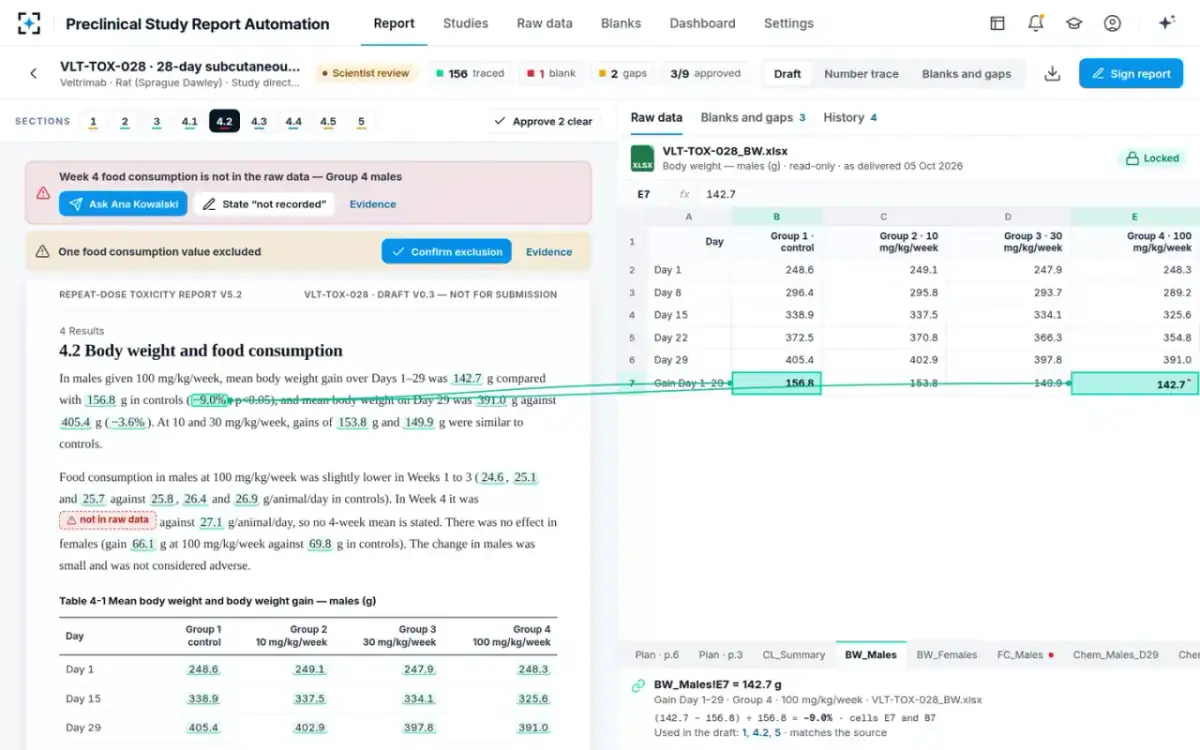
A number, and the two cells it is calculated from
How to stop AI inventing numbers in a report
Not by instruction, and not by review alone. The only reliable method is to remove the opportunity: make the number in the document a pointer to a value held elsewhere, so there is no step at which a character is chosen.
A free-typed number against a number that cites its source
Generated as text: The characters "142.7", chosen by the writer — human or model — at the moment of writing.
Inserted as a reference: A pointer to a cell, rendered as 142.7 when the page is read.
Generated as text: The document is now wrong and says nothing about it. Somebody has to remember.
Inserted as a reference: The sections that depend on the cell are redrafted and re-checked; the change is visible.
Generated as text: Open the export, find the sheet, find the animal, compare by eye. Repeat for every figure you sampled.
Inserted as a reference: Point at the figure. Every number in the draft is re-read against its source before signature.
Generated as text: The most likely output is a plausible value, because every nearby value is plausible.
Inserted as a reference: There is nothing to point at, so the draft carries a blank that names the empty cell and blocks signature.
Generated as text: Arithmetic performed once, invisibly, and trusted.
Inserted as a reference: The inputs and the formula are both stated, so the arithmetic can be re-run.
Generated as text: Whether the number is right.
Inserted as a reference: Whether the interpretation is right.
The same logic applies to the audit trail. The UK medicines regulator's data integrity guidance is blunt about the control that makes a trail worth anything: "Audit trails (identified by risk assessment as required) should be switched on. Users should not be able to amend or switch off the audit trail." A drafting system that records every step, edit, request, approval and signature with its author and time is only credible if nobody in the laboratory — or in the supplier — can quietly turn that recording off.
What the people still do, start to finish
The honest version of the benefit is not that fewer people are needed. It is that the same people spend their time differently. In the demonstration, drafting a 28-day report took about eleven working days by hand and most of that was re-keying and cross-checking; the design target with the agents is 1.4 days. The step that shrinks least is the study director's own review, edits and signature — about 1.2 days by hand against 0.7 in the solution's estimated split — because that is the part that is judgement.
The same report, before and after, for the five people who carry it
Today
Four studies open and two reports due. Re-keys tables, cross-checks figures, and signs for every number in a document she assembled from twelve spreadsheets.
With agents
Opens a full draft beside the read-only export, points at any number to see its cell, fills or states each blank, decides adversity and the dose levels, and signs.
Still theirs: Every judgement in the report, and the signature.
Today
Answers data queries phrased as "the food consumption looks odd in week 4" and goes looking for what was meant.
With agents
Is asked for one named empty cell and sends a corrected, versioned export, which becomes a traced number.
Still theirs: The record of what was measured, and the correction.
Today
Signs the pathology contributing report and hopes the writer transcribes the incidences correctly.
With agents
Reviews the histopathology section before the study director; his recovery findings are what the conclusion is redrafted on.
Still theirs: The reading of the slides, and the release of it.
Today
Many short reports, heavy on tables and historical control ranges, nearly all of it typing.
With agents
Tables built cell by cell from source; a historical range missing from the package is left blank and asked of her.
Still theirs: The scientific call on each assay.
Today
Samples numbers from the draft and walks each one back to the raw data by hand.
With agents
Receives the signed draft with the number-to-source trail and the list of every blank and how it was closed.
Still theirs: The audit, the statement, and the independence to say no.
How to test a drafting tool before a real study goes through it
Use closed studies. Take three signed reports whose data packages you still hold, run the packages through the tool, and compare its draft with what your people wrote, number by number rather than impression by impression. Three questions decide it. How many of its figures differ from the signed report, and in each case which one is right? How many of the gaps you found during the original write-up did it find, and did it find any you missed? And what did it do with the values that were missing the first time around?
Then break it deliberately. Remove one week's values from one group and confirm a blank appears with the cell named. Hand it an unsigned amendment and confirm it is flagged. Change one cell in the export after the draft exists and confirm the dependent sections are redrafted and re-checked rather than left. Give it a package missing a contributing report and confirm the gap is classed as blocking. None of those tests needs a live study, and together they are the credibility evidence a quality unit will ask for.
The blanks and gaps a drafting run produces, before anyone is asked
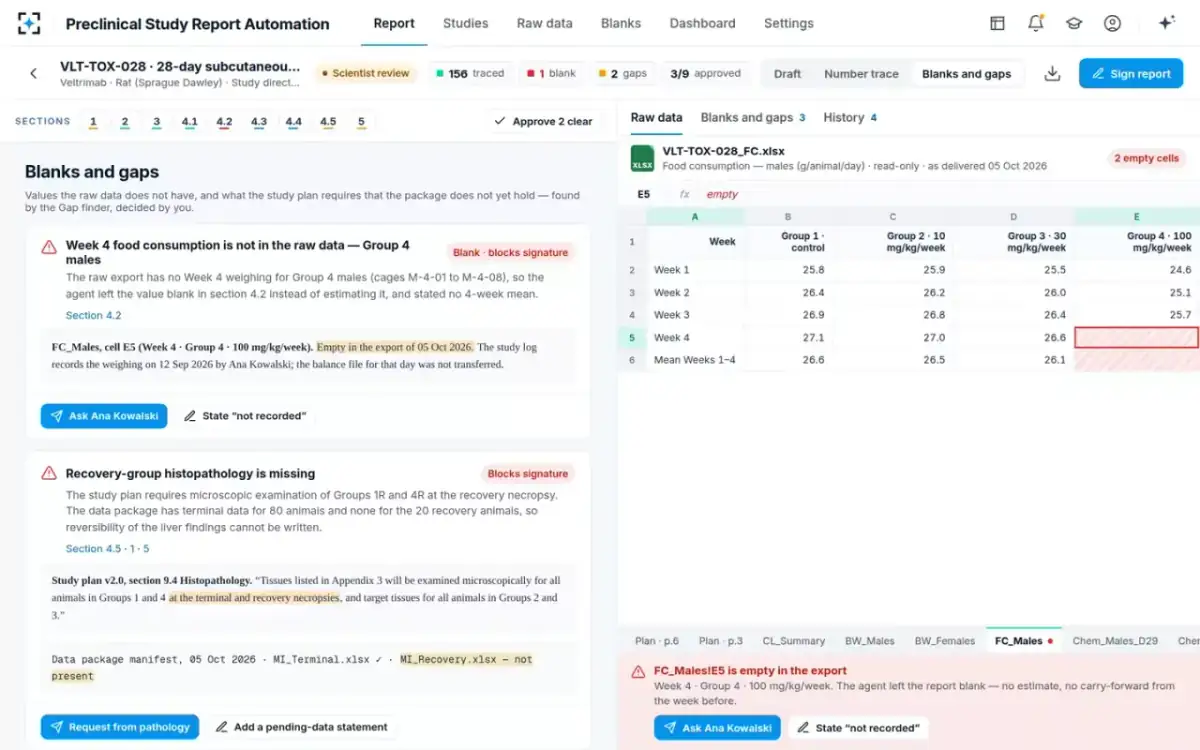
What the tool does with an empty cell is the single most revealing test, which is why it has a guide of its own: what happens when a value is missing from the raw data. To run the six agents on a package of your own, start from Preclinical Study Report Automation.
Questions people ask
Who approves an AI-drafted study report?
The same people as any other draft. In this design each section is reviewed before the study director sees it where the laboratory assigns a reviewer — histopathology by the study pathologist, for example — and the study director approves each section and signs the whole report with a stated meaning, bound to an exact version. The quality assurance unit then audits the signed draft and prepares its own statement. No agent approves or signs anything.
Does using AI have to be declared in the submission?
FDA's draft guidance asks sponsors to engage early where they are unsure whether a use is in scope, and sets out a credibility assessment framework for uses that are. EMA puts the duty on the sponsor or applicant to ensure every model, dataset and pipeline used is fit for purpose and in line with GxP standards. Neither publishes a declaration form for drafting tools; both expect you to be able to explain what the tool did and why it can be relied on.
What audit trail does an AI drafting tool need?
One that records who or what did each thing and when: every agent step, every edit as a tracked change, every request to a colleague, every approval and every signature. The UK regulator's guidance adds the control that makes it meaningful — users must not be able to amend or switch the trail off, and a system administrator who does must leave a record of that action.
Can an agent decide the no observed adverse effect level?
It should not, and here it does not. The drafter describes test item-related changes by group and sex with their size and statistical significance, and proposes adversity and the dose level, marked as a proposal with what it rests on. In the sample study the draft proposed the highest dose tested "subject to the recovery data", and the conclusion was redrafted once that data arrived. The call remained the study director's.
How is this different from a template with macros?
A template places text; it does not read a study plan, check a data package against it, or know that a cell is empty. The difference a buyer can test is whether the system can tell you what the plan required and the package did not contain, quoting the clause — and whether it refuses to proceed when the answer is "something".
Does the model see our raw data?
Ask that question of any supplier, and ask it precisely: what is read, what is retained, what leaves your environment, and what write access anything has to the source files. In this design the export is read-only to the system, raw values are never changed, and every excluded value is recorded with its reason.