A GLP compliance statement says whether a nonclinical study was run under the Good Laboratory Practice regulations, and — where it was not — why. Under the OECD Principles it sits inside the study report, signed by the study director; under the US rules it is filed by the sponsor with the investigational new drug application rather than required in the report itself. It is one of four signed things around a finished study report, and the four are regularly confused with each other. The work of producing them is slow because each waits on a different person, which is why Preclinical Study Report Automation drafts the sections, links every number to the raw data cell it came from, and leaves all four signatures where the rule puts them: with named human beings.
The screens on this page show the solution running on an invented 28-day study, VLT-TOX-028, with a fictional study director, technician, pathologist, second study director and Quality Assurance auditor. Everything quoted from a regulation is linked where it appears.
Four signatures around one study report, and what each one actually attests
What the signature attests: That this discipline’s findings — pathology, toxicokinetics, analytical chemistry — are as the scientist read and interpreted them. 21 CFR 58.185(a)(12) makes those signed reports part of the final report.
What it does not cover: The rest of the study. A pathologist signing a pathology report has not signed the summary, the conclusions or anyone else’s tables.
What the signature attests: Which inspections were made, on what dates, which phases, and when findings were reported to management and to the study director.
What it does not cover: The science. The statement is a record of independent monitoring, not an approval of the interpretation or a second opinion on the conclusions.
What the signature attests: Acceptance of responsibility for the validity of the data, and — under OECD — the extent to which the study complied with the Principles.
What it does not cover: A claim to have personally re-measured anything. It is responsibility for the study as a whole, which is why it cannot be delegated.
What the signature attests: That each nonclinical study subject to part 58 was conducted in compliance with it, or a brief statement of the reason for the noncompliance.
What it does not cover: Anything about studies outside part 58’s scope, and anything the study director did not put in the report.
What is a GLP compliance statement, and who signs it?
It is a short, explicit statement about compliance, and where it lives depends on which rulebook the study is written for. The OECD Principles put it in the report: the final report “should be signed and dated by the Study Director to indicate acceptance of responsibility for the validity of the data”, and “the extent of compliance with these Principles of Good Laboratory Practice should be indicated” (OECD Principles, 9.1). The study director's own duties repeat it — they are to “sign and date the final report to indicate acceptance of responsibility for the validity of the data and to indicate the extent to which the study complies with these Principles”.
The US regulations take a different route. Nothing in 21 CFR part 58 requires a compliance statement inside the report. The obligation lands at the submission instead: 21 CFR 312.23(a)(8)(iii) requires, for each nonclinical laboratory study subject to part 58, “a statement that the study was conducted in compliance with the good laboratory practice regulations in part 58, or, if the study was not conducted in compliance with those regulations, a brief statement of the reason for the noncompliance”. That statement is the sponsor's, filed with the application.
Most laboratories resolve the difference by writing the statement into every report. It costs nothing, it satisfies OECD, and it gives the sponsor the words to carry into the submission. The phrase to get right is “the extent”: a study whose analytical phase ran outside the GLP programme is not simply non-compliant, and saying so precisely in the report is better than leaving the sponsor to discover it. The fourteen items a final report must contain sets out where the statement sits among them.
The study director's signature: what it accepts responsibility for
It accepts responsibility for the validity of the data, which is a larger claim than “I read this”. 21 CFR 58.185(b) says only that “the final report shall be signed and dated by the study director”, and the weight comes from what the study director is, not from the signature line. The regulation makes one person answerable for the whole study.
“The study director has overall responsibility for the technical conduct of the study, as well as for the interpretation, analysis, documentation and reporting of results, and represents the single point of study control.”
21 CFR 58.33, Study director
Three of the duties in that section bear directly on the report. The study director shall assure that the protocol, including any change, is approved and followed; that “all experimental data, including observations of unanticipated responses of the test system are accurately recorded and verified”; and that unforeseen circumstances affecting quality and integrity “are noted when they occur, and corrective action is taken and documented”. Signing is the moment those three assurances become a written claim about a specific document.
That is also why the signature cannot be delegated or batched. “Single point of study control” is incompatible with a second person signing on the study director's behalf, and a report signed without the study director having worked through the numbers is a statement they are not in a position to make. What software can do is reduce how much of the fortnight before that moment is spent re-keying instead of reading: in the sample study the signing screen opens on a report whose every number already points at a cell in the raw data export, so the reading the study director does is the interpretation rather than the arithmetic.
Contributing scientists sign their own reports first
A toxicology report is written by several disciplines, and the rule keeps their authorship intact. Item (12) of the contents list is “the signed and dated reports of each of the individual scientists or other professionals involved in the study”, and OECD says the same: “reports of Principal Investigators or scientists involved in the study should be signed and dated by them”. The pathology report, the toxicokinetics report and the analytical chemistry report go into the final report as signed documents, not as material the writer digests and discards.
The sequencing matters more than it looks. A contributing report that is still in peer review is not yet a signed report, and a narrative drafted from it is a draft of a draft. In the sample study the study pathologist reviews the histopathology section before the study director sees it, and when the recovery histopathology arrives it arrives signed, for twenty animals, and three sections are redrafted on it — the section describing the findings, the summary and the conclusion. Nothing downstream of a contributing report can be finished before the report is signed, which is why the gap list treats an unsigned contributing report as a blocking item rather than a formatting note.
The order the signatures go on, in Preclinical Study Report Automation
Agent
Section drafterDrafts every section from the signed study plan and the raw data export, each number inserted as a reference to its file, sheet and cell.
Never: Signs anything
A person decides
Contributing scientistsSign and date their own discipline reports — pathology, toxicokinetics — which become item (12) of the final report.
Never: Sign for a discipline that is not theirs
A person decides
Study pathologistReviews the histopathology section against the slides and the signed pathology report before it reaches the study director.
Never: Releases recovery data the writer has assumed
Agent
Consistency checkerRe-reads every number against its source cell and checks that the summary and conclusion repeat the results exactly.
Never: Clears its own finding
A person decides
Study directorReviews and approves each section, chooses the meaning of the signature, and signs with a password against that exact version.
Never: Delegates the signature
A person decides
Quality Assurance auditorAudits the signed report against the raw data, then prepares and signs the statement that goes with it.
Never: Takes part in directing or conducting the study it audits
A person decides
Study director, againSigns an amendment if anything in the final report has to change afterwards, identifying the part and the reason.
Never: Edits the signed version in place
What the Quality Assurance statement says, and what it does not
The Quality Assurance statement is a record of independent monitoring, not an endorsement of the science. 21 CFR 58.35(b)(7) asks the unit to “prepare and sign a statement to be included with the final study report which shall specify the dates inspections were made and findings reported to management and to the study director”. Dates and recipients — that is the content. The substantive work sits in (b)(6), the review of the report against the raw data, and in (b)(3), which requires that “any problems found during the course of an inspection which are likely to affect study integrity shall be brought to the attention of the study director and management immediately”.
The independence is structural, and it is the reason the statement means anything. The regulation requires that “for any given study, the quality assurance unit shall be entirely separate from and independent of the personnel engaged in the direction and conduct of that study” (21 CFR 58.35(a)). An auditor who helped write the report cannot attest that it was independently monitored, and a laboratory that solves a resourcing problem by having the report writer audit a colleague's report has quietly removed the only check in the system.
Two practical consequences follow. First, the auditor needs the report and the raw data together, not the report alone — which is why in the sample study the signed draft goes to the auditor with the number-to-source trace and the list of every blank and how it was closed as appendices. Second, an auditor who has to re-key numbers to check them is doing the same error-prone work the writer did, twice. The point of a trace is that the check becomes reading rather than typing.
The sponsor's statement in the IND: compliant, or why not
The sponsor's statement has two legitimate branches and most people only use one. 21 CFR 312.23(a)(8)(iii) asks for a statement of compliance “or, if the study was not conducted in compliance with those regulations, a brief statement of the reason for the noncompliance”. The second branch exists because perfectly useful studies are run outside part 58 — exploratory work, studies run before a programme was in place, a literature study, a phase conducted at a site that is not in the GLP programme.
What gets a sponsor into difficulty is not the non-compliance branch; it is a blanket compliance statement that the study report does not support. The report is the evidence for the statement, so anything that qualifies compliance has to be visible in it: a phase outside the programme, a deviation that was not corrected, a contributing report from a site with a different monitoring arrangement. Item (9) of the report's contents, the description of all circumstances that may have affected the quality or integrity of the data, is where those qualifications belong, and a sponsor writing a compliance statement is reading item (9) first.
Can a GLP study report be signed electronically?
Yes, and the conditions are specific rather than onerous. 21 CFR 11.50(a) requires every signed electronic record to show three things with the signing: the signer's printed name, the date and time the signature was executed, and what the signature means — review, approval, responsibility or authorship are the rule's own examples. Paragraph (b) adds that all three appear in any human readable form of the record, on screen or on a printout.
Three more sections finish the picture. 11.70 requires signatures to be “linked to their respective electronic records to ensure that the signatures cannot be excised, copied, or otherwise transferred to falsify an electronic record by ordinary means” — in practice, a signature belongs to one version of one document. 11.200(a)(1) requires a non-biometric electronic signature to “employ at least two distinct identification components such as an identification code and password”. And 11.100(a) requires each electronic signature to be “unique to one individual” and never reused or reassigned.
A compliant electronic signature on a study report, element by element
| What must be shown or controlled | The requirement it comes from | On the signing screen in the sample study |
|---|---|---|
| The printed name of the signer | 21 CFR 11.50(a)(1) | The study director’s name, beside the role the laboratory assigned to sign this study type. |
| The date and time the signature was executed | 21 CFR 11.50(a)(2) | Stamped at the moment of signing, and kept with the version, not with the file name. |
| The meaning of the signature | 21 CFR 11.50(a)(3) | Chosen before signing — in the sample study, “Study director approval — release to Quality Assurance for audit”. |
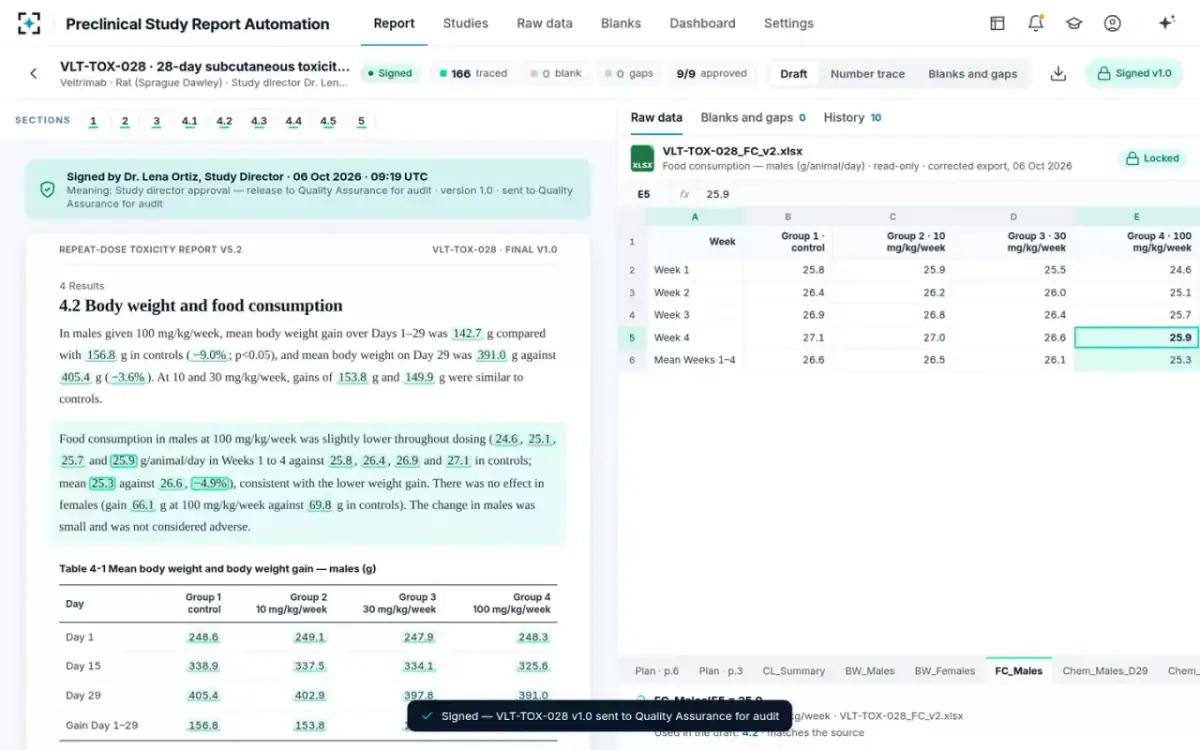
| Shown in the human readable form | 21 CFR 11.50(b) | The banner on the signed report carries name, date, time and meaning; so does the export. |
| Linked to that record, not transferable | 21 CFR 11.70 | The signature is bound to version 1.0 of this report; a later version is a different record. |
| Two distinct identification components | 21 CFR 11.200(a)(1) | Signed-in identity plus a password entered at the signing step. |
| Unique to one individual, never reassigned | 21 CFR 11.100(a) | One account, one person; the audit trail names who, what and when for every step. |
| An audit trail that does not obscure what came before | 21 CFR 11.10(e) | Edits are kept as tracked changes; a corrected source file is a new version and the first one stays. |
The signing screen: version, numbers traced, meaning, password
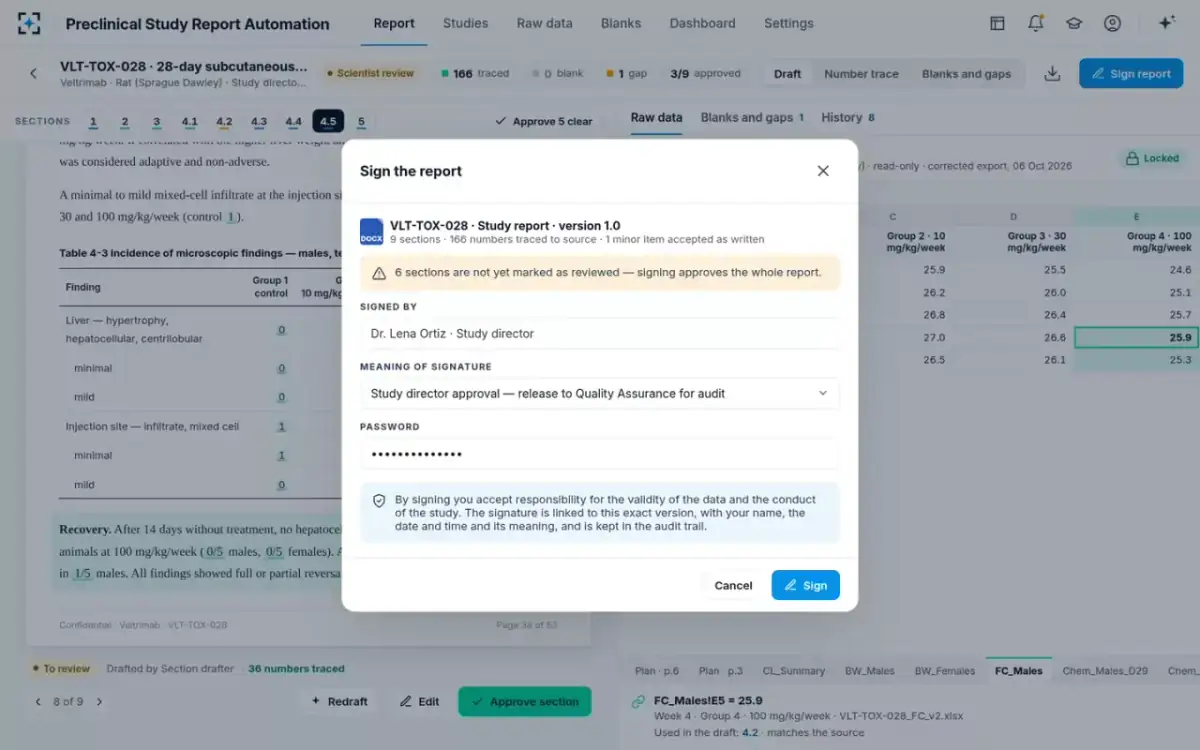
The warning on that screen deserves a word, because it is tempting to read it as a feature. It is not good practice to sign a report whose sections you have not marked as reviewed; the screen allows it and tells you what you are doing, which is the right behaviour for a tool but not an argument for the habit. If six sections are unreviewed, the thing to do is close the screen.
Who is the author when software drafts the sections?
The rule has already answered this, in the one place it describes what a signature means. 21 CFR 11.50(a)(3) gives review, approval, responsibility and authorship as its examples of a signature's meaning — and every one of them is something a person does. Part 58 is equally concrete: item (10) of the report's contents is “the name of the study director, the names of other scientists or professionals, and the names of all supervisory personnel, involved in the study”. There is no seat in either list for the thing that produced the first draft.
That gives a clean working rule, and it is the rule the solution is built to. Agents read the signed study plan and the raw data export, build the tables cell by cell, write each section in house style, list every gap with the plan clause behind it, and re-read every number against its source before the signing screen will open. They do not sign, they do not close their own gaps, and they do not decide the two things the report turns on — whether a finding is adverse, and what the no observed adverse effect level is. Those are proposals for the study director, and how a report should state the dose and who decides adversity works through why.
The honest way to describe such a draft, if anyone asks, is that the study director is the author and the software is the instrument — the same relationship a statistics package has to the statistical methods section. What changes is the evidence trail: an instrument that records which cell every number came from leaves the author in a better position to defend the document than a word processor does.
Changing a signed report: the amendment and the second signature
After signature a report is amended, not edited, and the amendment carries its own signature. 21 CFR 58.185(c) requires corrections or additions to be “in the form of an amendment by the study director”, identifying the part being corrected and the reasons, “signed and dated by the person responsible”.
Read the last phrase carefully: the amendment is by the study director, and it is signed and dated by “the person responsible” — which, read plainly, can include the scientist whose finding changed. Where a contributing scientist's finding changes — a re-read slide, a re-analysed sample — that scientist's signed, corrected report is the evidence, and both signatures end up in the file. OECD runs the same way and adds a useful exclusion: reformatting a report to meet a national authority's submission requirements is not a correction, addition or amendment. Changing a page size is not an amendment; changing a number is, however small it looks.
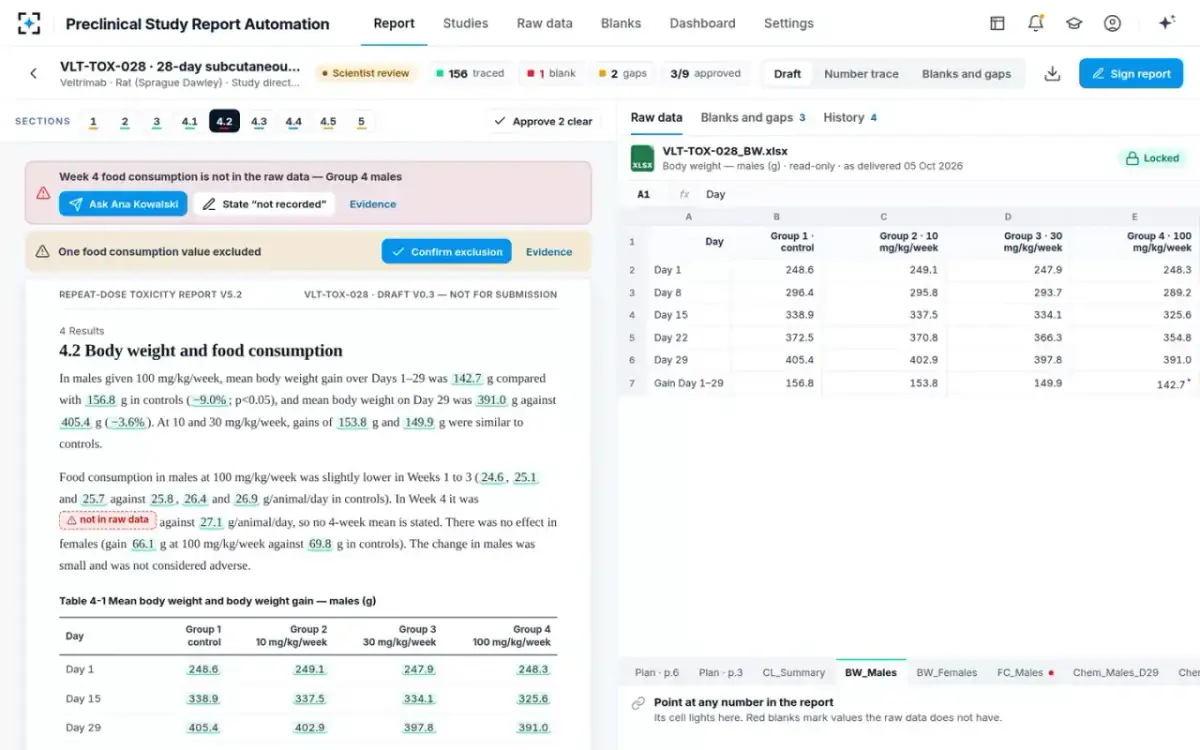
The practical reading is that everything which would become an amendment is worth catching while the document is still a draft. In the sample study the consistency check blocks rather than warns: any number that does not match its source cell, any open blank, any blocking gap stops the signature. That is a cheaper place to find a mismatch than an amendment signed three weeks later, and a much cheaper place than an audit.
The signed report: locked, with the meaning and the version on the banner
Five people, one report: how each one's fortnight changes
The signatures describe a division of responsibility, and that division is also a division of work. Three of the five people around a study report spend most of their time on the part that nobody's signature is really about: moving numbers, chasing files and checking arithmetic.
Five seats around one GLP study report, and what each still signs for
Today
Four studies open and two reports due this month, with the fortnight before each signature spent re-reading tables against twelve spreadsheets.
With agents
Opens a full draft beside the read-only export, points at any number to see its cell, deals with each blank, and signs one version with a stated meaning.
Still theirs: Responsibility for the validity of the data; the interpretation and the conclusions; the signature itself.
Today
Owns the balance and food weighings, and answers data queries that arrive as “something is missing in week 4”.
With agents
Is asked for one named empty cell and sends a corrected, versioned export that becomes a traced number.
Still theirs: The original observation, and the authority to say what was and was not recorded.
Today
Reads the slides, signs the pathology report, and finds narrative in the draft that ran ahead of what was released.
With agents
Reviews the histopathology section before the study director, with the recovery findings redrafting the sections that depend on them.
Still theirs: The diagnosis, the peer review, and the signature on the contributing report.
Today
Many short in vitro reports, heavy on historical control data, most of them tables rebuilt by hand each time.
With agents
Tables are built cell by cell from source; a historical range missing from the package is left blank and asked of her.
Still theirs: The interpretation of each assay and the signature on each report.
Today
Audits draft reports against the raw data, number by number, and raises a finding for each transcription slip.
With agents
Receives the signed draft with the number-to-source trace and every blank and how it was closed.
Still theirs: Independence from the study, the inspection record, and the signed statement.
Where the signing starts: the draft beside the raw data
Six things to confirm before you sign a report someone else drafted
- Every contributing report in the file is signed and dated
Item (12) of 21 CFR 58.185(a) asks for signed reports, not for the writer’s summary of an unsigned draft.
- The conclusions are yours, in your words
The study director signs for the interpretation and the analysis under 58.33, so a conclusion you would not have written is a conclusion to rewrite.
- Item (9) names everything that may have affected the data
Deviations, exclusions, equipment events — the test is “may have”, and 58.33(c) required them to be noted when they happened.
- Every number in the text can be pointed back at a source
If a figure cannot be reached from the raw data package, the Quality Assurance review under 58.35(b)(6) will find it before an inspector does.
- The signature’s meaning says what you intend
21 CFR 11.50(a)(3) makes the meaning part of the signed record; “approval” and “review” are not the same attestation.
- The version you are signing is the version you read
21 CFR 11.70 binds a signature to its record; if anything changed after your read-through, read the change before signing.
To see the four signatures in their proper order — contributing reports first, the study director's on a version with every number traced, the audit copy last — start from Preclinical Study Report Automation.
Questions people ask
Does the pathologist sign the study report?
The pathologist signs the pathology contributing report, not the final study report. Item (12) of 21 CFR 58.185(a) makes “the signed and dated reports of each of the individual scientists or other professionals involved in the study” part of the final report, so the pathologist's signature travels with it. The final report itself is signed by the study director under 58.185(b).
What is in the Quality Assurance statement of a GLP report?
Dates and recipients. 21 CFR 58.35(b)(7) requires the unit to prepare and sign a statement specifying “the dates inspections were made and findings reported to management and to the study director”. OECD asks for the same list including the phases inspected, and notes that the statement “would also serve to confirm that the final report reflects the raw data”. It is not an approval of the study's conclusions.
What does 21 CFR 11.50 require of an electronic signature?
Three pieces of information with every signed electronic record: the printed name of the signer, the date and time the signature was executed, and the meaning associated with it — review, approval, responsibility or authorship. The same section requires that information to appear in any human readable form of the record, so a printout that shows a name but no meaning does not meet it.
What happens if a signed GLP report has to change?
It is amended rather than edited. 21 CFR 58.185(c) requires an amendment by the study director that identifies the part being corrected, gives the reasons, and is signed and dated by the person responsible — which may be a contributing scientist where the corrected finding is theirs. The original signed version stays in the record.
Is the GLP compliance statement the same as the Quality Assurance statement?
No, and they are signed by different people for different purposes. The compliance statement says whether the study was run under GLP, and under OECD it is the study director's, in the report; under the US rules it is the sponsor's, filed with the IND under 21 CFR 312.23(a)(8)(iii). The Quality Assurance statement is the independent unit's record of its inspections and when it reported findings.
Who signs a GLP study report when the study director has left?
Whoever is the study director at the time of signature. 21 CFR 58.33 requires a study director to be identified for each study and makes that person the single point of study control, and 58.31(b) requires testing facility management to replace a study director promptly if that becomes necessary during the study. A replacement signs on their own responsibility, which is why the handover of the raw data and the study file matters as much as the paperwork.