SEND datasets for toxicology studies are the standard tabulation datasets a sponsor sends to FDA beside the study report, so a reviewer can re-analyse animal-level data rather than read a PDF. The Standard for Exchange of Nonclinical Data, in FDA's words, "provides the organization, structure, and format of standard nonclinical tabulation datasets for regulatory submission", and it is required by study type and study start date. What SEND does not do is write a sentence. The same body weights that populate the datasets are keyed a second time, by hand, into the report's tables and results text — which is where most of a fortnight goes on a repeat-dose report. That second keying is the job Botminds' Preclinical Study Report Automation takes over: it drafts every section from the signed study plan and the raw data export, and inserts each number as a reference to the file, sheet and cell it came from.
The examples below come from a working demonstration built on an invented study: VLT-TOX-028, a 28-day subcutaneous toxicity study of Veltrimab in Sprague Dawley rats. The compound, the study and the people in it are sample data, not a customer's work. The regulatory facts come from FDA and CDISC, linked where they appear.
The standard, the versions and the dates that bind
3.1.1
the SENDIG version FDA requires for single-dose, repeat-dose and carcinogenicity studies started after 15 March 2023
2021
when SENDIG v3.1.1 was published by CDISC — 30 March, against SDTM v1.5
15 Mar2025
from when in vivo micronucleus and comet assays need SENDIG-GeneTox v1.0
0
sentences of the study report that SEND writes
What are SEND datasets, and which studies need them?
A SEND package is a set of flat datasets, one per domain of observation, holding every animal's recorded values for that domain: body weights in one, food consumption in another, clinical observations, laboratory results, organ weights, macroscopic and microscopic findings, pharmacokinetic concentrations. Each row is one observation on one animal at one time point. Alongside the datasets travels a data definition file and, for nonclinical studies, a reviewer's guide. The point is that an FDA reviewer can load the study and compute, rather than squint at a table that has already been summarised for them.
CDISC, which maintains the standard, puts the relationship plainly: "SEND is an implementation of the SDTM standard for nonclinical studies. SEND specifies a way to collect and present nonclinical data in a consistent format" (CDISC, SEND). The implementation guide, the SENDIG, "is designed to support data typically found in single-dose general toxicology, repeat-dose general toxicology, and carcinogenicity studies, as well as respiratory and cardiovascular testing conducted during safety pharmacology studies." Other study types have their own guides: SENDIG-DART v1.2 for embryo-fetal development and juvenile toxicity data, SENDIG-AR v1.0 for Animal Rule work, SENDIG-Genetox v1.0 for in vivo micronucleus and comet assays.
Whether a given study needs SEND is not a matter of taste. FDA ties the obligation to what the study is for: "the expectation of SEND datasets for nonclinical studies is linked to the pharmacological and toxicological information required to provide FDA with the data needed to assess and support the safety of the proposed clinical investigations", and a study whose absence would leave the Agency unable to assess the risk to human subjects needs SEND (Study Data Technical Conformance Guide, section 4.1.3.4.1).
FDA's requirement dates, by centre and study type
The requirement is set by study initiation date and differs between CDER and CBER, so two studies on the same compound can sit on opposite sides of it. The table below reproduces the current dates for the study types most general toxicology groups run. Read it with the Agency's own warning in mind: the tables are published on a schedule, the catalogue is not.
Studies started after these dates require SEND datasets
| Study types modelled in SEND | SENDIG version | CDER — NDAs/BLAs | CDER — commercial INDs | CBER — NDAs, BLAs, commercial INDs |
|---|---|---|---|---|
| Single dose toxicity, repeat dose toxicity and carcinogenicity | SENDIG v3.0 | 17 December 2016 | 17 December 2017 | not listed |
| Single dose toxicity, repeat dose toxicity and carcinogenicity | SENDIG v3.1 | 15 March 2019 | 15 March 2020 | 15 March 2023 |
| Single dose toxicity, repeat dose toxicity and carcinogenicity | SENDIG v3.1.1 | 15 March 2023 | 15 March 2023 | 15 March 2023 |
| Cardiovascular and respiratory safety pharmacology | SENDIG v3.1 / v3.1.1 | 15 March 2019 / 15 March 2023 | 15 March 2020 / 15 March 2023 | 15 March 2023 |
| Animal Rule natural history and efficacy studies | SENDIG AR v1.0 | 15 March 2022 | 15 March 2023 | 15 March 2027 |
| Embryo-fetal development | SENDIG-DART v1.1 | 15 March 2023 | 15 March 2024 | not listed |
| Genetic toxicology: in vivo micronucleus and comet assays | SENDIG-GeneTox v1.0 | 15 March 2025 | 15 March 2025 | 15 March 2025 |
These are subject to change based on any future requirements for nonclinical data standards. While these tables will be updated to reflect any changes, there may be a delay based on publication schedules; therefore, always refer to the FDA Data Standards Catalog for the most up to date information on data standards requirements.
FDA, Study Data Technical Conformance Guide, section 4.1.3
Two practical readings follow. First, the governing document is the Data Standards Catalog, not the conformance guide's tables and not a consultant's slide; a programme that cannot name the catalogue entry its studies fall under has not checked. Second, because the trigger is the initiation date, a long carcinogenicity study started before a date can be reported years after it under the older version — and sponsors "should not mix versions within a study".
The difference between SEND and SDTM, and why it matters here
SDTM is the tabulation model for clinical trial data; SEND is its nonclinical implementation, which is why a clinical data manager recognises the shape of a SEND dataset but not its domains. The practical difference for a report writer is the unit of observation. In a clinical submission the subject is a person with a consent form; in SEND the subject is an animal in a group, and the analysis that matters is almost always the group comparison — dosed against control, by sex, at a time point.
That is why FDA asks not only that the datasets be correct but that they be summarisable the way the report summarises them. A dataset that is technically conformant and cannot reproduce the report's group means has solved the wrong problem. The requirement that both the report and the datasets trace back to the data originally collected is set out in the same section of the conformance guide, and is worked through in our guide on what to do when a value is missing from the raw data.
What a SEND dataset actually holds
A domain row carries the observation, the animal, the planned day, the unit, the method and the flags that explain its status. It does not carry the sentence a toxicologist would write about it, the comparison with controls, the statistical test, or the judgement that a change is adverse. The report carries all four, and carries almost none of the animal-level detail. Each document is a lossy view of the same study.
The same observation, in the datasets and in the report
A row in the tabulation datasets: One animal, one planned day, one parameter: animal 4-07, day 29, terminal body weight, with its unit and its planned time point.
A line in the study report: One group and sex: the mean and standard deviation of ten males at 100 mg/kg/week over days 1 to 29.
A row in the tabulation datasets: None. Control and dosed animals are rows that differ only by their group assignment.
A line in the study report: The point of the sentence: 142.7 g against 156.8 g in controls, a fall of 9.0%.
A row in the tabulation datasets: Not part of a tabulation dataset. A reviewer re-runs the analysis.
A line in the study report: Required. 21 CFR 58.185(a)(3) asks for "statistical methods employed for analyzing the data".
A row in the tabulation datasets: Carried as a flag on the row, with its reason, so the row survives the decision.
A line in the study report: A sentence, if the exclusion changes a mean — otherwise invisible to a reader.
A row in the tabulation datasets: Absent by design. The datasets are observations.
A line in the study report: Adversity, the relationship to the test item, reversibility and the no observed adverse effect level.
A row in the tabulation datasets: A reviewer with analysis software, and a conformance checker.
A line in the study report: A reviewer, an inspector, a quality assurance auditor, and the sponsor’s own programme team.
Does SEND replace the study report?
No, and it was never meant to. The datasets go with the report, not instead of it. FDA is explicit that they arrive together: "SEND datasets are required to be submitted at the same time as the nonclinical PDF study report for a commercial IND or NDA/BLA", and they are required even with a draft report, "as these data form the basis of regulatory decisions regarding nonclinical support for clinical development".
The report's contents are set by regulation, not by a data standard. A final report must state the "objectives and procedures stated in the approved protocol, including any changes in the original protocol" and the statistical methods used, among the fourteen items 21 CFR 58.185(a) lists; our guide to what a GLP final study report must contain goes through them. None of those items is produced by converting a dataset. The report is an argument about a study, written by scientists who were responsible for it, and signed.
The consequence for a toxicology group is dull and expensive. Both artefacts are built from the same recorded values, by different hands, in different tools, on different weeks. The datasets are generated from the collection system; the report's tables are typed, or pasted and reformatted, from an export of the same system. Nothing in the standard closes that loop.
One weighing, two destinations, two chances to mistype it
In life
A technician weighs animal 4-07 on day 29 and the balance writes 318.4 g to the collection system, attributed and timed.
The study's raw data
The value sits in the study's records with its own identity: a file, a sheet, a row for the animal and a column for the day.
Branch one · the datasets
Mapped into a tabulation domain by a conversion step, checked against conformance rules, described in the data definition file.
Machine to machine. No typing.
Branch two · the report
Summarised into a group mean, placed in a report table in the house template, repeated in the results text and again in the summary.
Four opportunities for a slip, in most groups.
The submission
Both arrive together, and a reviewer may compare them.
Traceability runs both ways: report, datasets, original data
FDA's conformance guide asks for traceability in both directions at once — the results in the report and the results in the datasets each have to lead back to what was recorded, and the datasets have to be summarisable into the report's own comparisons. It is a quiet sentence with a sharp edge: it makes the agreement between two documents a submission property, not an internal nicety.
Most groups meet it with a reconciliation exercise. Someone builds a spreadsheet, puts the report's table beside a listing from the datasets, and works down the columns. It finds real defects. It also costs days, happens once, late, and tests only the cells somebody thought to compare. The better place for the check is the point where the report cell is created, which is the argument of the page on transcription errors in a study report.
What is a define.xml in a SEND submission?
The define.xml is the metadata file that tells a reviewer what every dataset and variable in the package means: structures, variables, the possible values of a variable where that is bounded, the controlled terminology, the code list and the origin of each value. FDA calls it "arguably the most important part of the electronic dataset submission for regulatory review", and asks that every submitted dataset have its contents described with complete metadata in the define.xml file, and in the nonclinical reviewer's guide as appropriate.
It is also, on FDA's own account, a common weak point: "an insufficiently documented data definition file is a common deficiency that reviewers have noted", and the Agency asks for particular care over derived variables, where the file has to say how the value was computed. Sponsors are told to include a separate definition file for each kind of dataset submission and to submit it as a properly functioning define.xml, with Define-XML version 2.0 or later strongly preferred.
The companion document is the nonclinical study data reviewer's guide, submitted as nsdrg.pdf. Its job is the one nobody else does: a reviewer's guide "should describe any special considerations or directions or conformance issues that may facilitate an FDA reviewer's use of the submitted data and may help the reviewer understand the relationships between the study report and the data." That last clause is worth re-reading. The relationship between the report and the data is explained in a PDF written by hand, because nothing in the pipeline records it.
The endpoint-by-endpoint read of a data package against the study plan
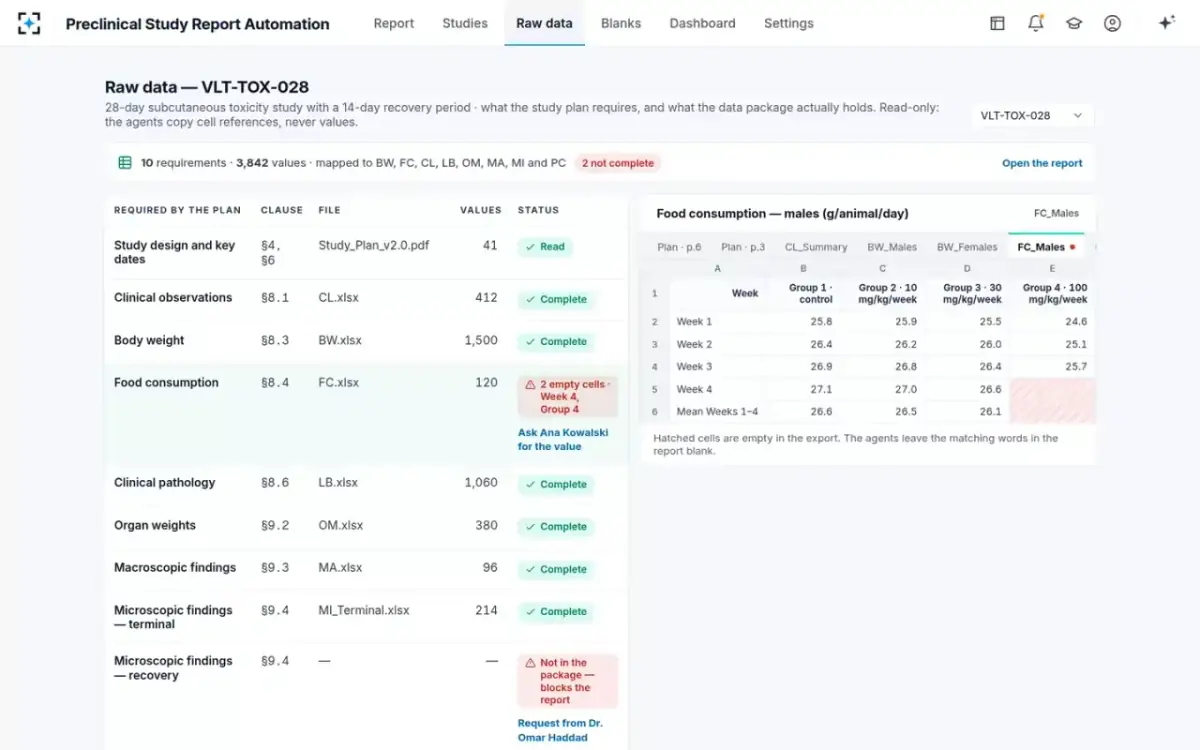
Where the datasets and the report disagree, and why
Disagreements are rarely dramatic. They come from a handful of ordinary causes, and each has a different fix.
The commonest is a rounding or precision rule applied once in the conversion and differently in the report, so a group mean differs in the last digit. The second is an exclusion: a value excluded from the report's mean for a documented reason that is flagged rather than removed in the datasets, so a reviewer recomputing the mean gets a different number unless the exclusion is explained. The third is timing — observations grouped by a planned day in the datasets and by a nominal week in the report, which FDA addresses directly by asking sponsors to use the appropriate timing variable "to group observations for summary analysis", including data collected over several days for one planned event.
The fourth is version drift: a corrected data file arrives, the datasets are regenerated, and a report table built weeks earlier is not. FDA's rule on resubmission assumes the datasets will move — if they change, send the new ones with the final report; if they do not, it still recommends an updated reviewer's guide noting the report's current version and that no dataset changes were needed. A report whose numbers are references to source cells, rather than typed characters, moves with the data instead of against it.
Study types not covered by SEND, and what you do there
SEND's scope is narrower than the work a toxicology group does, and FDA says where it stops. "SEND is not required for study types that are not listed in an FDA-supported SENDIG (e.g., primary pharmacology) even if one or more endpoints are able to be modeled in SEND." Dedicated juvenile animal studies with multiple phases and generations "cannot currently be modelled in FDA-supported SENDIGs and therefore would not require SEND" — though general toxicology studies run in young post-weaning animals do. Datasets generated for studies that are not intended to support clinical safety will be accepted but are not required.
Two scope rules in the same list are worth pinning up. The requirement does not depend on whether the report is a draft, an interim or a final — "the study report status or the finalization of the study report does not impact whether the SEND requirement applies". And it does not depend on GLP status: "as both GLP and non-GLP toxicity studies may be submitted to the FDA to support clinical safety, the decision for inclusion of SEND is independent of GLP status."
For everything outside SEND, the report is the submission. There is no machine-readable second copy to reconcile against, no conformance rule to catch a mistyped mean, and no reviewer re-analysis to notice that a table and its text disagree. The exposure is highest exactly where the standard has nothing to say.
What changes when the report is built from the same cells
The datasets solved the reviewer's problem. The writer's problem is still open, and it is a narrow one: a number that exists in a file has to appear, correctly, in nine sections of a document. Preclinical Study Report Automation treats that as a referencing problem rather than a writing problem. The study plan reader takes the design, groups, endpoints and time points from the signed plan and its amendments. A reader of the export maps each table to the endpoint it serves and checks counts, days and groups against the plan. The table builder then builds every report cell from its source, under the house precision rules, and the section drafter writes the results text with each figure inserted as a reference to the cell it came from, never typed.
Two consequences matter for the question this page asks. A report cell and a dataset row that both derive from the same recorded value cannot drift apart by transcription, because one of the two routes no longer involves a keyboard. And when the export changes — a corrected file, a late recovery necropsy — the sections that depend on it are redrafted and re-checked, rather than quietly left at the old figure.
The solution does not produce, convert or validate SEND datasets, and nothing on this page should be read as saying it does. It writes the other artefact, from the same source, and it exports the number-to-source trail as a spreadsheet so the reconciliation that used to take days can be read in an afternoon. In the demonstration study, 166 numbers in the signed draft each carried a file, a sheet and a cell.
Eight checks that your datasets and your report tell the same story
- Name the catalogue entry, not the folklore
For each study, write down the initiation date, the centre and the SENDIG version the Data Standards Catalog requires. Keep it with the study plan.
- Reconcile group means, not spot values
Recompute every report table’s mean and standard deviation from the dataset rows. A spot check of ten cells proves little about four thousand.
- Compare precision rules explicitly
The house rounding rule for the report and the conversion’s handling of significant figures should be written down in one place and compared.
- Test every exclusion both ways
An excluded value flagged in the datasets and removed from the report’s mean has to be explained, or a reviewer recomputing the mean will disagree with you.
- Check the time axis
Confirm that the planned day or nominal day used to group observations for analysis matches the week or interval the report’s tables use.
- Freeze the data version per table
Record which export version each report table was built from, so a regenerated package can be matched to the report that cites it.
- Write the reviewer’s guide from the differences you found
The nSDRG is where the relationship between report and data is explained. Write it from the reconciliation, not from a template.
- Ask what the report does with an empty cell
A missing value that becomes a blank in the report and a flagged row in the datasets is honest. One that becomes an estimate in the report is a finding waiting to happen.
One study's report, open beside its own export
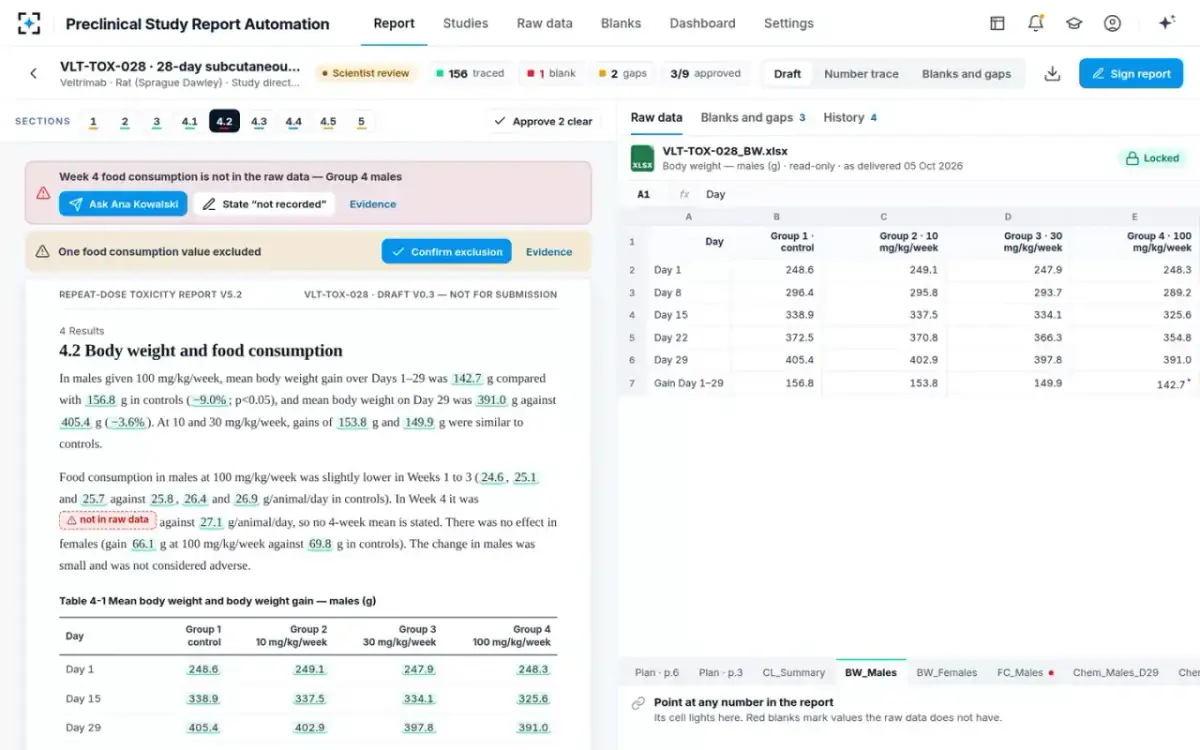
To see the drafting, the blanks and the number-to-source trail on a study of your own, start from Preclinical Study Report Automation.
Questions people ask
When did SEND become required by FDA?
In stages, by centre and study type. For CDER, single-dose, repeat-dose and carcinogenicity studies needed SENDIG v3.0 from 17 December 2016 for NDAs and BLAs and a year later for commercial INDs, moved to v3.1 in 2019 and 2020, and to v3.1.1 for studies started after 15 March 2023. CBER's dates for those study types begin at 15 March 2023. In vivo micronucleus and comet assays joined at 15 March 2025.
Do SEND datasets have to be resubmitted with the final study report?
Only if they changed. FDA asks for datasets with a draft report, and says that if changes require resubmission the new datasets replace the previous ones; where nothing changed, resubmission is not needed. It still recommends an updated nonclinical reviewer's guide with the current report version and a note that no dataset changes were made.
Does a non-GLP toxicity study need SEND?
It can. FDA states that the decision is independent of GLP status: if a non-GLP toxicity study is submitted to support a determination of clinical safety, it must include SEND. The trigger is what the study is being used for, not which quality regime it ran under.
Can one study report cover two studies in SEND?
Yes, and each study needs its own package. Where, say, a maximum tolerated dose study and a seven-day repeat-dose study are reported together, FDA asks that each be submitted with its own datasets, reviewer's guide and define.xml, with a unique study identifier, and that the single report be submitted once and referenced from both. Endpoints collected inside another study, such as safety pharmacology within a repeat-dose study, go in one package.
What is the nonclinical study data reviewer's guide?
A PDF, named nsdrg.pdf, that accompanies the datasets and explains anything a reviewer needs in order to use them — special considerations, directions, conformance issues, and how the submitted data relates to the study report. FDA does not specify a template, and points to a published community example instead.
Does SEND remove the need to check the report's numbers?
No. A conformance checker tests the datasets against the standard's rules; it has no view of the report. The report's numbers are checked against the study's own records, by a person under GLP or by a system that re-reads every figure against the cell it cites. The two checks have different subjects and neither substitutes for the other.