An FDA GLP inspection is rare and consequential: the Agency final-classified 44 good laboratory practice inspections across all its centres in fiscal year 2024, and in a separate review of 37 GLP inspections from the same year it issued a Form FDA 483 in 17 of them. What those observations are about is published, and it is not what most laboratories rehearse for. Sort FDA's own sub-categorisation and one cluster is about the final study report itself — what it left out, whether corrections were made as an amendment, and whether the quality assurance unit confirmed that the reported results matched the raw data. That last question is the one Botminds' Preclinical Study Report Automation is built around: it drafts each section of a study report from the signed plan and the raw data export, and every number in the draft is a reference to the file, sheet and cell it came from, re-checked before anybody signs.
The regulatory figures below come from FDA's published inspection metrics, its own 483 trends analysis, two warning letters and the regulation. The product figures come from a working demonstration on an invented 28-day study, VLT-TOX-028, with invented people; they are the demonstration team's own quality assurance findings, never a customer's result and never an inspection outcome.
Two FY2024 counts, from two different FDA publications
44
GLP inspections final-classified across all centres in FY2024, in the BIMO metrics
37
GLP inspections in FDA’s separate FY2024 483 observation trends analysis
17
of those 37 produced a Form FDA 483 — 46%, against 20 with none
0
official action indicated classifications in FY2024, against four in FY2020
How many GLP inspections does FDA run each year?
Fewer than most people assume, and the number moves. FDA's bioresearch monitoring metrics count inspections by the date a centre finally classified them, so the series is a classification count rather than a count of visits made in that year. Across the five fiscal years to 2024 it runs 33, 16, 33, 29 and 44.
Good laboratory practice inspections final-classified, by fiscal year
The 2021 trough and the 2024 peak are both visible in the centre-level rows, and the growth is concentrated in the drug centre: CDER's final classifications went from 7 in 2022 to 14 in 2023 to 23 in 2024. For a laboratory that files under CDER, the practical reading is that the chance of a visit in a given year has risen, from a low base.
What percentage of GLP inspections result in a 483?
In FDA's own FY2024 analysis, 46%: of 37 GLP inspections reviewed, 20 ended with no Form FDA 483 and 17 with one. The Agency built that analysis for a specific reason, which it states at the front: "Broadly written regulations do not always convey the specific details of the observed violation(s). FDA 483 citations issued during this fiscal year were reviewed and sub-categorized into more granular themes to identify trends."
A 483 is not by itself an enforcement action. It is a list of what the investigator observed, handed over at the close of the inspection. The classification that follows is the signal worth watching, and in FY2024 it was unusually benign at the top end.
How GLP inspections were classified, five fiscal years
| Classification | What it means in practice | FY2020 | FY2021 | FY2022 | FY2023 | FY2024 |
|---|---|---|---|---|---|---|
| No action indicated | Nothing objectionable was found that warrants further action. | 20 | 12 | 21 | 16 | 22 |
| Voluntary action indicated | Objectionable conditions were found, but not at a level warranting regulatory action; the firm is expected to correct them. | 9 | 4 | 9 | 10 | 22 |
| Official action indicated | Conditions serious enough that regulatory or administrative action is recommended. | 4 | 0 | 3 | 3 | 0 |
The most common GLP inspection findings, grouped into four themes
FDA sorted the FY2024 citations into four themes — testing facility management, study director, standard operating procedures, and training — and then into sub-themes underneath each. The themes are not what a toxicologist would guess. None of them is about the science of the study.
FDA's four FY2024 themes, and what sits under each
Testing facility management
Seven sub-themes
The unit that is supposed to catch the problem
Failures to establish required procedures, to replace a study director promptly, to make sure people understand the functions they perform, and to resource studies as scheduled — alongside three about the quality assurance unit: monitoring critical phases, and reporting what it found to management and the study director.
Study director
Nine sub-themes
Where the report citations sit
The largest cluster, and the one that reaches the report: protocol changes not properly documented, unforeseen circumstances not noted and corrected, studies not conducted in accordance with the protocol, and three citations about what the final study report contains or how it was corrected.
Standard operating procedures
Four sub-themes
The written method
Procedures management cannot be assured are adequate, revisions not approved by management, and deviations from procedures neither authorised by the study director nor documented in the raw data.
Training
Four sub-themes
People and records
Records and specimens not transferred to the archives, specimens not properly identified, study phase audits the quality assurance unit did not adequately perform, and individuals without the education, training and experience for their assigned functions.
Two of the four themes are about whether the written method was followed and documented; one is about whether the right people were trained and the records reached the archives; one is about the study director. Across all four, the recurring verb is some form of assure — the regulation puts the duty to make sure on a named person, and the citation records that they did not.
What FDA cites about the final study report
Under the study director theme, three of the nine sub-themes are about the report rather than the study: that protocol deviations were not included in the final report; that the final report did not describe all the circumstances that may have affected the data's quality or integrity; and that corrections or revisions to the report were not made as an amendment. A fourth, that study data were not accurately recorded and verified, sits one step upstream of the report. The point for a reporting group is that these are not science findings. They are documentation findings, and each is decided by comparing a finished document with a file.
The same cluster appears in the warning letters. In an October 2026 letter, FDA's cited violation at a research institute was aimed at the quality assurance unit: "failure of the quality assurance unit (QAU) to review the final study report" so as to make sure the reported results accurately reflected the raw data, under 21 CFR 58.35(b)(6). The specifics are the uncomfortable part. For one study, FDA wrote, "for 20 out of 34 animals, the final study report did not include all the abnormal cageside clinical observations" — sneezing, nasal discharge, abnormal stool, sunken eyes, laboured breathing — and for another, the report lacked "all the abnormal cageside clinical observations for all 48 animals" recorded between November 2022 and July 2023, as well as descriptions of dosing issues such as catheters pulled out during infusion and an animal not dosed because of a swollen muzzle (warning letter, 6 October 2026).
For 20 out of 34 animals, the final study report did not include all the abnormal cageside clinical observations.
FDA warning letter, 6 October 2026, under 21 CFR 58.35(b)(6)
An earlier letter shows the same shape with a different clause. There, FDA cited that "the study director failed to authorize all deviations in the study from standard operating procedures and ensure the deviations were documented in the raw data [21 CFR 58.81 (a)]", alongside a report that "did not include a description of all circumstances that may have affected the quality and integrity of the data [21 CFR 58.185 (a)(9)]" (warning letter, 20 October 2023). Something happened during the study, the raw data did not record it, and the report could not describe it. The report citation is the last link in a chain that broke earlier.
How the quality assurance unit audits a final study report
The regulation gives the quality assurance unit a short list of duties, and three of them bear on the report. It must "inspect each nonclinical laboratory study at intervals adequate to assure the integrity of the study" and keep signed records of each inspection, bringing anything likely to affect study integrity "to the attention of the study director and management immediately". It must "determine that no deviations from approved protocols or standard operating procedures were made without proper authorization and documentation". And it must "prepare and sign a statement to be included with the final study report which shall specify the dates inspections were made and findings reported to management and to the study director" (21 CFR 58.35(b)).
In practice the report audit is a reconciliation. The auditor takes the draft, picks the numbers, and walks each one back to the raw data: the study file, the instrument output, the pathology records, the toxicokinetic report. On a repeat-dose report with ten to twenty tables and hundreds to thousands of numbers, checking every one by hand takes days, and where the auditor samples instead, the sample is where the method's limits live — a transcription slip in an unsampled cell survives the audit, and surfaces, if it surfaces at all, when somebody outside the laboratory compares the report with the data.
The same audit, with and without a number that names its source
Reconstructing the trail by hand: Open the report, find the table, work out which export and which sheet the value should be in, locate the animal and the day.
When every figure cites its file, sheet and cell: Point at the number. The cell it came from is identified, with the calculation if it is derived.
Reconstructing the trail by hand: Every number at the cost of days, or a sample, with the other numbers assumed right because the sampled ones were.
When every figure cites its file, sheet and cell: Every number in the draft is re-read against its source before signature, and a mismatch stops the signature.
Reconstructing the trail by hand: Re-do the arithmetic from the values you believe were used, and hope the writer used the same ones.
When every figure cites its file, sheet and cell: The two source cells and the formula are stated, so the only question left is whether the formula is the right one.
Reconstructing the trail by hand: Spot the absence, ask why, wait for an answer from whoever remembers.
When every figure cites its file, sheet and cell: The exclusion and its recorded reason travel with the data, and an exclusion that changes a mean is flagged for a statement in the report.
Reconstructing the trail by hand: Hard to see. A number filled from the week before reads exactly like a number that was measured.
When every figure cites its file, sheet and cell: It is not a number. The draft leaves it blank, names the empty cell, and will not reach signature until it is filled from source or stated.
Reconstructing the trail by hand: Whether the sample was representative.
When every figure cites its file, sheet and cell: Whether the science is right — which is what the audit is for.
Which clauses get cited most often
FDA's FY2024 analysis also publishes the clauses behind the themes, as a ranking of top citations. They are worth reading as a list, because together they describe a laboratory's paperwork rather than its pipettes.
The clauses in FDA's FY2024 list of top GLP citations
| Clause | What it requires | Theme |
|---|---|---|
| 21 CFR 58.81(a) | Written procedures management is satisfied are adequate; and all deviations from them "shall be authorized by the study director and shall be documented in the raw data". | Mostly procedures; some testing facility management |
| 21 CFR 58.35(b)(5) | The quality assurance unit must "determine that no deviations from approved protocols or standard operating procedures were made without proper authorization and documentation". | Mostly study director; also testing facility management and training |
| 21 CFR 58.29(a) | Each person conducting or supervising a study must have "education, training, and experience, or combination thereof, to enable that individual to perform the assigned functions". | Training |
| 21 CFR 58.63(a) | Equipment "shall be adequately inspected, cleaned, and maintained", and equipment used to generate, measure or assess data "shall be adequately tested, calibrated and/or standardized". | Procedures and testing facility management |
| 21 CFR 58.90(g) | Feed and water "shall be analyzed periodically" for contaminants that could interfere with the study, with the analyses kept "as raw data". | Testing facility management |
| 21 CFR 58.35(b)(3) | The quality assurance unit must inspect each study at adequate intervals and keep signed records of each inspection, raising anything likely to affect study integrity immediately. | Testing facility management |
| 21 CFR 58.33(f) | The study director must assure that "all raw data, documentation, protocols, specimens, and final reports are transferred to the archives during or at the close of the study". | Study director and training |
FDA's separate list of common GLP observations, published with the inspection metrics, reads the same way: missing standard operating procedures; a quality assurance unit that "failed to determine if deviations from approved protocols had been made without proper authorization and documentation"; equipment design, inspection, cleaning and maintenance; "lack of authorization and documentation of deviations"; and equipment that "was not adequately tested, calibrated and/or standardized". FDA notes those are summarised rather than verbatim from the regulations.
What a traced report changes for the auditor, and what it does not
Nothing on this page says that software reduces a laboratory's chance of an inspection, or of a 483. Inspection outcomes turn on the whole quality system — procedures, training, equipment, the quality assurance unit's independence and its records — and a drafting tool touches one part of one of those. What it changes is narrower and checkable: the cost of proving that the report says what the data says.
In the demonstration, the signed report is released to the quality assurance auditor automatically, and it carries two appendices: the number-to-source trail, exported as a spreadsheet, and the list of every blank and gap found during drafting with how each was closed. The auditor starts with the reconciliation already done and spends the time on judgement instead. The trail of who did what — every drafting step, every edit as a tracked change, every request to a colleague, every approval and the signature itself — is recorded with its time and its author.
A signed report, locked, with its trail attached
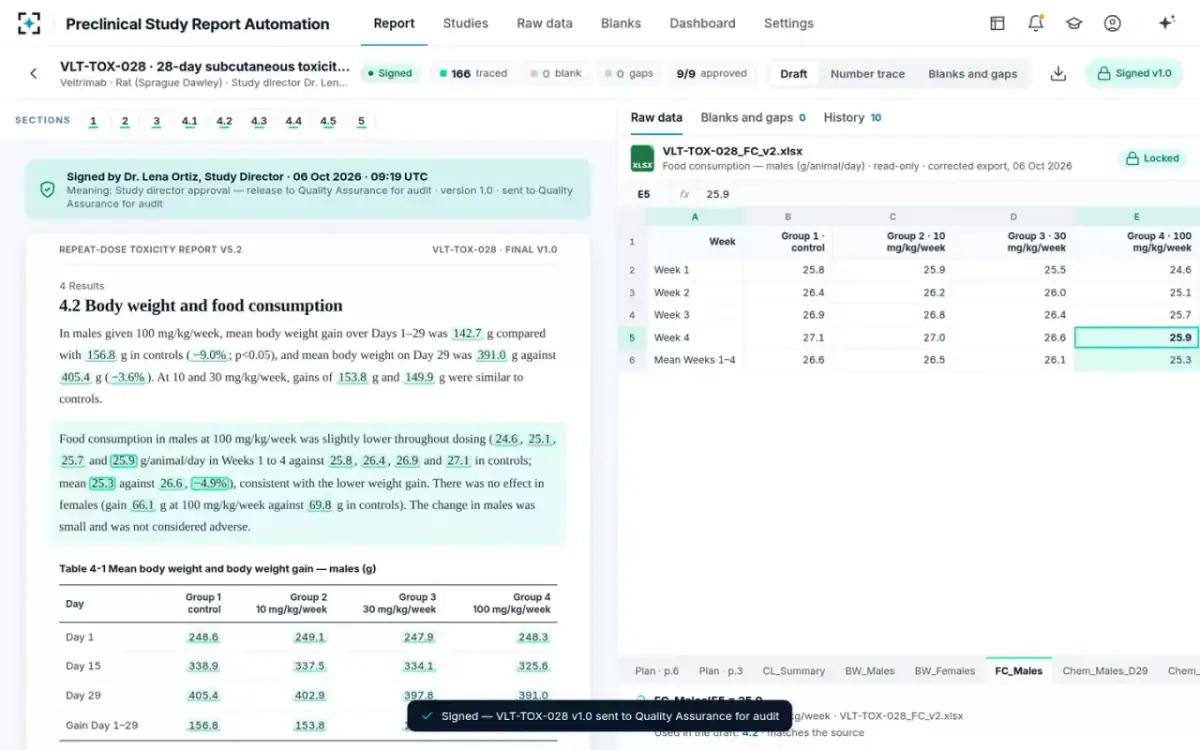
The demonstration team's own baseline is 4.6 transcription findings per report at its quality assurance audit by hand, against a design target of 0.3 with the agents drafting. Both are the team's figures on invented studies — one measured in the demonstration, one a target — and neither is an inspection statistic. The argument they support is modest: a finding that was never written cannot be defended, explained or amended later.
Preparing for an FDA GLP inspection without a fire drill
The useful preparation is not a rehearsal. It is being able to answer, for any one study, the questions an investigator asks in the order they ask them. The list below is ours, drawn from the clauses above and the two warning letters.
Nine things to have ready before an investigator asks for one study
- The signed plan and every signed amendment
With dates. A protocol change that is not properly documented is one of FDA’s nine study-director sub-themes.
- A route from any report number to its raw data
Not a method, a route: the file, the sheet, the cell, and who recorded it. This is the question behind 21 CFR 58.35(b)(6).
- Every deviation, with its authorisation
Authorised by the study director and documented in the raw data — the wording of the most-cited clause in FY2024.
- The quality assurance unit’s inspection records
Dates inspected, phase, inspector, findings, what was recommended, what was done, and when the study director and management were told.
- The statement that goes with the report
Signed by the quality assurance unit, listing inspection dates and when findings were reported. It is a required part of the final report.
- The circumstances paragraph, written while you remember
Anything that may have affected the quality or integrity of the data belongs in the report. Both warning letters quoted here turn on what was left out.
- Amendments, not quiet corrections
A change to a final report is an amendment that identifies what changed and why, and is signed. "Corrections or revisions not made in the form of an amendment" is a listed sub-theme.
- Contributing scientists’ signed reports
Pathology, toxicokinetics and any other specialist report, signed and dated, in the package the final report rests on.
- Archive transfer, evidenced
Raw data, documentation, protocols, specimens and final reports transferred during or at the close of the study — a top-cited clause and a training sub-theme both.
Every blank and gap, with the clause that makes it one
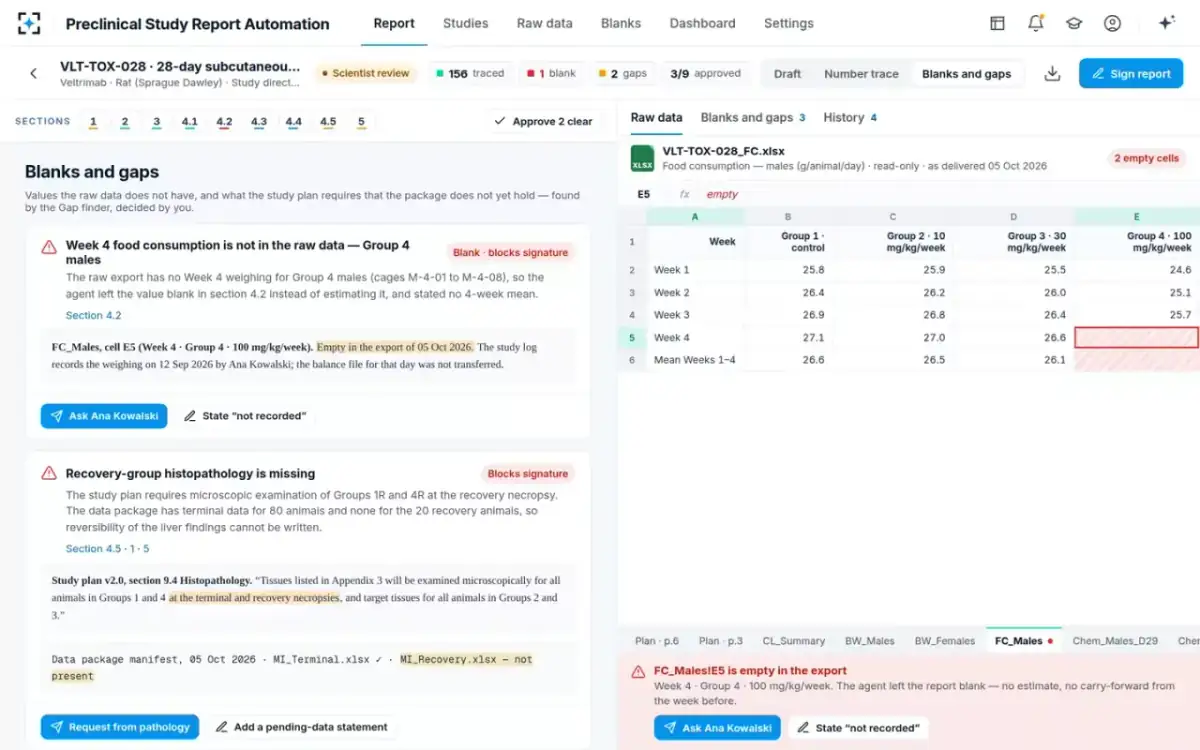
Two sibling guides go further into the parts an inspection touches: what a GLP final study report must contain, clause by clause, and what to do when a value is missing from the raw data. To see the drafting and the trail on studies of your own, start from Preclinical Study Report Automation.
Questions people ask
What is a 483 observation in a GLP inspection?
A Form FDA 483 lists what the investigator observed during the inspection and considers objectionable, and is issued at the close of the visit. It is the investigator's observations, not a final Agency determination. In FDA's FY2024 analysis of 37 GLP inspections, 17 ended with a 483 and 20 did not.
What happens after a GLP warning letter?
A warning letter follows the inspection and the firm's response when FDA judges the violations significant. It cites the clauses, sets out the observations behind each, and asks for corrective action. The two letters quoted on this page cite the quality assurance unit's review of the final report, the study director's authorisation of deviations, the report's description of circumstances affecting the data, and the transfer of records to the archives.
Does a 483 mean the study is invalid?
No. A 483 records observations; what follows depends on the classification and on the response. FDA's own FY2024 metrics show the pattern: 22 inspections classified as voluntary action indicated and none as official action indicated, against 22 with no action indicated. A finding about a report's completeness is a reason to amend the report, not automatically a reason to discard the study.
Why are so many GLP citations about documents rather than science?
Because the regulation is largely about documentation. Part 58 requires written procedures, authorised and documented deviations, raw data that reconstructs the study, a quality assurance unit that inspects and reports, and a final report that states what happened. An investigator can test every one of those against records. FDA sub-categorised its FY2024 citations precisely because, in its words, broadly written regulations do not always convey the specific details of the observed violation.
How many of FDA's GLP inspections are of contract laboratories?
The published metrics do not split the GLP figures that way. They report inspections final-classified by centre — CDER 23, CBER 11, CDRH 5 and CVM 5 in FY2024 — and classifications by outcome, with no breakdown by sponsor or contract facility. Any such split quoted elsewhere does not come from this table.
Can software reduce the number of 483 observations we receive?
Not in any way we would claim. Inspection outcomes depend on the whole quality system, and no supplier can see a laboratory's inspection history to measure against. What a drafting and checking system can change is narrower: whether every number in a report can be shown against the raw data it came from, and whether a missing value is visible rather than filled.