GLP report requirements come from one short regulation, not from a house template: for a study run under the United States Good Laboratory Practice regulations, 21 CFR 58.185(a) names fourteen things a final report must contain, 58.185(b) says the study director signs and dates it, and 58.185(c) says a change after that is an amendment. Meeting those requirements is where a fortnight goes. A repeat-dose report carries 9 sections, 10 to 20 tables and 400 to 4,000 numbers, and most of the time is spent moving those numbers out of the raw data export and checking them again. Preclinical Study Report Automation drafts every section from the signed study plan and the raw data export, links each number to the cell it came from, and lists what the plan requires that the package does not hold.
The screens and figures tagged demo on this page come from the solution running on an invented 28-day study — VLT-TOX-028, a humanised antibody called Veltrimab, with a study director, technician, pathologist and auditor who are all fictional. The regulation is quoted from its current text, linked where it appears.
One repeat-dose report, by the numbers the rule and the work both set
14items
named in 21 CFR 58.185(a) as the contents of a final report
9sections
in the house template the sample study is written to
demo
10–20tables
built from the raw data export for one repeat-dose study
demo
400–4,000
numbers in those tables, the text and the summary
demo
What does 21 CFR 58.185 require in a GLP final report?
It requires a document that lets a reader reconstruct the study. The regulation opens by saying that “a final report shall be prepared for each nonclinical laboratory study and shall include, but not necessarily be limited to, the following”, and then lists fourteen items: the facility and the study dates, the objectives and procedures from the approved protocol including any changes, the statistical methods, the test and control articles, their stability under the conditions of administration, the methods, the test system, the dosage and route, the circumstances that may have affected the data, the names, the data transformations and conclusions, the contributing scientists' signed reports, the storage locations and the Quality Assurance statement.
Two words in that sentence carry most of the weight. “Shall include” makes the list a floor, not a ceiling — a sponsor, a guideline or a review division may ask for more, and nothing in the rule stops a report carrying it. “Not necessarily be limited to” is the reason a house template is usually longer than fourteen headings: it folds in toxicokinetics, historical control data, individual animal data appendices and the discussion a reviewer expects.
What the rule does not do is tell you where each item goes. There is no required section order, no required numbering, and no requirement that the fourteen items be fourteen headings. A report with nine numbered sections is compliant if all fourteen items are somewhere in it, and a report with forty headings is not compliant if item (9) is missing. That is why an audit against the house template and an audit against the regulation are different exercises, and why the second one finds things.
The fourteen items, in the order a report is actually built
Reading the list in the order the rule prints it makes it look like a table of contents. Reading it in the order the facts arrive makes it look like a plan of work: four items come straight off the signed study plan, six come off the raw data package and the facility's own files, and the last four cannot be drafted until the study is over and other people have signed something.
The fourteen contents of a GLP final report, and who supplies each
| The item 21 CFR 58.185(a) names | Who supplies it | What it actually asks for |
|---|---|---|
| (1) Facility and dates | Study plan and facility records | “Name and address of the facility performing the study and the dates on which the study was initiated and completed.” |
| (2) Objectives and procedures | Study plan, plus every signed amendment | The approved protocol as approved — “including any changes in the original protocol”. |
| (3) Statistical methods | Study plan, confirmed against what was run | The methods employed for analysing the data, not the ones first proposed. |
| (4) Test and control articles | Test item characterisation file | Name, chemical abstracts or code number, strength, purity and composition. |
| (5) Stability | Analytical chemistry report | Stability “under the conditions of administration” — not shelf stability. |
| (6) Methods used | Study plan and standard procedures | A description, at a level that lets a reader repeat the work. |
| (7) Test system | Animal receipt and allocation records | Number of animals, sex, body weight range, source of supply, species, strain, substrain, age, identification. |
| (8) Dosage and route | Study plan and dosing records | Dosage, regimen, route of administration and duration. |
| (9) Circumstances affecting the data | Study director, from the study file | “A description of all circumstances that may have affected the quality or integrity of the data.” |
| (10) Names | Study file | The study director, the other scientists and professionals, and all supervisory personnel. |
| (11) Transformations, summary, conclusions | Raw data, then the study director | The calculations performed, the analysis, and “a statement of the conclusions drawn from the analysis”. |
| (12) Contributing scientists’ reports | Each contributing scientist | “The signed and dated reports of each of the individual scientists or other professionals involved in the study.” |
| (13) Storage locations | Archivist | Where the specimens, the raw data and the final report are to be stored. |
| (14) Quality Assurance statement | The Quality Assurance unit | The statement prepared and signed under § 58.35(b)(7). |
Items (1) to (8) are mostly transcription from the plan and the package, which is both the dullest part of the work and the part that produces findings. Item (9) is a judgement the study director has to make in writing. Items (12) and (14) are other people's signatures, and item (13) is a question for the archivist. A report that is “nearly finished” usually means items (1) to (11) are drafted and the four that depend on someone else are not.
The draft beside the raw data it came from, in Preclinical Study Report Automation
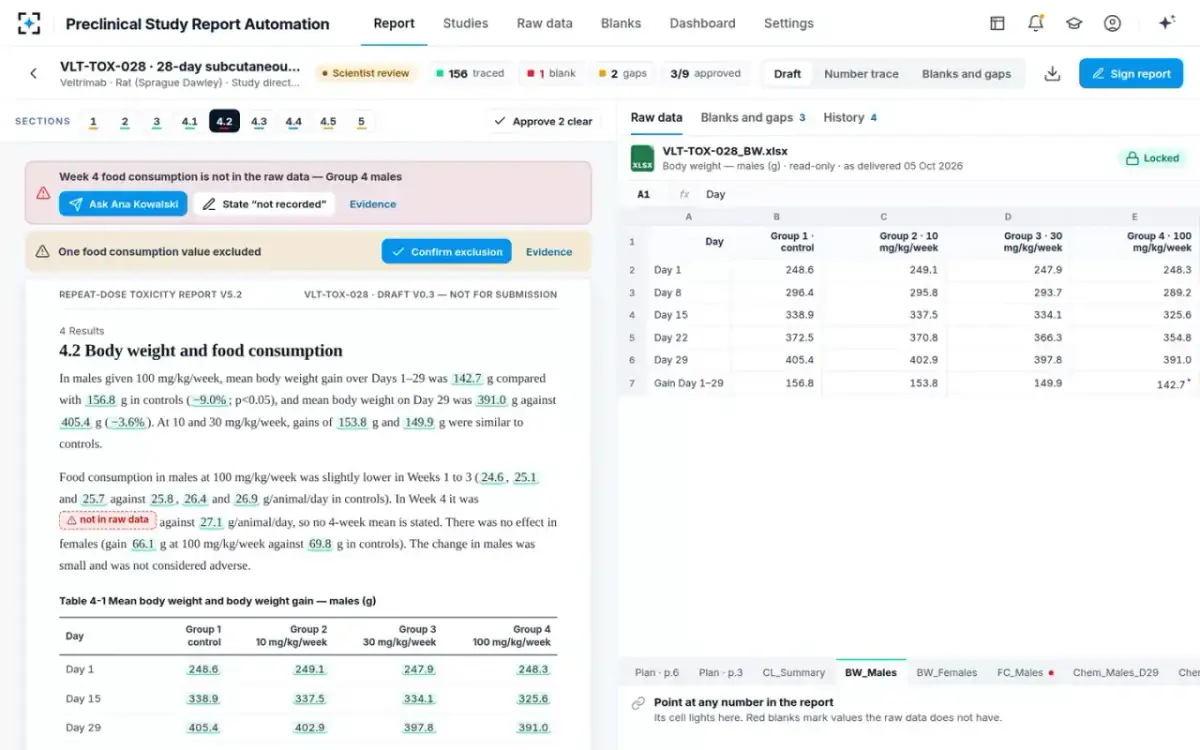
What the study plan has to carry before the report can
Four of the fourteen report items are copied out of the study plan, so a thin plan produces a thin report. 21 CFR 58.120(a) requires that “each study shall have an approved written protocol that clearly indicates the objectives and all methods for the conduct of the study”, and lists twelve things the protocol shall contain as applicable: the title and purpose, identification of test and control articles, the sponsor and the test facility, the test system's number, body weight range, sex, source, species, strain, substrain and age, the identification procedure, the experimental design including the methods for controlling bias, the diet and the vehicle with contaminant specifications, each dosage level with the method and frequency of administration, the type and frequency of tests, analyses and measurements, the records to be maintained, the date of sponsor approval with the study director's dated signature, and the proposed statistical methods.
Set that list against report items (2), (3), (7) and (8) and the overlap is almost exact. The report's objectives and procedures, its statistical methods, its description of the test system and its dosage statement are the protocol's own words, carried forward and then reconciled with what happened. Where the two differ, the difference is itself reportable: the rule asks for the objectives and procedures “including any changes in the original protocol”, and 58.120(b) requires that “all changes in or revisions of an approved protocol and the reasons therefore shall be documented, signed by the study director, dated, and maintained with the protocol”.
In practice this is the first thing worth automating, because it is pure comparison. In the sample study the agents read study plan v2.0 and its signed amendment 1 before touching a number, and an amendment without a signature is flagged rather than used. The same reading produces the list of endpoints the plan requires, which is what the package is then checked against.
Where each section's facts come from: plan, raw data, contributing reports
Every number in a compliant report is traceable to an original observation, because that is what raw data is defined as. 21 CFR 58.3(k) calls raw data “any laboratory worksheets, records, memoranda, notes, or exact copies thereof, that are the result of original observations and activities of a nonclinical laboratory study and are necessary for the reconstruction and evaluation of the report of that study”. The phrase that matters for report writing is the last one: raw data is defined by the report it has to support. If a figure in the report cannot be reached from the package, the package is incomplete by definition.
How a section of the report gets built, and what no agent is allowed to do
Agent
Study plan readerReads the signed plan and every signed amendment: design, dose levels, group sizes, endpoints with time points, guidelines followed.
Never: Infers a design element the plan does not state
Agent
Raw data readerLoads every table of the package, maps it to its domain, and checks animal counts, days and groups against the plan.
Never: Changes a raw value
Agent
Table builderBuilds each report table cell by cell from the source sheets, with significance markers, to the house precision rules.
Never: Types a number by hand
Agent
Section drafterWrites each section in house style, describing test item-related changes by group and sex with direction, size and significance.
Never: Fills an empty source cell with an estimate
Agent
Gap finderLists every missing file, empty cell, unsigned contributing report and exclusion that needs a statement, quoting the plan clause.
Never: Closes a gap itself
A person decides
Contributing scientistsSign their own reports — pathology, toxicokinetics — which become item (12) of the final report.
Never: Hand over an unsigned report for the file
A person decides
Study directorReviews each section against the raw data, decides item (9) and the conclusions, and signs the report.
Never: Delegates the signature
The contributing reports are the step most often underestimated. Item (12) asks for “the signed and dated reports of each of the individual scientists or other professionals involved in the study”, which means the pathologist's report and the toxicokineticist's report are not source material the writer paraphrases away — they go in, signed. A draft that quotes a pathology narrative from an unsigned draft report is not finished, and no amount of good writing fixes it.
Every endpoint the study plan requires, against what the package holds
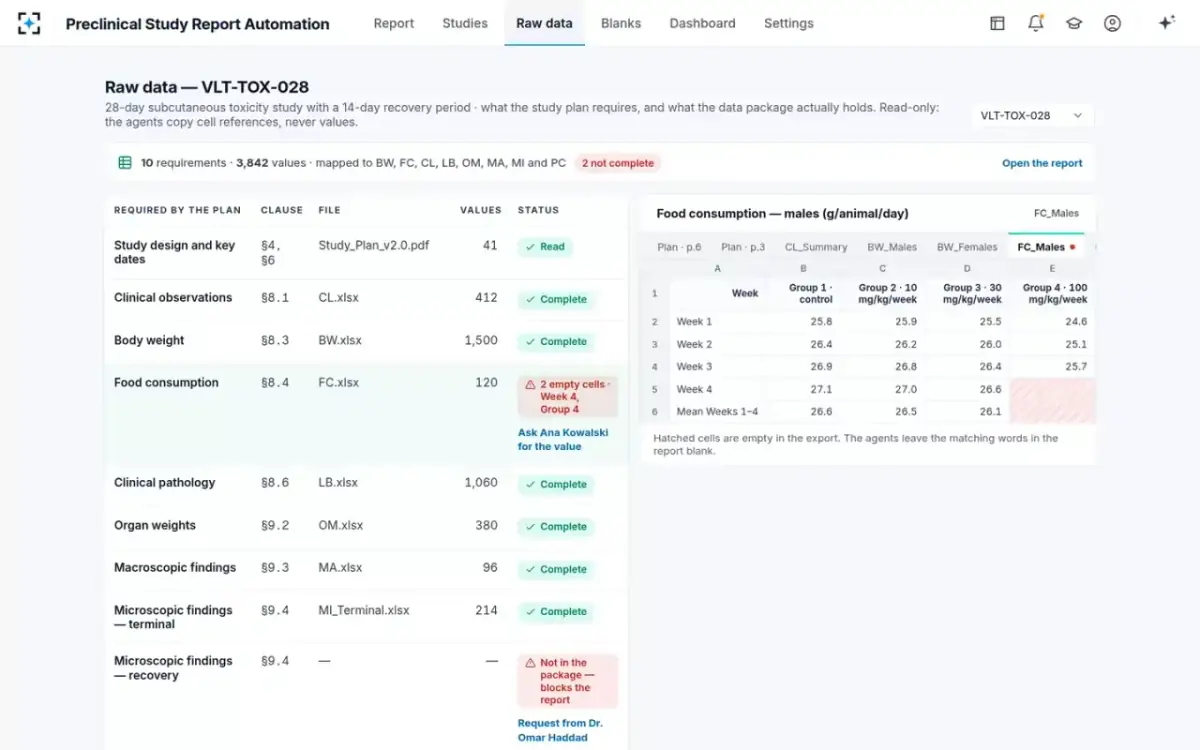
The two statements: the study director's and Quality Assurance's
Two of the fourteen items are statements written by named people rather than facts pulled from a file, and they attest different things. The study director's contribution is item (11)'s “statement of the conclusions drawn from the analysis”, together with item (9). The Quality Assurance unit's contribution is item (14).
What the Quality Assurance unit has to do first is read the report against the data. 21 CFR 58.35(b)(6) requires the unit to “review the final study report to assure that such report accurately describes the methods and standard operating procedures, and that the reported results accurately reflect the raw data of the nonclinical laboratory study”, and (b)(7) to “prepare and sign a statement to be included with the final study report which shall specify the dates inspections were made and findings reported to management and to the study director”. OECD puts the same idea more bluntly: its Quality Assurance statement “would also serve to confirm that the final report reflects the raw data” (OECD Principles, 9.2).
That is the sentence that decides how a report should be built. If the signed statement at the end of the document confirms the report reflects the raw data, then every number in it is a claim about a cell in a file, and a report assembled by re-keying puts a person between the claim and the evidence several thousand times. What the measured data-entry error rates predict for a report that size is the arithmetic behind the audit finding. Who signs what, and what each signature means, is set out in the guide to the compliance statement and the signatures.
The four items that arrive last, and what blocks each
| The late item | What it waits for | What it looks like when it is missing |
|---|---|---|
| (9) Circumstances that may have affected the quality or integrity of the data | The study director reading the whole study file: deviations, excluded values, equipment events, husbandry incidents. | A report with no such section at all, or one that says “none” while the study file records three deviations. |
| (12) The contributing scientists’ signed reports | The pathologist and the toxicokineticist signing, which often waits on peer review of the slides. | A draft that narrates pathology findings with no signed pathology report behind them. |
| (14) The Quality Assurance statement | The audit of the report against the raw data, which cannot start until there is a report. | A report issued with a placeholder page, or with inspection dates but no reported-to dates. |
| (13) The storage locations of specimens, raw data and the report | The archivist confirming where everything went, including anything held at another site. | A sentence naming the facility archive while the wet tissues sit at a subcontractor. |
Does the report have to say the study complied with GLP?
Under the FDA regulation, not in the report — and this surprises people. Nothing in 21 CFR 58.185 asks for a compliance statement. The statement is a submission requirement: 21 CFR 312.23(a)(8)(iii) requires, for each nonclinical laboratory study subject to part 58, “a statement that the study was conducted in compliance with the good laboratory practice regulations in part 58, or, if the study was not conducted in compliance with those regulations, a brief statement of the reason for the noncompliance”. The sponsor files that with the investigational new drug application.
Under the OECD Principles it is in the report. The final report “should be signed and dated by the Study Director to indicate acceptance of responsibility for the validity of the data”, and “the extent of compliance with these Principles of Good Laboratory Practice should be indicated” (OECD Principles, 9.1). Most laboratories therefore write a compliance statement into the report whatever the market, because a study intended for a European, Japanese or OECD-monitored submission needs one and a study intended only for an IND loses nothing by having one. What matters is that the statement is accurate about the extent — a study with a phase outside the GLP programme says so there, in the report, rather than leaving the sponsor to discover it.
“Circumstances that may have affected the quality or integrity of the data”
Item (9) is the shortest requirement in the list and the one that produces the most argument, because it asks the study director to write down what went wrong. The clause is one line: “a description of all circumstances that may have affected the quality or integrity of the data.” There is no threshold in it, no materiality test and no list of qualifying events.
Read it next to the study director's own duties and the scope becomes clearer. 21 CFR 58.33 makes the study director responsible for “the interpretation, analysis, documentation and reporting of results”, says they represent “the single point of study control”, and requires them to assure that “unforeseen circumstances that may affect the quality and integrity of the nonclinical laboratory study are noted when they occur, and corrective action is taken and documented”. Item (9) is where those contemporaneous notes come back out. A protocol deviation, a failed environmental control, an animal removed from the study, a balance that drifted, an analytical run repeated, a value excluded as spilled — each is a candidate, and the test is whether it may have affected the data, not whether the study director concluded it did.
The useful discipline is to draft item (9) from the study file rather than from memory, and to describe each circumstance with what was done about it. In the sample study the drafting is held up by two things the plan requires and the package does not hold, both listed with the clause that asks for them and whether they block signature; a third, minor item asks the study director to confirm one weighing recorded as spilled, and confirming it adds a note about the exclusion to the food consumption results. That is item (9) being built as a by-product of the data check instead of being written from scratch the night before signature. What to do when a value is simply not in the raw data takes the harder version of the same question.
The gap list: what the study plan requires, with the clause that requires it
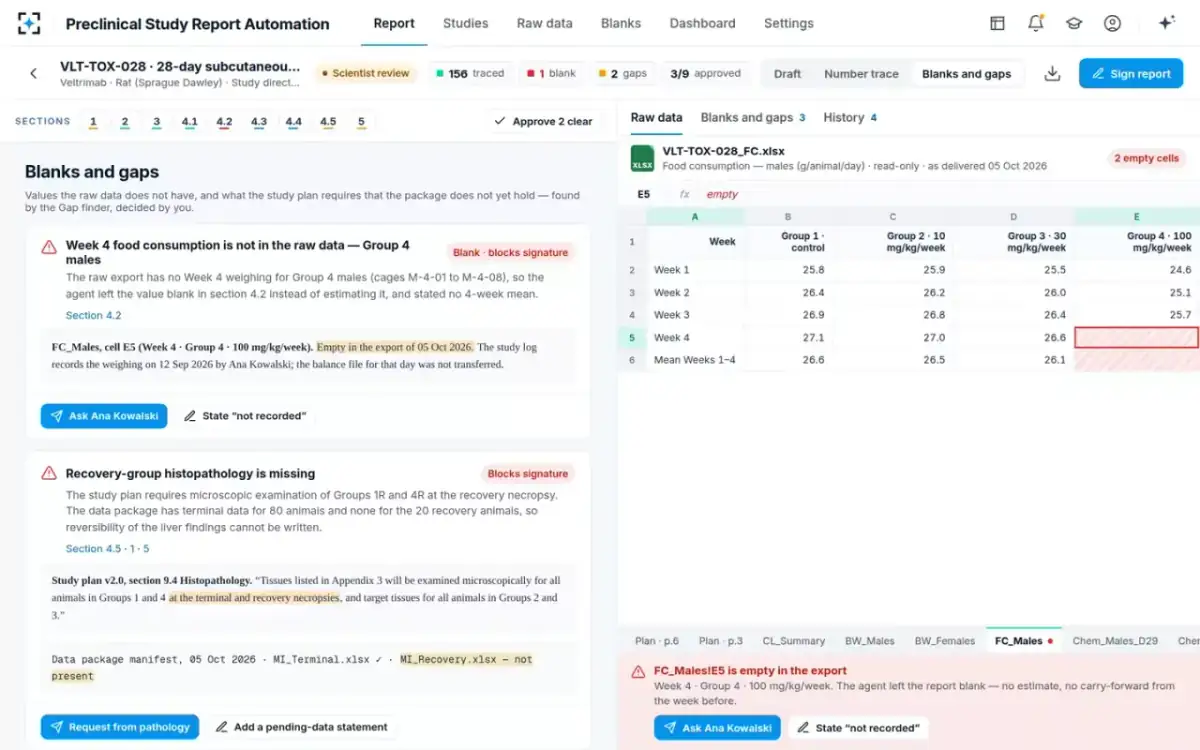
Correcting a signed report: an amendment, not an edit
Once the study director has signed, the report stops being a document you edit. 21 CFR 58.185(c) is explicit: “corrections or additions to a final report shall be in the form of an amendment by the study director. The amendment shall clearly identify that part of the final report that is being added to or corrected and the reasons for the correction or addition, and shall be signed and dated by the person responsible.” Three obligations sit in that sentence — identify the part, give the reason, sign and date — and all three are routinely thinned to a reissued PDF with a new version number.
OECD runs in parallel and adds one helpful exclusion. Corrections and additions “should be in the form of amendments” that “clearly specify the reason” and are signed and dated by the study director; but “reformatting of the final report to comply with the submission requirements of a national registration or regulatory authority does not constitute a correction, addition or amendment to the final report” (OECD Principles, 9.1). Changing a page size is not an amendment. Changing a number is, however small, and so is adding a paragraph that was always meant to be there.
The practical consequence is that the pressure to get it right lands before signature, not after. Everything that would otherwise become an amendment — a number that does not match its cell, a group size that does not match the plan, a summary that rounds differently from the table it summarises — is worth catching while the document is still a draft, which is why the consistency check in the solution re-reads every number against its source cell before the signature screen will open.
FDA and OECD side by side: one report, two lists
Most laboratories write one report for both. The two lists overlap heavily, and where they differ, the broader requirement wins because a report that satisfies both costs nothing extra.
The contents of a final report: 21 CFR 58.185 beside OECD GLP 9.2
21 CFR 58.185(a): Fourteen numbered items that the report “shall include, but not necessarily be limited to”.
OECD Principles, 9.1 and 9.2: Seven headings — identification, sponsor and facility, dates, statement, materials and methods, results, storage — each with sub-items.
21 CFR 58.185(a): Not a content requirement. The statement is filed with the IND under 21 CFR 312.23(a)(8)(iii).
OECD Principles, 9.1 and 9.2: In the report: the study director signs “to indicate acceptance of responsibility for the validity of the data”, and the extent of compliance “should be indicated”.
21 CFR 58.185(a): Item (14): the statement prepared and signed under § 58.35(b)(7), specifying inspection dates and when findings were reported.
OECD Principles, 9.1 and 9.2: Section 9.2 item 4: the same list of inspections, which “would also serve to confirm that the final report reflects the raw data”.
21 CFR 58.185(a): Item (12): their signed and dated reports are part of the final report.
OECD Principles, 9.1 and 9.2: Reports of Principal Investigators or scientists “should be signed and dated by them”, and their names and addresses appear in the report.
21 CFR 58.185(a): Item (13): where specimens, raw data and the final report are to be stored.
OECD Principles, 9.1 and 9.2: Section 9.2 item 7: where the study plan, samples of test and reference items, specimens, raw data and the final report are to be stored.
21 CFR 58.185(a): Silent. Any correction or addition is an amendment.
OECD Principles, 9.1 and 9.2: Reformatting for a national authority’s submission requirements “does not constitute a correction, addition or amendment”.
Three differences are worth planning for rather than discovering. OECD names the study plan and samples of the test and reference items in its storage list, so a storage paragraph written only against item (13) is short. OECD requires the extent of GLP compliance in the report itself. And OECD asks for the addresses of contributing scientists, which is trivial and still gets missed.
Nine checks to run before a GLP final report goes for signature
- All fourteen items of 58.185(a) can be pointed at in the document
Not “the template is complete” — a named page or paragraph for each of the fourteen, including (13) storage and (14) the Quality Assurance statement.
- The objectives, methods, test system and dosage match the plan as amended
21 CFR 58.185(a)(2) asks for the approved protocol “including any changes”, and 58.120(b) requires every change to be documented, signed and dated.
- Every amendment to the study plan is signed
An unsigned amendment cannot be the authority for what the report describes; flag it rather than drafting from it.
- Item (9) is drafted from the study file, not from memory
Deviations, exclusions, equipment events and husbandry incidents, each with what was done — the test is whether it may have affected the data.
- Every number in the text and the summary matches its source cell
The Quality Assurance unit must assure that “the reported results accurately reflect the raw data” under 58.35(b)(6), so this is checked twice whatever you do.
- The summary and conclusion repeat the results exactly
Different rounding between a table and the sentence that cites it is a mismatch, and reads as a second, different result.
- Each contributing scientist’s report is in the file, signed and dated
Item (12) is their signed report, not the writer’s paraphrase of a draft.
- Storage locations cover specimens held anywhere else
Including wet tissues, slides, blocks and electronic raw data at a subcontractor or a separate site.
- Nothing in the document is a value the raw data does not hold
A number with no cell behind it is the one finding that cannot be argued down at an audit.
To see the fourteen items being assembled from a study plan and a raw data export, with every number pointing at its cell, start from Preclinical Study Report Automation.
Questions people ask
Who signs a GLP final report?
The study director, under 21 CFR 58.185(b): “the final report shall be signed and dated by the study director.” Two other sets of signatures are part of the report without being the report's signature — each contributing scientist signs their own report under item (12), and the Quality Assurance unit signs its statement under item (14). OECD adds that the study director's signature indicates “acceptance of responsibility for the validity of the data”.
What is the difference between a study plan and a final report?
The study plan, called the protocol in 21 CFR 58.120, is approved before the work and says what will be done; the final report says what was done and what it showed. Four of the report's fourteen items are copied forward from the plan, which is why the rule asks for the objectives and procedures “including any changes in the original protocol”. A change to the plan during the study is documented, signed and dated as an amendment to the plan — a different document from an amendment to a signed report.
Does the FDA GLP final report have to list the raw data location?
Yes. Item (13) of 21 CFR 58.185(a) requires “the locations where all specimens, raw data, and the final report are to be stored”. It is easy to under-answer when material is split: 58.190(b) allows raw data and specimens to be held elsewhere provided the archives carry a specific reference to those other locations, so a report naming only the facility archive while slides sit at a subcontractor is incomplete.
What does OECD GLP require in a final report that FDA does not?
Three things, mainly. OECD expects the extent of GLP compliance to be indicated in the report itself, while FDA takes the compliance statement at the submission under 21 CFR 312.23(a)(8)(iii). OECD's storage list is longer, covering the study plan and samples of the test and reference items as well as specimens and raw data. And OECD names the addresses of contributing scientists and of any test sites.
How do you correct a GLP final report after it is signed?
With an amendment by the study director, not an edit. 21 CFR 58.185(c) requires the amendment to identify the part being corrected, give the reasons, and be signed and dated by the person responsible. Reissuing the report with a quiet change and a new version number does not satisfy any of the three, and OECD says the same thing while excluding pure reformatting for a national authority's submission requirements.
What counts as a circumstance that affected the quality or integrity of the data?
Anything that may have affected it — the clause carries no materiality threshold. In practice that means protocol deviations, excluded or lost values, equipment and calibration events, environmental and husbandry incidents, analytical runs repeated, and animals removed from the study. 21 CFR 58.33(c) requires the study director to note unforeseen circumstances when they occur and document the corrective action, so item (9) is best drafted from those contemporaneous notes.