GLP data integrity is the requirement that every result in a study report can be traced back to an original observation that was attributable, legible, contemporaneous, original and accurate — and the hardest moment for it is not a wrong number but an absent one. A week before a report is due, a cell in the raw data export is empty. There are three ways to close it: get the measurement from the person who holds the record, state in the report that it was not recorded, or fill it with something that looks like data. Only the third is quick, and it is the one that turns a missing value into a data-integrity finding. Preclinical Study Report Automation leaves the blank, says why it is blank, names who to ask, and will not let the report be signed while it is open.
The example running through this page is an invented 28-day study in the solution — VLT-TOX-028, a humanised antibody, with a fictional study director, technician and pathologist. The regulations and guidance are quoted from their current texts and linked where they appear.
“Any change in entries shall be made so as not to obscure the original entry, shall indicate the reason for such change, and shall be dated and signed or identified at the time of the change.”
21 CFR 58.130(e), Conduct of a nonclinical laboratory study
What does GLP data integrity mean inside a study report?
Inside a report it means one thing above all: the document and the raw data say the same thing, and anyone can get from one to the other. That is not a slogan borrowed from quality management — it is how the rule defines the two objects. Raw data is defined by reference to the report it supports, and the Quality Assurance unit's review exists to confirm that the reported results reflect it. Break the link and the report stops being evidence.
The FDA says the same thing from the dataset side. Its technical conformance guide for study data states that “it is important that the results presented in the study report and in the accompanying SEND datasets be traceable back to the original data collected and that the results in the SEND datasets can be summarized for meaningful group comparison aligned with the study report”. Traceable back to the original data collected — not to an intermediate working file, and not to a number someone was fairly sure about.
A missing value attacks that link in a particular way. A wrong number can be found by comparison, because there is something to compare. An invented number cannot, because the raw data has nothing to put beside it. That asymmetry is why the honest blank is worth defending against the pressure of a due date.
Raw data, as the rule actually defines it
Three definitions are worth holding together, because teams working to all three sometimes assume they say different things. The US regulation defines raw data as laboratory worksheets, records, memoranda, notes or exact copies of them that result from original observations and are necessary to reconstruct and evaluate the report. It then makes one allowance that is easy to miss: “in the event that exact transcripts of raw data have been prepared (e.g., tapes which have been transcribed verbatim, dated, and verified accurate by signature), the exact copy or exact transcript may be substituted for the original source as raw data.” A transcript can stand in for the original — if it is verbatim, dated, and verified accurate by signature. Those three conditions are the whole of the allowance.
OECD is broader and simpler: raw data is “all original test facility records and documentation, or verified copies thereof, which are the result of the original observations and activities in a study”. The UK regulator's definition comes at it from the capture end: raw data is “the original record (data) which can be described as the first-capture of information, whether recorded on paper or electronically”, and “information that is originally captured in a dynamic state should remain available in that state”.
Read together, they agree on the point that decides what to do with an empty cell. Raw data is the first capture, or a verified exact copy of it. An export is neither of those things — it is a convenience, and if the export is missing a value the first question is whether the first capture is missing it too. In the sample study it was not: the study log recorded the food weighing taken on 12 September, and the balance file from that day had simply never been transferred into the package.
ALCOA, and the “+” that catches the missing weighing
ALCOA is the five-attribute shorthand for what data has to be, and the “+” adds four more that data governance has to ensure. The MHRA guidance sets it out plainly: “ALCOA being Attributable, Legible, Contemporaneous, Original, and Accurate and the ‘+’ referring to Complete, Consistent, Enduring, and Available”, adding that “there is no difference in expectations regardless of which acronym is used”.
For a missing value, the attribute that bites is in the plus. “Complete – the data must be whole; a complete set.” A food consumption series with three of four weeks present is not a complete set, and no amount of care about the three recorded weeks makes it one. The second attribute that bites is Attributable: a carried-forward value has no person behind it, because nobody observed it.
The nine ALCOA+ attributes, read against one missing food weighing
| Attribute | What it asks for | What the missing week 4 weighing does to it |
|---|---|---|
| Attributable | To the person generating the data. | A value filled from week 3 has no observer. There is no honest name to put against it. |
| Legible | Legible and permanent. | Unaffected — which is part of the problem: an invented number is perfectly legible. |
| Contemporaneous | Recorded at the time of the activity. | A value supplied a month later, during report writing, is the opposite of contemporaneous. |
| Original | The original record, or a certified true copy. | The original record exists — on the balance, in the study log — and has not reached the export. Chasing it is the right move. |
| Accurate | The value is right. | An estimate may even be close. Accuracy is not the attribute that fails first, which is why the slip feels harmless. |
| Complete | The data must be whole; a complete set. | Three of four weeks is not a complete set. This is the attribute a filled blank is designed to hide. |
| Consistent | Self-consistent. | A filled value usually is consistent — with the week before, which is where it came from. |
| Enduring | Durable, lasting throughout the data lifecycle. | The corrected export has to survive as a new version beside the first, not replace it. |
| Available | Readily available for review or inspection. | If the balance file was never transferred, the data exists and is not available — an availability failure before it is anything else. |
What happens when a measurement never reaches the export
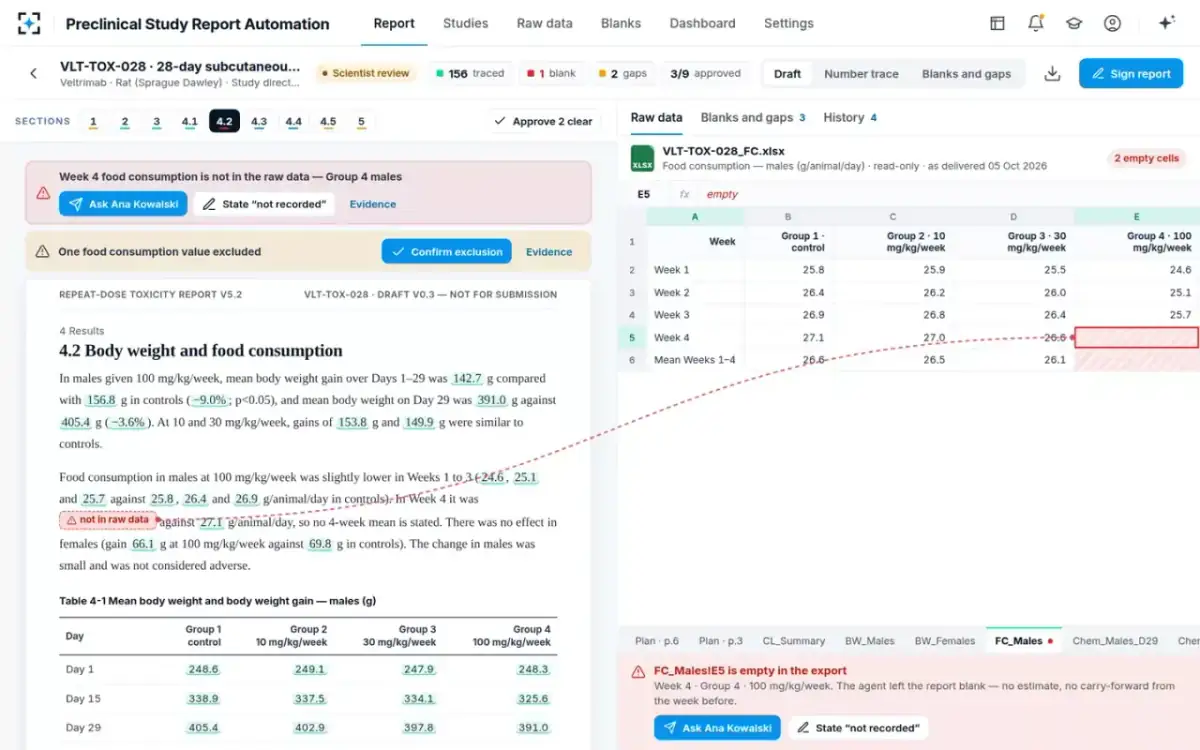
Something very ordinary. In the sample study, cell E5 of the male food consumption sheet — week 4, group 4 — is empty in the export dated 5 October 2026. The weighing itself happened; the study log records the technician taking it on 12 September. The balance file for that day was never transferred into the data package. No rule was broken at the bench, and nothing about the study is in doubt. What is in doubt is one number in one table, a week before a report is due.
The drafting rule in the solution is absolute at this point: an empty source cell stays blank. The section describing food consumption was written without the week 4 figure and, more importantly, without the four-week mean that would have been calculated from it — because a mean over three of four weeks presented as a four-week mean is a quieter version of the same invention. The sentence says the value is not in the raw data.
The red blank, where the four-week mean would have been
Why a carry-forward reads as data
Because nothing in the document distinguishes it. A food consumption figure filled from the week before, or averaged from the sister group, lands in the table in the same font as the measured values, carries a decimal place like them, and flows into the four-week mean and the percentage change exactly as a real reading would. A reviewer sees a complete series. An auditor comparing the report to the raw data sees a number with no cell behind it — and that comparison is the one check in the system designed to catch it.
The consequence is not proportionate to the effort involved. One filled cell makes the table wrong, the derived mean wrong, the percentage change wrong, and any sentence quoting them wrong, while looking tidier than the truth. It also makes a false claim about a person: the data is supposed to be attributable to whoever generated it, and nobody generated this.
A missing week 4 weighing, closed two ways
Filled from the week before: A complete four-week series, visually indistinguishable from measured data.
Left blank, with a reason: Three measured weeks and one stated absence, with the sheet and cell named.
Filled from the week before: A four-week mean and a percentage change computed partly from a number nobody observed.
Left blank, with a reason: No four-week mean is stated, because the inputs for one do not exist.
Filled from the week before: Nobody. The person named on the sheet did not record it.
Left blank, with a reason: Nobody — and the report says so, which is the difference.
Filled from the week before: A report number with no raw data behind it: a data-integrity finding, not a typographical one.
Left blank, with a reason: A documented gap and the query that closed it, which is a record of control rather than a failure of it.
Filled from the week before: An amendment to a signed report under 21 CFR 58.185(c), and a conversation about how it happened.
Left blank, with a reason: One query to the person who holds the record, before anyone has signed.
Filled from the week before: A claim about the validity of data that includes a value they cannot source.
Left blank, with a reason: A report whose every number has a cell behind it, and whose gaps are named.
The honest blank: how to state a value you do not have
A stated absence is a normal part of a scientific report, and it has a form. Name what is missing, where it should have been, why it is not there if that is known, and what was done about it. Then do not derive anything from it. In the sample study the drafted sentence carries the sheet and the cell; the gap list carries the evidence and whether it blocks signature; and the four-week mean simply does not appear.
Where the absence is permanent — a sample lost, a reading never taken, an animal found dead between observations — the report says so in those words, and the circumstance belongs in the section the rule reserves for it. Item (9) of the report's contents is “a description of all circumstances that may have affected the quality or integrity of the data”, and 21 CFR 58.33(c) required the study director to note unforeseen circumstances “when they occur” and document the corrective action, so the material for that description should already exist in the study file. What else the final report must contain sets item (9) among the other thirteen.
The setting that makes this work in the solution is deliberately not optional: leaving a value blank when it is not in the raw data is on and required, with the rule stated as never estimating, carrying forward or averaging around an empty cell. A rule that can be switched off under deadline pressure is a rule that will be.
Who holds the record, and how a corrected file comes back
The person to ask is the one who generated the data — for in-life measurements, the study technician who owns the balance and the weighings; for histopathology, the study pathologist; for an analytical result, the analyst. The route matters because the answer has to be a record, not a recollection. A value read back over the phone and typed into the report is a transcription with none of the controls, and it is attributable to the wrong person.
Closing a blank, from the empty cell to a traced number
Agent
Raw data readerFinds the empty source cell when the package is loaded, and records which report table and section depend on it.
Never: Changes a raw value
Agent
Section drafterWrites the section without the value and without any figure derived from it, stating what is not in the raw data.
Never: Estimates, carries forward or averages around an empty cell
Agent
Gap finderLists the blank with its evidence — the sheet, the cell, the export date — and marks it as blocking signature.
Never: Closes the gap itself
A person decides
Study directorDecides whether the value can be obtained, and sends the query to the role that holds the record.
Never: Supplies the value from memory
A person decides
Study technicianRetrieves the original record and sends a corrected, versioned export, signed — the first export stays in the package.
Never: Overwrites the original file
Agent
Section drafter, againRedrafts only the sections the corrected cell feeds, with the new numbers traced, and the consistency checker re-reads every one.
Never: Redrafts a section the change does not touch
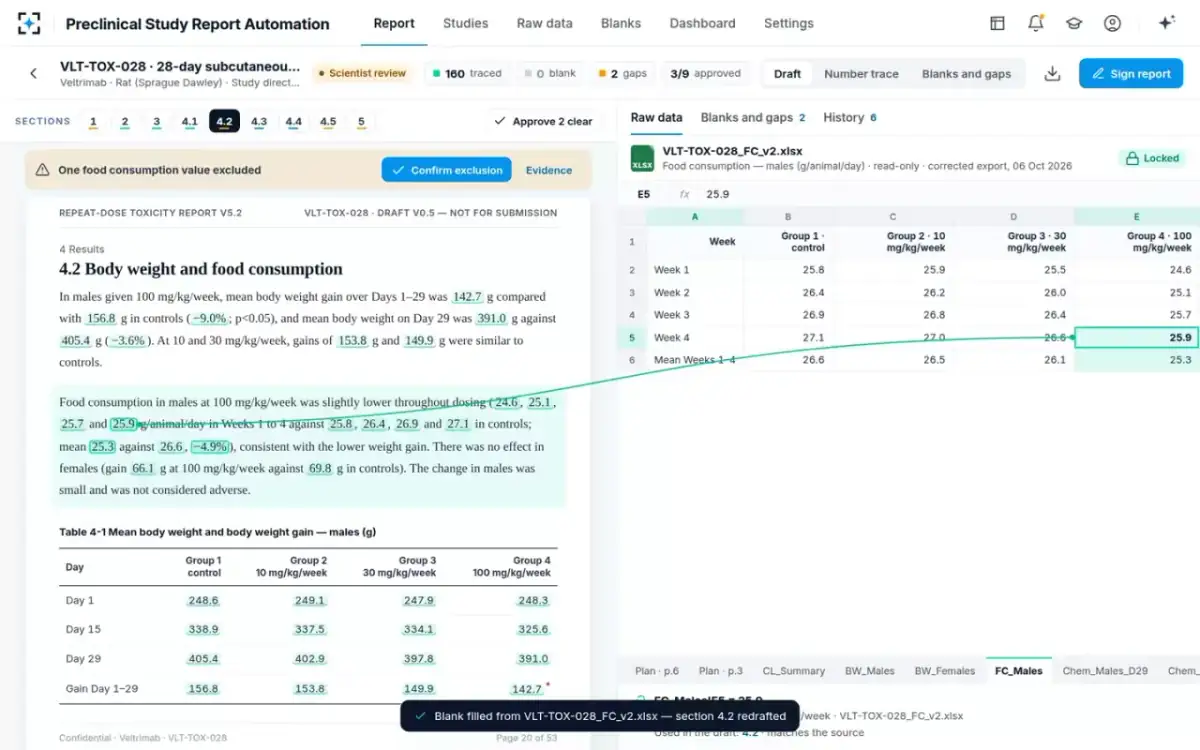
In the sample study the corrected file came back as a new version of the male food consumption sheet, signed and versioned, with the first export kept in the record. Week 4 was 25.9 g per animal per day. The food consumption section was redrafted with a four-week mean of 25.3 against 26.6 in controls, a fall of 4.9%, and the consistency check found no mismatches between the redrafted text and its sources. The blank cost one query.
The corrected export arrives versioned, and the section is redrafted
Corrections that must not obscure the original entry
Versioning rather than overwriting is not a software preference; it is the rule. 21 CFR 58.130(e) requires that any change in entries be made so as not to obscure the original entry, indicate the reason, and be dated and signed or identified at the time of the change — and the same paragraph extends it to automated systems, requiring that changes to automated data entries likewise not obscure the original, carry the reason, be dated, and identify the responsible individual.
The UK guidance describes the procedure that should sit around this. A procedure should describe the actions to be taken if data review identifies an error or omission, and “this procedure should enable data corrections or clarifications to provide visibility of the original record, and traceability of the correction, using ALCOA principles” (MHRA guidance, section 6.15, Data review and approval). Visibility of the original record and traceability of the correction: two separate things, and a replaced file gives you neither.
Applied to a report, it means the first export stays in the package, the corrected export arrives as a version, and the report records which version each number came from. It also means an edit to the draft is a tracked change rather than a silent rewrite, so the reason a sentence changed between review and signature is still readable afterwards.
What an auditor looks for when a number is absent
An auditor is not looking for a perfect dataset; studies have gaps. They are looking for whether the gap was handled as a gap. That is a short list of questions, and all of them are answerable from the record if the gap was documented when it was found.
Did the report state the absence, or quietly work around it? Is there a number in the report that has no raw data behind it? If a value was corrected or supplied late, is the original still visible and the correction attributable and dated? Did anything derived — a mean, a percentage, a conclusion — depend on a value that was not measured? And was the circumstance described under item (9) if it may have affected the quality or integrity of the data?
Every blank across the team's studies, and how each one closed
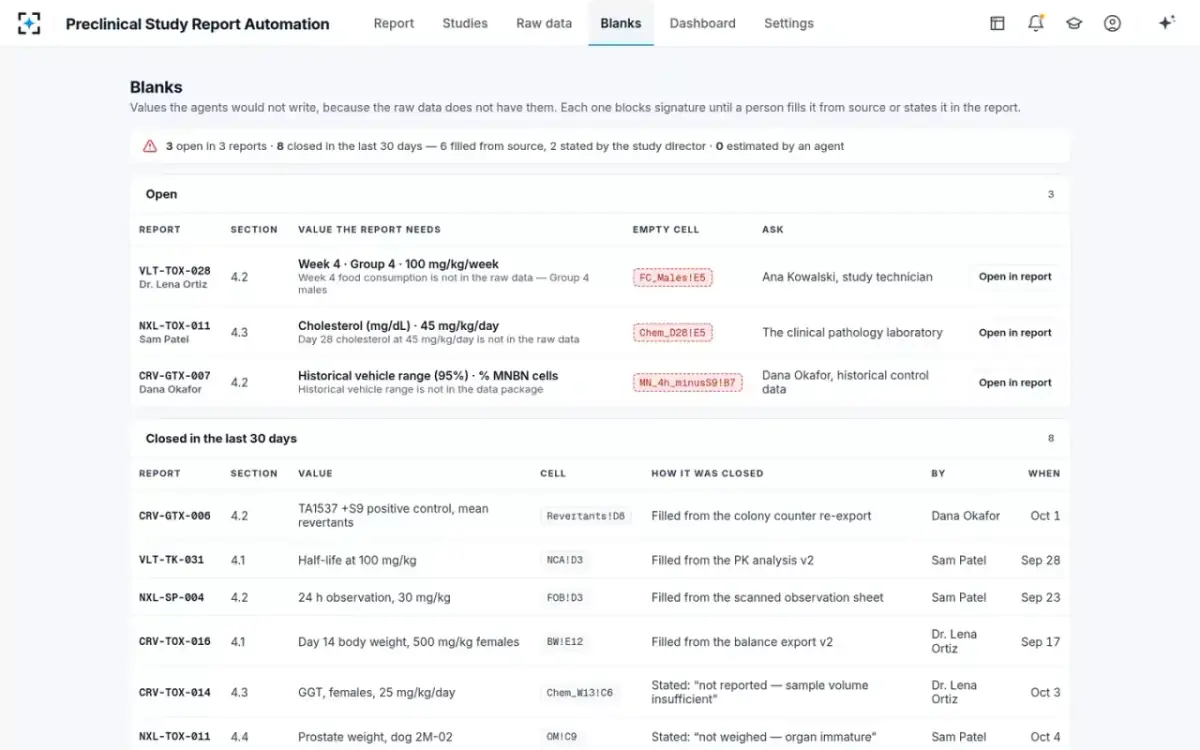
One number on that list is worth more than the rest: how many blanks were closed by a corrected source file rather than by a statement. A high proportion of statements can mean a laboratory is being honest, or it can mean data is not reaching the package — and those need different responses. The arithmetic of re-keying covers the other half of the same problem, the numbers that do arrive and get carried wrongly.
Seven questions to ask before any blank in a study report is closed
- Does the original record exist somewhere outside the export?
A study log, a balance printout, an instrument file. The export is a convenience; raw data is the first capture or a verified exact copy of it.
- Who generated the data, and have they been asked?
Data must be attributable to the person generating it, so the query goes to the role that holds the record — not to whoever is nearest the spreadsheet.
- If a value comes back, does it arrive as a record?
A corrected, versioned, signed file — not a figure read out in a meeting and typed into the report.
- Is the original still visible?
21 CFR 58.130(e) requires changes not to obscure the original entry; the first export stays in the package beside the corrected one.
- Is anything derived from the missing value?
Means, percentage changes, totals and incidence rates. A four-week mean over three weeks is a second invented number, not a workaround.
- Does the report state the absence where it cannot be closed?
In the words that describe it — not recorded, not available, animal removed on day 12 — rather than a gap the reader has to notice.
- Does the circumstance belong under item (9)?
If it may have affected the quality or integrity of the data, 21 CFR 58.185(a)(9) wants it described, and 58.33(c) expected it noted when it happened.
To see a draft that leaves the blank, names the cell and will not be signed until it is closed, start from Preclinical Study Report Automation.
Questions people ask
What counts as raw data in a GLP study?
Under 21 CFR 58.3(k), the laboratory worksheets, records, memoranda, notes or exact copies of them that result from original observations and are necessary to reconstruct and evaluate the report — including photographs, computer printouts, magnetic media and recorded data from automated instruments. An exact transcript may stand in for the original only if it is verbatim, dated and verified accurate by signature. OECD's definition is equivalent: original test facility records and documentation, or verified copies of them.
What are the ALCOA+ principles?
Attributable, Legible, Contemporaneous, Original and Accurate, plus Complete, Consistent, Enduring and Available. The MHRA guidance defines the four additions as the data being whole, self-consistent, durable through its lifecycle and readily available for review. For a missing value the decisive one is Complete: three of four weeks is not a complete set, however carefully the three were measured.
Can you carry forward a missing measurement in a study report?
Not as if it were a measurement. A value filled from the week before, from a sister group or from an average has no observer behind it, which breaks the first ALCOA attribute, and no cell behind it, which is what the Quality Assurance review against the raw data is designed to detect. Where a statistical method handles missing values, the plan and the report say so openly; the defensible closes for the table itself are a corrected, versioned record from the person who generated the data, or a stated absence.
How do you correct raw data without obscuring the original?
21 CFR 58.130(e) sets the form: the change must not obscure the original entry, must indicate the reason, and must be dated and signed or identified at the time of the change — with the same requirements for automated systems, including identifying the responsible individual. In practice that means a new, signed version of the file beside the first, and a report that records which version each number came from.
Who has to answer a data query about a missing value?
The person who generated the data: the study technician for in-life weighings, the pathologist for histopathology, the analyst for a bioanalytical result. Routing queries by role rather than by name keeps the rule stable when people change studies, and it keeps the answer attributable to someone who was actually there.
Does a missing value have to be reported as a deviation?
Not automatically, but it has to be considered under item (9) of 21 CFR 58.185(a), which asks for a description of all circumstances that may have affected the quality or integrity of the data — a test of possibility, not of proven impact. If the study plan required the measurement and it is not in the record, that is a deviation from the plan as well, and 58.33(c) expects it to have been noted when it occurred with the corrective action documented.