The difference between market-based and location-based Scope 2 is the emission factor. Location-based Scope 2 multiplies a company's purchased electricity by the average emission factor of the grid each site is connected to; market-based Scope 2 multiplies it by factors from the company's own contracts (renewable energy certificates, guarantees of origin, power purchase agreements or a supplier's published mix) and uses a residual mix or grid average for the rest. The US EPA's guidance asks companies to calculate and report both, clearly labelled. For a GP collecting data from dozens of portfolio companies, the practical rule follows: ask for both totals, or ask for one and say which, and never add a market-based number to a location-based one. Botminds' Portfolio Company ESG Data Collection labels each Scope 2 value with its method (location-based in its sample campaign) and cites the bills behind it, so a fund total is built from one method at a time.
The rules and factors are quoted from the EPA's guidance and emission factor hub. One fictional sample company from the solution's sample campaign, Brandauer Verpackung, appears in the screens; it and its figures are invented.
What the EPA's Scope 2 guidance asks of every inventory
2totals
location-based and market-based, each calculated and each labelled with its method
6months
before the reporting period, or 3 after, is the EPA's best-practice window for a certificate's generation date
None
national residual mix factor for the US: a market-based report has to disclose the gap and use the grid average
What is the difference between location-based and market-based Scope 2?
They measure different things. Location-based Scope 2 describes the emissions of the electricity a company physically draws from its local grid, so two companies with the same meters on the same grid report the same figure. Market-based Scope 2 describes the electricity a company has chosen to buy, so a company that buys renewable certificates reports less than its neighbour on the same grid, and one whose supplier sells a dirtier mix reports more.
Location-based and market-based Scope 2, row by row
Location-based: What did the grid emit to supply this company's electricity?
Market-based: What did the electricity this company contracted for emit?
Location-based: Grid average for each site: in the US an eGRID subregion's total-output factor; elsewhere a regional or national factor.
Market-based: In order: certificates, contracts, a supplier-specific factor, a residual mix factor, then regional or national grid averages.
Location-based: Electricity used and the grid's generation mix.
Market-based: Electricity used and the company's purchases: certificates, power purchase agreements, green tariffs.
Location-based: None.
Market-based: The certificated megawatt-hours take the certificate's factor, usually zero.
Location-based: Bills by site and the site's grid region.
Market-based: Bills by site, plus each certificate or contract: volume, vintage, market, retirement record.
Location-based: It cannot show a company's purchasing choices.
Market-based: Weak or mismatched certificates can make a company look cleaner than its electricity is.
The EPA's guidance is explicit that a report needs both: "The organization should quantify and report both totals in its GHG inventory." It is equally explicit about labels: "Both results should be clearly labeled according to the method used" (EPA, Scope 2 guidance, sections 1 and 3.3). A company setting a reduction target may base it on either method, but must say which, and must use the same method for any combined Scope 1 and 2 total it reports against the target.
How to calculate Scope 2 location-based emissions
Location-based Scope 2 is purchased electricity, site by site, multiplied by the grid factor for each site's location. The EPA recommends calculating each facility separately rather than adding up the meters first, because sites on different grids have different factors. In the US the recommended factors are eGRID's total-output subregion factors, published in the EPA's emission factor hub; where no regional factor exists, a national one is the fallback.
The calculation is the same one set out in converting kWh to tCO2e: megawatt-hours times the factor, with methane and nitrous oxide added at their warming potentials. What makes a location-based figure wrong is almost always the activity data, the unit or the factor's region, not the method; reading an annual report in any language shows how a scale header changes what the digits mean.
How to calculate market-based Scope 2 emissions: the factor hierarchy
Market-based Scope 2 splits the company's electricity into the megawatt-hours each contractual instrument covers and the megawatt-hours nothing covers, applies a factor to each slice, and adds them up. The EPA ranks the factors to use, from most to least specific.
The market-based emission factor hierarchy, in the EPA's order of preference
| Rank | Factor | What it covers | The catch |
|---|---|---|---|
| 1 | Energy attribute certificates | Megawatt-hours matched by retired certificates: RECs in the US, guarantees of origin in Europe | Must meet the quality criteria; the factor is usually zero but need not be |
| 2 | Contracts | Electricity bought from a named generator, such as a power purchase agreement | If the generator's certificates were sold to someone else, the buyer cannot claim them |
| 3 | Supplier-specific factor | A utility's or retailer's published factor for the product the company buys | It must cover all the electricity the supplier delivers, bought-in power included |
| 4 | Residual mix | Everything not covered above, at the grid's factor after others' claims are removed | Not available across the US; the lack must be disclosed |
| 5 and 6 | Regional, then national grid average | The fallback when no residual mix exists | Counts some renewable output other buyers have already claimed |
The residual mix is the factor most companies forget. It is the grid's emissions once every certificate and contract claimed by someone has been removed, and the EPA calls residual mix factors "the preferred market-based default emission factors" because using them "avoids double counting of the emissions attributes of contractual instruments". They are not published for most of the US. The guidance therefore tells companies that "Organizations must disclose the lack of residual mix factors as part of their scope 2 reporting", and to fall back on the regional grid average.
Renewable energy certificates and Scope 2: what a certificate has to prove
A certificate lowers market-based Scope 2 only if it meets the quality criteria the EPA adopts from the GHG Protocol's Scope 2 guidance. The instrument must carry the emission-rate claim for its megawatt-hours, be the only instrument that does, be retired by or for the reporting company, match the reporting period closely enough and come from the same market as the company's operations.
Two of those criteria trip up portfolio companies. Vintage: the EPA's best practice is to apply an instrument only if its "energy generation occurred within the reporting period, up to six months prior to the reporting period, or up to three months after the reporting period". Market: the EPA treats the US as one market and the EU as one market, so a European company's guarantees of origin count for its European sites, but a US certificate does not cover a site in Mexico or Canada. A third is simpler and still missed: the guidance says that, however they are bought, "the RECs must be acquired and retired". A certificate a company owns but has not retired is not a claim.
Timing matters too. Where a company's fiscal year and its supply contract do not line up, for instance a fiscal-year inventory against a calendar-year green tariff, the EPA's guidance applies the contract's factor only to the months it covers. A renewable share that changes partway through a year should show up as a partial change in the market-based figure, not a full one.
Same company, two totals: a worked example in Texas
Take a company with one site in Texas that used 10,000 MWh in a year and bought and retired unbundled RECs for 6,000 MWh with vintages inside the EPA's window. Its location-based figure uses the ERCOT grid factor for all 10,000 MWh. Its market-based figure gives the certificated 6,000 MWh a factor of zero and, because no US residual mix exists, puts the other 4,000 MWh on the same ERCOT factor, with a disclosure saying so.
One Texas site, 10,000 MWh, 6,000 MWh of retired RECs: two Scope 2 totals
| Line | Location-based | Market-based |
|---|---|---|
| Electricity purchased | 10,000 MWh | 10,000 MWh |
| Covered by retired RECs, in vintage | Not relevant | 6,000 MWh at 0 t/MWh |
| Remaining electricity | 10,000 MWh | 4,000 MWh |
| Factor applied to the remainder | ERCOT total output, 0.3360 t CO2e/MWh | No US residual mix: ERCOT grid average, 0.3360 t CO2e/MWh, with the lack disclosed |
| Scope 2 | 3,360 t CO2e | 1,344 t CO2e |
| Label in the dataset | Scope 2, location-based | Scope 2, market-based |
Both figures are correct. The company emitted, in the grid's terms, 3,360 tonnes; it also paid for 6,000 MWh of renewable generation somewhere in the US market, and the market-based figure credits that. What would be wrong is adding this company's 1,344 tonnes to a neighbour's location-based figure and calling the sum a fund's Scope 2.
Which Scope 2 method should investors use? Collect both, labelled
For a GP, the sound default is to collect both totals with their evidence and to report each output on the method its reader expects. The EPA's guidance asks companies for both. The SFDR's principal adverse impact template lists "Scope 2 GHG emissions" under indicator 1 without naming a method (Delegated Regulation (EU) 2022/1288, Annex I, Table 1), so a manager has to choose one, apply it to every investee and say which it chose in its methodology. An LP questionnaire may ask for either.
If a GP collects only one, location-based is the one every company can produce from its bills alone, and it is the one a fund can sum without checking anyone's certificates. Market-based is the one that rewards a company's renewable purchases, which many LPs want to see and which many portfolio companies will want credit for. Either way, the method goes into the dataset as a label beside each number, not as a sentence in the methodology appendix.
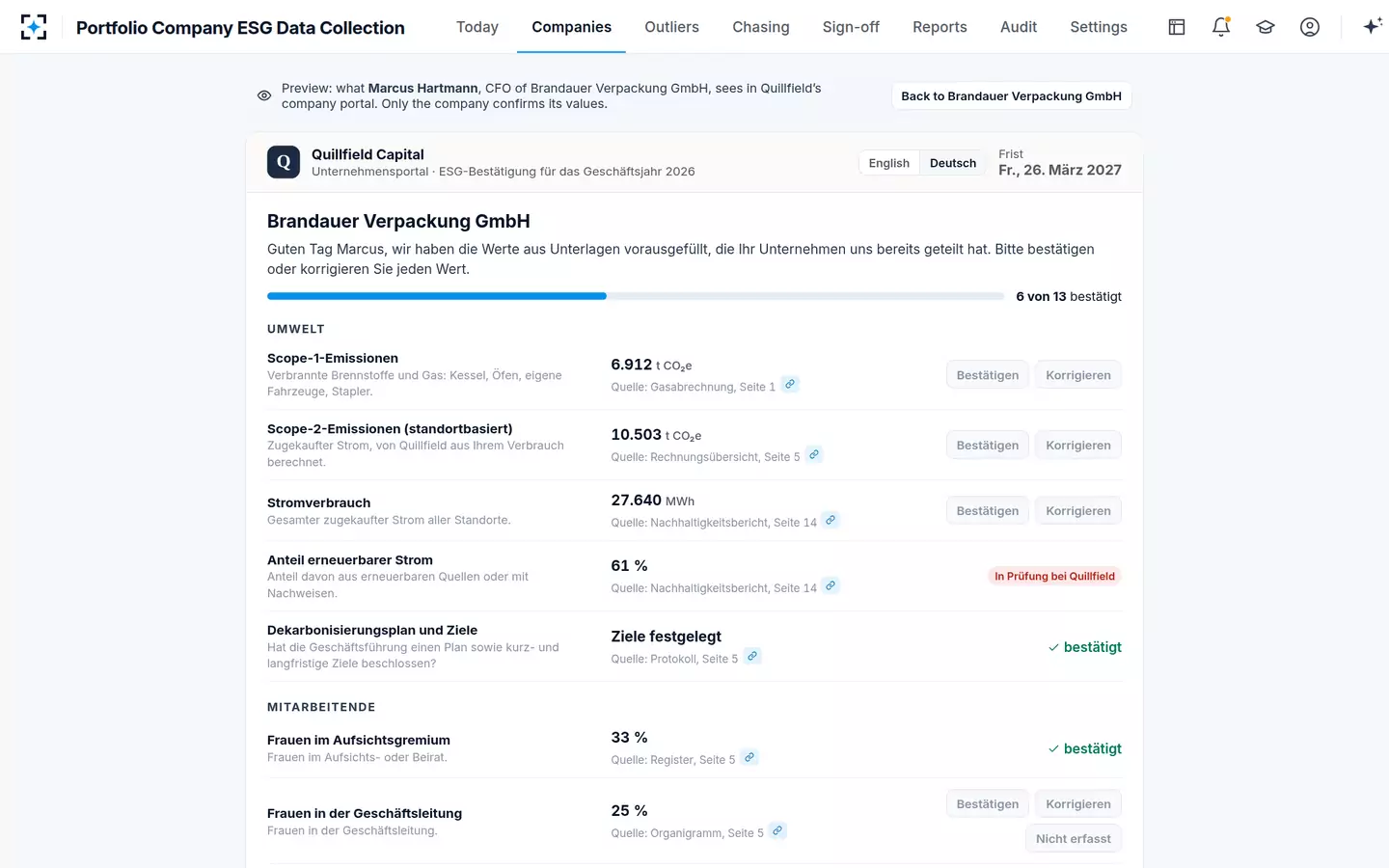
A location-based Scope 2 value, prefilled and cited, in Portfolio Company ESG Data Collection
Where mixed methods break a portfolio dataset
Mixing methods breaks three things a GP reports. The fund total stops meaning anything, because some companies' figures include their renewable purchases and others' do not. Year-on-year change becomes ambiguous, because a company that switches method, or whose certificate contract ends, shows a jump with no change in its business. And peer comparison fails, because a peer set built from market-based figures makes every location-based company look worse than it is; benchmarking portfolio companies deals with that in more detail.
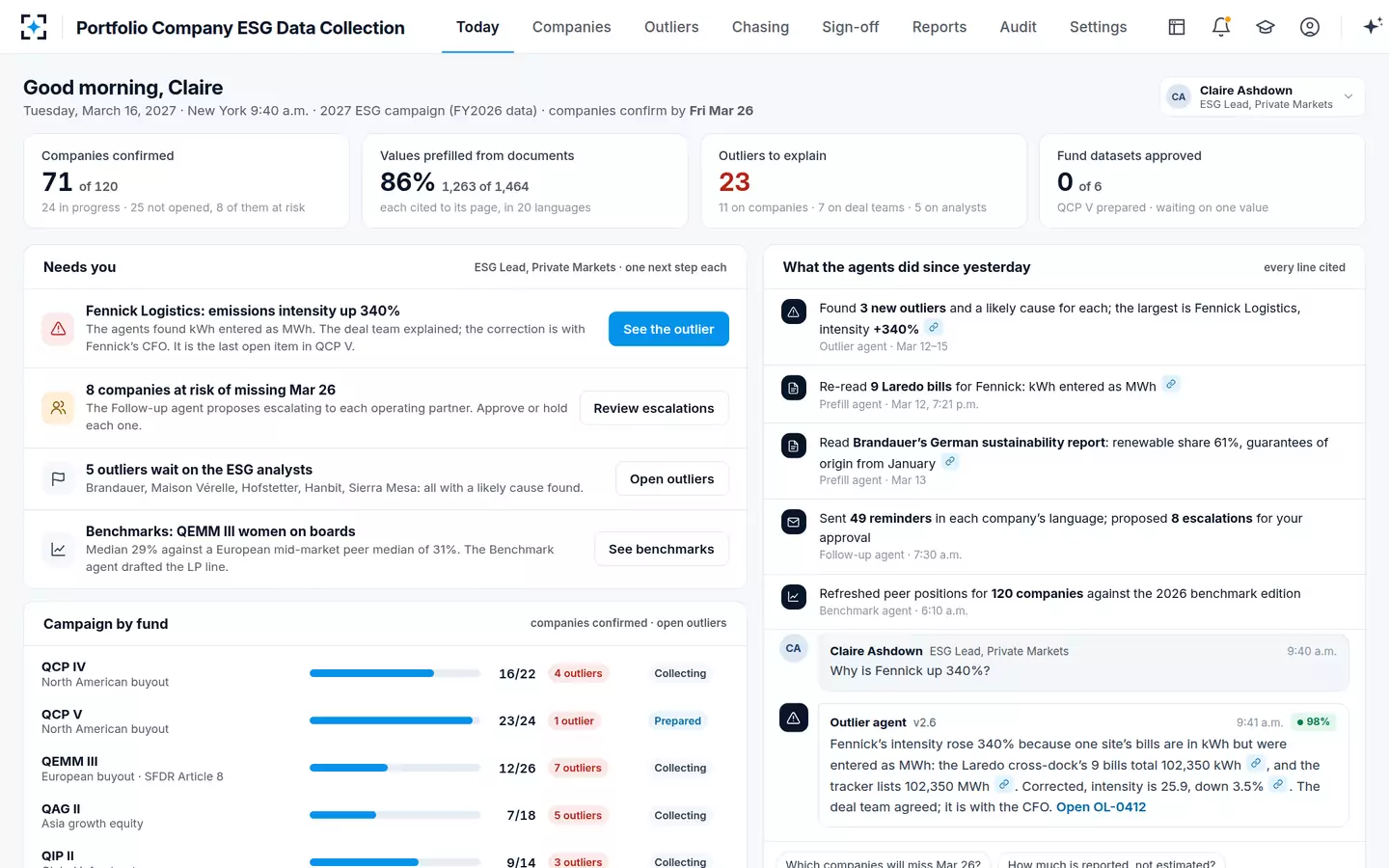
The sample campaign shows the second problem from both directions. Brandauer's renewable share rose from 18% to 61% because both its plants began buying guarantees of origin in January 2026: real purchasing, which a market-based Scope 2 would credit and its location-based Scope 2 does not. Another sample company's renewable share fell from 100% to 12% because its green power contract ended in June 2026 and was not renewed. Neither company used less electricity or moved grid. In a dataset that records the method, both are explicable in a sentence; in one that does not, both look like errors.
For Brandauer, the market-based figure would follow the hierarchy above: 61% of its 27,640 MWh, about 16,860 MWh, at the certificates' factor if they meet the quality criteria, and the remaining 10,780 MWh at the German residual mix factor for the year. That second number is the one to ask the company for, or to look up, rather than to assume.
Today in Portfolio Company ESG Data Collection: the guarantees of origin, read from the company's own report
What to ask each portfolio company for
A request that produces usable Scope 2 data from every company asks for the evidence behind both totals, once, and records the method with the number. It does not ask a mid-sized company to compute a market-based figure it has never heard of; it asks for the documents from which either figure can be computed and confirmed.
A Scope 2 request that a GP can add up across a portfolio
- Electricity by site, from the bills, with the unit
Kilowatt-hours or megawatt-hours as printed; one row per site, so each can take its own grid factor.
- Where each site is
Enough to choose the grid factor: the eGRID subregion in the US, the country elsewhere.
- Every certificate and contract
Type, megawatt-hours, generation period, market and retirement record. A purchase without a retirement record is not yet a claim.
- The supplier's factor, if the company relies on one
With confirmation that it covers all the electricity the supplier delivers.
- Both totals, each labelled
Computed by the company or by the GP from the evidence above, with the factor set and edition for each.
- What changed
Contracts started or ended, sites opened or closed, certificates bought for a different period. These explain next year's jumps.
Where the solution fits, and where it does not: the sample metric set collects location-based Scope 2, recomputed by the Carbon agent from activity data with a versioned factor set, and the renewable share as its own metric, read from the company's documents and cited. A fund that also reports market-based Scope 2 adds that metric and the certificate evidence to its request; the agents read and cite the documents, but whether a certificate meets the quality criteria is a judgment the analyst and the company make, not one the agents make for them. To see a request built this way, start from Portfolio Company ESG Data Collection.
Questions people ask
What is a residual mix factor?
It is the emission factor of the electricity left on a grid after every certificate, contract and supplier-specific claim has been removed. Where certificates for low-emission output are widely claimed, taking them out leaves a residual mix above the grid average. The EPA prefers it as the default for uncovered electricity in market-based reporting, but notes that it is not available across the US.
Are RECs and guarantees of origin the same thing?
They do the same job in different markets: each certifies one megawatt-hour of generation and carries its attributes. The EPA names RECs in the US and guarantees of origin in Europe as examples of energy attribute certificates, and a certificate counts only in the market where the company's electricity-consuming sites are.
Can market-based Scope 2 be higher than location-based?
Yes. A company with no certificates or contracts, on a grid where a residual mix factor exists, applies that factor to all its electricity, and where low-emission output has been claimed by others, the residual mix sits above the grid average. A supplier-specific factor for a high-carbon product can do the same.
Does a power purchase agreement count for market-based Scope 2?
It can. A contract with a named generator carries that generator's emission factor if no certificates were issued separately; if certificates were issued, the factor travels with the certificates, so a buyer whose generator sold them to someone else cannot claim the renewable attribute.
Should the LP report show both Scope 2 totals?
Where both are available, showing both is the most transparent choice, each labelled, with the fund total built from one method. Where a GP shows only one, it should say which, apply it to every company in the total and explain any company whose figure changed because of a contract rather than a change in use.