ESG survey questions for investors, in a private equity-backed company, are the annual questionnaire the fund's GP sends to every portfolio company: how much electricity and fuel the company used and from which sources, its Scope 1 and 2 emissions, whether it has a decarbonisation plan, how many women sit on its board and in its leadership, its recordable injuries and days lost, hires, turnover, whether it ran an employee survey, and how many cybersecurity incidents reached its board. Nearly every answer already sits in a document the company keeps for another reason. The way to stop the annual scramble is to answer each question from that document, record which document and page it came from, and next year confirm the answer rather than search for it again. Botminds' Portfolio Company ESG Data Collection is built around that idea: the GP's agents prefill each answer from documents the company has already shared, cite the page, and the CFO confirms or corrects.
The sample company on this page, Fennick Logistics, and its CFO are fictional, from the solution's sample campaign. The EPA's guidance on electricity data and the EU's 2026 rules on information requests are quoted from the texts themselves.
ESG survey questions investors ask every year, and the document that answers each
- How much electricity did you use, by site?
Utility bills, one line per meter, in the unit printed on the bill. Not the budget and not a sub-meter.
- How much fuel and gas did you burn?
Gas bills, fuel invoices and fleet fuel-card statements for the whole year, for every vehicle and boiler.
- What share of your electricity was renewable?
Supplier contracts, green-tariff confirmations and retired certificates, with the period each covers.
- Do you have a decarbonisation plan or targets?
The board minutes or strategy paper in which they were approved, with the date.
- How many women are on the board and in the leadership team?
The board register and a current organisation chart, as at year-end.
- How many recordable injuries and days lost?
The health and safety log, with the definition used (employees only, or contractors too).
- Net new hires and employee turnover?
Payroll or the HR system: starters, leavers and average headcount, with acquired staff shown separately.
- Did you run an employee engagement survey?
The HR report or board paper that records it.
- How many cybersecurity incidents were reported to the board?
Board minutes or the IT report to the board.
What is an ESG questionnaire?
An ESG questionnaire is a fixed list of environmental, social and governance questions that one organisation asks another, usually every year, to feed its own reporting. In private equity there are two layers. LPs send questionnaires to the GP about the fund and the firm, and many base theirs on industry forms such as the ESG section of the ILPA due diligence questionnaire. The GP then sends its own questionnaire to each portfolio company, to collect the figures it needs to answer its LPs, write its LP report and, for an EU fund, complete its SFDR disclosures.
The company sees only the second layer, but its answers end up in the first. When the SEC's examiners reviewed ESG practices in 2021, the documents they compared with what firms actually did included "responses to due diligence questionnaires, requests for proposals, and client/investor-facing documents" (SEC Division of Examinations, April 2021). A portfolio company's answer is the raw material of the GP's response, which is why GPs ask it to sign.
ESG questionnaire for portfolio companies: what the questions are really asking
Each question asks for a number with a boundary, a period and a definition, and most of the questions a CFO finds hard are hard because one of those three is unstated. "How much electricity did you use?" means every site the company controlled, for the fiscal year, from the bills. "How many injuries?" means whichever definition the investor uses, applied the same way as last year. A company that answers the number without the boundary and the definition gets the same question back in March.
The three things behind every number an investor asks for
| Question | Boundary: which entities and sites? | Period | Definition to settle once |
|---|---|---|---|
| Electricity used | Every site the company controls, including new and leased sites | Fiscal year | Purchased electricity in kWh or MWh, from the meters on the bills |
| Scope 1 emissions | Fuel the company burns in its own boilers, kilns and vehicles | Fiscal year | Which emission factors, and which edition |
| Recordable injuries | Employees, and contractors if the investor's definition includes them | Fiscal year | What counts as recordable; contractors in or out |
| Net new hires | The company before any acquisition, unless told otherwise | Fiscal year | Organic hires only, or acquired staff too |
| Women on the board | The board that governs the company: supervisory, advisory or both | At year-end | Which body counts as the board |
What documents do I need for an ESG questionnaire?
The documents you already keep for tax, payroll, safety and governance: utility bills, fuel invoices, payroll and HR reports, the safety log, the board register and minutes. Gathering them into one folder for the fiscal year does most of the work, and sharing that folder with the investor removes most of the typing.
For energy, the EPA's guidance says which bill to use, and which not to. Bills are the best activity data because they meter "the electricity entering the organization's facility", better than "sub-metering data from within the facility, which may be incomplete". Where a company buys electricity from a retail supplier and pays a separate delivery charge to the local utility, the guidance recommends the utility's metered figure and warns: "To avoid counting the same consumption twice, ensure that consumption from the commodity supplier is not also included in the activity data" (EPA, Scope 2 guidance, section 3.1). A tenant without its own meter can estimate from the building's total "by multiplying the electricity purchases for the entire facility by the percentage of the floor area that the organization occupies", and should say it did.
How to answer an ESG survey once
Answer from a document, record the document, and keep the record. A survey answered from memory has to be answered again next year from memory; one answered from a cited bill can be confirmed next year against the next bill, and any change has an obvious cause.
Answering from memory against answering from the document
From memory, each spring: Facilities emails a total from a tracker; nobody knows which sites or units it includes.
From the document, once: One line per meter from the bills, each with its unit and page; the total adds them.
From memory, each spring: HR sends a number; next year a different person counts contractors.
From the document, once: The count from the safety log with the definition written beside it, unchanged unless the investor changes it.
From memory, each spring: Typed from recollection after a mid-year change.
From the document, once: Read from the register as at year-end.
From memory, each spring: Goes back down the chain to whoever answered; often someone else answers.
From the document, once: Answered by opening the cited page.
From memory, each spring: Start again.
From the document, once: Confirm or correct last year's pattern against the new documents.
Who in the company answers the ESG questionnaire?
The CFO signs it; four or five people hold the answers. The fastest companies decide who owns each block once, write it down, and give each owner the document to keep for the year rather than a question to answer in the spring.
Inside the company: who holds which answers, before and after a prefilled form
Today
Receives the survey, forwards it in pieces and chases colleagues for weeks.
With agents
Reviews a form already filled from the company's documents and confirms or corrects each value.
Still theirs: The confirmation and the attestation
Today
Adds up a year of bills on request, sometimes in a tracker with mixed units.
With agents
Is asked only when a bill is missing or a value looks wrong, with the bill attached.
Today
Counts hires, leavers and injuries on whatever definition is to hand.
With agents
Checks a prefilled count against the log, with the definition stated.
Today
Retypes board composition and digs out minutes about targets.
With agents
Confirms values read from the register and minutes, page cited.
The answers that become outliers, and how to avoid them
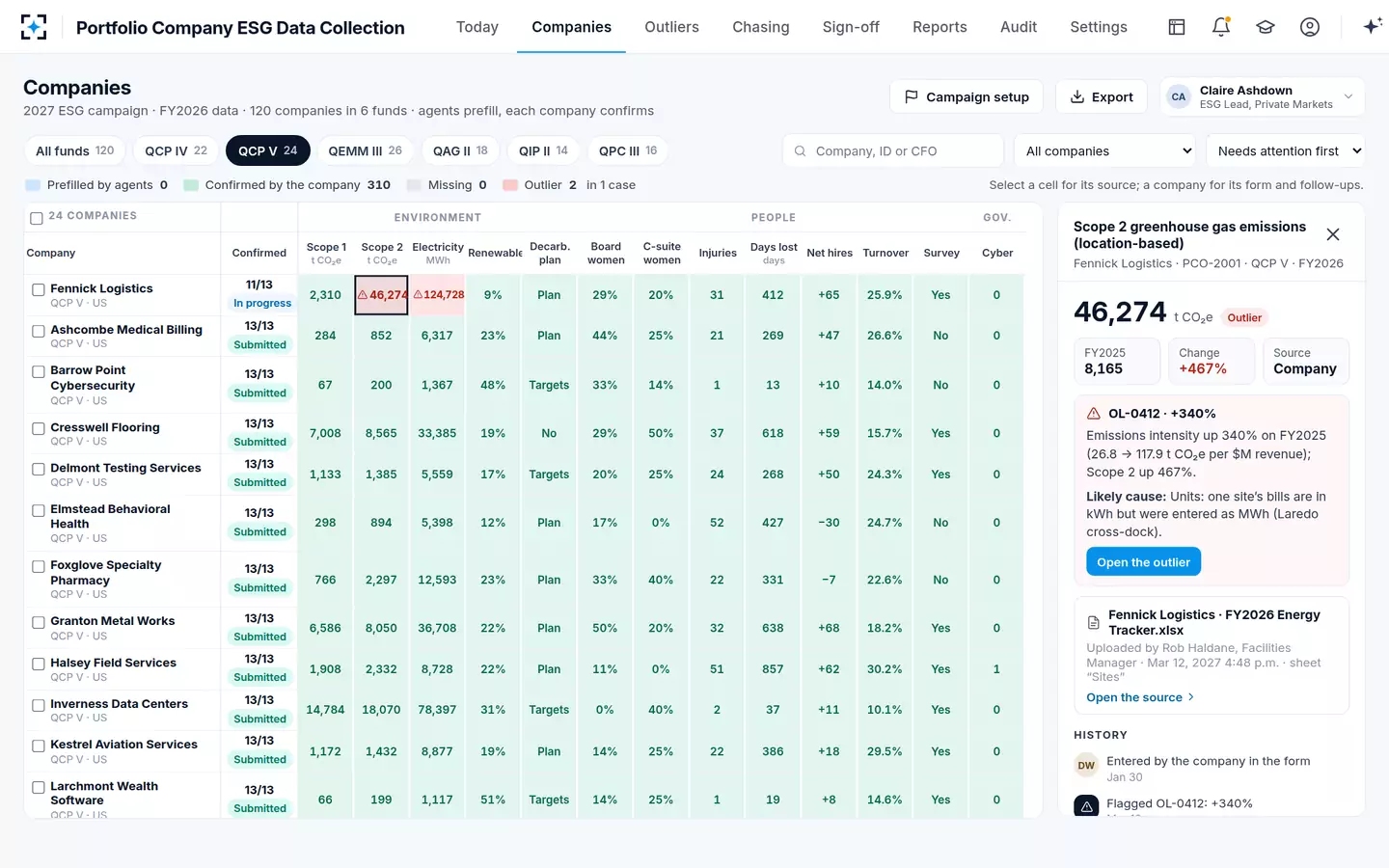
Most of the questions an investor sends back in March come from five causes, and a CFO can head off each with one line of comment. In the solution's sample campaign the investor's agents name these causes for every outlier: a real change, a boundary change, a definition change, incomplete data or a conflict between two documents.
The biggest are the quietest. A new site that bills in kilowatt-hours entered in a column of megawatt-hours makes electricity jump a thousandfold; an acquisition doubles a fleet's fuel; a contract that lapses drops a renewable share from 100% to 12%. A one-line note ("Laredo site opened April, bills in kWh"; "Gdańsk carrier acquired August") turns each from a query into an explanation. The unit case is worked through in converting kWh to tCO2e.
An answer that became an outlier, in Portfolio Company ESG Data Collection
Can a company refuse an ESG data request?
Sometimes, under EU law, and only for one kind of request. The 2026 Omnibus directive gives companies with up to 1,000 employees a statutory right to decline information beyond the Commission's voluntary standard when a large company asks for it to write its own CSRD statement.
"Protected undertakings shall have the right to decline to provide information exceeding the information specified in the voluntary standards in response to a request made for the purpose of sustainability reporting as required by this Directive."
Directive (EU) 2026/470, Article 1
The requester may rely on the company's own declaration of its size, and if it asks for more than the voluntary standard it must say which items exceed it and that the company may decline. But the right covers requests made for CSRD reporting. The Commission's delegated regulation on the voluntary standard, adopted on 3 July 2026, says the cap only applies to information gathering for sustainability reporting under the accounting directive and should not affect requests needed to comply with other EU or national law (European Commission, C(2026) 5011). An investor's request for its LP reports or its SFDR disclosures is a different request, usually backed by the information rights in the company's investment documents.
In practice, the better question for a CFO is what the investor needs and why. A request that maps each question to an output, and accepts the documents the company already holds, is cheaper to answer than to argue about. ESG reporting requirements for private companies sets out which companies carry a legal duty of their own.
What a prefilled form changes for the CFO
A prefilled form replaces the search with a review. The investor's agents read the documents the company has already shared, such as bills, accounts, HR and safety reports and board minutes, in the company's language, and fill each value with its source page; the CFO sees the company's own form, never anyone else's, and has two choices per value: confirm, or correct with a reason and, if there is one, a document. A metric the company does not track can be marked as not tracked. The set is attested once.
A CFO's confirm-only form in Portfolio Company ESG Data Collection
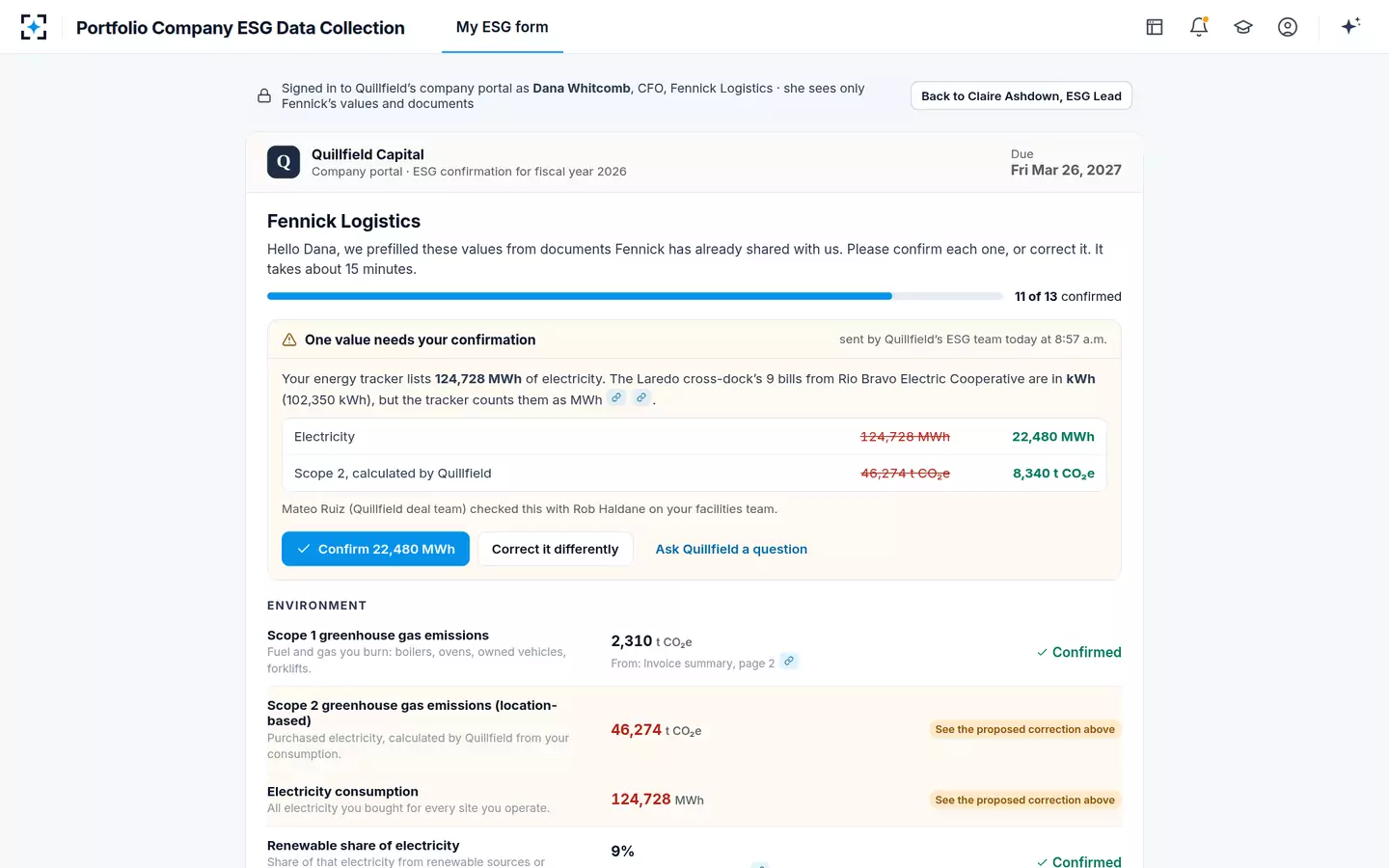
What the CFO gives up is nothing that was valuable: the hunting for bills, the retyping and the second round of questions. What the CFO keeps is the decision. The agents never confirm, change or approve a value, and a correction proposed by the investor's side reaches the company with the evidence beside it, as Fennick's did. To see the form on your own company's documents, start from Portfolio Company ESG Data Collection.
Questions people ask
What if we do not track a metric the investor asks for?
Say so explicitly rather than leaving it blank or guessing. "Not tracked" is an answer an investor can report and plan around; a blank is often treated as missing data and chased, and in some investor reports a missing value has been counted as zero, which misstates the fund.
Is the ILPA ESG questionnaire sent to portfolio companies?
Not usually. ILPA's due diligence questionnaire is a form LPs use with GPs; a portfolio company receives its GP's own request, which is shaped by what the GP's LPs ask. The metrics overlap, so a company that keeps its answers with their sources can reuse them across investors.
Do our ESG figures need to be audited?
No law requires a private company below the CSRD's thresholds to have its ESG data assured. Your investors may ask for the documents behind a figure, and a company in scope of the CSRD needs limited assurance on its statement. Answering from bills and registers, with the page cited, gives an investor the trail it would otherwise ask an auditor for.
We have several investors asking different questions. What should we do?
Answer the underlying facts once, from the documents, with the source, and let each investor's form draw on them. Most investor questions are variations on the same few dozen figures; the boundary, period and definition are what differ, so record those with each answer.
When will the questionnaire arrive?
For most calendar-year companies, early in the new year: investors need the data for LP reports and, for EU funds, for a principal adverse impact statement due by June 30. Keeping the year's bills, payroll extracts and safety log in one folder from January makes the request a review rather than a project.