ESG data collection software should be priced against the cost it replaces, and that cost is mostly hours: the GP's ESG analysts sending, chasing, retyping and checking; the portfolio company's CFO, facilities and HR staff finding answers; and the deal team explaining the numbers that look wrong. The useful unit is one portfolio company for one year. At US government wage data, a few hours on each side of the request already costs several hundred dollars per company before anyone has found an error, and an error that reaches an LP report costs far more. Vendors do not publish prices, so the way to judge a platform, Botminds' Portfolio Company ESG Data Collection included, is to price your own unit first and then ask what each tool removes from it.
Wage and compensation figures come from the US Bureau of Labor Statistics; penalties from the SEC's own releases. The worked example uses our own illustrative hours, labelled as such, and the screens come from the solution's fictional sample campaign, in which every company and person is invented.
Three government figures that price an hour of ESG data work
$49.79
median hourly wage of US financial analysts (all specialisms), 2025
70.0%
share of private employers' compensation cost paid as wages, June 2026; benefits are the other 30%
$46.89
average total compensation cost per hour worked, all US private industry workers, June 2026
How much does ESG data collection cost? Price it per company, per year
The cost of a campaign is the sum, over every portfolio company, of the hours each person spends on that company's data, times what an hour of that person costs, plus what errors cost. Pricing it per company makes three things visible that a campaign budget hides: the cost lands mostly outside the ESG team, it grows with every company added, and a handful of difficult companies cost several times the median.
No regulator or independent study publishes what a GP's campaign costs or how long it takes, and vendors don't publish prices. The figures that exist are your own: last year's email and file history gives the hours, your payroll or a government series gives the rates. The ESG data collection process page sets out five timestamps per company that turn that history into a measurement.
What goes into the hours: the GP, the company and the deal team
Four groups of people spend time on each company every year. Only one of them is the ESG team, and a cost model that counts only its hours undercounts the campaign.
Where the hours on one company's ESG data go, by who spends them
| Who | What they spend the hours on | What drives the hours up |
|---|---|---|
| GP ESG analyst | Sending the request, answering questions, chasing, retyping answers, checking units and boundaries, preparing the fund dataset | Companies that answer late, in another language or in different units from last year |
| GP ESG lead | Approving each fund's dataset, deciding escalations, reviewing the LP section | Outliers found late, when the LP report is already in draft |
| Deal team | Explaining why a company's numbers moved; calling a CFO who has not answered | Being asked weeks after the fact, by forwarded email, without the evidence |
| Company CFO, facilities, HR and finance | Finding bills, payroll and safety data, typing the answers, answering the GP's questions about them | A blank survey every year; questions about values the company sent months ago |
A worked example: 120 companies at government wage rates
Take a GP with 120 portfolio companies and assume, for illustration, seven hours of GP time and eight hours of company time per company per year by hand. Cost the GP's hours at the financial analyst wage loaded for benefits, about $71 an hour, which is a floor because ESG leads and deal teams cost more. Cost the company's hours at the BLS average for all private industry, $46.89. The result is about $870 per company per year, or roughly $105,000 for the campaign, before any error.
Illustrative cost of one company's ESG data for one year, by hand
The per-company unit is useful because the hours are not spread evenly. A company that confirmed last year's values in its own language and has a finance team that keeps its bills costs a fraction of the median; a newly acquired company with no history, another language and a site that bills in different units can cost five times as much. Measuring the unit per company, rather than per campaign, shows where software would save time and where it would not.
Pricing the error, not just the hours
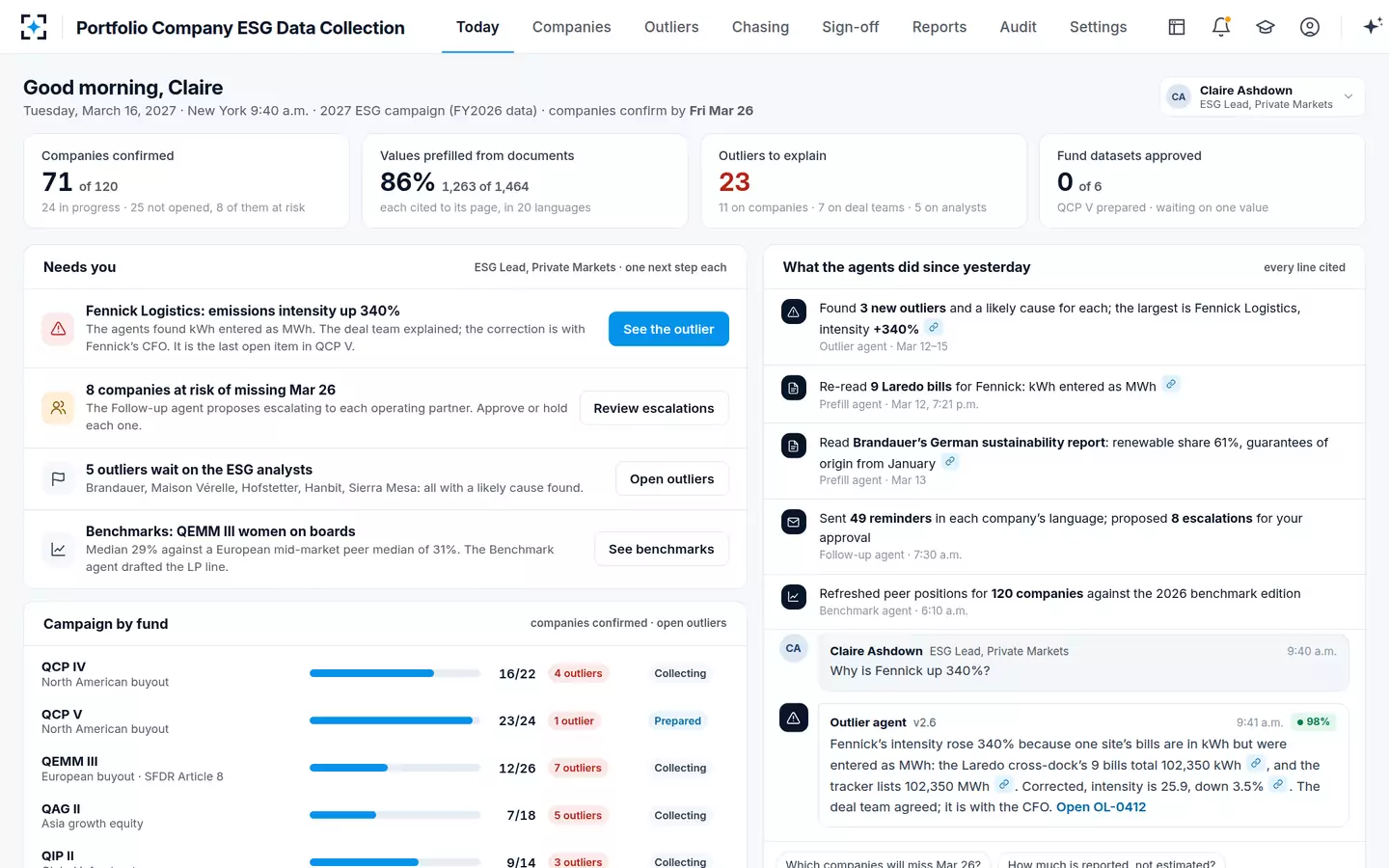
The hours are the visible cost; an error that reaches an LP is the larger one. In the solution's sample campaign, one company's site billed in kilowatt-hours and typed as megawatt-hours would have overstated a fund's Scope 2 by 37,934 tonnes, turning a 3.6% rise in its reported Scope 1 and 2 into a 30% one. Caught before approval, it cost a deal-team call and a confirmation by the company's CFO. Caught after the LP report, it costs a restatement, a letter to every LP who received the number, and a question in every due diligence questionnaire for the next fundraise.
The regulatory end of the range is public. The SEC fined advisers whose ESG statements their own processes did not support: $1.5 million for BNY Mellon Investment Adviser in 2022 (SEC release 2022-86), $4 million for Goldman Sachs Asset Management in 2022 (2022-209), $19 million for DWS in the ESG part of its 2023 settlement (2023-194) and $17.5 million for Invesco Advisers in 2024 (2024-179). None was about a single wrong number; each was about a process that did not do what investors were told it did. That is the cost a campaign's controls are buying down, and the private equity ESG report page follows it through to the LP.
What should ESG data collection software do? Five things that remove hours
Software that sends a survey and stores the answers moves the spreadsheet online without removing much of the cost. The hours in the table above go away only where a tool takes over the finding, the chasing or the checking, and the error cost falls only where it checks every value against evidence before approval.
Five capabilities that remove hours from the per-company cost
- Prefill from documents the company already shared, cited to the page
Removes the company's finding and typing for most values; leaves it a confirmation. In the sample campaign, 86% of 1,464 values arrived prefilled.
- Ask only for what is still open, in the company's language
Removes repeat requests and translation, the main cause of the long tail of late companies.
- Recompute emissions from activity data with named factors
Catches unit and factor errors without an analyst redoing the arithmetic.
- Compare every value with last year, peers and the company's other answers, with a likely cause
Turns a week of analyst checking into a list of questions, each routed to the person who can answer it.
- Draft LP outputs only from approved data, every number traced
Removes the reconciliation between the dataset and the report, and the risk of releasing an unapproved number.
The ESG lead's day in Portfolio Company ESG Data Collection: four numbers and one next step each
ESG data collection platform, tool or spreadsheet: what each leaves you paying for
The categories overlap and their names are used loosely, but they differ in which of the four groups' hours they remove. The comparison below is by what each does, not by brand.
Three ways to run the campaign, and which costs each removes
| Cost | Spreadsheet and email | Survey portal or ESG data management software | Prefill and confirm |
|---|---|---|---|
| Company finding and typing | All of it stays | All of it stays, in a web form | Mostly removed: values read from documents, the company confirms |
| Analyst chasing | All of it stays | Reminders automated; the same blank form resent | Reminders ask only for what is open, in the company's language |
| Analyst checking | By hand, after the form is complete | Field validation: is a value possible? | Every value against bills, last year and peers, with a likely cause |
| Evidence for each number | In email attachments, if anywhere | An optional upload field | A page reference on every value, or a signed company entry |
| LP and SFDR outputs | Built by hand from the spreadsheet | Exports; drafting by hand | Drafted from approved data, every number traced |
| What you pay for it | Nothing in licences; all the hours | A licence; most of the hours | A licence; the confirming, explaining and approving hours |
How to price ESG data collection software when vendors don't publish prices
Ask for a price in the same unit you measured your cost in, per company per year, and ask what is inside it. A price per user, per fund or per module can be converted, but only if you know how many companies, funds and users your campaign really involves.
Questions that turn a vendor's quote into a cost per company
- What is the pricing unit, and what counts?
Per company, per fund, per user or per metric. Do exited and newly acquired companies count in the year they move?
- Who fills the values?
The company, from scratch? Or the tool, from documents, with the company confirming? Ask to see a prefilled value with its page.
- Which languages, for documents and for the company's form?
A portfolio with companies in 20 countries pays for translation one way or another.
- How does it check a value?
Field validation, or comparison with bills, last year and peers? Ask it to find a kWh typed as MWh in last year's data.
- Which emission factors, and which edition?
Named, versioned, and recorded beside every recomputed figure, or a number with no source shown?
- Who approves, and is it recorded?
Can the person who prepared a fund's dataset approve it? Is every approval, correction and escalation on an audit trail you can export?
- What do you take with you if you leave?
Every value, its source document, its confirmation and its history, in a format you can load elsewhere.
What Portfolio Company ESG Data Collection removes from the cost, and what it leaves
The solution is built to remove the finding, chasing and checking hours and to put the remaining ones (confirming, explaining, approving) in front of the right person with the evidence. Seven agents prefill from the company's own documents, recompute Scope 1 and 2, chase in each company's language, find the likely cause of each outlier, benchmark, and draft LP and SFDR outputs from approved data. They never confirm, change or approve a value.
Fund dataset sign-off in Portfolio Company ESG Data Collection: six checks before any LP output
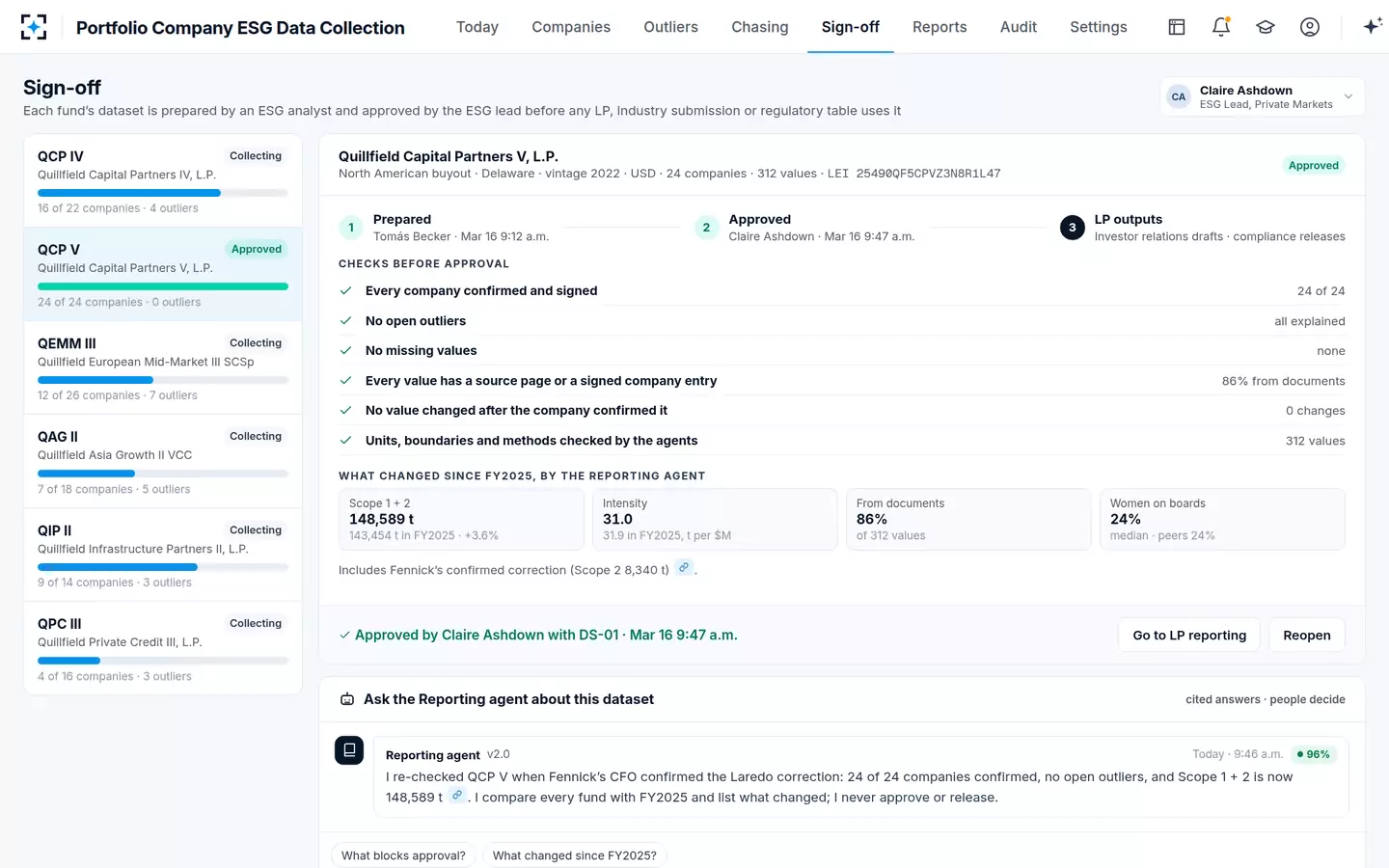
It does not remove every cost. Companies still confirm their values and sign; deal teams still explain outliers for the companies they know; the ESG lead still approves each fund's dataset and every escalation to an operating partner. It does not replace a licensed peer benchmark, which it reads, or a portfolio monitoring system, to which it writes approved values back. And the per-company saving depends on what the companies have shared: a company whose documents are not on file is asked, like any other tool would ask it. Going live before the spring campaign sets out what a GP brings and how long it takes. To price it against your own unit, start from Portfolio Company ESG Data Collection.
Questions people ask
Is an ESG data collection system the same as an ESG data platform?
Not quite. A data platform usually means a store for ESG data with workflows and reports on top; a collection system is the part that gets the data from the people who hold it. For listed issuers, where the data is read from published reports, see ESG data management software: buy the estimate or read the report. For a GP, the expensive part is collection from portfolio companies, so a management tool without a strong collection side moves the spreadsheet without removing the chase.
Should a GP pay per company or per fund?
Whichever unit it can compare with its own cost. Per company aligns the price with the work, which grows with every company; per fund can be cheaper for funds with many small holdings. Convert any quote into a cost per company per year before comparing.
Does ESG data collection software save the portfolio companies money too?
It can, and that saving belongs to the fund. A company that confirms prefilled values instead of finding and typing them spends fewer hours of its CFO's and staff's time, and those hours are paid for by a business the fund owns. Count them in the business case.
Is ESG reporting software for private equity different from corporate ESG software?
Yes, in who answers. Corporate ESG software collects from a company's own sites and departments, which the reporting team can instruct. A GP collects from companies it owns but does not run, in many languages and on different fiscal years, and has to keep each company's data visible only to that company and the GP.
How do you measure the return on ESG data collection software?
Measure the per-company hours and the outliers caught before approval, before and after. The hours come from timestamps on requests, answers and approvals; the outliers from the count of corrections made before the fund dataset was approved, compared with corrections made after an LP saw a number.