ESG reporting requirements for private companies are narrow and size-based. In the EU, after Directive (EU) 2026/470, the Corporate Sustainability Reporting Directive (CSRD) reaches only companies with more than EUR 450 million of net turnover and more than 1,000 employees, from financial years starting in 2027. In the UK, large unquoted companies report energy use and emissions in their directors' report, and those with more than 500 employees and £500 million of turnover add climate-related financial disclosures. In the US no federal rule applies to private companies, but California's SB 253 requires companies with more than $1 billion of revenue doing business in the state to report emissions. For the typical private equity portfolio company, below all of these lines, the ESG data request comes from its investors instead: the GP's annual request, driven by LP reports and, for EU funds, the SFDR. Botminds' Portfolio Company ESG Data Collection is built for that request.
The screens below come from a fictional sample GP, Quillfield Capital, as its campaign runs through the solution; every company and person named in them is invented. The rules are quoted from the texts themselves, linked where they appear, and dated, because several moved in 2025 and 2026 and some are still moving.
The size lines that decide whether a private company reports directly
€450million
of net turnover and more than 1,000 employees: the EU CSRD threshold from financial years starting in 2027
£500million
of turnover and more than 500 employees: the UK line for climate-related financial disclosures by a private company
$1billion
of annual revenue, for a US company doing business in California: the SB 253 line for emissions reporting
Is ESG reporting mandatory for private companies?
Only for large ones, and only in some places. Being private does not exempt a company from the EU or UK rules, which test size, not listing. But the size tests are high enough that most companies owned by a mid-market buyout or growth fund fall below them, and the US has no federal requirement for private companies at all.
ESG reporting requirements for private companies, rule by rule, in force or proposed in 2026
| Rule | Who is caught | What they report | When |
|---|---|---|---|
| EU: CSRD, as amended by Directive (EU) 2026/470 | Companies, listed or not, exceeding EUR 450 million net turnover and an average of 1,000 employees, or parents of such groups | A sustainability statement in the management report | Financial years starting on or after 1 January 2027; national laws due by 19 March 2027 |
| EU: SFDR and Delegated Regulation 2022/1288 | The fund manager, not the company | Principal adverse impact (PAI) statement and fund disclosures, built from investee data | PAI statement by 30 June each year |
| UK: Streamlined Energy and Carbon Reporting (SI 2018/1155) | Large unquoted companies, unless they used 40,000 kWh or less | UK energy use, greenhouse gas emissions and energy-efficiency action, in the directors' report | Each annual report |
| UK: climate-related financial disclosures (SI 2022/31) | Companies with more than 500 employees that are traded, on AIM or have turnover of more than £500 million | Climate-related financial disclosures in the strategic report | Financial years starting on or after 6 April 2022 |
| US: SEC climate disclosure rules (2024) | SEC registrants only; private companies were never in scope | Not applicable to private companies | Rescission proposed 29 May 2026 |
| US: California SB 253 | US companies with more than $1 billion of annual revenue doing business in California, public or private | Scope 1 and 2 emissions in the first year; Scope 3 under a later regulation | First report due 10 November 2026 |
| US: California SB 261 | US companies with more than $500 million of revenue doing business in California | Biennial climate-related financial risk reports | Enforcement enjoined since 18 November 2025; voluntary filing open |
CSRD thresholds after the 2026 Omnibus: who is left in the EU
The Omnibus directive of 24 February 2026 rewrote the CSRD's scope around two tests that must both be met. From financial years starting on or after 1 January 2027, the reporting duty applies to undertakings which "exceed a net turnover of EUR 450 000 000 and an average number of 1 000 employees during the financial year", or to parent undertakings whose groups do so on a consolidated basis (Directive (EU) 2026/470, Article 1). Member States must transpose it by 19 March 2027.
The change matters most for the companies it removes. Under the original CSRD, a large private company in the EU, defined by thresholds far below these, would have been brought into reporting in a later wave. Companies in the first wave that fall below the new tests leave the regime for financial years starting in 2027, and Member States may exempt them for 2025 and 2026 as well. For a private equity portfolio, the practical result is that only the largest holdings, typically big carve-outs and late-stage buyouts with thousands of staff, will publish a statement under the European Sustainability Reporting Standards. The rest will not, and their numbers will reach investors only if investors ask.
Non-EU groups are not entirely outside. The amended rules reach the EU subsidiaries or branches of a third-country undertaking that generated EU net turnover above EUR 450 million in each of the last two financial years, with a branch caught only above EUR 200 million of its own turnover. A US-owned portfolio company with a large European business can therefore end up reporting in the EU when its US parent reports nowhere.
What is the CSRD value chain cap, and does it limit what a GP can ask?
The value chain cap protects companies with up to 1,000 employees from information requests made for CSRD reporting, and only for that purpose. A protected company may decline to provide anything beyond the Commission's voluntary reporting standard, a reporting company that asks for more must tell it which items exceed the standard and that it has a right to decline, and the reporting company may rely on the protected company's own declaration of its size.
"There is evidence that undertakings in the value chain, including small and medium-sized enterprises, receive disproportionate requests for information from reporting undertakings, notwithstanding the existing limitations set out in that Directive."
Directive (EU) 2026/470, recital 12
The cap does not reach every request a portfolio company receives. The directive states that the protections leave untouched any request made for a purpose other than CSRD reporting, naming due diligence duties as an example (Article 1). The Commission's delegated regulation setting out the voluntary standard, adopted on 3 July 2026 as C(2026) 5011, is explicit that the cap "should therefore not affect requests for information needed to comply with obligations stemming from other Union or national law" (European Commission, C(2026) 5011). A fund manager's SFDR request rests on a different law, and an LP report rests on a contract.
So the cap does not restrict an ordinary GP request, but it will shape expectations. The voluntary standard becomes the reference set a mid-sized company knows it can be asked for, and a GP whose request stays inside it will find answers easier to get. Where the GP or its parent is itself a large reporting undertaking collecting portfolio data for its own CSRD statement, the cap applies to that request directly.
Does the SFDR apply to private equity portfolio companies? Through the fund
Not directly: the Sustainable Finance Disclosure Regulation places its duties on financial market participants, so a private company has no SFDR obligation of its own. But a fund manager that considers principal adverse impacts must report indicators about every investee company, private ones included, and it can only get most of them by asking. The delegated regulation anticipates exactly that. Where information is not readily available, the manager must describe the efforts it made to obtain it, and the first route the regulation names is asking the investee company directly; the others are its own research, data providers or outside experts, and reasonable assumptions (Delegated Regulation (EU) 2022/1288, Article 7(2)).
Supervisors have checked how far those efforts go. Reviewing managers' 2024 statements, the European Supervisory Authorities recalled that, under their joint Q&A, managers "should include all investments in the PAI disclosures" (ESAs, JC 2025 26; how one PAI figure is built), not only those with data. For a private equity fund, the GP's annual request to portfolio companies is the best effort; a weak one shows up as a gap in a published statement.
The regime may change, but has not yet. The Commission proposed a revised regulation, commonly called SFDR 2.0, on 20 November 2025; its text would remove the entity-level PAI statement and replace Articles 8 and 9 with product categories. The Council adopted its negotiating mandate on 24 June 2026 and the Parliament's ECON committee its report on 10 September 2026, and on 7 October 2026 Parliament's plenary confirmed the decision to open talks with the Council (European Parliament, Legislative Train). No text has been agreed, so the current regulation and its June 30 statement still apply. The data a GP collects will be needed under either version: fund-level disclosures under the proposal still rest on investee figures.
Two routes by which ESG reporting reaches a private company, and the one Portfolio Company ESG Data Collection serves
A direct legal duty: The law and its standard (ESRS, SECR, CARB's rules).
Through its investors: The GP, from what its LP reports, questionnaires and SFDR tables need.
A direct legal duty: Only companies above the size tests: EUR 450 million and 1,000 staff in the EU, £500 million and 500 staff for UK climate disclosures, $1 billion in California.
Through its investors: Every portfolio company of a fund whose investors or regulator ask, whatever its size.
A direct legal duty: The company, in its own annual report or a state filing.
Through its investors: The fund manager, in LP reports and its SFDR disclosures; the company publishes nothing.
A direct legal duty: Limited assurance under the CSRD for those in scope.
Through its investors: None required by law; the GP's own review and the LP's due diligence questions.
A direct legal duty: On the statutory date, once transposed or adopted.
Through its investors: Every year the fund holds the company, on the GP's calendar.
ESG reporting requirements in the UK: energy and carbon, and climate disclosures
UK private companies face two requirements, both in the annual report. Streamlined Energy and Carbon Reporting, introduced by SI 2018/1155, created "new requirements on large unquoted companies to make statements in the directors' report concerning the company's greenhouse gas emissions, energy use and action taken to increase energy efficiency within the UK" (explanatory note to SI 2018/1155). A company that "consumed 40,000 kWh of energy or less" during the period need not disclose, provided its report says so.
The second is narrower. SI 2022/31 added climate-related financial disclosures to the strategic report for companies with more than 500 employees that are traded, banking or insurance companies, on AIM, or "a high turnover company which is a company which does not fall within another category but which has a turnover of more than £500 million" (explanatory note to SI 2022/31). It has applied to financial years starting on or after 6 April 2022.
For a GP, SECR is the useful one. A UK portfolio company large enough to be caught already calculates its UK energy use and emissions for its directors' report, from its bills and with the government's conversion factors. That figure, its page and the factor year can be read straight into the GP's request rather than asked for again; converting kWh to tCO2e covers the factors and what changed in the 2026 set.
Is ESG reporting mandatory in the USA? Not federally; California is the exception
No federal rule requires a private company to report ESG data. The SEC's 2024 climate disclosure rules applied to registrants, and on 29 May 2026 the Commission proposed to rescind them (91 FR 33296, published 3 June 2026); the rescission is still a proposal. The SEC's 2022 proposal on ESG disclosures by investment advisers and funds was withdrawn on 17 June 2025 (90 FR 25531), so there is no federal ESG template for a private fund's reporting either.
California's laws do reach private companies. SB 253 applies to business entities formed in the US "with total annual revenues in excess of one billion dollars ($1,000,000,000) that do business in California", and the California Air Resources Board gives the first deadline for Scope 1 and 2 emissions as 10 November 2026, with enforcement discretion for 2026 reporting (CARB, Corporate Disclosure of Climate Data). SB 261, the climate-risk report law for companies above $500 million of revenue, is on hold: on 18 November 2025 the Ninth Circuit issued an order "granting an injunction against the enforcement of SB 261 during the pendency of appellate proceedings" (CARB, Climate-Related Financial Risk), and CARB is accepting reports only voluntarily.
For a US-heavy portfolio, that leaves a short list. The few companies above $1 billion of revenue that do business in California have a filing to make this year; for them, the GP should read the filed Scope 1 and 2 figures rather than ask for them again. Everyone else reports to the GP or to nobody.
ISSB and financed emissions: the request that reaches companies next
The next driver is the investor's own reporting. IFRS S2, the ISSB's climate standard, requires an asset manager to disclose financed emissions, and the December 2025 amendments, effective for periods starting on or after 1 January 2027, make clear that an asset manager's financed emissions include the emissions attributable to the assets it manages for clients (IFRS Foundation, Amendments to IFRS S2, December 2025).
Where a jurisdiction adopts the ISSB standards for a GP or for its LPs, the portfolio companies' Scope 1 and 2 figures stop being a voluntary courtesy and become an input to a regulated number. Nothing in IFRS S2 obliges the portfolio company; it obliges the investor, who then asks the company. That is the same route as the SFDR, and it argues for collecting the data once, with its source, in a form that can serve every investor-side framework.
So who sets the metric set? For most portfolio companies, the GP
For a company below every size test, the only binding ESG request is the one in its investment documents and its investor's annual campaign. That puts the GP in the position the CSRD now forbids large companies to abuse: it decides how much a small company is asked for. The responsible answer is to ask for what the GP's outputs need and no more, to accept documents the company already has, and to prefill what can be read from them.
What a company receives in Portfolio Company ESG Data Collection: the fund's request, prefilled, in its own language
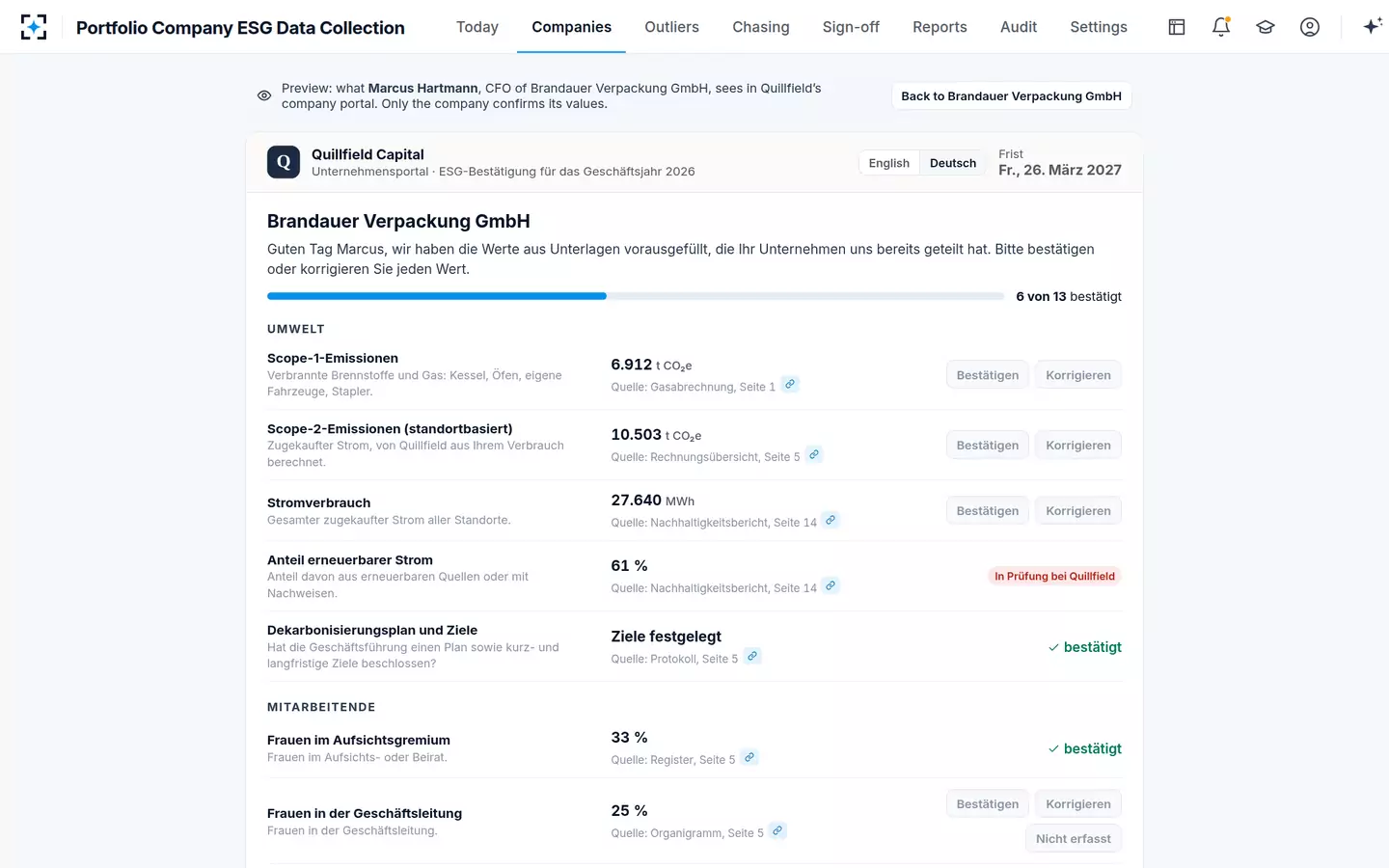
For a portfolio company CFO: which ESG reporting requirements apply to us?
- Are we, or our group, above EUR 450 million net turnover and 1,000 employees?
Both tests. If yes, the CSRD applies from financial years starting in 2027, once your Member State has transposed the 2026 directive.
- Does a non-EU parent have more than EUR 450 million of EU turnover?
For two consecutive years. If so, the EU subsidiary or a large EU branch may have to publish group-level information.
- Are we a large unquoted UK company?
Then SECR applies: UK energy, emissions and efficiency action in the directors' report, unless you used 40,000 kWh or less.
- More than 500 employees and more than £500 million of turnover in the UK?
Climate-related financial disclosures in the strategic report as well.
- More than $1 billion of revenue and business in California?
SB 253: Scope 1 and 2 to CARB, first due 10 November 2026. SB 261 is enjoined.
- Is any of our investors an EU fund manager that considers principal adverse impacts?
Then expect the PAI indicators in its request, by spring, every year.
- If none of these apply, what does our shareholder agreement say?
The investor's request is then the only one that binds, and its scope is a matter of contract and of what the investor needs to report.
Every requirement on this page ends in the same place: numbers about private companies reaching an investor report. The private equity ESG report follows those numbers to the LP, and the CFO's guide to investor ESG surveys covers the company's side. To see the request, the prefill and the approvals together, start from Portfolio Company ESG Data Collection.
Questions people ask
Do small private companies in the EU have to report ESG data?
Not under the CSRD after the 2026 Omnibus, which also removed listed small and medium-sized companies from mandatory reporting. The Commission's voluntary standard gives them a simple format if they choose to report, or if a customer or investor asks, and it is the ceiling for what a large company may demand of them for its own CSRD statement.
Is SFDR 2.0 law yet?
No. The Commission's proposal of 20 November 2025 is still being negotiated between the Council and the Parliament, after the Council's mandate in June, the ECON committee's report in September and Parliament's plenary vote to open talks on 7 October 2026. Until a final text is published and applies, the current SFDR and its delegated regulation, including the June 30 PAI statement, remain in force.
Does a US private equity fund have to report ESG data to the SEC?
No federal rule requires it: the SEC withdrew its 2022 proposal on ESG disclosures by advisers and funds in June 2025. What a fund says about ESG to investors is still covered by the anti-fraud rules, which is why the SEC has fined advisers whose ESG statements their own processes did not support.
Does the value chain cap stop a GP asking portfolio companies for ESG data?
No. The cap applies to requests made for CSRD reporting, and the Commission's delegated regulation says it does not affect requests needed for obligations under other EU or national law. A GP collecting for LP reports or SFDR disclosures is outside it, unless it is itself collecting for its own CSRD statement.
Which emission factors does a UK company use for SECR?
Most use the UK government's annual greenhouse gas conversion factors, published by the Department for Energy Security and Net Zero, which name SECR among the reporting they support. The 2026 set was published on 11 June 2026; its UK electricity factor is 26% lower than the 2025 one, partly because of a change in method.