The ESG data collection process at a private markets GP is the yearly campaign in which the GP's ESG team asks every portfolio company for the same set of metrics (energy, Scope 1 and 2 emissions, workforce, board and safety figures), checks the answers, has each fund's dataset approved and turns it into the LP report and, for EU funds, the SFDR tables. It is hard for an ordinary reason: each answer sits with a different person inside a company the GP does not run, and each handoff is a wait. Botminds' Portfolio Company ESG Data Collection exists to remove the waits that need no judgment. Agents prefill each metric from documents the company has already shared, cite the page, chase in the company's language and explain outliers, while the company confirms its own values and the ESG lead approves each fund's dataset.
The examples on this page come from a fictional sample GP, Quillfield Capital, as its 2027 campaign for fiscal 2026 data runs through the solution: six funds, 120 portfolio companies, documents in 20 languages. Every name in it is invented. The research and rules are linked where they appear.
Where one fund's campaign spends its time, by Botminds' estimate
54days
working days for one fund's campaign done by hand, scoping to LP draft
25days
of them spent chasing companies and deal teams, not answering anything
30June
the date an EU manager's principal adverse impact statement is due, which fixes the end of the season
What is ESG data collection? Six moves, one year apart
ESG data collection is the part of ESG reporting that happens before anyone writes a sentence: getting a number from the company that owns it, with its unit, its boundary and its source. In private markets it happens once a year for most metrics, because the companies are private, report on their own fiscal years and publish little or nothing themselves. The GP has to ask.
The campaign has the same six moves at every GP, whatever the tool. Scope: which companies are in which fund, which metric set each fund needs, who the contact is. Request: send the metric set to each company. Answer: someone at the company finds each figure. Check: the ESG team compares each answer with last year, with peers and with the company's other answers. Approve: a person signs off each fund's dataset. Report: the approved numbers go into the LP report, LP questionnaires, an industry submission and, for an EU fund that considers principal adverse impacts, the SFDR tables.
The metric set is usually some mix of three sources. Many GPs use the ESG Data Convergence Initiative's common metrics (Scope 1 and 2, renewable energy, board and C-suite diversity, injuries, net new hires, turnover, an employee survey). EU funds need the indicators in Table 1 of Annex I to the SFDR delegated regulation, fourteen of which apply to investee companies. And each LP's own questionnaire adds a few questions of its own. The ESG data collection template page maps a typical set cell by cell.
How to collect ESG data from portfolio companies: three ways to run the request
GPs run the request in one of three ways, and the choice decides where the waits fall. The first is a blank spreadsheet by email: cheap to send, expensive to chase, and checked only when a whole workbook comes back. The second is a survey portal: the same questions in a web form, with automated reminders and field validation, but the company still finds and types every answer. The third starts from the documents: the GP reads what each company has already shared, fills in what the documents show with a citation, and asks the company to confirm or correct.
The first two move the same work around. The third removes a step: the company's search for the bill, the payroll extract or the board register. What it cannot remove is the company's confirmation, which is the step that gives an answer its authority. The rest of this page follows the chain in all three models, because the people and the handoffs are the same; only the amount of waiting differs.
Who fills in the ESG survey at a portfolio company?
The CFO receives it and almost never fills it in alone. The request lands with the finance chief because that is the contact the GP holds, and the CFO forwards each block to the person who owns the underlying record. That forward is where the first wait starts, and it repeats for every block.
One request, five owners: who holds each answer inside a portfolio company
| Block of the request | Who holds it | The document it comes from | Why it waits |
|---|---|---|---|
| Electricity, fuel, renewable share | Facilities or operations manager | Utility bills, fuel invoices, supplier contracts, certificates | Bills sit at site level; a new site may bill in different units |
| Scope 1 and 2 emissions | Finance, a sustainability lead if there is one, or nobody | Calculated from the energy figures with an emission factor | Cannot start until the energy block is in |
| Headcount, hires, turnover, injuries | HR and health and safety | Payroll extract, HR system, injury log | Definitions differ: contractors in or out, organic or acquired hires |
| Board and leadership composition | Company secretary or CFO | Board register, organisation chart, minutes | Usually quick, unless the board changed during the year |
| Revenue and other denominators | Finance | Audited accounts or management accounts | Audited figures may not exist until months after year-end |
The same campaign from five seats
Today
Receives a blank survey every spring, forwards it in pieces and waits for facilities, HR and finance to answer.
With agents
Opens a form already filled from documents the company shared, confirms or corrects each value with its source, and signs.
Today
Is asked for kilowatt-hours by email, weeks after the bills were paid, by someone who does not know which sites changed.
With agents
Is asked only when a bill is missing or a value looks wrong, with the bill and the question attached.
Today
Is copied on reminders and asked why a number looks odd, long after the survey went out.
With agents
Explains an outlier once, with the agents' likely cause and the evidence beside it, inside the outlier itself.
Today
Retypes answers, checks units by hand and chases the companies that never opened the spreadsheet.
With agents
Reviews what was prefilled and why, accepts what is proven and prepares each fund's dataset.
Today
Finds out what does not add up when the LP report is already in draft.
With agents
Approves escalations and each fund's dataset, and never the dataset she prepared.
Still theirs: Every approval, and every escalation to an operating partner
Where the days go: waiting, not answering
Most of the calendar is waiting. Finding last year's electricity total in a stack of bills takes a facilities manager an hour; the request reaches that manager a week after it reached the CFO, and the answer comes back to the GP a week after that. Botminds' estimate for one fund's campaign done by hand puts nearly half the working days into chasing and less than a fifth into checking.
By hand, chasing takes almost half of one fund's campaign
The chase is long because it is serial. The CFO waits for facilities, the emissions figure waits for the energy figure, the ESG analyst waits for the whole form before checking any of it, and the deal team is only asked to help once a company is already late. A question about one number travels the whole chain again: analyst to deal team, deal team to CFO, CFO to the site, and back.
The same fund's campaign, by hand and with the agents doing the reading and the chasing
- Scope, send and check17 d
- Chase25 d
- Approve and draft12 d
- Scope, send and check4 d
- Chase6 d
- Approve and draft4 d
How long does ESG data collection take? Measure your own campaign
No regulator or independent study publishes how long a GP's annual ESG campaign takes, so the useful number is your own. You can measure it from the email and file history of last year's campaign in an afternoon, and the measurement tells you where to spend effort before the next one.
Five timestamps per company that turn last year's campaign into a measurement
- Request sent
The day the survey or spreadsheet left the GP for that company. Your campaign starts here, not at the kickoff meeting.
- First response
The first answer of any kind. The gap from the request is pure wait: forwarding, reading, deciding who answers.
- Last value in
The day the final metric arrived. The gap from the first response is internal chasing at the company.
- Last question closed
The day the ESG team stopped asking about that company. Count how many round trips each question took.
- Fund dataset approved
Per fund, not per company: one late company holds the whole fund. Note which company it was.
Two numbers usually come out of this. The first is the share of the campaign spent between a question and its answer, which in a serial process is most of it. The second is the shape of the tail: a handful of companies, often the newest acquisitions or the ones without a finance team in the language of the request, finish weeks after everyone else and decide when each fund's dataset can be approved.
The end date is less flexible than the start. An EU manager that considers principal adverse impacts publishes its statement by June 30 for the previous calendar year, under Article 4 of Delegated Regulation (EU) 2022/1288. The statement averages four quarter-end positions, but the companies do not need to report four times a year: the ESAs' consolidated Q&A says that "the provision of data by undertakings on a quarterly basis is not a pre-requisite to perform at least four quarterly calculations" (ESAs, JC 2023 18). One annual campaign can feed it, provided it finishes in time.
ESG data collection challenges: the answers that come back wrong
The second cost of a serial process is that problems surface late. An answer that arrives in week six and fails a check in week eight goes back up the chain in week nine. The failures fall into five families, and each has a different person who can fix it.
Every outlier in Portfolio Company ESG Data Collection, with its likely cause and who it waits on
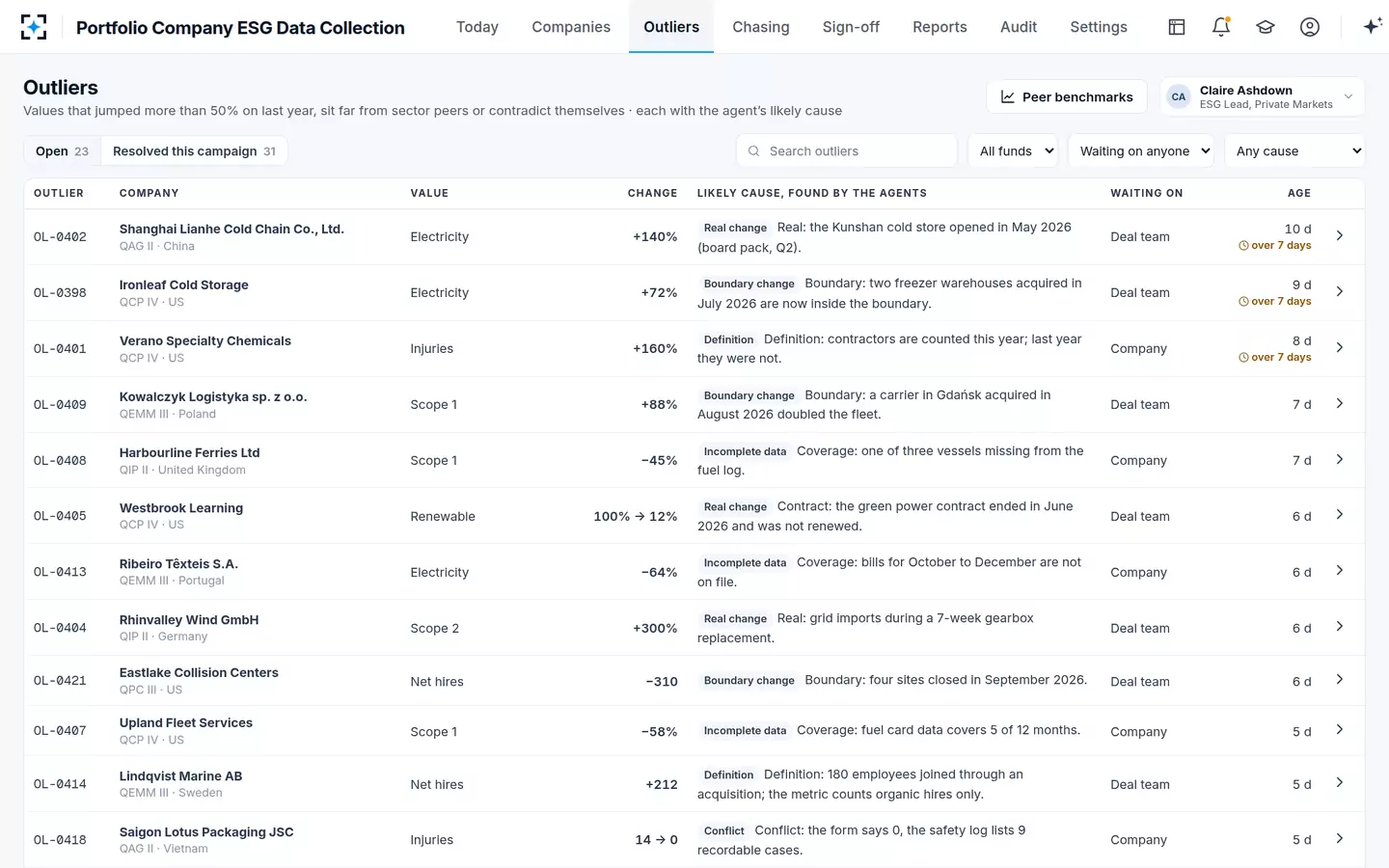
A real change, such as a new cold store, needs only an explanation from someone who knows the business, usually the deal team. A boundary change (an acquisition or a closure) needs a decision about whether last year is restated. A definition change, such as contractors counted in injuries this year and not last, needs the company to answer on the old definition or the GP to restate. Incomplete data, such as fuel cards that cover five months of twelve, needs the missing documents. And a conflict, a form that says zero injuries beside a safety log that lists nine, needs the company to choose, with the evidence in front of it.
In a serial process, each of these is discovered by the ESG analyst after the whole form is in, and then waits again. Checked as each value arrives, and routed straight to the person who can resolve it, the same outlier costs a day instead of a fortnight.
Why the GP owns the waits: LPs ask, and the record has to show the work
The campaign exists because fund investors want the data. In the first large study of private equity firms' ESG disclosures, Abraham, Olbert and Vasvari found that "the demand for ESG information from fund investors is a significant determinant of PE firms' ESG disclosures" (Journal of Accounting Research, 2024). LPs set the deadline, the GP sets the request, and the portfolio company carries the work.
The SEC's examiners have also said what they expect the work to leave behind. Their 2021 review of ESG investing, which covered private funds, closed by advising firms to document and keep records of each important stage of their ESG investing process (SEC Division of Examinations, April 2021). For a GP, the annual campaign is one of those stages: who was asked, what they answered, what was questioned and who approved it. A campaign run in email leaves that record scattered across inboxes; a campaign run with timestamps leaves it in one place, and it is the same data that measures the waits.
What changes when the company confirms instead of answering
The fastest way to shorten a chain of waits is to remove the steps that need no judgment. Most of a portfolio company's answers already exist in documents the GP holds or can be sent: utility bills, audited accounts, HR and safety reports, board minutes, a sustainability report. Reading them is work an agent can do, citing the page; confirming them is work only the company can do.
In the sample campaign, the Prefill agent filled 1,263 of 1,464 values (86%) from documents the companies had shared, each cited to its page, and left the rest for the company to answer rather than guess. The company's CFO sees a form in the company's own language with every value already filled and two buttons beside each one: confirm or correct. The CFO's side of the process is described in answering an investor ESG survey once.
The chase in Portfolio Company ESG Data Collection: an agent that asks only for what is still open
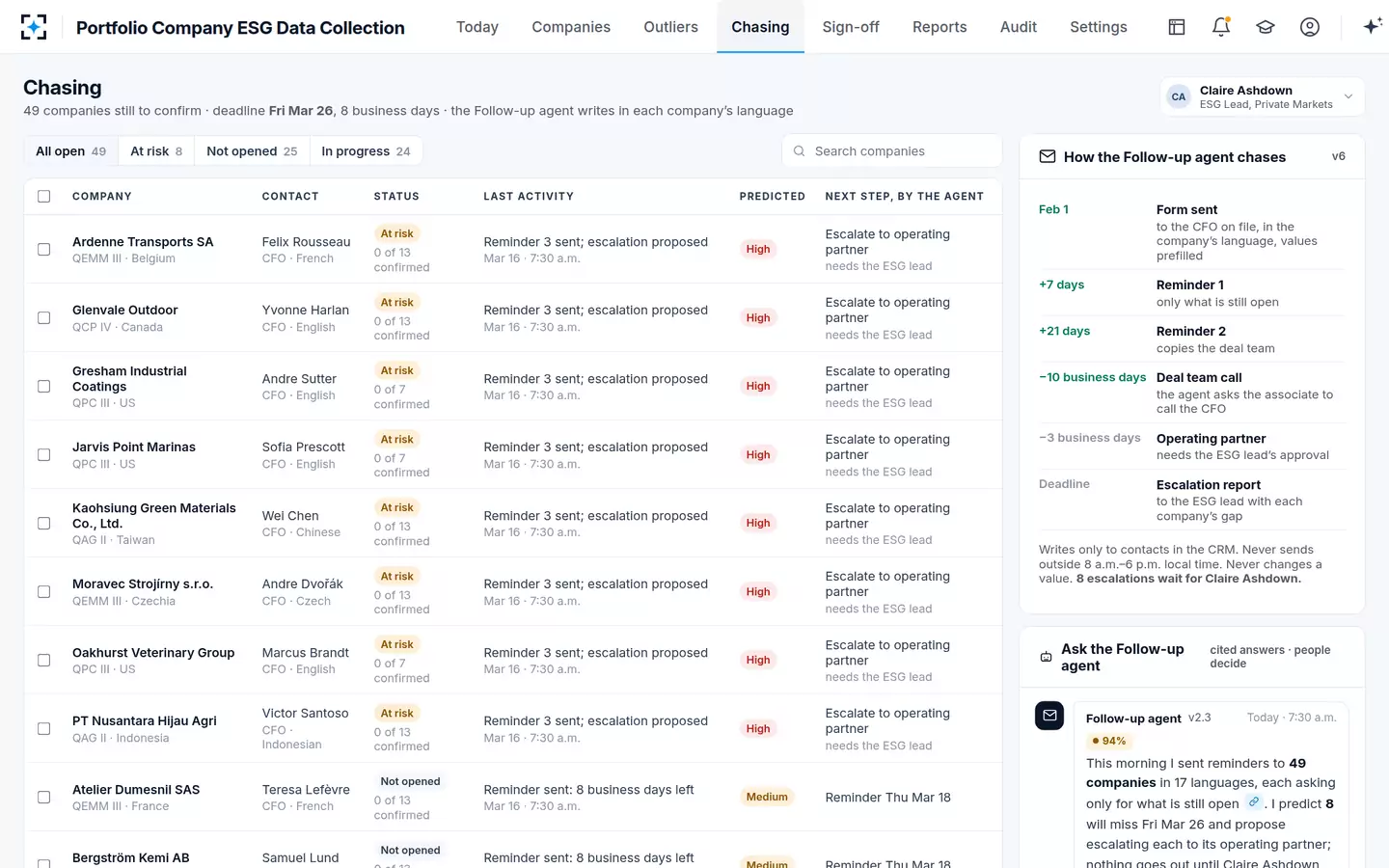
The chase changes shape too. Instead of the same full spreadsheet sent three times, each reminder asks only for what is still open, in the company's language, on a ladder the ESG lead sets: a reminder after a week, the deal team copied after three, a deal team call ten business days before the deadline, and an operating partner only with the ESG lead's approval. On the sample campaign's March 16, 71 of 120 companies had confirmed and eight were predicted to miss the deadline, each with a proposed escalation waiting for a decision.
What does not change is who decides. The agents never confirm, change or approve a value. The company confirms its own figures and signs an attestation, the deal team explains outliers for the companies it knows, an ESG analyst prepares each fund's dataset, and the ESG lead approves it only if she did not prepare it. To see the whole campaign in the solution, start from Portfolio Company ESG Data Collection.
Questions people ask
Is ESG data collection the same as ESG due diligence?
No. Due diligence happens once, before an investment, and asks whether a company carries ESG risks the buyer should price or fix. The annual data collection campaign starts after closing and repeats every year for as long as the fund holds the company, asking for the same metrics so that the GP can track and report change.
When should a GP send the annual ESG data request?
Work back from the earliest output. For an EU manager that considers principal adverse impacts, that is the June 30 statement covering the previous calendar year; LP reports and industry submissions often fall in the same quarter. Most portfolio companies close their year on December 31, so a request in January or February catches the bills and payroll data while they are fresh, with audited revenue following later.
How many metrics should the request ask for?
Only those an output needs. List every output the data feeds (the LP report, each LP's questionnaire, an industry metric set, the SFDR table for each EU fund) and keep a metric only if at least one output uses it. Every extra metric is another person to chase at every company, every year.
Should the deal team be part of the ESG data collection process?
Yes, but late and narrowly. Deal teams know why a company's numbers moved (an acquisition, a new site, a lost contract) and are the right people to explain outliers. They are the wrong people to chase routine answers, and copying them on every reminder teaches them to ignore the reminders that matter.
What records should a GP keep from the campaign?
Enough to show how each reported number was produced: the request each company received, the value it gave and its source document, every question asked and its answer, every correction with its reason, and who approved each fund's dataset and when. The sample campaign keeps these on a hash-chained audit trail for seven years after the fund year, a retention period the GP sets.