A private equity ESG report is the GP's periodic account to its limited partners of the ESG performance of a fund's portfolio companies: Scope 1 and 2 emissions and intensity, renewable energy, workforce and board diversity, health and safety, cybersecurity, and the GP's own ESG policies and engagement. In private equity ESG reporting, each number is a statement by an investment adviser to its investors, so it carries the same duty of accuracy as a performance figure. The report is only as good as the trail behind each figure: which company document it came from, who at the company confirmed it, what was questioned, and who approved the fund's dataset. Botminds' Portfolio Company ESG Data Collection drafts the LP section from approved data only, with every number linked to its company confirmation and source page, and leaves the release to investor relations and compliance.
The fund, companies and people in the examples are fictional, from the solution's sample campaign. The SEC's findings and orders are quoted from the SEC's own releases.
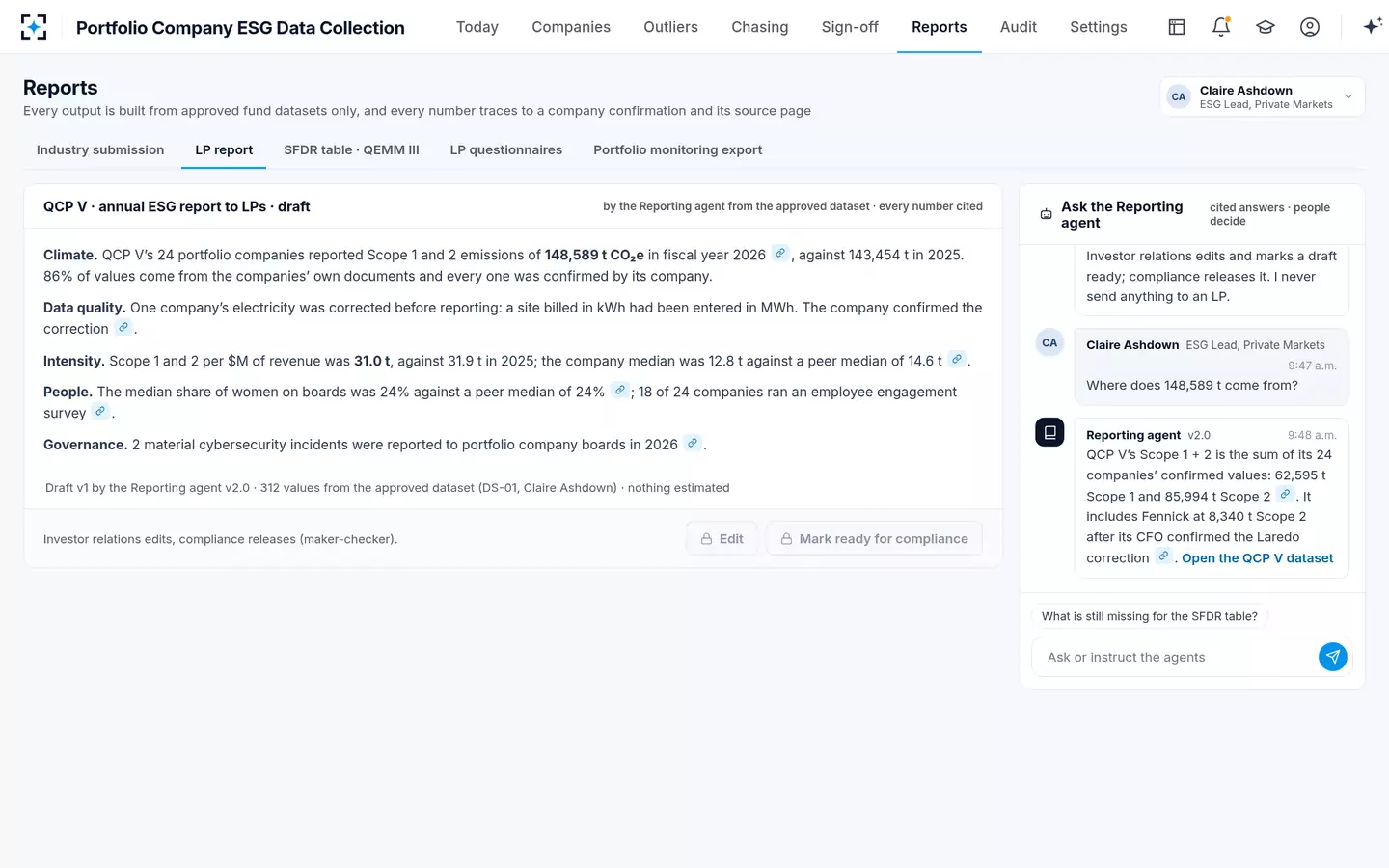
One LP report section, and what stands behind each of its sentences
| What the LP reads | Where it comes from | Who stood behind it |
|---|---|---|
| Climate: the fund's 24 companies reported Scope 1 and 2 of 148,589 t CO2e in fiscal 2026, against 143,454 t in 2025 | 62,595 t of Scope 1 and 85,994 t of Scope 2, the sum of 24 companies' confirmed values; 86% read from the companies' own documents, each with its page | Each company's CFO confirmed and signed; an analyst prepared the dataset; the ESG lead approved it |
| Data quality: one company's electricity was corrected before reporting | A site billed in kWh had been entered in MWh; the bills, the deal team's explanation and the CFO's confirmation are on the outlier | The company confirmed the correction; the outlier closed only after the agents proposed, the deal team explained and the company confirmed |
| Intensity: 31.0 t per $M of revenue against 31.9 in 2025; company median 12.8 against a peer median of 14.6 | Approved values divided by revenue; peers from the licensed benchmark's 2026 edition, which carries FY2025 data | The Benchmark agent drafted the line; it was used only after the dataset was approved |
| People: median share of women on boards 24% against a peer median of 24%; 18 of 24 companies ran an engagement survey | Board registers and HR reports, confirmed by each company | Each company's CFO |
| Governance: 2 material cybersecurity incidents reported to portfolio company boards in 2026 | Board minutes and IT reports, confirmed by each company | Each company's CFO |
What is ESG in private equity?
In private equity, ESG covers two things: how a GP considers environmental, social and governance factors when it buys, owns and sells companies, and how it measures and reports what happens to those companies while it owns them. The first lives in policies, due diligence and engagement; the second in data, collected each year from companies the GP owns but does not run.
The reporting side grew because LPs asked for it, and the research suggests it is not only paperwork. In a study of PE firms' ESG disclosures from 2000 to 2022, Abraham, Olbert and Vasvari found that "more PE firm ESG disclosures are associated with better ESG outcomes at the portfolio company level, suggesting that voluntary ESG disclosures align with real actions for the average PE firm" (Journal of Accounting Research, 2024). The data a GP reports is evidence of what it does, which is why it has to be right.
What goes in a private equity ESG report to LPs
Most GP ESG reports to LPs have the same five parts, whatever the template: the fund's climate figures, a data-quality note, intensities against peers, people and governance metrics, and the GP's own ESG activity in the year. A company-by-company appendix and answers to each LP's own questionnaire usually travel with it.
The data-quality note is the part most often missing and the most useful to an LP. It says what share of values came from the companies' own documents, what share were estimated and how, and which figures were corrected before reporting. LPs comparing several GPs can do little with a number whose origin they cannot see; they can do a great deal with one whose source, confirmation and corrections are stated.
What stands behind the sample fund's LP section
24 of 24
companies confirmed and signed their values before the fund dataset was approved
86%
of the fund's 312 values read from the companies' own documents, each cited to its page
1
correction made before reporting, with the bills, the explanation and the CFO's confirmation on record
Why every number in an LP report is an ESG claim
Because an adviser's statements to investors in its funds are covered by the anti-fraud rules, ESG figures included. The SEC's 2021 review of ESG investing, which covered private funds, reminded advisers that "Advisers Act Rule 206(4)-8 prohibits advisers to pooled investment vehicles from making false or misleading statements to existing or prospective investors in those pooled investment vehicles" (SEC Division of Examinations, April 2021). A unit error caught before release is a correction; a report built without the controls to catch one is the kind of process examiners look at.
"compliance controls and oversight for reporting to sponsors of global ESG frameworks and responses to requests for proposals and due diligence questionnaires appeared to be ineffective."
SEC Division of Examinations, Review of ESG Investing, April 2021
The same review found "a lack of compliance review of the data underlying those measures" in firms' marketing metrics. For an LP report the lesson is direct: compliance should review not only the wording of the ESG section but the dataset it is drawn from, and should be able to see, for any figure, where it came from and who approved it.
What the SEC's ESG cases say about process, not numbers
The SEC's ESG enforcement cases against advisers were not about a wrong figure. Each was about a process that did not do what clients and investors had been told it did, and each order describes that gap in terms a GP's ESG team will recognise.
In the Goldman Sachs Asset Management case, the firm's procedures required a questionnaire for every company before it entered a portfolio, but staff often completed the questionnaires only after the securities had been chosen, leaning on older research (SEC release 2022-209). In the DWS case, the order found that the adviser "failed to adopt and implement policies and procedures reasonably designed to ensure that its public statements about the ESG integrated products were accurate" (SEC release 2023-194). In the Invesco case, the order found that the firm "lacked any written policy defining ESG integration" (SEC release 2024-179).
Read as a checklist for an LP report, the three cases ask: was each figure produced by the process the GP describes, in the order it describes; is there a written procedure for checking the figures before release; and are the terms in the report (reported, estimated, confirmed, approved) defined somewhere and applied the same way to every company? A report traced number by number answers all three.
Reported or estimated: say which, and how much
State, for each metric, what share of the portfolio reported it and what share was estimated, and how the estimates were made. The European Supervisory Authorities recommend exactly this for the SFDR's principal adverse impact statements: it "would be a good practice, but not obligatory" for managers to disclose the proportion of investments for which they relied on "data obtained directly from investee companies" and the proportion for which they relied on research, data providers, experts or "reasonable assumptions" (ESAs, consolidated SFDR Q&A, JC 2023 18).
The same split makes an LP report more credible. A fund that says 86% of its values were read from companies' own documents and confirmed, and that nothing was estimated, has told the LP something it can rely on. A fund that reports a total without the split leaves the LP to assume the worst, or to ask in its next questionnaire.
Tracing one number from the bill to the LP report
A traced number has a chain that can be walked in either direction: from the LP report to the approved dataset, to the company's confirmation, to the document and page; or from the bill forward to every output that uses it. The chain below is the one behind the sample fund's 148,589 tonnes.
One figure's chain in Portfolio Company ESG Data Collection, from the company's bills to the LP
Agent
Prefill agentReads each company's bills and reports, in their language, and fills each value with its unit and page.
Never: confirms a value for a company
A person decides
Company CFOConfirms or corrects each value with its source, and signs the attestation.
Agent
Outlier and Carbon agentsCompare every value with last year and peers, recompute Scope 1 and 2 from activity data, and name a likely cause for anything that jumps.
Never: change a value
A person decides
Deal team, then ESG analystThe deal team explains outliers; the analyst prepares the fund's dataset as maker.
A person decides
ESG leadApproves the fund's dataset when every check passes, and only if she did not prepare it.
Agent
Reporting agentDrafts the LP section, questionnaire answers and SFDR table from the approved dataset, every number linked to its source.
Never: sends anything to an LP
A person decides
Investor relations and complianceInvestor relations edits and marks the draft ready; compliance releases it.
The chain is what made the sample fund's correction possible. One company's Scope 2 had been entered with a site's kilowatt-hours typed as megawatt-hours, an error of 37,934 tonnes that would have turned a 3.6% rise in the fund's emissions into a 30% one. Because the value was checked against the bills before approval, the LP section reports the corrected figure and says, in one sentence, that a correction was made.
The LP report section in Portfolio Company ESG Data Collection, drafted from approved data
Who drafts, who approves, who releases
Separate the people who prepare the numbers from the people who approve them, and both from the people who release the report. In the sample configuration, an ESG analyst prepares each fund's dataset and the ESG lead approves it, never the same person; investor relations edits the drafted section; compliance releases it. A confirmed value that changes later goes back to the company and reopens the approved dataset, so a figure cannot change silently between approval and release.
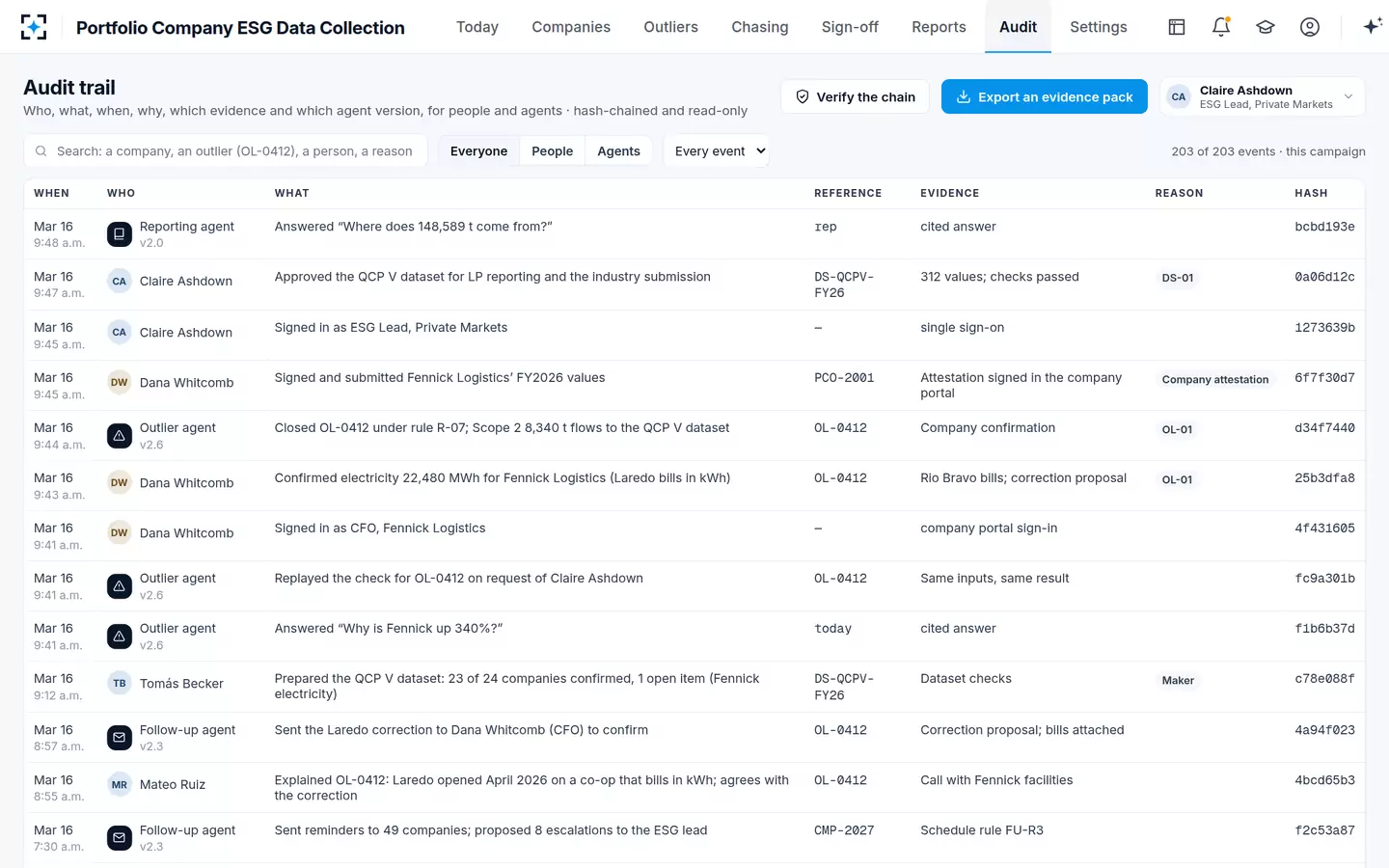
The record is the other half of the control. Every confirmation, correction, outlier close, approval and release is logged with who did it, which agent version was involved, the evidence and a reason code, on a hash-chained trail that internal audit can verify and export.
The record behind the LP section in Portfolio Company ESG Data Collection
SFDR for private equity funds: the same numbers in a regulated table
An EU private equity fund that considers principal adverse impacts reports the same company figures again, in a regulated format. The manager's statement follows Table 1 of Annex I to the SFDR's delegated regulation, which lists Scope 1, 2 and 3 emissions, carbon footprint, GHG intensity, energy, board gender diversity and other indicators for investee companies, and averages four quarter-end positions (Delegated Regulation (EU) 2022/1288). Article 8 and 9 funds add periodic disclosures of their own.
The practical rule is one dataset, many outputs. The LP report, the LP questionnaires, an industry submission and the SFDR table should all be drawn from the same approved values, so that no LP can find two different numbers for the same company and year. The SFDR's revision, proposed by the Commission in November 2025, was still in negotiation in late October 2026 (European Parliament, Legislative Train); whatever its final form, it will still need investee data, and a traced dataset serves either version. Which companies carry duties of their own is covered in ESG reporting requirements for private companies, and how a fund line against peers should read in ESG benchmarking for portfolio companies. To see an LP section traced on your own portfolio, start from Portfolio Company ESG Data Collection.
Questions people ask
How do LPs check a GP's ESG data?
Mostly through their questionnaires and due diligence: they ask how data is collected, what share is estimated, who reviews it and whether it is assured. An LP can rarely check a portfolio company's figure itself, so a GP that can show the source, the company's confirmation and the approval for any number it reports answers the question before it is asked.
Does a GP's ESG report need external assurance?
Neither the SFDR nor the SEC's rules require a private fund's ESG report to its LPs to be assured. Some GPs commission it, and LPs may ask. A dataset in which every value has a source page or a signed company entry, and every change is logged, is what an assurance provider would test, so it lowers the cost of assurance as well as the need for it.
What is the difference between a GP ESG report and a portfolio company ESG report?
A portfolio company report is the company's own account of its performance, where it publishes one. A GP's report aggregates many companies' figures for a fund's investors and adds the GP's own policies and engagement. Most private portfolio companies publish nothing, so the GP's report is often the only place their figures appear.
What happens if a number changes after the LP report is released?
Correct it openly. Record the change, its cause and who confirmed it, tell the LPs who received the figure, and carry the corrected value into every other output that used it. In the sample configuration, a confirmed value that changes goes back to the company and reopens the approved dataset, so the correction follows the same chain as the original.
How often do private equity firms report ESG data to LPs?
Most report annually, often alongside or soon after the annual financial report, because most portfolio company metrics are annual. Some LPs ask for selected metrics more often, and an EU manager's principal adverse impact statement averages four quarter-ends, though the ESAs have said companies need not report quarterly for that calculation.