An ESG data collection template in Excel is the workbook a GP sends each portfolio company every year: one row per metric (Scope 1 and 2 emissions, electricity, renewable share, board and leadership diversity, injuries, hires, turnover), each with a unit, a definition, a reporting period and a cell for the answer. The template most GPs send is a form to fill in. The template worth sending also carries, for every row, the document the answer should come from, last year's value and who confirmed it, because those columns are what make the answers checkable. Most of the answers already sit in documents the company has shared, so most cells can be filled before the company opens the file. Botminds' Portfolio Company ESG Data Collection does that prefill with agents that cite the page, and turns the template into a form the company confirms.
The sample figures on this page come from the solution's fictional sample campaign: a GP called Quillfield Capital with 120 portfolio companies across six funds. All names and figures in it are invented.
Who fills the cells in Portfolio Company ESG Data Collection: a blank template against a prefilled one
A blank Excel template
- Company finds and types every value · 100%
Sample campaign, 1,464 values
- Prefilled from documents, cited to the page · 86%
- Left for the company · 14%
What goes in an ESG data collection template?
Eight columns, not two. A template that holds only a metric name and an answer gives the GP a number and nothing to check it against. The columns below are the ones that let an analyst test an answer without writing back to the company.
An ESG data collection template in Excel, column by column
| Column | What it holds | Why it is there |
|---|---|---|
| Metric and ID | A stable identifier and the metric's name | Rows can be compared year to year even if the wording changes |
| Unit | MWh, t CO2e, %, count: one unit per row, never typed into the value cell | A unit in its own locked column is the cheapest defence against kWh entered as MWh |
| Definition and boundary | The definition the fund follows, with its version, and which entities and sites are in | Contractors in or out, acquired hires or organic, which sites: the source of most year-on-year jumps |
| Period | The fiscal year the value covers | Companies close on different dates; the fund reports on one |
| Value | The number or the answer | The only column most templates have |
| Source document and page | The bill, report or register the value was read from | The difference between a value and a claim; it is also what makes prefill possible |
| Last year and change | Last year's confirmed value and the percentage change | A large change without a comment is the first thing to question |
| Status and owner | Prefilled, confirmed, corrected or not tracked, and by whom | Shows who stands behind each number when an LP asks |
The source column does more work than any other. EU managers that publish a principal adverse impact statement must describe, among other things, "the data sources used" (Delegated Regulation (EU) 2022/1288, Article 7(1)(e)), and an LP that asks where a number came from deserves a page, not a person's name. A template that captures the source at the moment of answering never has to reconstruct it.
ESG KPIs examples: a common private-markets metric set, and where each answer lives
Most GP templates are built around a short common set. The ESG Data Convergence Initiative's metrics are widely used in private markets, and EU funds add the indicators of the SFDR's principal adverse impact table. The examples below are the thirteen metrics of the sample campaign's set, which follows the common one and adds a cybersecurity metric, with the document each answer comes from.
ESG KPIs examples, and which cells of a template can be prefilled from documents
| Metric | Unit | Where the answer lives | Prefill from documents? |
|---|---|---|---|
| Scope 1 emissions | t CO2e | Fuel and gas invoices; fleet fuel cards | Yes, from the invoices, then recomputed with a factor |
| Scope 2 emissions | t CO2e | Calculated from electricity | Recomputed from the electricity row, not typed |
| Electricity used | MWh | Utility bills, by site | Yes, where bills or a report with site totals were shared |
| Renewable share | % | Supplier contracts, certificates, sustainability report | Yes, but a change needs the evidence behind it |
| Decarbonisation plan and targets | Yes / no / plan | Board minutes, strategy papers | Yes, if the minutes are on file |
| Women on the board | % | Board register | Yes |
| Women in the C-suite | % | Organisation chart | Yes, if a current chart was shared |
| Recordable injuries | count | Health and safety log | Yes, with the definition stated |
| Days lost to injury | days | Health and safety log | Yes, with the definition stated |
| Net new hires | count | Payroll or HR report | Often; acquisitions need a separate line |
| Turnover | % | HR report | Often; the formula must match last year's |
| Employee engagement survey | Yes / no | HR report, board papers | Only if a document says so |
| Cybersecurity incidents reported to the board | count | Board minutes, IT reports | Only if the minutes are on file |
ESG KPIs list: what to leave out of the template
Leave out every metric no output uses. Each row in a template is a question to every company, every year, and a row nobody reports is pure cost. Before sending, list the outputs the data feeds (the LP report, each LP's questionnaire, an industry metric set, and for each EU fund the SFDR table) and keep a row only if at least one of them needs it.
Be careful with indicators few companies can answer. When the European Supervisory Authorities reviewed managers' 2024 principal adverse impact statements, data coverage remained low for emissions to water, hazardous and radioactive waste and the unadjusted gender pay gap (ESAs, JC 2025 26). A GP that needs those indicators should ask for them, but with a clear "not tracked" option and without expecting most private companies to have them; a template that forces an answer gets guesses.
Why the Excel template breaks: units, boundaries and definitions
An Excel template fails in the same three places every year. Units, because a value cell accepts any number and a site billed in kilowatt-hours looks the same as one billed in megawatt-hours once it is typed. Boundaries, because a company that acquired a business in August has two answers to every question, and the template rarely says which one it wants. Definitions, because "injuries" and "hires" mean different things in different HR systems and to different people in the same company from one year to the next.
A fourth failure is quieter: answers that are estimated without saying so. The EPA's guidance on electricity data notes that a company may know only what it spent, and calls this "the least accurate method of determining consumption" and one that "is not recommended for GHG reporting" (EPA, Scope 2 guidance, section 3.2). A template with a source column exposes a spend-based guess, because the source says "budget" instead of "bills"; a template without one cannot tell the two apart.
Which ESG data can be prefilled from documents the company already shared?
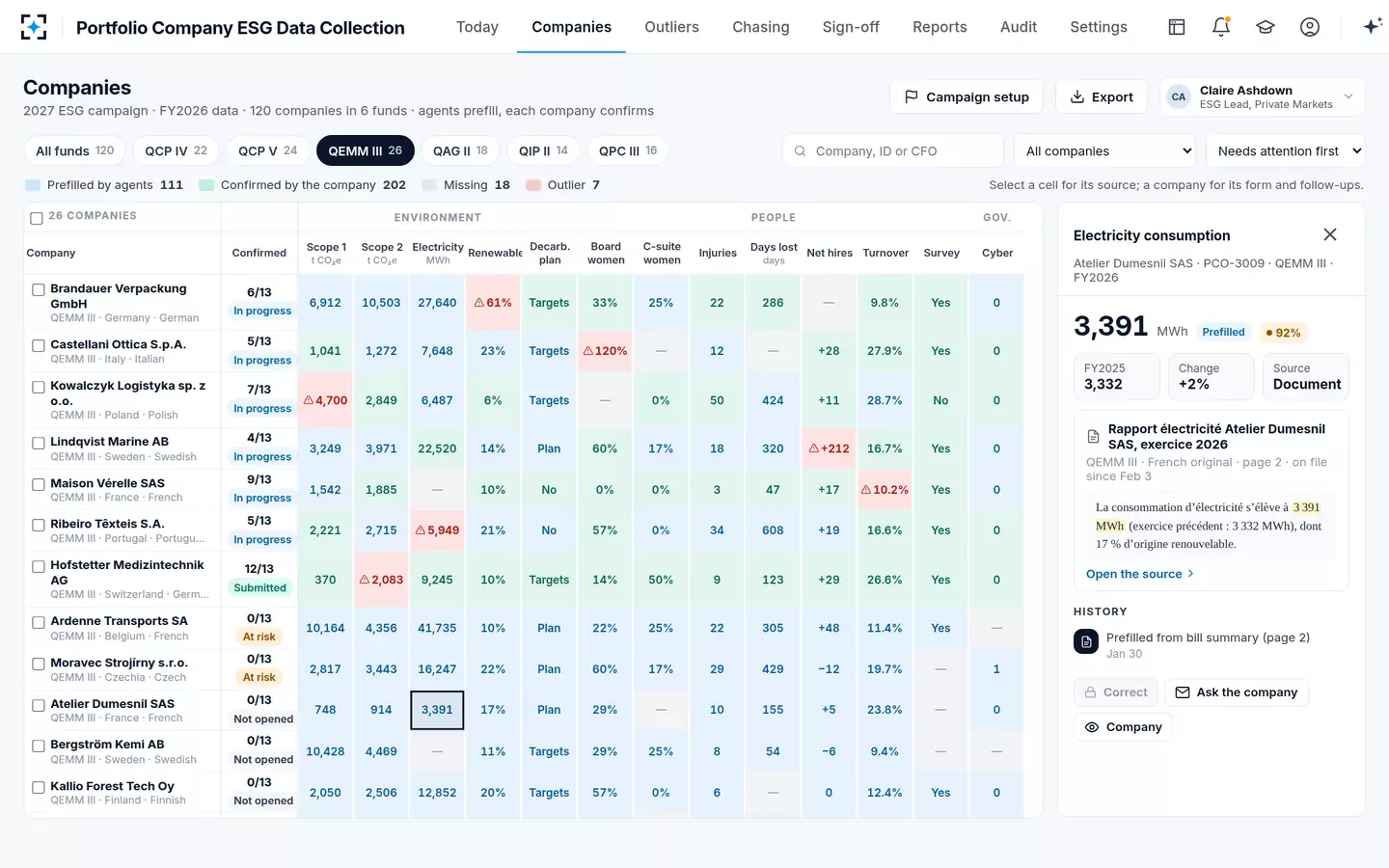
More than most GPs assume. A portfolio company sends its owners audited accounts, board papers and often a sustainability or HR report every year, and the data room from the acquisition holds bills and policies. Most cells of a common template can be read from those documents, which is why the sample campaign could prefill 86% of its values before any company opened a form.
Reading them at scale is the part that used to be impractical. Researchers who built an assistant for corporate sustainability reports put the problem plainly: "the sheer volume and complexity of these reports make human analysis very costly" (Ni et al., ChatReport, EMNLP 2023 system demonstrations, peer-reviewed conference paper). Their answer, as with any tool used for this, was to keep each answer traceable to the text it came from. A prefilled cell without a page reference is a guess the company is being asked to sign.
The confirmation grid in Portfolio Company ESG Data Collection: every cell prefilled, confirmed, missing or in question
Which cells cannot be prefilled, and must stay with the company
Some cells can never be prefilled, and a template should say so rather than leave them to chance. Anything that depends on a judgment the company has to own (whether a decarbonisation plan exists if the minutes are ambiguous, whether a metric is tracked at all) goes to the company as a question. Anything that changed in a way no document records (a site closed last month, a contract that ended) goes to the company or the deal team. And anything where the documents disagree goes to the company with both documents side by side.
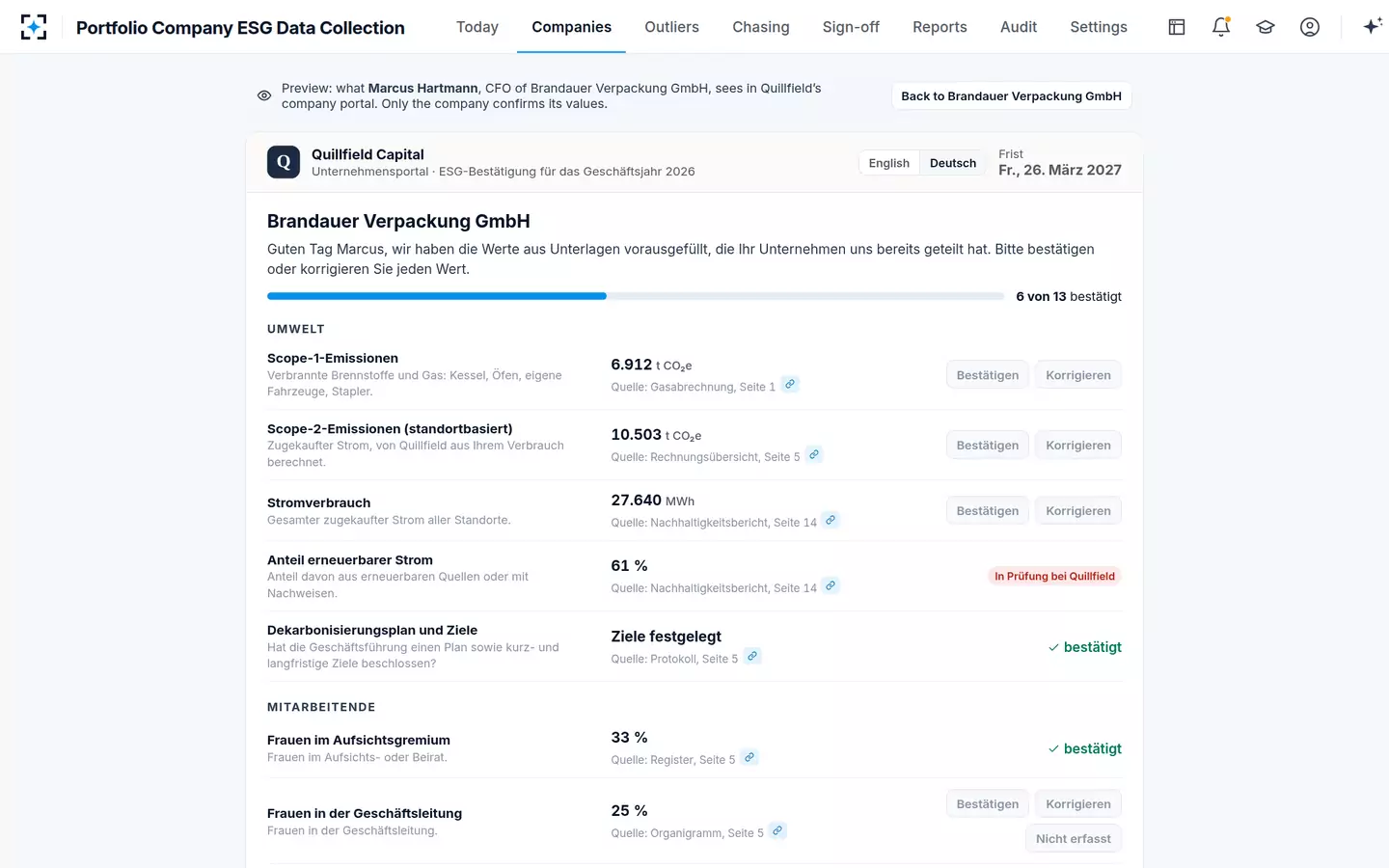
In the solution, the Prefill agent leaves a value empty when its confidence is below 90%, and every prefilled value, however confident, waits for the company to confirm it. A metric the company does not track can be marked as not tracked, which is an answer, not a blank. That keeps the line between what the documents say and what the company attests where it belongs.
Design rules for an ESG template a company can confirm instead of fill in
- One unit per row, in a locked column
The value cell takes a number only. Any conversion happens in a visible formula, not in the respondent's head.
- Definitions with a version
Link each row to the definition the fund follows and the version used last year, so a change of definition is a decision, not an accident.
- Last year beside this year
Pre-populate last year's confirmed value and compute the change. Ask for a comment above a threshold you set.
- A source for every value
Document and page, or "company entry" with a name. A spend-based estimate says so.
- Not tracked is an option
Distinguish "we do not measure this" from "we have not answered yet". A blank is neither.
- Prefill only with a citation
Fill a cell from a document only when the page can be shown; leave the rest for the company.
- Confirm, correct, attest
Every value, prefilled or typed, is confirmed by a named person at the company, and the whole set is attested once.
From spreadsheet to confirm-only form
Once every row has a source and an owner, the spreadsheet is no longer the best container. A company that receives a workbook still has to open it, find the tab, read the instructions and save the file somewhere. A company that receives a form showing each prefilled value with its source has one decision per row. The form is the template, re-presented; the columns are the same.
The same template as a confirm-only form, in the company's language
What the agents do with each template row, and what they never do
Each row of the template passes through agents and people in a fixed order, and the line between them is the line between reading and deciding. Agents propose the campaign, read documents, check values and draft; people approve the campaign, confirm values, explain outliers and approve each fund's dataset. No agent confirms, changes or approves a value, and every agent's message cites its source.
Who does what to a template row, from scoping to approval
Agent
Campaign agentProposes each fund's metric set, companies and contacts from the fund administrator's list and last year's campaign.
Never: launches a campaign
A person decides
ESG leadApproves the metric set and the launch.
Agent
Prefill agentFills each row from the company's own documents, in their language, with the unit and the page.
Never: fills a value below 90% confidence or confirms one
A person decides
Company CFOConfirms or corrects each value, marks metrics not tracked and signs the attestation.
Agent
Outlier agentCompares each value with last year, peers and the company's other values and names a likely cause.
Never: changes a value
A person decides
ESG analyst, then ESG leadThe analyst prepares the fund dataset; the ESG lead, who did not prepare it, approves it.
The template is one end of a longer chain; the ESG data collection process follows the waits between these steps, and the CFO's guide to investor ESG surveys shows the same rows from the company's side. To see a template turned into prefilled forms on your own companies' documents, start from Portfolio Company ESG Data Collection.
Questions people ask
Is there a free ESG data collection template in Excel?
Several industry bodies publish metric definitions that GPs turn into workbooks, and many GPs share their own. Whatever the starting point, add the columns that make answers checkable (unit, definition version, period, source and page, last year, status) before sending it; a free template with only an answer column costs more in checking than it saves in drafting.
What is EDCI metrics guidance?
The ESG Data Convergence Initiative publishes its own definitions and guidance for the common private-markets metrics it collects. A template that uses its metric set should link each row to the edition of that guidance the fund follows, so that a definition change between editions is visible rather than buried in a year-on-year jump.
Should the template ask for Scope 1 and 2 emissions or for the energy data?
Both, if you can. The energy and fuel data are what the company actually holds, from bills and invoices; the emissions are a calculation from them with a factor the company may or may not know. Collecting the activity data lets the GP recompute and check the company's emissions with a named, dated factor.
How many metrics should an ESG template have?
As many as the GP's outputs need and no more. The sample campaign uses thirteen, a common private-markets set plus cybersecurity incidents; an EU fund that reports principal adverse impacts needs the fourteen indicators for investee companies in the SFDR template, several of which overlap with that set.
Can a portfolio company upload documents instead of filling in the template?
That is the faster route for most companies. Bills, an HR report and board minutes uploaded once let the template be filled from them, with each value cited; the company then confirms values rather than typing them, and next year's request starts from the same documents.