ESG software providers fall into four groups: corporate ESG reporting platforms built for a company's own sites, ESG data and ratings vendors that sell data about listed issuers, portfolio monitoring systems with an ESG module, and tools built to collect ESG data from portfolio companies. A private markets GP needs the last kind, or a platform that does it well, because its problem is getting checked data from companies it owns but does not run, in their languages, every year. The choice has a deadline. The request goes out early in the year, and for EU funds the principal adverse impact statement is due on June 30, so any provider has to be live, with last year's data loaded, before the campaign starts. Botminds' Portfolio Company ESG Data Collection is one such tool; this guide covers what to ask any provider and a plan for going live in time.
The sample screens come from the solution's fictional sample campaign, Quillfield Capital's 2027 campaign for fiscal 2026 data; every company and person in it is invented. The week-by-week plan is our suggestion, not a measured implementation.
Working back from a 1 February launch: a go-live plan keyed to the campaign calendar
- Companies, funds, metric sets, contacts2 wk
- Documents and last year's dataset connected2 wk
- Pilot on last year's companies2 wk
- Thresholds, approvers, sign-off2 wk
- Companies confirm8 wk
- Outliers explained, datasets approved4 wk
- LP report, industry file, SFDR tablesto 30 Jun
What is ESG software? Four products under one name
ESG software is any system that stores, collects, calculates or reports environmental, social and governance data, which is why one search returns products that do not compete with each other. Telling them apart by the problem each was built for is quicker than comparing feature lists.
ESG software providers: four kinds, and what each is built to do
| Kind | Built for | Where it fits a GP | Where it does not |
|---|---|---|---|
| Corporate ESG reporting platform | A company reporting on its own sites, often under the CSRD or a voluntary framework | A large portfolio company that reports in its own right | Collecting from many companies the GP does not run |
| ESG data and ratings vendor | Data about listed issuers, gathered from public disclosures | Listed holdings, peer benchmarks | Private companies, which disclose little or nothing |
| Portfolio monitoring system with an ESG module | Quarterly financial KPIs from portfolio companies, with ESG fields added | One place for financial and ESG KPIs | Checking ESG values against bills, factors and peers; multilingual collection |
| Portfolio company ESG data collection tool | The GP's annual request: prefill, chase, check, approve, report | The spring campaign end to end | A company's own statutory sustainability report |
ESG platform providers: what to look for as a GP
Look for the things that remove the cost of the campaign and keep the record a regulator or an LP will ask for. Four questions separate tools built for the GP's problem from tools adapted to it.
First, where do the values come from? A tool that sends a blank form and stores the answers leaves the finding and typing with the company. Ask to see a value prefilled from a company document, with the page. Second, how is a value checked? Field validation catches impossible answers, not wrong ones; ask the provider to find a site billed in kilowatt-hours and typed as megawatt-hours in last year's data. Third, who decides? The company should confirm its own values, and the person who prepares a fund's dataset should not approve it. Fourth, what is recorded? Every value, its source, every correction and every approval, exportable.
Where a provider uses AI, the record matters more. The SEC's examination priorities for fiscal 2027 describe firms' use of what the Division calls "super intelligence (SI)" and say that, as these tools become part of everyday work, examiners are paying closer attention to how they affect results (SEC Division of Examinations, FY2027 priorities, 23 October 2026). ESMA's 2024 statement, written for MiFID investment firms, is more specific about what to keep: records of how AI is deployed, covering how decisions are reached, which data sources and algorithms are used, and each change over time (ESMA, public statement on AI and investment services, May 2024, paragraph 24).
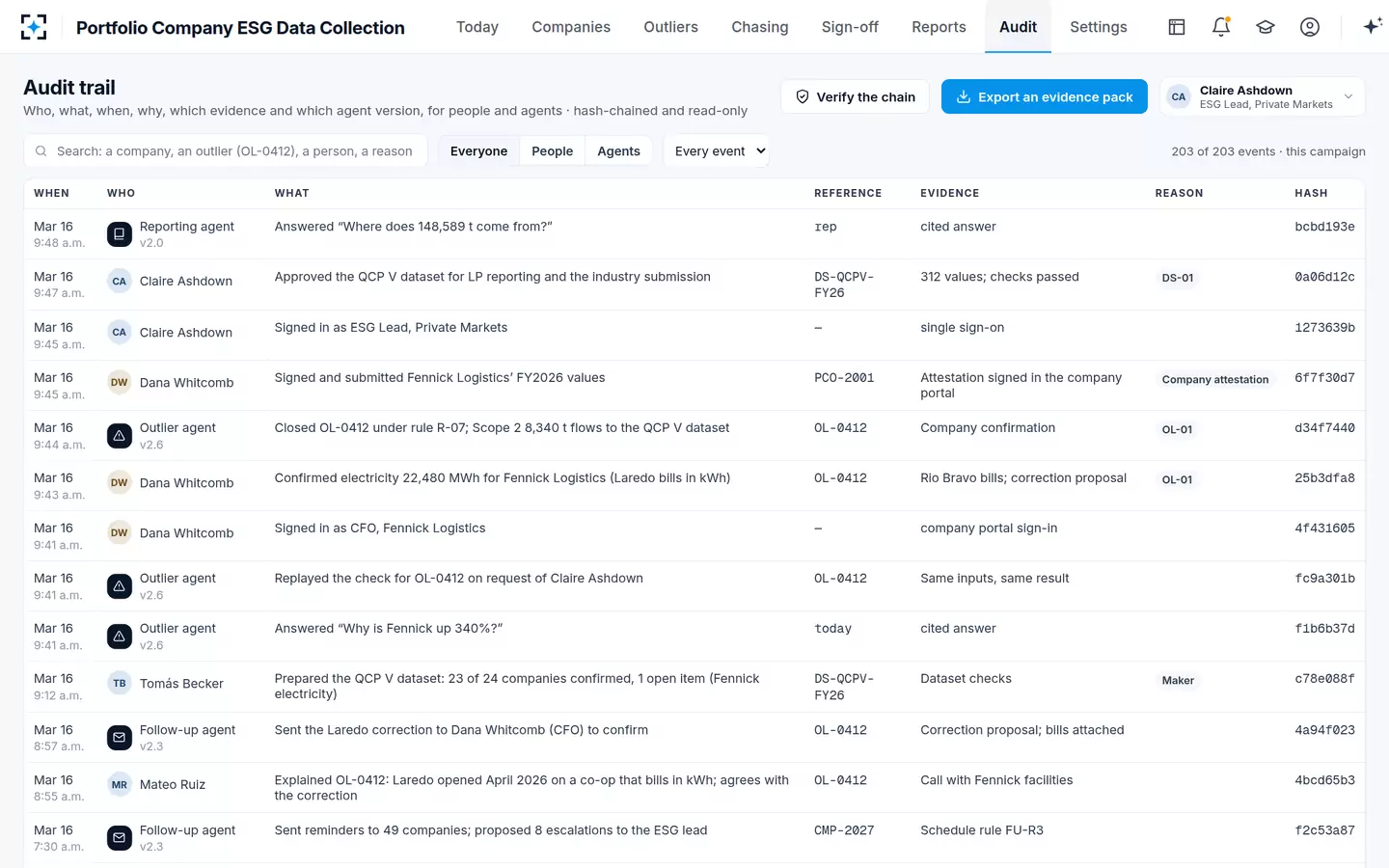
For an ESG campaign, that translates into something concrete: for each value, which agent version read which document, what it proposed, who accepted or changed it, and when the agent or its settings changed. A provider that cannot show you that for one value cannot show it to an examiner for a fund.
The audit trail in Portfolio Company ESG Data Collection: people and agents, version by version
How long does ESG software implementation take? Work back from the campaign
Long enough to load last year and test on it, and no longer than the gap before the request goes out. No regulator or independent study publishes implementation times for ESG software, and vendors' figures describe their best cases. The schedule that matters is yours: if the request goes out on 1 February, the tool has to be live, with last year's confirmed dataset loaded and a pilot passed, by late January.
Three outside dates shape the plan. The first is the June 30 PAI statement for EU funds, unchanged while the SFDR's revision is still being negotiated (European Parliament, Legislative Train). The second and third are emission factor releases: the EPA published its 2025 hub in January 2025 and still lists it as the latest edition (EPA, GHG Emission Factors Hub), while the UK government published its 2026 factors on 11 June 2026 (DESNZ). A plan that loads factor sets in December should expect to reload at least one before the campaign closes, and record which version each figure used.
Week by week: from the company list to the first prefilled form
Eight weeks is enough for a GP with a clean company list and last year's dataset to hand; a GP starting from scattered spreadsheets needs the first fortnight twice. The order matters more than the length.
An eight-week go-live, in order
- Weeks 1–2: companies, funds, metric sets and contacts
The fund administrator's company list by fund, exits and acquisitions since last year, the metric set each fund needs, and the CFO and deal-team contacts from the CRM.
- Weeks 3–4: documents and last year's dataset
Connect the places company documents already live (data rooms, document management, the portfolio monitoring system) and load last year's approved dataset, so every value has a prior year.
- Weeks 5–6: a pilot on last year's companies
Prefill a sample of companies from their documents and compare with what they confirmed last year. Count agreements, disagreements and values left empty, and read every disagreement.
- Weeks 7–8: thresholds, approvers and sign-off
Set the outlier thresholds, the escalation ladder, who prepares and who approves each fund's dataset, retention and data regions; the ESG lead approves the settings.
- Launch: the first prefilled forms go out
Each company receives a form in its own language with its values prefilled and cited; the first reminder is scheduled, not improvised.
ESG software solutions: what the pilot has to prove
The pilot is where a provider's claims meet your documents, and it should be scored like an audit sample, not watched like a demonstration. Take last year's companies, give the tool only the documents those companies had shared, and compare every value it produces with what each company confirmed last year.
Three counts matter. Agreements, where the tool's value matches the confirmed one at the same unit and boundary. Disagreements, each of which needs a reason: sometimes the tool misread a document, sometimes it found the error in last year's confirmed figure. And values left empty, which are not failures: a tool that leaves a cell blank when the document is unclear is behaving correctly, and a tool that fills every cell should make you suspicious. Read every disagreement before deciding; the reasons tell you more than the rate. A pilot that cannot show the page behind each value it filled has not tested what matters.
What do you need to implement ESG software? What you bring
Most of the inputs already exist at the GP; the work is finding the current version of each. A provider can configure a tool in days, but it cannot invent last year's confirmed values or decide who approves a fund's dataset.
What a GP brings to go live
- The company list by fund
From the fund administrator, with ownership and any companies entering or leaving this year.
- Last year's approved dataset
Every value, its unit and, ideally, its source. Without it, every change is unexplained.
- The metric set per fund, with definitions
Including the version of any industry metric guidance it follows, and the SFDR indicators for each EU fund.
- Where company documents live
Data rooms, document management, the portfolio monitoring system: read access is enough.
- Contacts
Each company's CFO and the deal team for each company, from the CRM: the only people the tool should write to.
- Emission factor sets and a peer benchmark
Which factor publisher and edition for each country, and any licensed benchmark the GP already holds.
- Decisions only people can make
Outlier thresholds, the escalation ladder, preparers and approvers per fund, retention, and where each fund's data must stay.
Who does what while the tool goes live
Today
Owns the campaign calendar and the metric sets.
With agents
Approves the settings, the thresholds and the launch; decides what the pilot's disagreements mean.
Still theirs: Approval of settings and of every fund dataset
Today
Holds last year's spreadsheets and knows which companies were difficult.
With agents
Loads last year's dataset, reads every pilot disagreement and writes down why.
Today
Run the data rooms, document stores and CRM.
With agents
Grant read access, set data regions and keep each company's data visible only to that company and the GP.
Today
Draft and release LP reports and questionnaires.
With agents
Agree which outputs are drafted from approved data, who edits, and who releases.
After launch: what to watch in the first fortnight
The first two weeks of the first campaign show whether the go-live worked, and they are measured in companies, not features. Watch how many companies have opened their form, how many have confirmed at least one value, and which have not opened anything after the first reminder; in a campaign that launches on 1 February, the companies still unopened in mid-February are the ones that will decide the deadline.
Watch the outliers too, by cause rather than by count. A cluster of unit errors from one region points at a document type the pilot did not cover; a cluster of definition changes points at a metric whose wording changed since last year; outliers waiting on deal teams for more than the agreed number of days point at an escalation ladder that is not being followed. Each is a setting to change in week three, not a lesson for next year.
Where Portfolio Company ESG Data Collection sits among ESG software providers
The solution belongs in the fourth row of the table above: the GP's annual request from scoping to LP output. It reads the documents a GP already holds in any language, prefills each value with its page, chases in each company's language, recomputes Scope 1 and 2 with versioned factors, explains outliers and drafts the LP report section, industry submission file, SFDR table and questionnaire answers from approved data only. People confirm, explain, prepare and approve.
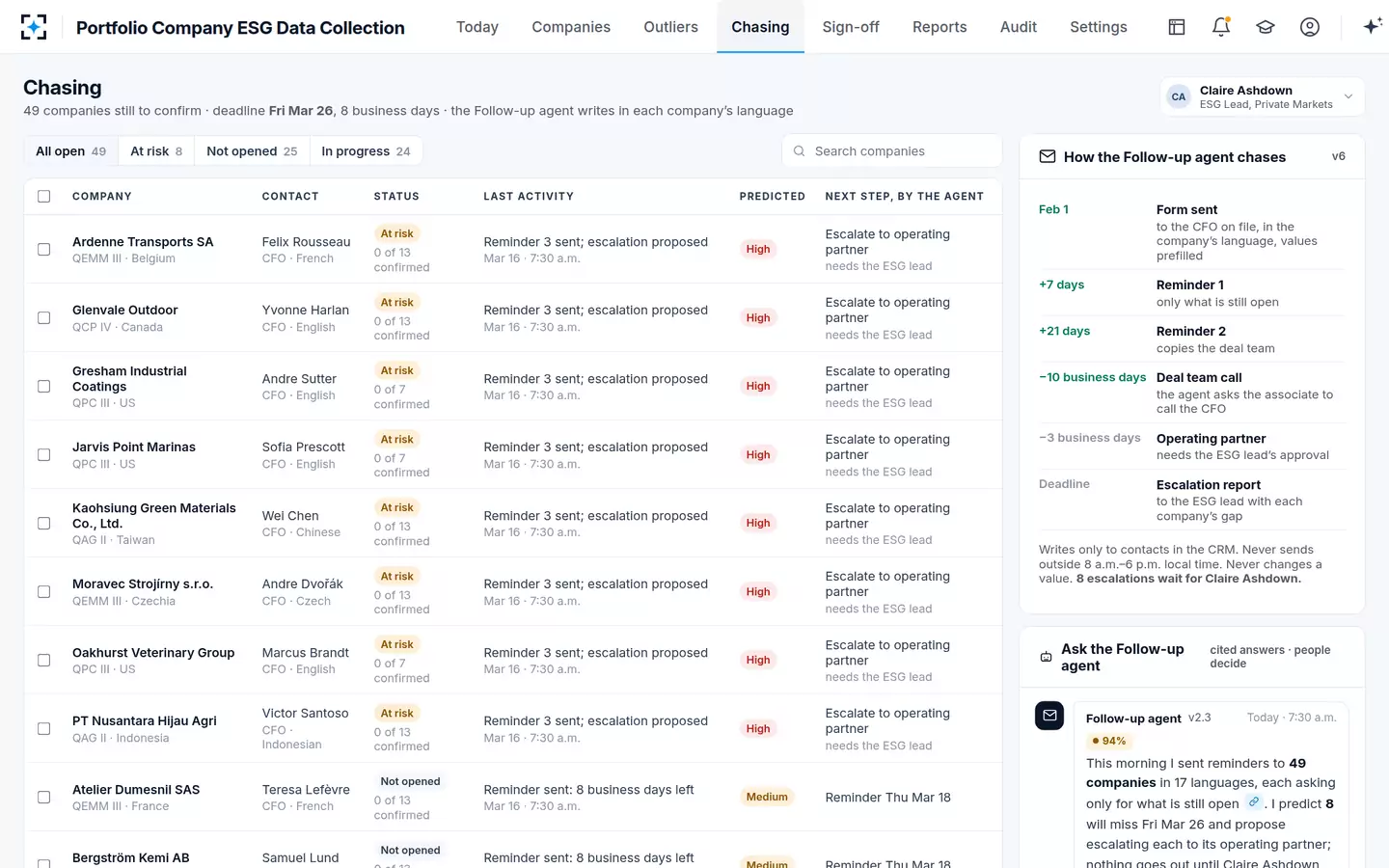
The Follow-up agent's ladder in Portfolio Company ESG Data Collection, set before launch
It is not a corporate reporting platform for a large portfolio company's own CSRD statement, a ratings feed for listed holdings, or a replacement for the portfolio monitoring system, to which it writes approved values back. It needs read access to where documents already are; a company whose documents are not on file is asked, as it would be by any tool. The price question is in the cost per company, and which companies are obliged to report anything at all is in ESG reporting requirements for private companies. To plan a go-live against your own calendar, start from Portfolio Company ESG Data Collection.
Questions people ask
Can a GP switch ESG software providers mid-campaign?
It is possible but expensive: companies already working in one system have to be moved, and values confirmed in one place must not be confirmed again in another. Switch between campaigns, with last year's confirmed dataset exported in full, including each value's source and history.
Should ESG data collection sit inside the portfolio monitoring system?
The data should end up there, and the collection can live elsewhere. Portfolio monitoring systems are built for quarterly financial KPIs from a template; an ESG campaign needs document reading, unit and factor checks and multilingual chasing. A common pattern is to collect and approve ESG data in a dedicated tool and write the approved values back.
What should a pilot of ESG software test?
Whether it gets last year right. Run it on a sample of last year's companies and documents and compare every value with what the companies confirmed: count agreements, disagreements and values left empty, and read the reasons for each disagreement before deciding.
Do ESG software providers need access to portfolio company systems?
Usually not. Most of what a campaign needs is in documents the GP already holds or the company can upload: bills, accounts, HR and safety reports, board minutes. Read access to the GP's data rooms and document stores, and each company's own portal login, are enough for most metric sets.
How should data residency be handled for funds in different regions?
Keep each fund's data in the region its documents and investors require, and make that a setting decided before launch rather than a fix afterwards. The sample configuration keeps data in each fund's region and holds diversity data as counts, never names.