To convert kWh to tCO2e for purchased electricity, divide the kilowatt-hours on the bills by 1,000 to get megawatt-hours, multiply by the emission factor for the grid that supplied the site (in tonnes of CO2-equivalent per MWh, or pounds that you then convert), and add the methane and nitrous oxide terms if the factor gives them separately. With the US EPA's 2025 factors for the Texas grid, 102,350 kWh comes to about 34 tCO2e. The hard part in a private equity portfolio is not the formula but the inputs: a site billed in kWh and typed as MWh turns those 34 tonnes into 34,392, and nothing on a survey form will object. Botminds' Portfolio Company ESG Data Collection recomputes each company's Scope 2 from its bills with a versioned factor set and flags the jump before an LP sees it.
The examples use the EPA's and the UK government's published factors, and one fictional sample company, Fennick Logistics, from the solution's sample campaign; Fennick, its sites and its people are invented.
Three numbers that change a kWh-to-tonnes answer without changing a single kilowatt-hour
1,000×
the error when a site billed in kWh is entered as MWh: the form still shows a plausible positive number
−26%
the change in the UK grid electricity factor between the 2025 and 2026 government sets, partly from a change of method
+71%
how much higher Texas emissions come out if the EPA's non-baseload factor is used instead of the total-output factor
How do you convert kWh to tCO2e? The formula in four steps
The EPA's guidance on purchased electricity reduces the calculation to one line: "Emissions = Electricity x EF" (EPA Center for Corporate Climate Leadership, Scope 2 guidance). Everything else is getting the two inputs right and expressing the answer in the unit the report asks for.
Step one is the electricity, taken from the bills. The same guidance treats utility bills as the best activity data because they meter what enters the facility, and it names the two units you will meet: "For electricity, kilowatt-hours (kWh) or megawatt-hours (MWh) are most common." Divide kWh by 1,000 to get MWh. Step two is the factor for the grid that supplied the site, in the unit the publisher uses. Step three, if the factor lists carbon dioxide, methane and nitrous oxide separately, is to multiply each by its global warming potential and add them. The EPA's 2025 hub uses the IPCC's Fifth Assessment values: 28 for methane, 265 for nitrous oxide. Step four is the unit: tonnes, not pounds or kilograms, and tCO2e, not tCO2.
What is the emission factor for electricity, and how is it calculated?
An electricity emission factor is the average mass of greenhouse gas emitted per unit of electricity generated on a grid over a year: total emissions of the power plants supplying that grid divided by their total output. Governments publish them because no company can compute its own grid's average. In the US, the EPA publishes factors for each eGRID subregion; in the UK, the Department for Energy Security and Net Zero publishes one UK factor each year.
The publisher matters, and so does the column. The EPA's hub gives two sets of factors for each subregion, and its notes say which one belongs in an inventory: "Total output emission factors can be used as default factors for estimating GHG emissions from electricity use when developing a carbon footprint or emissions inventory." The other set, non-baseload, is for estimating the effect of saving electricity, and "should not be used when developing a carbon footprint or emissions inventory" (EPA, GHG Emission Factors Hub 2025, Table 6). For Texas the non-baseload figure is 71% higher. Both are correct numbers; only one is the right one.
Factors also lag the grid. The EPA's 2025 hub, last modified in January 2025, takes its electricity factors from eGRID2023, so it describes the grid of 2023. The EPA's own guidance warns that "There may be a delay between the release of a new version of eGRID and the update of the Emission Factors Hub." The hub still lists its January 2025 edition as the latest (EPA, GHG Emission Factors Hub), so a company searching for 2026 US factors will find the 2025 set and should say so.
kWh to tCO2e conversion, worked: one Texas site with the EPA's 2025 factors
The worked example below converts a year of bills for one site on the ERCOT grid, using only the EPA's published figures. The site is the sample company's Laredo cross-dock, billed by a cooperative that invoices in kilowatt-hours.
102,350 kWh to tCO2e on the Texas grid, step by step
| Step | Calculation | Result |
|---|---|---|
| 1. Electricity, from nine bills | 102,350 kWh ÷ 1,000 | 102.35 MWh |
| 2. Factors for ERCOT (eGRID subregion ERCT), total output | CO2 738.0 lb/MWh; CH4 0.043 lb/MWh; N2O 0.006 lb/MWh | EPA 2025 hub, Table 6 |
| 3. Combine the gases with GWPs of 28 and 265 | 738.0 + (0.043 × 28) + (0.006 × 265) | 740.79 lb CO2e/MWh |
| 4. Pounds to metric tonnes | 740.79 × 0.45359 ÷ 1,000 | 0.3360 t CO2e/MWh |
| 5. Scope 2, location-based | 102.35 MWh × 0.3360 | 34.4 t CO2e |
| The same bills typed as MWh | 102,350 MWh × 0.3360 | 34,391 t CO2e |
Two things in that table are easy to get wrong without noticing. Step four converts pounds to metric tonnes; a factor quoted per short ton, or a result left in pounds, is off by about 10% or by a factor of 2,205. And the last row is the arithmetic of a single unit slip. Nothing about 34,391 tonnes looks impossible for a logistics company: it is a positive number, in the right unit, in a field that expects thousands.
kWh to MWh: the conversion that breaks a dataset by a factor of 1,000
The unit slip is not hypothetical, and it rarely happens on the bill. It happens one step later, when a facilities manager copies site totals into a tracker whose column is headed MWh, and one site, usually a new one with a different supplier, bills in kWh. In the sample campaign, that is exactly what happened at Fennick Logistics.
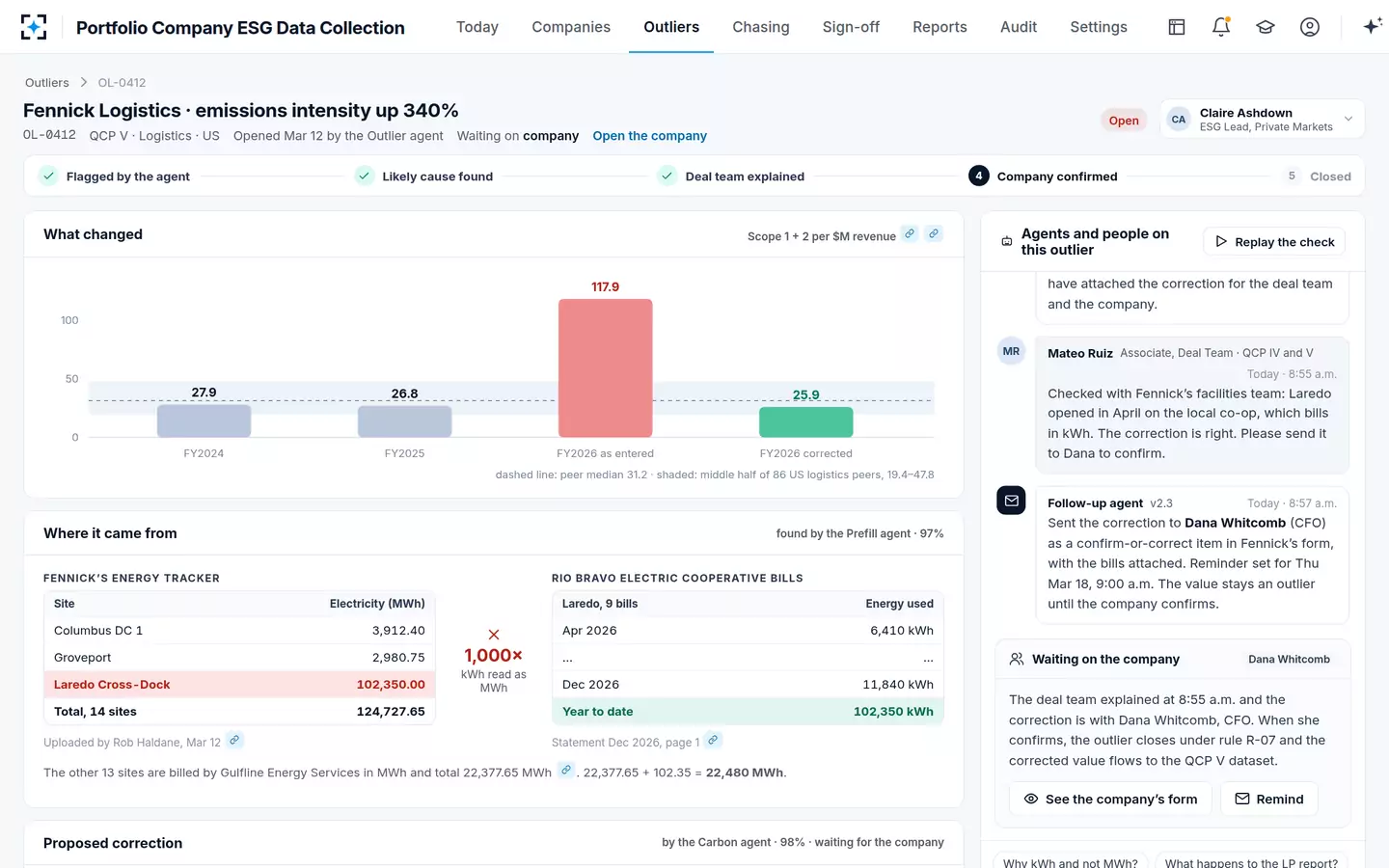
Fennick's tracker listed 14 sites in megawatt-hours. Thirteen were billed in MWh by one supplier and totalled 22,377.65 MWh. The fourteenth, a Laredo cross-dock opened in April 2026 on a cooperative that bills in kilowatt-hours, was entered as 102,350.00 MWh: the kWh total, unchanged. The tracker's total, 124,727.65 MWh, went into the company's answer, and its Scope 2 became 46,274 tonnes against 8,165 the year before.
Fennick Logistics' Scope 2: last year, as entered, and recomputed from the bills
The emissions intensity moved even more visibly, from 26.8 tonnes per million dollars of revenue to 117.9, a rise of 340% for a company whose revenue grew 5.9% and whose staff grew 3.2%. That combination, a large jump with no matching change in the business, is the signature of a unit error.
Where the jump came from in Portfolio Company ESG Data Collection: the tracker row beside the bills, 1,000 times apart
Why a valid answer can be a thousand times wrong
A survey form checks whether an answer is possible. It can require a number, a unit and a value above zero, and 124,728 MWh passes all three. Whether the answer is true is a different question, and it can only be answered against something outside the form: the bills, last year, the company's own other answers and its peers.
What a form can check, and what catches the kWh typed as MWh
Field checks on the form: A unit is present and is MWh, as the field requires.
Checks against evidence: The unit on each source bill matches the unit in the total. Laredo's bills say kWh.
Field checks on the form: The value is positive and below a ceiling set for the field.
Checks against evidence: The value is within a plausible band of last year: +467% is not.
Field checks on the form: Scope 2 is filled in whenever electricity is.
Checks against evidence: Electricity per site, per employee and per dollar of revenue moved with the business. Revenue +5.9% and Scope 2 +467% did not.
Field checks on the form: None: the company's Scope 2 is accepted as typed.
Checks against evidence: Scope 2 is recomputed from activity data with a named factor, and a gap over a set threshold is flagged.
Field checks on the form: None.
Checks against evidence: Intensity of 117.9 against a peer median of 31.2 is outside the peer band.
Which emission factors to use in 2026: dated, versioned and sometimes corrected
Use the latest published factor for the grid and year you are reporting, record which edition it was, and expect the result to move when the edition changes. The UK shows how much. The government's 2026 factor for UK grid electricity is 0.13096 kg CO2e per kWh, against 0.17700 in the 2025 set, a fall of 26% (DESNZ, Greenhouse gas reporting: conversion factors 2026).
Part of that fall is the grid getting cleaner and part is a change in how the factor is built. The 2026 major changes report explains that "In previous updates, the data used in the calculations lagged the publication year by two years. In this year's update, the lag has been reduced to one year using latest Energy Trends statistics," so the change "reflects two years' worth of changes in the electricity grid mix and grid losses, rather than the usual one year" (DESNZ, 2026 major changes report). A UK portfolio company that used exactly the same electricity in 2025 and 2026 reports 26% lower Scope 2 emissions. Its LP report should say why.
Published factor sets are also corrected. The same page records that on 31 July 2026 the department republished the 2026 flat file "to correct a number of values that were initially reported as 0", in factors for some vehicles and hotel stays. A dataset built in June with the first file and one built in August with the second can differ for no reason anyone at the company would see. Recording the factor set and its version beside every computed number is what makes the difference explainable.
CO2 or CO2e, and the missing value counted as zero
Report CO2e unless a template asks for something else, and never leave a blank as zero. Carbon dioxide is nearly all of the electricity figure: the EPA's guidance notes that in the US it accounts for "approximately 99 percent of the total CO2 equivalent GHG emissions from fuels combusted for electricity production". That makes a CO2-only number look right and carry the wrong label, which is enough to make it incomparable with everyone else's.
The blank is the more serious error, because it disappears. When the European Supervisory Authorities reviewed managers' 2024 principal adverse impact statements, they found that for most indicators managers had simply put zero wherever data was missing (ESAs, JC 2025 26), and reminded them that the rules require best efforts to obtain the data instead. A portfolio company that leaves Scope 2 blank has not reported zero emissions. A dataset that shows it as zero has made the fund look cleaner than it is, in a published number.
Seven checks before a converted number reaches an LP
Every check below can be run by hand on a small portfolio, and each one would have caught one of the errors on this page. Run on every value of every company, they are what the solution's agents do before a fund's dataset can be approved.
Seven checks for every kWh-to-tCO2e figure a portfolio company reports
- Unit on the bill, unit in the total
Compare the unit printed on each source bill with the unit of the total it feeds. New sites and new suppliers are where kWh and MWh get mixed.
- Recompute from activity data
Electricity × factor, with the factor's publisher, table and edition recorded. Flag any gap with the company's own figure above a threshold you set.
- Right factor column
Total output, not non-baseload, for a US inventory; the factor for the subregion or country where each site sits, applied site by site.
- CO2e, in metric tonnes
Methane and nitrous oxide included with stated warming potentials; pounds and kilograms converted; the label says tCO2e.
- Last year, at the same boundary
A change above a set threshold needs a cause: a new site, an acquisition, a closure, a real change in use. Fennick had one new site, not a fivefold business.
- Ratios that should move together
Energy per employee, per square metre or per dollar of revenue. A change in one without the others is a question.
- Blank is not zero
A missing value stays visibly missing until the company answers or the GP records an estimate as an estimate.
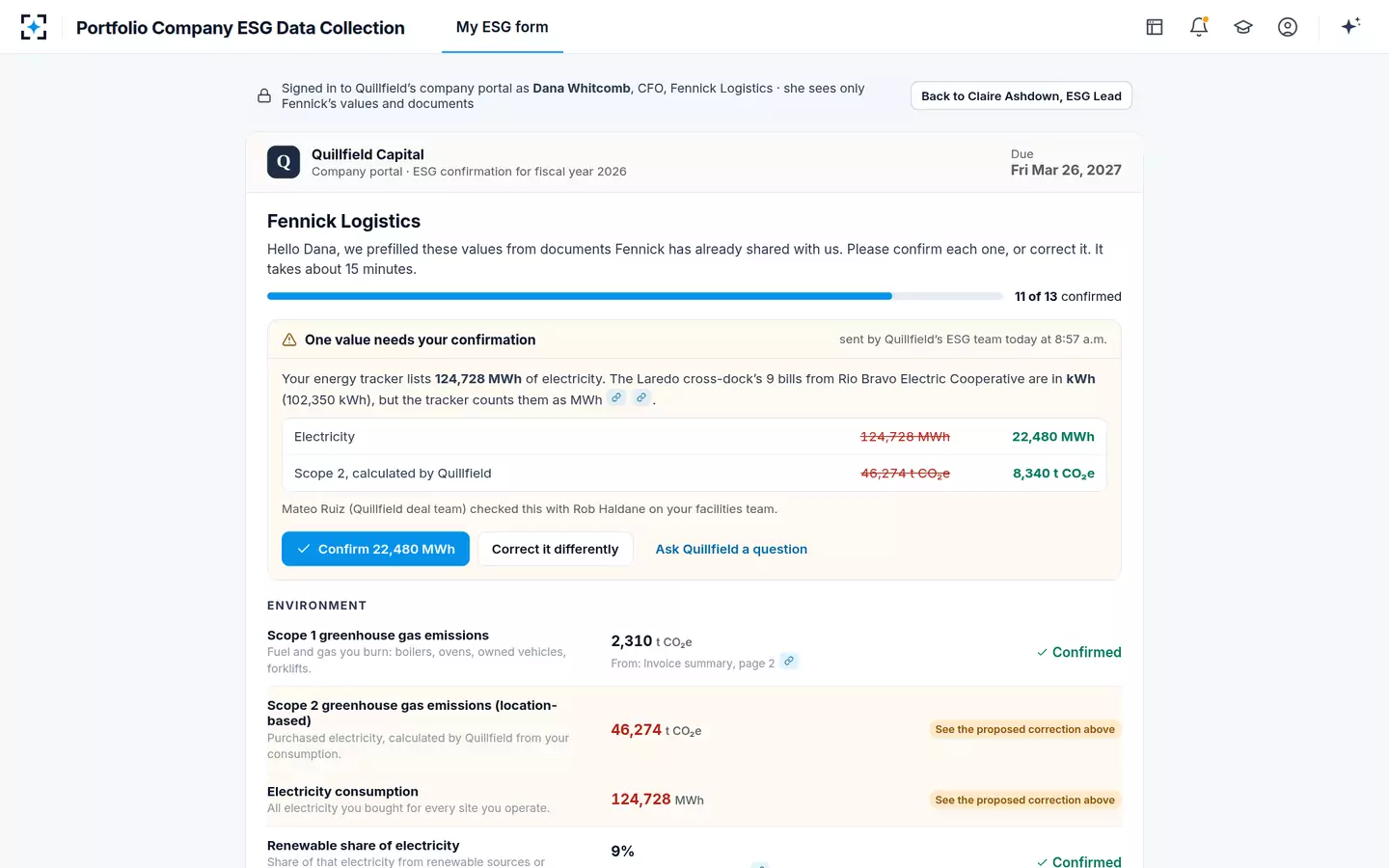
In the solution, the Carbon agent recomputes Scope 1 and Scope 2 from activity data with a versioned factor set, records the version, and never overwrites the company's figure. The Outlier agent compares every value with last year, peers and the company's other answers, and names a likely cause with its source. The correction goes to the company to confirm, because only the company can.
The correction, confirmed by the company's CFO in Portfolio Company ESG Data Collection
Whether to collect the location-based figure, the market-based one or both is a separate decision, covered in Scope 2 market-based vs location-based. How a corrected figure then sits against peers is in ESG benchmarking for portfolio companies. To see the recalculation on a sample of your own companies, start from Portfolio Company ESG Data Collection.
Questions people ask
Is there a kWh to CO2e calculator I can trust?
Any calculator is only as good as the factor it uses and whether it tells you which one. Use one that names the factor's publisher, table and edition, lets you choose the grid region, and shows carbon dioxide, methane and nitrous oxide separately. The EPA's hub and the UK government's conversion factor spreadsheets are free and are what most calculators draw on.
What is the US average electricity emission factor?
In the EPA's 2025 hub the US average total-output factor is 771.5 lb CO2, 0.057 lb CH4 and 0.008 lb N2O per MWh, about 0.35 t CO2e per MWh once combined with warming potentials of 28 and 265. Use it only when you cannot place a site in an eGRID subregion; subregion factors range from 241.0 lb CO2 per MWh in upstate New York to 1,543.0 in Puerto Rico.
Should transmission and distribution losses be added to Scope 2?
Not for the company that uses the electricity. The EPA's hub says its grid loss percentages "should not be applied to scope 2 emissions for an end-user"; losses belong to the grid operator's Scope 2 and to the user's Scope 3, category 3.
How do I convert MWh to tCO2e directly?
Multiply MWh by a factor expressed in tonnes of CO2e per MWh. For the UK 2026 factor of 0.13096 kg per kWh, that is 0.13096 t per MWh, so 1,000 MWh is 131 tCO2e. The arithmetic is the same as for kWh; the unit on the factor has to match the unit on the bill.
Why did our emissions fall when our electricity use did not?
Usually because the factor changed. A newer factor set describes a newer, often cleaner grid, and in 2026 the UK also shortened the lag in its method, which moved its electricity factor down 26% in one edition. Report the factor edition beside the figure and explain the change, so a reader does not mistake a new factor for a real reduction.