To extract data from an annual report, make five choices in order and write each one down: which document holds the figure, which table in it, which corporate boundary the figure covers, which fiscal year it belongs to, and which unit it is in. Then convert it to your template's rules and keep the page number, so someone else can check it without starting again. For ESG figures the document is often not the annual report at all but a sustainability or integrated report, an exchange filing or a local-language edition published months before the English one. The holdings that most need reading, small caps and emerging-market issuers, are the ones whose reports are in Korean, Japanese, Chinese, Portuguese or Bahasa, with March year-ends and parent-only figures next to consolidated ones. Botminds' ESG Data Extraction reads them in the original language and puts the cropped table beside the English, so the person who signs can see every choice.
The examples come from sample data on a fictional asset manager, Quillfield Capital, and its issuers in the solution. The rules come from the EU, the US Environmental Protection Agency and the Japanese and Korean regulators, linked where they apply.
Where reading reports goes wrong: one season's 287 open exceptions, by kind
How to extract data from an annual report: five choices, in order
Extraction is not copying; it is five decisions, each of which can be right or wrong independently of the digits. Getting the order right matters, because a later choice depends on an earlier one: the unit means nothing until you know which table, and the year means nothing until you know which document's fiscal calendar.
Five choices between a report and a template cell
Agent
The documentMatch the report to the issuer by ISIN, LEI or name in any script; know whether it is the annual, sustainability, integrated report or an exchange filing, and whether it restates an earlier one.
Never: guesses a match below the template's confidence threshold
Agent
The tableFind the table that holds the field and note its page and title in the original language.
Never: fills a field without a page and table
Agent
The boundaryRead whether the figure is for the consolidated group or the parent company alone, and apply the template's boundary rule.
Never: switches boundary without a person
Agent
The year and unitMap the fiscal year to the template's year by rule; convert thousands, ten-thousands or joules; write the arithmetic out.
A person decides
The reader of the languageConfirms the header, the boundary and the year against the original table, and decides any exception with a reason code.
Which report? Annual, sustainability, integrated, or the exchange filing
The figure an investor needs is often in more than one document, and the documents do not always agree. A large issuer may publish an annual report, a separate sustainability report, an integrated report that combines them and a statutory filing to its exchange or regulator, in its own language first and in English later. In the fictional sample, the season expects 3,040 reports for 1,686 issuers: 1,512 sustainability reports, 1,086 annual reports, 294 integrated reports and 148 others.
Regulation is changing which document carries the figure. In the EU, companies in scope of the sustainability reporting rules publish their sustainability statement inside the management report, and ESMA notes that while financial statements are marked up in machine-readable form, "until rules on the marking up of sustainability reporting are adopted by way of a Delegated Regulation, undertakings shall not be required to markup their sustainability reporting" (ESMA, electronic reporting). So even EU sustainability figures are read from the page for now, and the 2026 Omnibus directive narrowed the rules to undertakings with more than EUR 450 million of turnover and more than 1,000 employees (Directive (EU) 2026/470), leaving smaller issuers to report voluntarily.
When issuers in three markets will publish to a standard, and where
| Market | What the regulator has set | What it means for extraction |
|---|---|---|
| European Union | Sustainability statements for undertakings above EUR 450 million turnover and 1,000 employees; machine-readable mark-up not required until rules are adopted. | Fewer mandatory reports; the rest voluntary, in any format; read from the page. |
| Japan | Prime-market companies report under the SSBJ standards in the annual securities report from the fiscal year ending March 2027 (market cap ¥3 trillion or more), March 2028 (¥1–3 trillion) and March 2029 (¥500 billion–¥1 trillion). | March year-ends; for two years, sustainability disclosures may follow the financial statements. |
| Korea | A roadmap of July 8, 2026: ESG disclosure from 2028 for KOSPI companies with KRW10 trillion or more in assets, KRW5 trillion from 2029; Scope 3 from 2031; it needs a change to the capital markets law. | Until then, voluntary Korean-language reports for most holdings. |
Timing follows the documents. Japan's roadmap allows a company, as transition relief, "to report sustainability disclosures after the financial statements, for two years" (FSA, roadmap), so a Japanese holding may need two reads in one year. And when a later report restates an earlier figure, it is the restatement an investor needs: the sample's intake caught a Japanese integrated report that restated fiscal 2024 Scope 3 from 4.10 to 4.62 million tonnes.
Where are emissions in an annual report?
Usually in a sustainability section or annex, in a table, and sometimes only in a chart. Under the European standards a company discloses gross Scope 1, location- and market-based Scope 2 and significant Scope 3 categories "in metric tonnes of CO2eq" (ESRS E1, paragraphs 48–51), which gives a reader four places to look and a unit to expect. Outside the EU the layout is the issuer's own.
Charts are the hard case. In the central banks' Project Gaia, some figures "are contained in infographics but not in text format in reports" and were not extracted (BIS, Project Gaia). A peer-reviewed test on airline sustainability reports found HTML versions gave "superior extraction results compared to PDFs" (Martín-Domingo et al., 2025). When an issuer publishes a data annex or an HTML version, read that before the designed PDF.
Consolidated vs parent-only figures: which one the template wants
Some issuers publish two honest figures for the same scope: one for the consolidated group and one for the parent company alone, often in different documents. The template should name which it carries, keep the other beside it, and never switch silently.
Two boundaries, two honest numbers for one company
Consolidated group: The parent and the subsidiaries in the boundary the company chose: equity share, financial or operational control.
Parent company only: The legal entity alone, often as required in a local statutory filing.
Consolidated group: Sustainability and integrated reports; ESRS statements, which split the group from investees under operational control.
Parent company only: Exchange business reports and statutory filings.
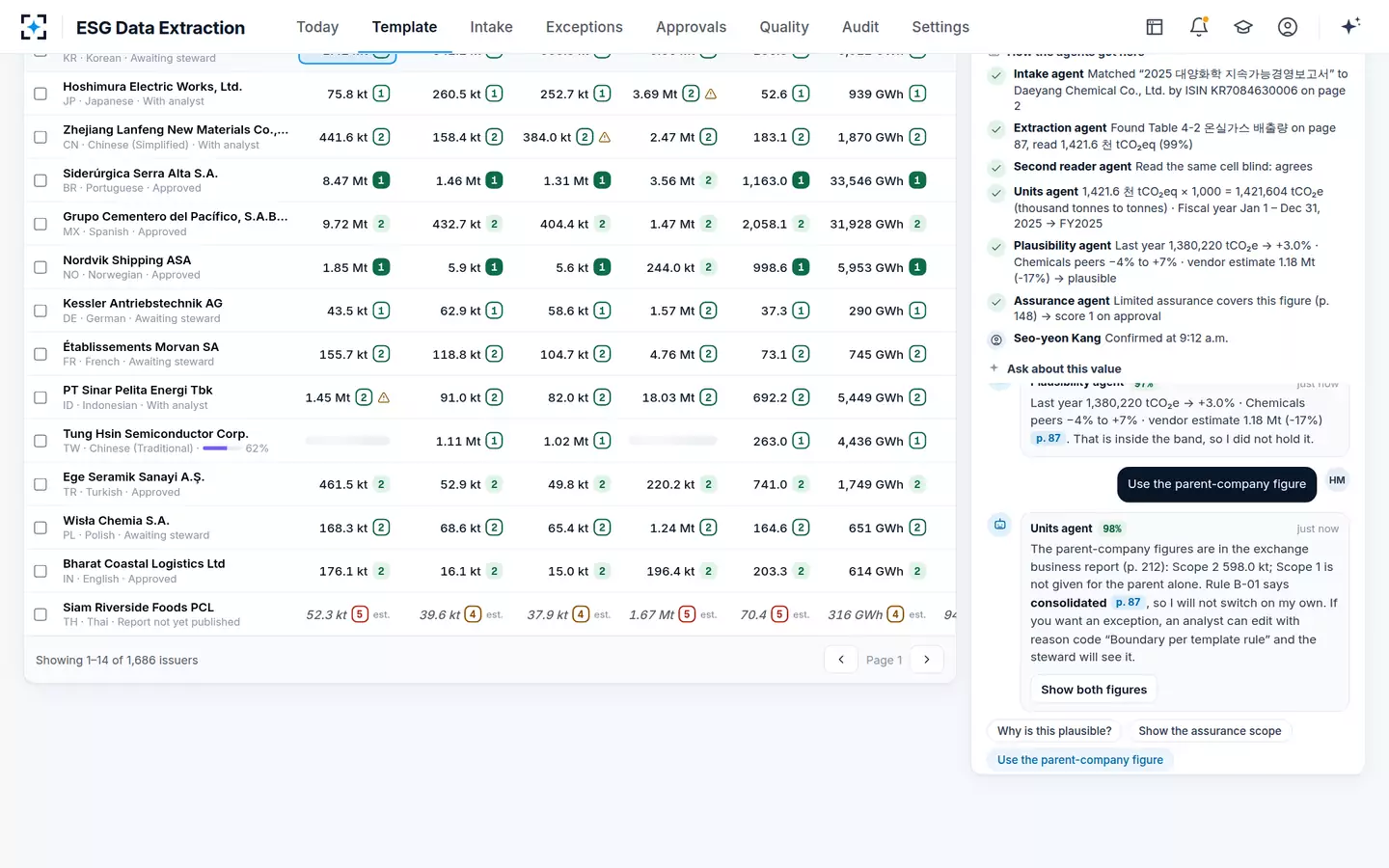
Consolidated group: Daeyang Chemical's Scope 2: 608.3 kt, market-based, from its sustainability report.
Parent company only: The same issuer's exchange business report, page 212: Scope 2 of 598.0 kt and no Scope 1 for the parent alone.
Consolidated group: Rule B-01 in the sample: consolidated.
Parent company only: Kept beside it, so the choice is visible.
The consolidation approach changes figures even within one boundary. EPA's table shows a joint venture counted at the company's equity share under the equity-share and financial-control approaches, but at 100% or zero under operational control; an associate counts at its equity share under one approach and not at all under operational control (EPA). ESRS asks for Scope 1 and 2 separately for "the consolidated accounting group (the parent and subsidiaries)" and for investees under operational control (ESRS E1, paragraph 50). An analyst who notes which approach the issuer used can explain a jump that is really a change of method.
Which year does a March fiscal year belong to?
To whichever calendar year your written rule says, applied the same way every year. The investor's reporting period is fixed: the PAI statement covers the previous calendar year, January to December (RTS 2022/1288, Article 4). An issuer's year that runs from April to March straddles two of them, and nothing in the regulation tells you which to use.
The sample template's rule is "the calendar year holding most of it": a fiscal year ending March 31, 2026 runs nine months in 2025 and three in 2026, so it maps to FY2025. Other rules are defensible, such as the calendar year in which the fiscal year ends, but a rule applied inconsistently is not. Japan's schedule makes this a lasting question: its largest companies apply the SSBJ standards from the "Fiscal Year Ending March 2027" (FSA).
The lag that follows is real and should be visible. The ECB, in its own climate disclosures, applied 2024 emissions to holdings for both 2024 and 2025 "owing to the natural delay with which emissions data become available" (ECB, June 2026). Whatever the rule, the template should show the issuer's fiscal year beside the year it was mapped to.
How to extract data from a report in another language
Translate the headers and notes, not just the numbers, and keep the original table beside the translation. The digits in a Korean or Japanese table are the same as in English; the words around them decide what the digits mean. A header in 천 tCO₂eq is thousands of tonnes; one in 万t is ten-thousands; a footnote may say the figure excludes a subsidiary or explains a one-time disposal.
Semantic search across languages works: Gaia's page search, which matches the meaning of a KPI definition rather than keywords, "works across languages", the report notes. The risk sits in the last step, where a reader decides whether the translated header and the original agree.
ESG Data Extraction asked to break a boundary rule, in plain words
How to extract data from an annual report to Excel without losing the source
Put one issuer per row and, for each field, not one column but six: the value, the unit, the fiscal year, the boundary, the page and the status. A spreadsheet that holds only values cannot answer an auditor's first question, which is where the number came from.
The six columns each extracted field needs
- Value, in the template unit
Converted on the way in, with the original value and unit kept in a note or a second column.
- Unit and gas
tCO₂e, MWh, m³, tonnes; CO2 or CO2e named explicitly.
- Fiscal year, and the year it maps to
Both, so a March year-end is visible.
- Boundary
Consolidated or parent only, and the approach if the issuer states it.
- Document, page and table
Enough to open the source in one step.
- Status: reported, estimated or not disclosed
Never a zero for missing data; with the pages searched for "not disclosed".
The status column is the one that most often goes missing, and it is the one supervisors noticed. A blank cell, a zero and "not disclosed" are three different answers; a spreadsheet that cannot tell them apart will sooner or later publish the wrong one.
When two documents disagree, which figure wins?
The one your written rule names, decided by a person when the rule does not settle it. Conflicting figures were 47 of the sample's 287 exceptions on one day. One example: the fictional Chinese issuer Zhejiang Lanfeng's market-based Scope 2 is 384.0 kilotonnes in its ESG report and 402.0 in its annual report. Either may be right; the difference may be a boundary, a restatement or an error.
Three rules are worth writing down in advance. A later restatement beats an earlier figure, with the change shown. A figure inside an assurance scope beats one outside it. A consolidated figure beats a parent-only one, if that is the template's boundary. What is left goes to an analyst with both pages, and the decision is kept with its reason.
Report intake in ESG Data Extraction: matched in any script, restatements caught
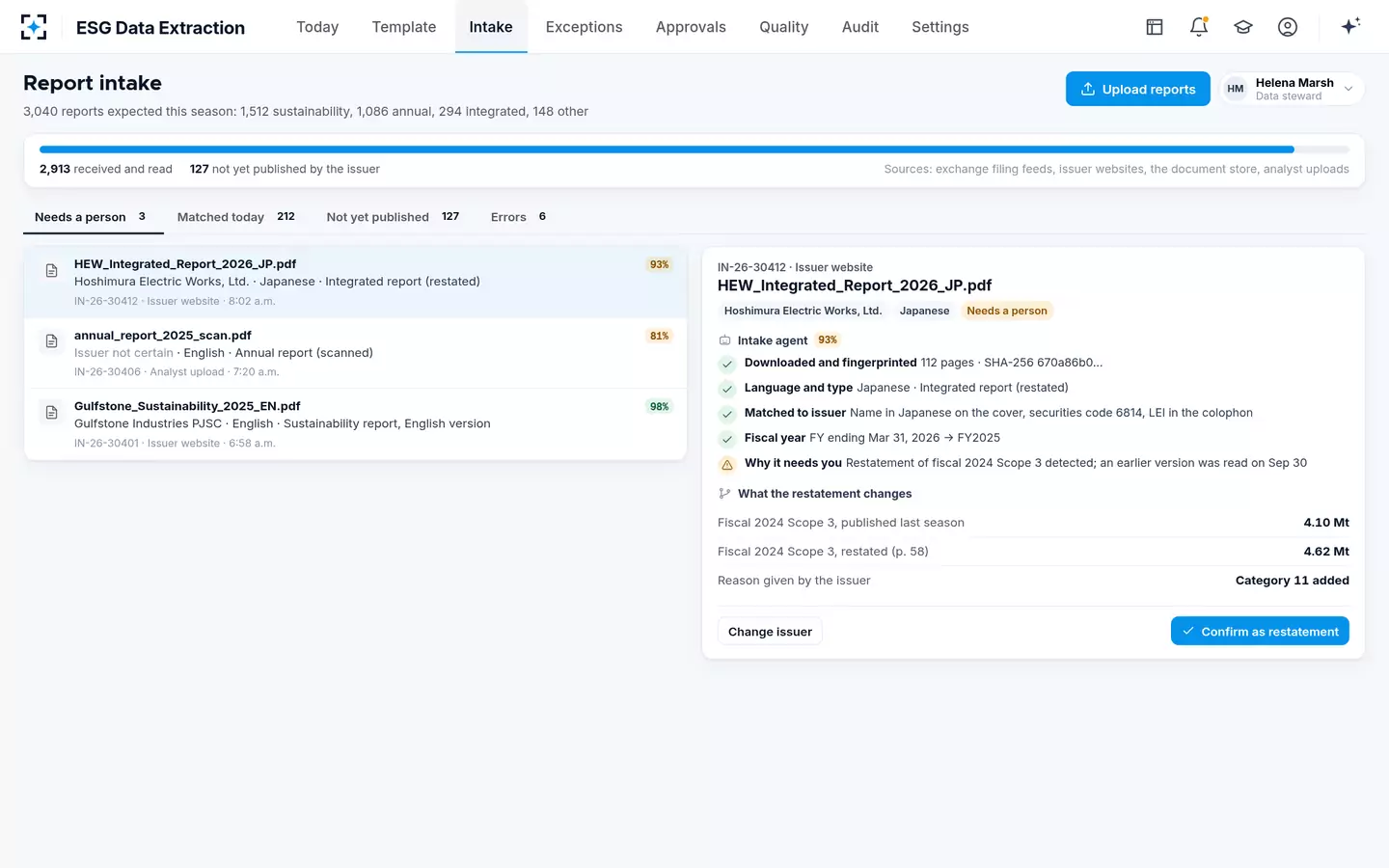
The solution's role is to make each of the five choices visible and fast: matched documents, cited tables, boundary and year rules applied with the arithmetic shown, and the original language beside the English. The people who read the language keep the decisions that need them. More on the solution at ESG Data Extraction.
Questions people ask
How do you read an annual report for ESG data?
Start from the sustainability section or annex and its data tables, check the scope of any assurance statement, then look for notes on boundary, restatements and methods. Read the table headers for units before copying any number.
Can you use machine translation for a sustainability report?
For finding the right table and understanding notes, yes. For the header that decides the unit and the note that decides the boundary, a reader of the language should confirm. ESG Data Extraction shows the cropped original table beside the English so that check takes seconds.
Should you wait for the English edition of a report?
Not if the holding matters. English editions can arrive months later; the sample Korean issuer published its report on June 30, 2026, with the English version not expected before December. Reading the original moves the holding off an estimate half a year sooner.
What is a parent-only figure?
A figure for the parent company as a legal entity, excluding its subsidiaries. It often appears in statutory or exchange filings beside a consolidated figure for the group, and the two can differ substantially for a company with large subsidiaries.
How do you extract tables from a scanned annual report?
Recover the text and layout first, then read the table, and treat the result as lower confidence. In the fictional sample, a scanned table read at 71% confidence was sent to an analyst rather than published, which is the right default for scans.