Scope 3 category 15 is "investments", the last of the fifteen categories in the GHG Protocol's corporate value-chain standard: the emissions of the companies and projects a reporting company invests in or lends to, attributed in proportion to its stake. For a bank, insurer or asset manager it is usually the largest part of its footprint, and IFRS S2 calls that attributed share financed emissions, "part of Scope 3 Category 15 (investments)". Deciding what goes into it takes several separate choices: which holdings, whether derivatives are included, and which of each investee's own scopes come along. IFRS S2's December 2025 amendments, effective from 2027, change some of those answers. Each choice ends in an issuer's emissions figure, and Botminds' ESG Data Extraction reads those figures from the issuers' own reports so the branch each one took can be shown.
The examples below are sample data on a fictional asset manager, Quillfield Capital, and its holdings, as they run through the solution. The rules come from the IFRS Foundation, the EU and the US Environmental Protection Agency, linked where they apply.
Five decisions between a holding and a Category 15 number
A person decides
Scope of the measureDecide whether Category 15 is limited to financed emissions, as IFRS S2 paragraph 29A permits from 2027, and whether derivatives are excluded; write down what counts as a derivative.
Agent
Which holdingsClassify each position: loans, project finance, bonds, equity, undrawn commitments, assets under management; flag what falls outside and its value.
Never: changes the firm's scope decision
Agent
Which investee scopesRead the issuer's Scope 1, Scope 2 (both methods) and Scope 3 from its own report, with the page, the year and the boundary.
Never: fills a scope without a page
Agent
How much is attributedApply the allocation method, value held over EVIC for listed issuers, and keep the dates of each input.
A person decides
Who signsAn analyst confirms each issuer's figures and a different person approves them before they reach the total.
What is Scope 3 category 15? The investments category, defined
Category 15 covers the emissions associated with a reporting company's investments that are not already in its Scope 1 or Scope 2. IFRS S2 requires companies to "consider all 15 categories of Scope 3 greenhouse gas emissions, as described in the Greenhouse Gas Protocol Corporate Value Chain (Scope 3) Accounting and Reporting Standard (2011)" and to say which categories their total includes (IFRS S2, paragraph B32). The European standards set the same frame: a company screens its total Scope 3 "based on the 15 Scope 3 categories" and discloses the significant ones; a financial institution should consider the financed-emissions standard of the industry's carbon accounting partnership, PCAF (ESRS E1, AR 46).
For a non-financial company, Category 15 is often small or empty: a minority stake in a joint venture, say. Boundaries decide even that. US EPA guidance on the GHG Protocol's consolidation approaches notes that "when a joint venture is excluded from the scope 1 and 2 boundary, its emissions will be included in scope 3, category 15 (investments)" (EPA, Determine Organizational Boundaries). For a financial institution the category is the business itself, and that is why the ISSB wrote rules for it.
Scope 3 category 15 investments: which holdings count?
Under IFRS S2, an asset manager's financed emissions cover the assets under management it includes in the calculation, and it must say how much of its AUM that is. Paragraph B61(c) asks for "the percentage of the entity's total AUM included in the financed emissions calculation. If the percentage is less than 100%, the entity shall disclose information that explains the exclusions, including types of assets and associated amount of AUM" (IFRS S2, B61).
Which positions count as loans and investments under the amended IFRS S2
| Position | In financed emissions? | What the standard says |
|---|---|---|
| Listed equity | Yes | "Equity investments" are among the loans and investments named in paragraph 29A. |
| Corporate bonds | Yes | "Bonds" are named in 29A. |
| Loans and project finance | Yes | Named in 29A; commercial banks disclose them by industry and asset class (B62). |
| Undrawn loan commitments | Yes | Named in 29A. |
| Assets under management | Yes, for asset managers | "financed emissions include greenhouse gas emissions attributed to assets under management" (29A). |
| Derivatives | May be excluded | From 2027 an entity "is permitted to exclude greenhouse gas emissions attributable to derivatives" and must explain what it treated as one (29A, 29B). |
| Positions left out for any reason | Disclosed as a gap | The share of AUM outside the calculation, with the types and amounts (B61(c)). |
Two practical consequences follow for a data team. The coverage percentage is only as high as the issuer data allows: a holding whose issuer has no emissions figure, reported or estimated, is either estimated or left out and counted in the gap. And the denominator of that percentage is the whole AUM, so cash, derivatives and fund-of-fund positions have to be classified explicitly rather than quietly dropped.
Are derivatives included in category 15?
From 2027, under IFRS S2, they need not be. The December 2025 amendments added paragraph 29A, which lets a company limit Category 15 to financed emissions and states that "for the purpose of the limitation, an entity is permitted to exclude greenhouse gas emissions attributable to derivatives" (ISSB, Amendments to Greenhouse Gas Emissions Disclosures, December 2025).
In preparing disclosures to meet the requirement in paragraph 29(a)(i)(3), an entity is permitted to limit what it includes in its measure of Scope 3 Category 15 greenhouse gas emissions to only its financed emissions.
IFRS S2, paragraph 29A, as amended December 2025
The permission comes with two duties. Paragraph 29B asks the company to "explain what it has treated as a derivative", for example by pointing to the definition in the accounting standards behind its financial statements, and to describe the financial activities it excluded, "including activities associated with derivatives". So the exclusion is not silent: the firm has to show its working, and an auditor will compare the explanation with the positions.
The amendments take effect for reporting years that start on 1 January 2027 or later, and firms may adopt them sooner (IFRS Foundation, project page). Whether a given firm applies them depends on whether its jurisdiction has adopted IFRS S2 and when; until then, a firm reporting under the 2023 text should state how it treats derivatives on its own terms.
Is Scope 3 category 15 the same as financed emissions?
Not quite: financed emissions are part of Category 15, and Category 15 can be larger. IFRS S2 defines financed emissions as the share of an investee's emissions that belongs to the firm's loans and investments in it (the calculation, line by line); anything else a firm chose to put into Category 15 sits beside them. If a firm includes more than financed emissions, paragraph 29C requires it to "disclose the total Category 15 greenhouse gas emissions and the subtotal of financed emissions included in that total" (IFRS S2, 29C).
For an investor reading an issuer's report, the same distinction runs the other way. A bank or insurer in the portfolio will report its own Category 15, and that figure is the bank's financed emissions, not its operations. The ECB's disclosures show how dominant it can be: for the supranational and agency bonds in its portfolios, Scope 3 made up more than 99% of total carbon emissions in 2025, which the ECB attributes to "high scope 3 emissions resulting from financed projects" (ECB, June 2026). A data analyst who extracts a lender's Scope 3 total is mostly extracting other companies' emissions, and the template should say so.
Does financed emissions include the investee's own Scope 3?
Under IFRS S2 and the SFDR statement, yes, reported separately. IFRS S2 B61(a) asks asset managers for absolute gross financed emissions "disaggregated by Scope 1, Scope 2 and Scope 3", and indicator 1 of the SFDR principal adverse impact statement lists Scope 3 GHG emissions of investee companies beside Scopes 1 and 2 (RTS 2022/1288, Annex I).
The investee's Scope 3 is the weakest input in the calculation. Comparing several data providers, a peer-reviewed study found corporate carbon data "especially inconsistent for Scope 3", and third-party estimates less consistent than figures drawn from companies' own reports (Busch, Johnson and Pioch, Journal of Industrial Ecology, 2022). The ECB reports its own Scope 3 metrics separately "given that quality issues for scope 3 emissions data continue to limit their reliability and comparability over time" (ECB, June 2026).
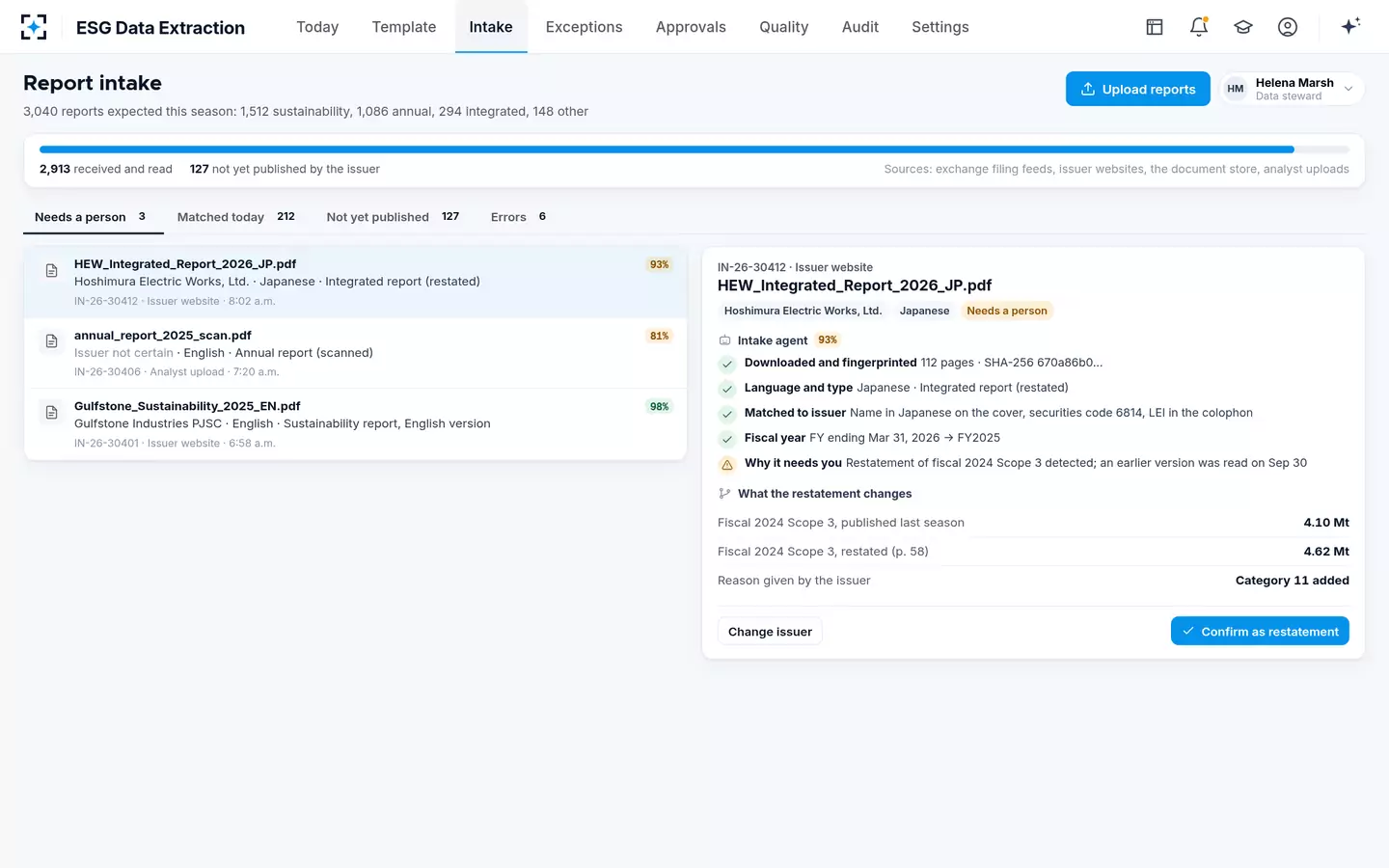
An issuer's Scope 3 total also hides its own composition. The fictional Korean issuer in the sample, Daeyang Chemical, reports 9.86 million tonnes across five categories; another sample issuer, the fictional Hoshimura Electric Works, restated its fiscal 2024 Scope 3 from 4.10 to 4.62 million tonnes after adding Category 11, the use of sold products. A template that stores only the total cannot tell a year in which emissions rose from a year in which the issuer counted more categories.
What changes, and when: the dated branches of the tree
Several of these answers depend on the reporting year and the rulebook. The table below separates what IFRS S2 said when issued from what it says for periods starting in 2027, and adds the dates that decide when the issuers in a book will start publishing these numbers at all.
Category 15 under IFRS S2: as issued in 2023, and from 2027
IFRS S2 as issued (June 2023): All Category 15 emissions in the Scope 3 measure, with additional disclosure of financed emissions for asset management, banking and insurance.
As amended (periods from January 1, 2027): A company may limit Category 15 to financed emissions (29A) and must then describe what it excluded (29B).
IFRS S2 as issued (June 2023): No specific permission to exclude them.
As amended (periods from January 1, 2027): May be excluded, with an explanation of what was treated as a derivative.
IFRS S2 as issued (June 2023): No specific subtotal.
As amended (periods from January 1, 2027): Total Category 15 and the subtotal of financed emissions (29C).
IFRS S2 as issued (June 2023): Scope 3, including financed emissions, may be left out (transition relief C4(b)).
As amended (periods from January 1, 2027): Unchanged.
The issuer side has dates of its own. In the EU, the 2026 Omnibus directive narrowed mandatory sustainability reporting to companies with more than EUR 450 million of turnover and more than 1,000 employees, so fewer holdings will publish ESRS reports. In Korea, the Financial Services Commission's roadmap of July 8, 2026 would require ESG disclosure from 2028 for KOSPI-listed companies with KRW10 trillion or more in assets, with the Scope 3 duty taking effect from 2031, pending a change to the capital markets law (FSC, July 8, 2026). For many holdings, the Scope 3 figure an investor needs will come from a voluntary report for years yet.
Scope 3 category 15 calculation, holding by holding
The calculation is the financed-emissions formula applied to every included holding and every scope: the value held divided by the investee's EVIC, times the investee's emissions for each scope, summed. The arithmetic is set out in the financed emissions calculation, line by line; what this page adds is the classification that decides which holdings enter it and which scopes they bring.
The order matters for quality. Classify first, so the coverage gap is known before any number is computed. Then source each issuer's figures by scope, reported where possible, with the year and boundary. Then attribute. A team that starts from a vendor file of portfolio totals inverts the order, and cannot say which part of its Category 15 rests on what. IFRS S2 itself asks companies to prioritise "data that has been verified" and data "from specific activities within the entity's value chain" when measuring Scope 3 (IFRS S2, B40); for an investor, the value chain is the issuers, and their own reports are the specific data.
ESG Data Extraction's data quality view: how much of each indicator is reported, estimated or missing
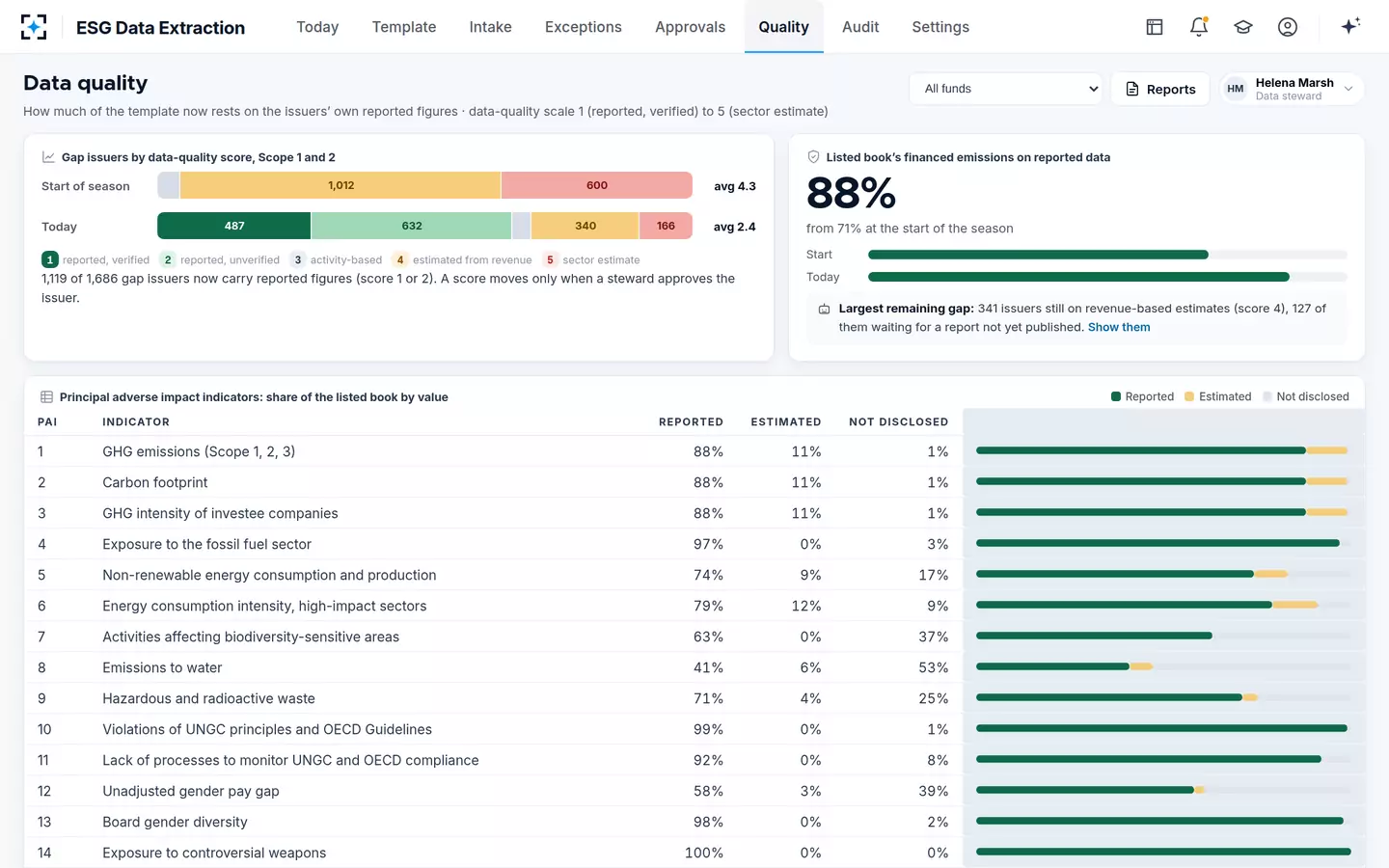
What the template should keep for every Category 15 input
Seven things to store beside each issuer's figure
- The holding's classification
Loan, bond, equity, undrawn commitment, fund, derivative, cash: so the coverage percentage can be computed and explained.
- The scope and, for Scope 3, the categories
Which of the 15 categories the issuer included, so a restatement that adds one is visible.
- Reported, estimated or not disclosed
Never a zero for missing data; the ESAs criticised firms that assigned 0 where data was not available.
- The page and table
So a reviewer can open the source in one step.
- The fiscal year and boundary
Consolidated or parent only; the fiscal year mapped to a calendar year by a written rule.
- Whether assurance covers it
Scope 3 is often outside the assurance scope even when Scopes 1 and 2 are inside.
- The rulebook branch
Whether the figure entered a total measured under the 2023 or the amended IFRS S2, and whether derivatives were excluded.
The last line is the one most templates lack. A Category 15 total measured in 2026 and one measured in 2027 may differ only because the second excluded derivatives; without the branch, the change looks like decarbonisation or its opposite.
How ESG Data Extraction sources the issuer side
The solution handles the issuer half of the tree: finding each investee's report, reading its emissions by scope and Scope 3 by category, and showing which figures are reported, estimated or missing. Intake catches restated reports, because a restated Scope 3 changes Category 15 for every investor that holds the issuer.
A restated Scope 3, caught at intake by ESG Data Extraction
The firm-side decisions, whether to limit Category 15 to financed emissions and what counts as a derivative, stay with the people who own the disclosure. The agents classify and read; they do not change a rule. The scoring of each input is covered in the PCAF data quality score guide, and the solution itself at ESG Data Extraction.
Questions people ask
Is category 15 mandatory for asset managers?
Under IFRS S2, asset managers must disclose financed emissions as part of Scope 3, except in the first year of applying the standard, when Scope 3 may be left out. In the EU, the SFDR statement's indicator 1 already asks for investees' emissions. Whether IFRS S2 applies to a firm depends on its jurisdiction.
Does category 15 include the investee's Scope 2?
Yes. IFRS S2 asks for financed emissions disaggregated by Scope 1, Scope 2 and Scope 3 of the investees. Because issuers report Scope 2 two ways, location-based and market-based, the template should say which method it carries.
How do you treat a fund of funds in category 15?
Look through to the underlying holdings where the data allows, or treat the fund as an excluded position and disclose it. IFRS S2 B61(c) requires an asset manager to explain any assets under management left out of the financed-emissions calculation, with their types and amounts.
Is category 15 the same as PCAF financed emissions?
PCAF's standard is the industry's method for calculating financed emissions, and ESRS tells financial institutions to consider its Part A. IFRS S2 places financed emissions inside Category 15, so a PCAF-style calculation is the usual way to measure that part of the category.
Why did an issuer's Scope 3 jump in one year?
Often because it counted more categories, not because it emitted more. The fictional sample issuer Hoshimura Electric Works restated fiscal 2024 Scope 3 from 4.10 to 4.62 million tonnes after adding Category 11. Store the categories behind every Scope 3 total so a change of method is visible.