A commercial lines service center is the carrier or agency team that services business policies after the sale: it reads change requests from brokers and insureds, checks each change against the underwriting rules and its own authority, prices and issues the endorsement, and refers the rest to underwriting. Its two measures are time and accuracy, and they pull against each other, because requests arrive as mixed emails that hold several changes at once and a field keyed wrong today usually surfaces only when a claim is filed. On the sample desk in this guide, 41 requests on one Monday held 96 separate changes, and 11 of those were outside the desk's authority. Botminds' Policy Endorsement Processing has agents read, split, check, price and draft each request, so the service center's people spend their time on the acceptances, referrals and letters only a person may send.
This guide is written for the people who run service centers: heads of policy service, service team leads and the operations leaders who decide what stays in-house and what goes to an outsourced team. The worked example is a fictional sample desk, Bracken Hill Mutual's commercial service team in Ohio and Indiana; the broker, insureds, policies and premiums are sample data. The rules quoted from statutes and regulators are real and linked where they appear.
Monday 12 October on the sample service desk
41
change requests in the queue that Monday
96
separate changes inside those 41 requests
24of 41
requests that arrived as email rather than on a form
11
changes the desk may not issue alone: they need an underwriter
What does a commercial lines service center's workload look like?
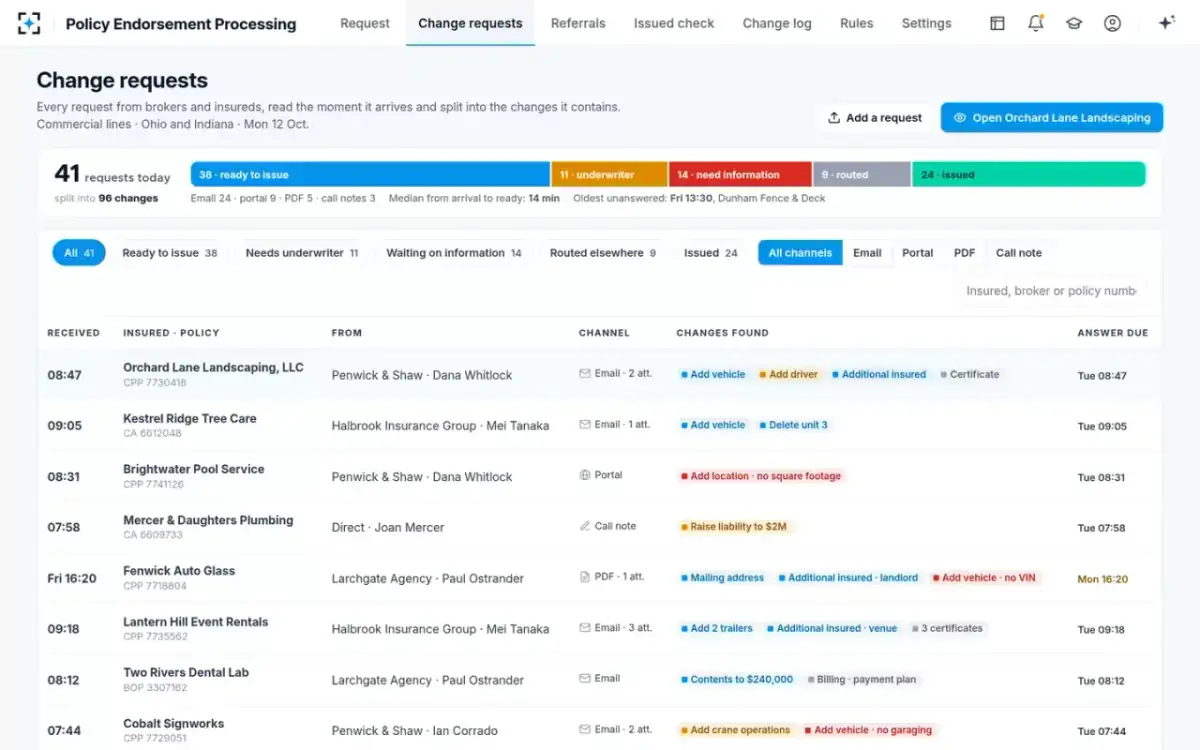
The workload is changes, not requests, and a center that counts requests understates it by half or more. On the sample Monday the 41 requests held 96 changes: 38 ready to issue, 11 with an underwriter, 14 waiting on a broker, 9 routed to another queue such as certificates or billing, and 24 already issued by mid-morning. The median time from a request's arrival to ready was 14 minutes, and the oldest unanswered request had been waiting since Friday at 13:30.
Commercial requests are harder than personal lines ones for three reasons. A commercial package holds several coverage parts at once, typically business auto, general liability and property, each with its own schedules. The changes come with documents attached, a bill of sale or a services contract, which decide what the endorsement must say. And the insured's contracts with its own customers often require specific endorsements the insured never mentions.
The service center's queue in Policy Endorsement Processing, against a one-day promise
One request across the desk's morning, minute by minute
At 08:47 on the sample Monday, an account manager at the broker Penwick & Shaw forwards an email from the owner of Orchard Lane Landscaping. He has bought a 2026 Ford F-350 dump truck, financed, and wants it on "full coverage like the other trucks" from Thursday; a new hire aged 20 will drive it; a new client, Crestline Property Group, must be an additional insured before a grounds contract starts on 1 November, and the contract is attached; and could they send a certificate. That is three policy changes and a certificate request, each of a different kind.
The agents read the email and both attachments and split them into those four items in 52 seconds, each change pinned to the page of the policy it alters. From there the request runs on four clocks, and only two of them are in the service representative's hands.
One email, four clocks: the Orchard Lane request across the morning
- Reviewed and issuedissued 09:12
- CG 20 01 added, issuedissued 09:12
- Held for change 3released 09:14
- Letter to brokersent 09:06
- Waiting on the broker for date of birth and licencereply 10:52
The two changes inside the representative's authority were issued at 09:12, 25 minutes after the email, and read back against the request: 14 of 14 fields matched. The certificate waited for the endorsement it evidences, because a certificate issued before the additional insured is on the policy describes cover that does not exist. The driver is the long clock, and not because of the desk: the email gave his age but not his date of birth or licence number, so the motor vehicle record could not be ordered until the broker replied at 10:52.
The representative's own 24 minutes went on judgement: checking that the truck was priced like units 4 and 5, the other F-350 dumps; adding the contract's primary and noncontributory wording, which the email never mentioned; and sending the letter telling the broker the truck was on, the driver was not, and he should not drive unit 12 until he was. How to split such an email into separate requests is set out in the change request form and the email that skips it.
Where handling time goes on a multi-change request
By hand, the mechanical steps take most of the time. Botminds estimates about four hours of handling for a commercial request with more than one change when a person does every step, and half of it goes to two things: checking rules, authority and missing items, and keying the change into the policy system.
Where four hours go on a multi-change commercial request, done by hand
By hand, about 4 hours (Botminds’ estimate)
- Read, split, find the page · 25%
- Rules, authority, missing items · 25%
- Rate pro rata · 12.5%
- Key into the system · 25%
- Compare issued with request · 12.5%
Two slices deserve separate treatment in a staffing model. Keying is transcription, and transcription errors are where the cost hides: a VIN with two digits swapped or a birth year reversed reads perfectly well to the person who typed it. Checking is judgement, and it is the slice that shrinks when a queue is under pressure, because skipping it is the quickest way through. A center that budgets both as "processing" staffs for the first and loses the second. The keying errors that slip through, and a seeded test that counts them, are set out in insurance endorsement errors examples.
Which changes may the service center issue without an underwriter?
Those the carrier's authority matrix allows, issued by staff who hold whatever licence the state requires for what they do. The sample carrier's matrix is typical in shape: a service representative may issue a premium change of up to $2,500 a year, above which the team lead decides; a driver under 23 on a vehicle over 10,000 pounds gross vehicle weight, any limit increase, a new class of operations, a location in a new state and an effective date more than 15 days back each go to an underwriter under a numbered rule.
The sample service center's authority matrix
| Change | Service representative | Goes to |
|---|---|---|
| Premium change up to $2,500 a year | Issues | None |
| Premium change over $2,500 a year | Prepares | Team lead |
| Driver under 23 on a vehicle over 10,000 lb GVW | Asks for the missing items | Underwriter |
| Any limit increase | Prepares | Underwriter |
| New class of operations or a location in a new state | Prepares | Underwriter |
| Effective date more than 15 days back | Prepares | Underwriter |
| Certificates, billing questions, cancellations | Routes | Their own queues |
Licensing law sets the outer limit, and states draw it in different places. Florida is direct about binding: "An employee or an authorized representative located at a designated branch of an agent or agency may not bind insurance coverage unless licensed and appointed as an agent or customer representative" (Fla. Stat. §626.0428(2)). The NAIC's model producer licensing law exempts employees whose activities are "executive, administrative, managerial, clerical or a combination of these, and are only indirectly related to the sale, solicitation or negotiation of insurance" (Model #218, §4B). A center that lets unlicensed staff bind changes in Florida, or discuss coverage terms with insureds where the state treats that as negotiation, has a licensing problem whatever its authority matrix says. Who has authority to accept a commercial policy change request works through the policy's changes clause and the state rules in full.
What examiners test on a service center's work
State market conduct examiners test the service center's output directly. One of the NAIC's underwriting and rating standards expects policies and endorsements to be issued and renewed accurately, on time and in full (NAIC examination standards, 2024). The review procedures behind it, in the 2017 edition of the NAIC Market Regulation Handbook, tell the examiner to "Determine if policies and endorsements are issued in appropriate time frames" and to "Review new issues prior to mailing to ensure correct procedures, forms, disclosures, etc., are used" (2017 edition, Chapter 16).
Read as an operating standard, those two lines say a center is accountable for speed, for accuracy and for the right forms, and that someone should check what was issued before it goes out. Complaint data shows what happens when that fails. In our count of the Texas Department of Insurance's open complaint data, 197 complaints closed in 2025 named an endorsement or rider among their reasons; 77 also named policyholder service, and 78 also named a claim-handling reason such as a denied claim, a claims delay or an unsatisfactory offer (TDI open data, queried November 2026).
Texas complaints closed in 2025 that named an endorsement or rider
The 78 are the expensive ones. The endorsement was keyed months before the complaint; the complaint arrived with the claim. A change keyed wrong costs the center nothing on the day and costs the carrier, the agency or both when the loss comes in, which is why read-back belongs in the service standard rather than in a quarterly audit. How a missed change becomes an errors and omissions claim is traced in insurance agent E&O claims examples.
How should a service center measure accuracy?
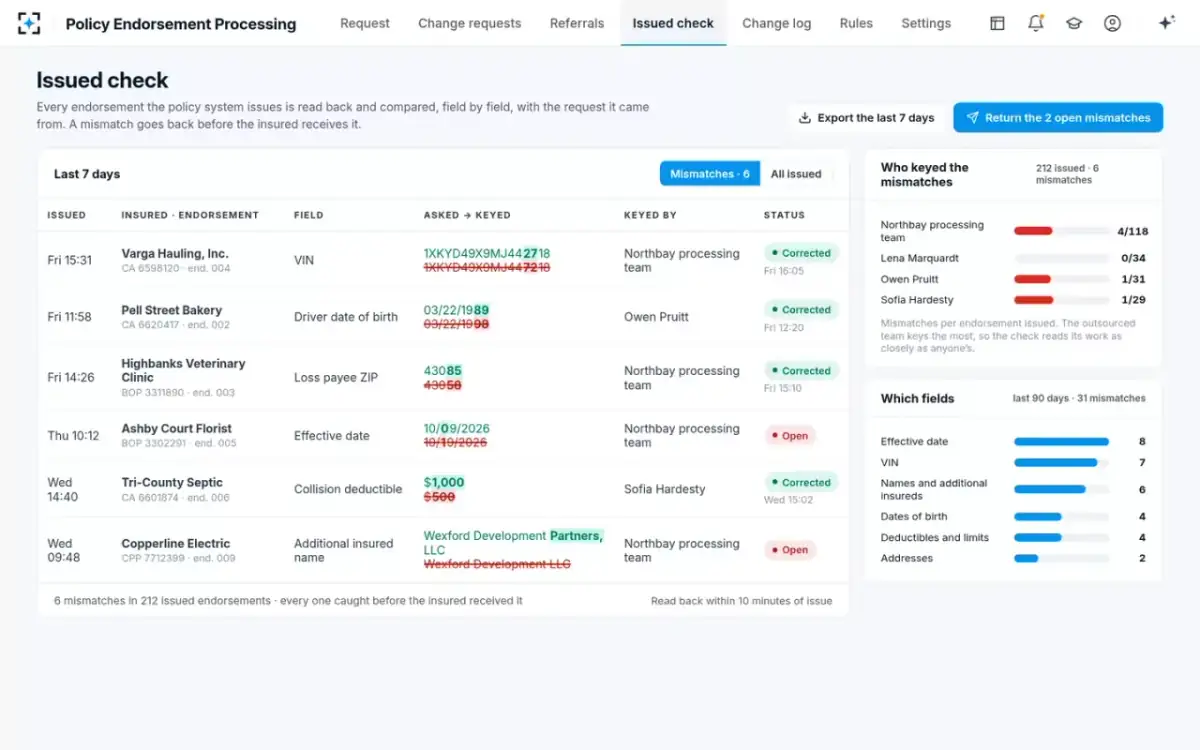
By comparing every issued endorsement, field by field, with the request it came from, and counting mismatches per endorsement issued, by the person or team who keyed it. A rate per endorsement scales with volume, so a team that issues four times as many endorsements is not penalised for doing more work.
On the sample desk over seven days, one service representative keyed 34 endorsements with no mismatch, while an outsourced processing team keyed 118 with four: a rate of about 3.4 per hundred, against zero. Those are sample figures, and four mismatches is a small number, but the comparison is the one an operations leader needs before deciding how much work to send outside. The same view lists which fields went wrong, which tells a team lead where a second look pays.
Last week's issued endorsements against their requests: who keyed each mismatch
The service center's operating standard, written down
A service center runs to the standard it writes down, and most write down throughput only. The list below is a standard written from the sample desk and the rules above; set the limits to your own authority letter and state licensing.
An operating standard for a commercial lines service center
- Count changes, not requests
Split every request into its changes at arrival, and report both; one email can hold a vehicle, a driver, an additional insured and a certificate.
- Pin each change to the page it alters
Business auto schedule of covered autos, driver schedule, additional insured schedule, location schedule, with the request sentence it came from.
- Check authority before accepting
Issue inside the matrix; refer the rest with the rule that applies and the evidence attached.
- Ask for every missing item once
VIN, date of birth, licence number and state, garaging address, square footage, the contract behind an additional insured; never guess a value.
- Read the contract
Additional insured, primary and noncontributory wording and waiver of subrogation are set by the contract, not the email.
- Rate pro rata and show the working
Annual premium difference times the share of the term left, plus flat charges as filed; no rate overrides.
- Read back every issued endorsement
Field by field against the request, before it reaches the insured.
- Route what is not a policy change
Certificates after the endorsement they evidence; billing and cancellations to their own queues.
- Match licences to tasks
Staff who bind or discuss coverage terms hold the licence the state requires; clerical staff stay clerical.
What Policy Endorsement Processing changes in the service center's numbers
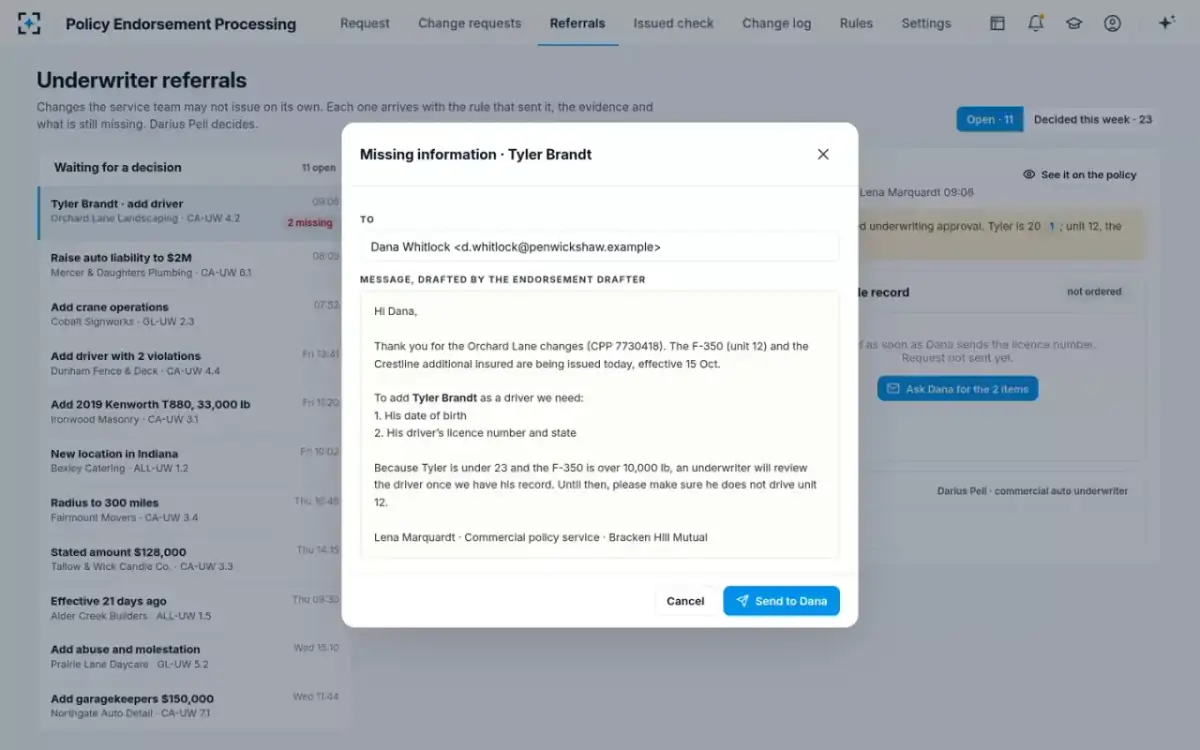
The center keeps every decision and loses most of the transcription. Six agents read, split, locate, check, rate, draft and read back; the representative accepts and issues, an underwriter decides referrals, and no agent issues or sends anything. Each referral reaches the underwriter with the rule that sent it, the driver, the vehicle and the motor vehicle record on one screen, and each missing-information letter is drafted for the representative to read, edit and send, with a reminder to the broker after two business days.
The letter the representative reads and sends, drafted for her
The measures move accordingly. On the estimate above, handling time on a multi-change request falls from about four hours to about 25 minutes; the sample desk's median from arrival to ready was 14 minutes; and every issued endorsement is read back, so accuracy is measured on all of them rather than on a sample. Elapsed time still depends on brokers, which is why the oldest open request and the count waiting on brokers belong on the same screen as the speed. How the agents trace one email in 52 seconds is set out in insurance policy processing automation software, and the whole series starts from Policy Endorsement Processing.
Questions people ask
What is a commercial lines service center?
A team at a carrier or agency that services business insurance policies after the sale: change requests and endorsements, referrals to underwriting, certificates, and billing and cancellation requests routed to their own queues. Its work is examined against the NAIC standard that policies and endorsements be issued accurately, on time and in full.
How many changes does a commercial change request contain?
Often more than one. On the fictional sample desk, 41 requests on one Monday held 96 separate changes, and one broker email alone held three policy changes and a certificate request.
What is the endorsement process in insurance?
A request to change a policy mid-term is read, checked against the policy and the underwriting rules, priced, issued as an endorsement and confirmed to the insured and broker. Changes outside the service team's authority, such as a young driver on a heavy vehicle or a limit increase on the sample desk, are referred to an underwriter before issue.
Can unlicensed service center staff bind coverage?
Not in Florida, where an agency employee may not bind coverage unless licensed and appointed as an agent or customer representative. The NAIC model exempts employees whose work is clerical or administrative and only indirectly related to sales; binding is not clerical.
Should endorsement processing be outsourced?
Only with a measure that compares the outsourced team's accuracy with the in-house desk's on the same field-by-field read-back. On the sample desk an outsourced team keyed 118 endorsements in a week with four mismatches; the insurer stays accountable to examiners for every one of them.
What should a service center report weekly?
Requests and changes received, median time from arrival to ready, the oldest open request, changes waiting on brokers, referrals sent with their rule, and mismatches per endorsement issued by person or team. Those map onto what examiners test: timeliness and accuracy.