A near miss in operational risk is an operational risk event that did not result in a financial loss: a fraudulent wire stopped by a callback, a duplicate payment file caught before release, a system failure that happened during a test rather than a business day. The FR Y-14Q instructions define it as "An operational risk event that did not result in an actual financial loss or gain to the institution" and leave it out of the loss file. Yet the same event that never reaches the regulatory file is often the best evidence a bank has about its controls, because it shows a control working, or nearly failing, before money is lost. Botminds' Operational Risk Loss Data Collection keeps near misses as events in their own right, found from incident tickets, classified by the loss they would have been, linked to the control that stopped them, and never mixed into gross loss.
The six near misses on this page are sample data from fictional Corvane National Bank's week of August 31 to September 3, 2026, in the solution. The definitions are quoted from the FR Y-14Q instructions and the Basel Committee's principles.
What the regulatory file keeps, and what the internal loss database keeps
FR Y-14Q Schedule E: Every one, with three dates, gross and recoveries
The internal loss database: Every one, the same way
FR Y-14Q Schedule E: Not required; never bundled to clear it
The internal loss database: Kept, each its own event, if the bank collects below the threshold
FR Y-14Q Schedule E: Left out
The internal loss database: Kept: no gross loss, the potential amount, the control that stopped it
FR Y-14Q Schedule E: Left out
The internal loss database: Kept, flagged
FR Y-14Q Schedule E: Left out
The internal loss database: Kept, flagged, outside gross loss
FR Y-14Q Schedule E: Left out, except retail card fraud
The internal loss database: Kept, flagged for credit risk
FR Y-14Q Schedule E: A description only for events of $250,000 or more
The internal loss database: For every event, linked to the control
What is a near miss in operational risk?
A near miss is an operational risk event with no financial loss. Something went wrong, or someone tried to make it go wrong, and the bank did not lose money, usually because a control, a person or luck intervened. The definition turns on the outcome, not the event: the same spoofed email that cost one bank $182,400 is a near miss at another, or at the same bank on a different day, if the callback is made.
Two edges need a rule. A loss that is later recovered in full is not a near miss: it had a gross loss, and the recovery is recorded separately. An event that produced a gain is not a near miss either; FR Y-14Q lists gains as their own exclusion, "Situations where an operational risk related failure results in a financial gain for the institution". The bank's boundary rules should say both, because the business lines will otherwise call any event that ended well a near miss.
Are near misses reported on FR Y-14Q?
No. The Schedule E instructions list near misses first among the events that should not be included in the gross loss amount or in the completed schedule, alongside timing events, credit boundary events, forgone revenues and gains (FR Y-14Q instructions, Schedule E). The schedule is built to capture "actual or realized losses"; a near miss has none.
The capital rules reach the same place by definition. Both today's rule and the March 2026 re-proposal define an operational loss event as one "that results in loss" (12 CFR 217.101; 91 FR 14952). A near miss produces no operational loss, so it adds nothing to the total operational losses that the proposal would feed into the business indicator. Leaving it out of the regulatory file is correct; deleting it is a waste.
What is the difference between a near miss and a loss?
Money, and with it, every field that follows from money. A loss has a gross amount, accounting dates, perhaps recoveries, and it enters the regulatory file if it clears the threshold. A near miss has none of those; what it has instead is a potential amount, the amount that would have been lost, and the control or person that stopped it. Both have an occurrence date, a discovery date, an event type and a business line.
That difference makes a near miss easy to lose. Nothing posts to the general ledger, so a ledger-first process cannot find it; nothing obliges a business line to report it, so a form-first process rarely sees it. Near misses live in incident tickets, operations logs and fraud alerts, and a database only keeps them if it reads those sources on purpose.
Why record near misses?
Because they are event data, and the Basel principles treat event data as the base for operational risk assessment. Describing the event dataset banks often maintain, the Committee says it "typically includes internal loss data, near misses, and, when feasible, external operational loss event data" (BCBS, Revisions to the principles for the sound management of operational risk, 2021).
A sound event management approach typically includes analysis of events to identify new operational risks, understanding the underlying causes and control weaknesses, and formulating an appropriate response to prevent recurrence of similar events.
Basel Committee, Revisions to the principles for the sound management of operational risk (2021), on event management
A near miss is the cheapest way to learn those things. The cause and the control weakness are visible, the people involved remember what happened, and nobody has to explain a loss to the board. A bank that keeps only losses learns about each weakness at the price of a loss; one that keeps near misses learns some of them for free.
Six examples of operational risk near misses from one week
In the sample week, the solution kept six near misses from Corvane's incident tickets, each with no loss and a reference number of its own. They show the range: fraud stopped by a control, processing errors caught before release, a resilience test that failed safely, and a duplicate deposit caught on the second presentment.
Six near misses kept beside the week's small losses
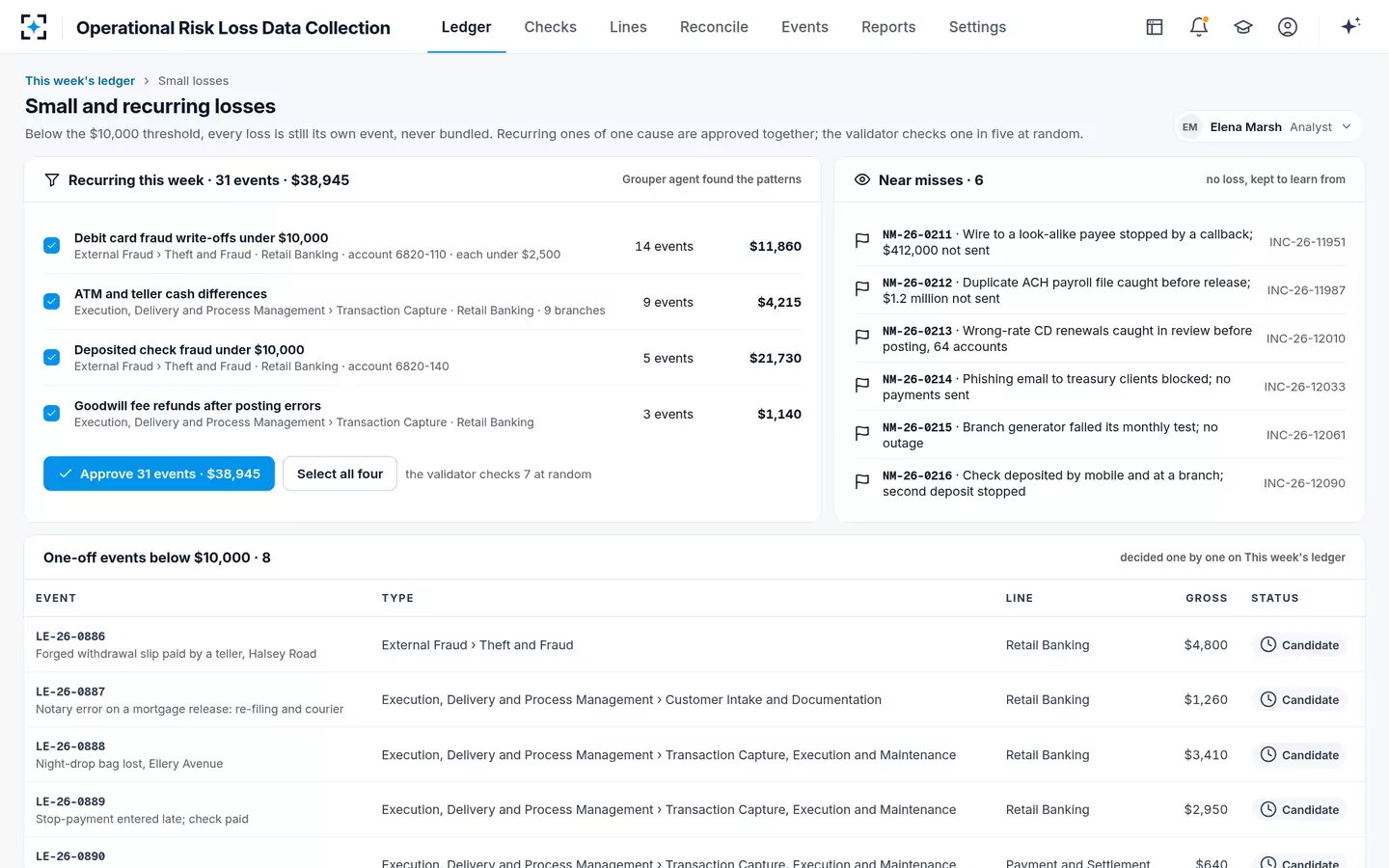
The six near misses, by the event type each would have been
The first near miss is the most instructive. NM-26-0211 was a wire to a look-alike payee, $412,000 not sent because a callback was made. The same week's review also held LE-26-0847, a $182,400 wire fraud of the same kind from August 3 that went through because the callback was skipped. One control, two outcomes: together they are better evidence about callback control WIR-CB-02 than any self-assessment rating. How the classifier argued that loss's event type follows the other half.
What a week of near misses tells the risk committee
Near misses put a size on luck. In the sample week, the two near misses with a known amount would have cost $412,000 and $1.2 million, about $1.6 million together, against $1,021,055 of gross loss in the 29 events at or above the threshold that the same week produced. A risk committee that sees only the losses sees about two fifths of the money that was at stake that week; the rest was stopped by a callback and a payroll file check.
That comparison is not a loss figure and should never be added to one. It is a statement about controls: which ones carried the most weight, and what their failure would have cost. Reported beside the loss trend, by control and business line, it turns a list of incidents into a view of where the bank's protection is thin.
How are near misses used in an RCSA?
As evidence on control effectiveness, in both directions. A near miss stopped by a control shows the control operating; a near miss stopped by luck or a last-minute catch shows a control that did not operate. The Basel principles name the test the RCSA should pass: set the frequency and severity of the bank's own losses against what the self-assessments predicted, and see whether the assessments hold up (how to measure control effectiveness quotes the principle). Near misses extend that comparison to the events that did not cost money.
From a near miss to evidence in the RCSA
A person decides
Operations or fraud staffOpen an incident ticket for the event, as they would for any incident.
Agent
Finder agentReads the ticket queue, recognizes an event with no financial impact, and proposes it as a near miss.
Never: Never gives a near miss a gross loss
Agent
Classifier agentProposes the event type it would have had, the business line, and the control that stopped it, with citations.
A person decides
Operational risk analystApproves the near miss, corrects the control link if needed, and keeps it outside every loss total.
A person decides
Control owner, in the RCSASees the near miss against the control: operated, or nearly failed, and rates the control with it in view.
The RCSA itself is a different process with its own owner, and RCSA Automation is the Botminds solution for it; the RCSA process, one cycle week by week shows how it runs. The loss database's job is to hand it clean events, losses and near misses alike, each linked to the control involved.
Do near misses count toward capital?
No. Under the March 2026 proposal, operational risk capital would be driven by the business indicator, which includes total operational losses; a near miss has no loss to include. Under today's advanced approaches and the Basel standard, loss data enters the calculations through losses at or above a threshold; near misses are not losses.
They can still matter to capital indirectly. Scenario analysis, which the Basel principles say typically draws on "relevant internal and external loss data, information from self-assessments, the control monitoring and assurance framework, forward-looking metrics, root-cause analyses", is where a bank asks what a severe event would cost; a near miss with a $1.2 million potential, like Corvane's duplicate ACH payroll file, is a concrete starting point for that question.
How do you capture near misses without a form?
Read the systems where they already appear. Fraud alerts that were stopped, payment exceptions caught before release, reconciliation breaks cleared before posting, resilience tests that failed safely: each produces a ticket, an alert or a log entry. A near miss process that depends on someone filling in a form will capture the dramatic ones and miss the routine ones, which are the more useful.
What a near miss needs, to be useful later
- A written definition in the boundary rules
No financial loss or gain; a fully recovered loss is not a near miss; a gain is its own case.
- A source other than memory
Incident tickets, fraud alerts and payment exceptions, read on a schedule.
- The event type it would have been
Classified with the same definitions as losses, so near misses and losses can be compared.
- The control or person that stopped it
Linked to the control library, so the RCSA can use it.
- A potential amount where one is known
Kept in its own field, never as gross loss.
- Its own reference number
Never bundled with losses or with other near misses.
- Occurrence and discovery dates
The gap shows how fast the control worked.
- A monthly look
Near misses by control and business line, next to the losses on the same controls.
How Operational Risk Loss Data Collection keeps near misses
The solution reads the incident management system every 15 minutes, including near misses, alongside the weekly general ledger sieve. In the sample week the Finder agent's summary read: 381 entries grouped into 68 candidate events, 29 at or above $10,000 and 39 below, "and 6 near misses from tickets". Each near miss gets its own reference number, a type, a business line, the control that stopped it, and a potential amount where the ticket gives one.
Near misses arrive with the week's candidate events, from the tickets

The regulatory file then leaves them out by rule: the quarterly preview's checks list near misses, timing events and credit-boundary events left out, six, three and 66. Nothing is deleted to make the file right; it is built from the events that belong in it. The FR Y-14Q Schedule E field map shows what the file keeps, and the credit boundary decision tree places near misses at its first branch. The full solution is at Operational Risk Loss Data Collection.
Questions people ask
Should a near miss have an amount?
It should have no gross loss, because none occurred. Many banks keep a potential amount, what would have been lost, in a separate field; in the sample week two near misses carried one, $412,000 and $1.2 million not sent, and the rest did not, because the ticket gave none.
Is a near miss the same as an incident?
Not quite. An incident is anything that went wrong; it becomes a near miss in loss data terms when it had the potential for an operational loss and caused none. Many incidents are neither losses nor near misses, such as a slow system with no financial consequence.
Who should report near misses?
Whoever stops them, through the systems they already use: fraud teams through alerts, payments teams through exception queues, operations through incident tickets. A loss data function that reads those systems does not need a separate near miss form, and gets the routine near misses a form would miss.
Do near misses need second-line review?
Lightly. Because they carry no loss, a sample review is usually enough, but the link between a near miss and the control that stopped it should be checked, because the RCSA will rely on it.
How many near misses should a bank expect?
No public benchmark exists, and counts depend on what the bank defines and reads. A falling count is not automatically good news: it may mean fewer events, or fewer tickets. The ratio of near misses to losses on the same control is more informative than either count alone.