An operational risk data warehouse is the store that holds a bank's operational loss events and the data around them, such as recoveries, dates, classifications, causes and links to controls, so that risk management, reporting and capital can all draw on one history. Most warehouses store events well. The questions that separate them come from what the rules ask the data to be: comprehensive above a threshold, built from three dates, with gross loss and recoveries kept apart, grouped by common trigger, independently reviewed for completeness, and long enough to cover acquired banks. And they come from the test every head of operational risk eventually faces: does the database tie to the general ledger? Botminds' Operational Risk Loss Data Collection is one answer, built around that tie-out; the 15 questions below are written so a buyer can test it, or any other option, on its own data.
Examples come from fictional Corvane National Bank's sample data in the solution; rules are quoted from the Federal Register, the FR Y-14Q instructions and the Basel Framework.
Fifteen questions for an operational risk data warehouse, with a good answer, a red flag and a test
Completeness and the general ledger
1Does it reconcile to the general ledger every month, by account group, with every difference explained?
Good answerYes, and signing is blocked while anything is unexplained.
Red flag"We import your loss events" with no general ledger feed.
TestGive it last month’s accounts and events; ask for the difference list.
2Can it find a loss nobody reported?
Good answerIt reads the accounts where losses land and the incident tickets, not only forms.
Red flagCapture starts from a form or an upload.
TestSeed a test month with an unlinked legal fee, a refund and a suspense write-off.
3Does everything it sets aside carry a rule, and can a person send it back?
Good answerEach excluded entry shows the rule; one click returns it as a loss, logged.
Red flagSilent filters or confidence scores without reasons.
TestOpen one excluded layer and trace three entries.
How an event is built
4How does it group entries into one event, and where is the grouping policy?
Good answerBy common trigger, with the joining evidence cited and a policy the bank versions.
Red flagGrouping by account or month.
TestA reimbursement, legal fee and recovery a month apart: one event or three?
5Are recoveries separate entries with their own dates, under the event’s reference?
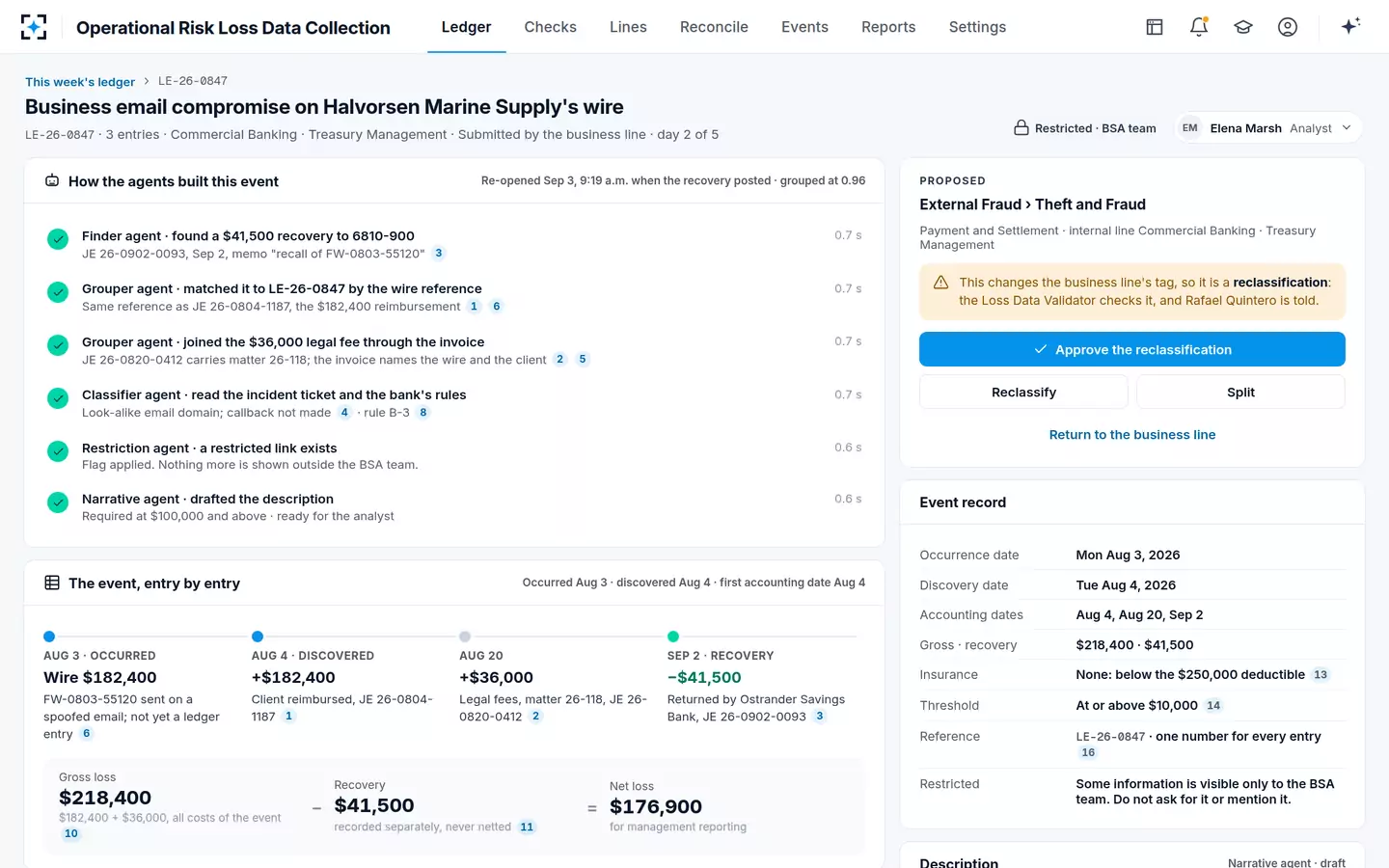
Good answerYes; gross, insurance and non-insurance recoveries all identifiable; net is a calculation.
Red flagA "net loss" field that overwrites gross.
TestPost a recovery; check gross is unchanged.
6Does it keep occurrence, discovery, accounting and capture dates for every impact?
Good answerAll four, with accounting dates per entry and checks between them.
Red flagOne date per event.
TestEnter a discovery date before occurrence; it should be stopped.
7Can it keep near misses, timing and credit boundary events without letting them into gross loss?
Good answerKept and flagged, excluded from regulatory views by rule.
Red flagThey are deleted, or mixed into losses.
TestBuild the regulatory view and count the exclusions.
Classification
8Does each classification cite the definition, the evidence and the bank’s rule, and ask when unsure?
Good answerOne plain sentence with citations, and a threshold below which it asks.
Red flagA type with a score and no reasons.
TestA spoofed-email wire the business line called a processing error.
9Can it hold the bank’s own Level 3 taxonomy and boundary rules as versioned settings?
Good answerYes, with an approver and a date on every version.
Red flagTaxonomy changes need the vendor.
TestChange a rule; see the version and approval on the audit trail.
Control and evidence
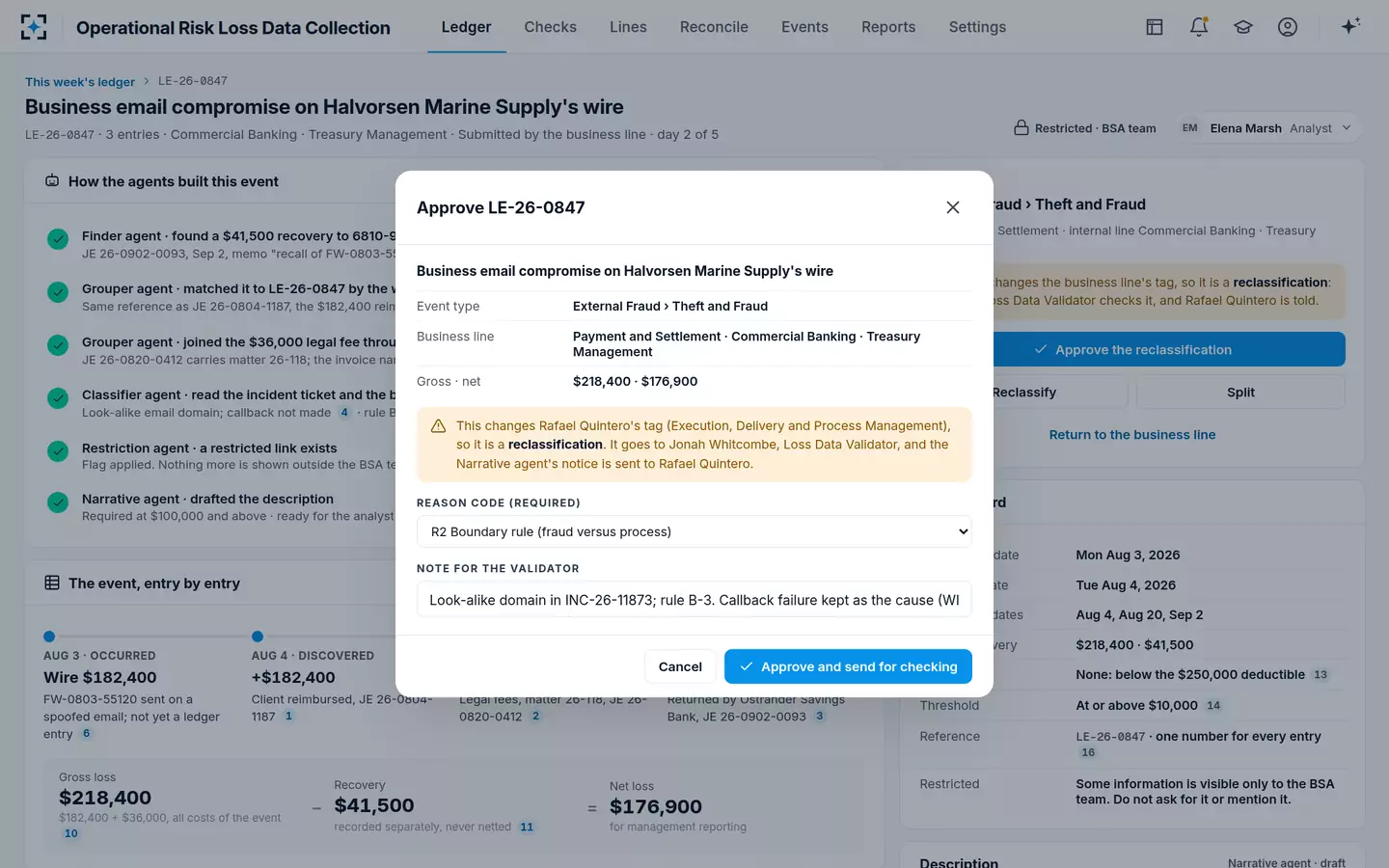
10Is there a maker and a checker on every decision, and a reason code on every override?
Good answerNobody checks their own decision; overrides are counted by reason.
Red flagApproval by the same user who edited.
TestTry to confirm your own reclassification.
11What does the audit trail record, and can it be exported for examiners and audit?
Good answerWho, what, when, why and the evidence, uneditable, with logged export packs.
Red flagA change log of field values only.
TestExport one event’s full history.
12How are events linked to confidential BSA matters restricted?
Good answerA restricted flag outside the BSA team; detail never in reports or files.
Red flagFree-text descriptions that can mention a filing.
TestView a restricted event as an analyst outside the BSA team.
13How are its models and prompts changed?
Good answerVersioned, run on last month’s events first, approved by the head of operational risk.
Red flagSilent vendor updates.
TestAsk for the last three version changes and their test runs.
Outputs and history
14Can it produce FR Y-14Q Schedule E and the 2026 proposal’s data elements from the same events?
Good answerOne event model, several views, field checks, nothing filed without approval.
Red flagA separate spreadsheet for each report.
TestBuild last quarter’s file and compare it with what was filed.
15Can it hold ten years, including acquired banks, and migrate history with identifiers intact?
Good answerYes, with acquired entities named and old reference numbers kept.
Red flagHistory starts on go-live day.
TestLoad an acquired bank’s history and check the entity field.
What is an operational risk data warehouse?
It is the bank's system of record for operational risk data: internal loss events first, and often also near misses, external loss data, scenario results, key risk indicators and the links between losses and the controls in the self-assessment. The Basel principles describe the core of it as a "comprehensive operational risk event dataset that collects all material events experienced by the bank and serves as basis for operational risk assessments" (BCBS, 2021).
The term covers two very different products. An event store holds what it is given and reports on it. A reconciled loss database holds what the bank actually lost, proves it against the accounts each month, and can say how each event was built and who decided it. The difference does not show in a demonstration with clean sample data; it shows in the first month on the bank's own general ledger.
An event store and a reconciled loss database, question by question
Event store: Forms and uploads
Reconciled loss database: The general ledger and incident tickets, with forms as evidence
Event store: Counts of events received
Reconciled loss database: A monthly reconciliation with every difference explained
Event store: One amount, sometimes net
Reconciled loss database: Each entry dated, recoveries apart, gross and net both derivable
Event store: The submitter’s choice
Reconciled loss database: A proposal with cited reasons, decided by the analyst, checked by the second line
Event store: Extracted and fixed in spreadsheets
Reconciled loss database: Built from the same events with field checks
Event store: Field change history
Reconciled loss database: Who, what, when, why and the evidence for every action
What should an operational risk database store?
At minimum, what the rules ask for, at the level of each accounting entry rather than each event. The March 2026 proposal, still a proposal, lists gross operational loss amounts, recovery amounts, the occurrence and discovery dates, and "the date (or dates) when losses or recoveries related to the event were recognized in the [BANKING ORGANIZATION]'s profit and loss accounts (accounting date)", together with the mapping to seven event types and descriptive information about drivers (91 FR 14952, proposed §__.150(d)(2)). FR Y-14Q adds the capture date, the threshold in effect, the Basel and internal business lines, the acquired entity and, for large events, a description (Schedule E).
What an operational loss database needs to store, and which text asks for it
| Data element | Level | Asked for by |
|---|---|---|
| Reference number linking all of an event’s entries | Event | FR Y-14Q field B |
| Gross loss amount per accounting impact | Entry | March 2026 proposal; FR Y-14Q field H; Basel OPE25.19 |
| Recovery amount, insurance and non-insurance identifiable | Entry | Proposal; FR Y-14Q field I (non-insurance only); Basel OPE25.25 |
| Occurrence, discovery and accounting dates | Event and entry | Proposal; FR Y-14Q fields D–F; Basel OPE25.19 |
| Capture date and the threshold in effect | Event | FR Y-14Q fields C and G, Section E.4 |
| Basel event type Levels 1 and 2, business line Levels 1 and 2 | Event | Proposal (seven types); FR Y-14Q fields J–M |
| Internal business line and unit of measure | Event | FR Y-14Q fields N and Q |
| Cause and drivers, linked to the failed control | Event | Proposal (drivers); Basel principles (root cause) |
| Acquired or merged entity | Event | FR Y-14Q field O; proposal (ten full years for acquired entities) |
| Flags for near miss, timing, credit boundary, restricted | Event | FR Y-14Q exclusions; the bank’s rules |
| Who decided, who checked, why, on what evidence | Action | Independent review of comprehensiveness and accuracy (proposal); audit |
The questions about completeness and the general ledger
Questions 1 to 3 decide whether the warehouse can prove it is complete. The proposal would require an independent review of whether loss data is comprehensive and accurate; a reconciliation to the general ledger is the most direct evidence such a review can examine. The test for question 2 is the most revealing in the whole rubric: plant three losses that no form reports, a legal fee, a refund and a suspense write-off, in a month of real accounts, and see which the system finds and how it explains the rest.
Does an operational risk system need to tie to the general ledger?
No rule says those words, and every serious review ends there. The current advanced approaches rule judges a threshold by whether the bank still captures substantially all of its losses by value, the proposal asks for data that is comprehensive and independently reviewed, and a dollar value can only be shown against the accounts. A system that cannot tie its events to the general ledger leaves the bank to do it in a spreadsheet at quarter-end, which is where most of the hours in a loss data function go.
In the solution's sample August, Corvane's general ledger showed $4,322,915 in 38 accounts and the database $4,192,340; all $130,575 of difference was traced to four items, each an entry or a rule, before the head of operational risk could sign. How a ledger-first reconciliation measures what forms miss describes the method.
How should recoveries be stored?
As separate entries with their own accounting dates and the event's reference number, never as a reduction of the gross loss. The Basel standard requires that banks "must be able to identify the gross loss amounts, non-insurance recoveries, and insurance recoveries for all operational loss events" (OPE25.25), and FR Y-14Q puts non-insurance recoveries in their own column and forbids netting them into gross. Net loss is then a calculation, available for the Basel loss component and management reporting, while gross stays intact for the regulatory file.
One event, three entries, recoveries kept apart
The questions about how an event is built
Questions 4 to 7 test the event model. Grouping is the hardest to get right and the easiest to hide, because a warehouse can store whatever grouping it is given. The Basel standard is specific about both the rule and the policy behind it.
All operational losses caused by a common underlying trigger or root cause should be grouped into one operational loss event in a bank's operational loss event dataset.
Basel Framework, OPE25.29, FAQ 1
The same answer asks banks for "a clear, well-documented policy" on grouping, firm-wide understanding of it, sharing of loss data across businesses to apply it, and controls including independent review. A warehouse that proposes groupings with the joining evidence shown, a wire reference, a ticket number, a legal matter, and asks before joining anything it is unsure of, makes that policy testable. The opposite failure is bundling: FR Y-14Q forbids combining separate small events into one to clear a threshold, so the model must also keep apart what should not be joined.
Can a loss data system support the 2026 Basel proposal?
It can support the loss data part, if it already stores what the proposal lists; the capital calculation itself belongs elsewhere. The proposal's loss data text asks for a $20,000 threshold before recoveries, gross and recoveries, three dates, mapping to seven event types, drivers, documented procedures, an independent review of comprehensiveness and accuracy, and audit of both. For acquired or merged entities, it asks for loss data for ten full years, including the years before the deal.
Two cautions for buyers. The proposal is not final, so any vendor claiming "compliance" with it is claiming too much; ask instead which of its data elements the system stores today. And because the proposal adds total operational losses into the business indicator, loss data accuracy becomes a capital input even without a loss multiplier; what one loss event costs to capture works through that arithmetic.
What audit trail does loss data need?
One that lets an independent reviewer rebuild every decision: who did what, when, why, and on which evidence, for people and automated agents alike, and that nobody can edit. The proposal would put both the loss data procedures and the completeness review under regular review by internal or external audit; an auditor cannot review a decision whose reason was never captured.
A reclassification needs a reason code before it reaches the checker
How is BSA-related loss data restricted?
By flag, not by description. Federal regulation makes a suspicious activity report, and any information that would reveal its existence, confidential (31 CFR 1020.320(e)), and a fraud loss is exactly the kind of event that may be linked to one. A loss database that lets free text, reports or regulatory files mention a filing creates a disclosure risk the BSA officer has to manage.
In the solution, a Restriction agent checks each event against restricted links from case management, applies a "Restricted · BSA team" flag and masks account numbers; nothing outside the BSA team shows a referral's existence or detail, restricted links never appear in the quarterly file, and they appear only in the BSA officer's export pack. A buyer should test the equivalent in any warehouse by viewing a restricted event as an analyst outside the BSA team, and reading the description and every export it reaches. The BSA officer, not the operational risk team, should own that test.
Where Operational Risk Loss Data Collection fits, and where a warehouse is still the right buy
Operational Risk Loss Data Collection is designed to answer most of these questions: it reads the general ledger and incident tickets, groups and classifies with cited reasoning, keeps recoveries apart, holds the bank's rules as versioned settings, puts a maker and a checker on every decision, reconciles monthly, restricts BSA-linked events and builds the FR Y-14Q layout for approval. Question 15 depends on the bank's history: migrating ten years of an old database with its reference numbers is a project, and a buyer should ask for a plan, not a promise.
It is not the whole operational risk data warehouse. It does not store scenario analysis, key risk indicators or a full RCSA; it reads the control library rather than owning it; it does not compute capital; and it does not supply external loss data, which banks obtain separately, from industry data consortia such as the Operational Riskdata eXchange Association or from public sources. A bank that already has a warehouse it trusts can put the solution in front of it as the capture and reconciliation layer, writing approved events back. The full solution is at Operational Risk Loss Data Collection, and the go-live plan on 38 accounts shows what a trial on the bank's own month looks like.
Questions people ask
How do you evaluate operational risk software?
On the bank's own data, against tests rather than features. Run one month of the bank's general ledger accounts and last quarter's events through it, then check whether it found losses the forms missed, whether its groupings and classifications are explained, whether the month reconciles with nothing unexplained, and whether a second person can check every decision on the same evidence.
Is an operational risk data warehouse the same as a GRC system?
Not usually. A GRC system runs workflows such as forms, approvals and self-assessments; the warehouse holds the data those workflows and other feeds produce. Many banks run both, and the integration between them, which system is the source of truth for an approved event, is worth settling before buying either.
How long should operational loss data be kept?
Long enough for every use the bank has. The Basel loss component uses ten years; the March 2026 proposal would require ten full years for acquired and merged entities; FR Y-14Q asks for the complete history since systematic capture began. The solution's sample settings keep the loss history for its life and supporting documents at least five years.
Should external loss data sit in the same warehouse?
It can, but it must stay distinguishable from internal data, because the rules treat them differently: internal events are the bank's own history and enter its regulatory files, while external data is an input to scenario analysis and benchmarking. The Basel principles encourage banks to gather external data where feasible.
What is the biggest red flag in a loss data demonstration?
A net loss field that replaces gross. It means recoveries are being netted at entry, which FR Y-14Q forbids for the regulatory file and which hides how much the bank lost before it recovered anything.