FR Y-14Q Schedule E is the operational risk schedule of the Federal Reserve's quarterly Capital Assessments and Stress Testing report. Each quarter, a filer submits its Operational Loss History, a complete history of operational losses at or above its collection threshold, together with a Legal Reserves Frequency file and its thresholds, business lines and units of measure. The loss history has 18 fields per row, from a permanent row identifier to a detailed description for large events, and the rules behind them are precise: three dates per impact, gross loss and recoveries in separate columns, one reference number across an event's rows, and no bundling of separate small losses. The hard part is not the layout but the source: every value has to come from a general ledger entry, an incident ticket or a legal matter, and most errors start where the loss database and the general ledger disagree. Botminds' Operational Risk Loss Data Collection builds the file in this layout from events already reconciled to the general ledger, checks its fields, and leaves approval and filing to people.
The instructions are quoted from the current FR Y-14Q instructions on the Federal Reserve's form page. The examples use fictional Corvane National Bank's sample data in the solution; at $92 billion, Corvane is below the filing threshold, so its file is a preview in the Schedule E layout, not a submission.
Every FR Y-14Q Schedule E loss field, where its value comes from, and the usual error
| Field | What it asks | Where the value comes from | Where it usually goes wrong |
|---|---|---|---|
| A · Unique identifier | A permanent ID for each row, constant across submissions | The loss database’s row key | Re-keyed rows when a system is migrated |
| B · Reference number | The firm’s ID for the loss event, shared by all its rows | The event, not the entry | One event split across several numbers |
| C · Capture date | When the event entered the internal loss database | The database’s own log | Overwritten when the event is edited |
| D · Occurrence date | When the event occurred or began | Incident ticket, payment, complaint | Set to the accounting date by default |
| E · Discovery date | When the firm first discovered it; not before occurrence | Ticket open date, first report | Earlier than occurrence after a keying error |
| F · Accounting date | When the financial impact hit the financial statements; no later than a legal reserve | The general ledger entry’s posting date | Legal losses dated at settlement instead of the reserve |
| G · Threshold | The collection threshold in effect for that business line at capture | Threshold settings with their effective dates | Today’s threshold applied to old events |
| H · Gross loss amount | Total financial impact before recoveries, excluding insurance and tax effects | General ledger entries joined to the event | Recovery netted in; legal fees left out |
| I · Recovery amount | Funds received from a third party, excluding insurers; same reference number | Recovery account entries | Netted into gross, or posted with no event |
| J, K · Basel event type | ET1–ET7 required; ET11–ET76 or ET00 | The approved classification | The business line’s label instead of the definition |
| L, M · Basel business line | BL1–BL9 required; BL11–BL81 or BL00 | The approved classification | Internal line used for the Basel line |
| N · Internal business line | Numeric code mapped in Section E.2 | The bank’s organization mapping | Codes reused after a reorganization |
| O · Acquired or merged entity | The entity’s name, or NA | Legal entity of the loss | Acquired losses blended in without a name |
| P · In the capital estimate? | Y, N, or N/A if no statistical model | Quantification team | Left blank |
| Q · Unit of measure | Numeric code mapped in Section E.3 | Quantification team | Mapping out of date |
| R · Description | Required for gross loss of $250 thousand or more | The event’s short-form description | Missing for events that grew past $250,000 later |
What is FR Y-14Q Schedule E?
Schedule E is the operational risk part of FR Y-14Q, the quarterly report the Federal Reserve uses to assess large firms' capital adequacy and run its supervisory stress test models. The instructions open with the duty: "Each quarter an institution must submit the Operational Loss History and Legal Reserve Frequency data files." Section E.1 is the loss history; E.2 and E.3 map the internal business lines and units of measure the codes refer to; E.4 lists the collection thresholds; E.5 counts pending legal events with reserves.
The loss history is cumulative, not quarterly. Firms "Submit a complete history of operational losses at and above the institution's established collection threshold(s)", starting from the point at which the firm began capturing loss data systematically. Each quarter's file therefore repeats every earlier row, which is why the unique row identifier must "remain constant with the specified row of data in subsequent submissions". In the solution's Q3 preview, Corvane's history runs to 2,214 events in 2,871 rows.
Which firms file FR Y-14Q?
U.S. bank holding companies, U.S. intermediate holding companies of foreign banking organizations and covered savings and loan holding companies with $100 billion or more in total consolidated assets, measured as the average of the four most recent quarters on the FR Y-9C. Participation is mandatory (Federal Reserve, FR Y-14Q form page). Foreign banking organizations report the losses that affect their U.S. operations.
FR Y-14Q Schedule E in four numbers
$100bn
total consolidated assets that bring a holding company into the panel
18
fields per row in the operational loss history, A to R
7 · 9
Basel event types and business lines every event must map to
$250k
gross loss at which a detailed description is required
Banks below the threshold still meet Schedule E's ideas. A regional bank preparing for $100 billion, or adopting the March 2026 capital proposal's loss data standards voluntarily, needs the same three dates, the same separation of gross and recoveries and the same event-type mapping; building the database in the Schedule E shape early avoids a migration later.
What fields are in the operational loss history?
Eighteen, in four groups. Identity: the row identifier (A) and the event's reference number (B). Time: capture, occurrence, discovery and accounting dates (C to F). Money: the threshold in effect (G), the gross loss amount (H) and the recovery amount (I). Classification: Basel event type and business line at Levels 1 and 2 (J to M), internal business line (N), acquired entity (O), whether the event is in the latest capital estimate (P), unit of measure (Q) and, for large events, a description (R).
The money fields carry the strictest rules. Gross loss is reported "in units of one (not thousands)", in U.S. dollars converted at the exchange rate of the accounting date, and "Cannot be reported as a negative value, except cases where it represents a decrease in reserves". Recoveries follow the same unit and currency rules and may never be negative. The classification fields demand exact codes: "The exact code provided must be used (e.g., "ET1") with no additional characters or spaces added."
What is the difference between occurrence, discovery and accounting date?
Occurrence is when the event happened or began; discovery is when the firm first found out; accounting is when the money hit the financial statements. The instructions add two constraints: the discovery date "should not be earlier than its occurrence date", and the accounting date "should be consistent with, and no later than, the date a legal reserve is established". Accounting may, in some cases, precede discovery.
The gaps between the three dates are information. In Federal Reserve data for 35 large holding companies, the average operational loss took 1.0 quarters to discover and 1.6 more to be accounted for (Dallas Fed Working Paper 2215). A database that defaults the occurrence date to the accounting date erases the first gap, and with it the evidence of how long the bank took to notice.
The legal-reserve rule is the one most often missed. A legal loss is dated at the reserve, not the settlement, which matches the 2011 interagency guidance that "a bank should include legal losses in its quantification processes using a date no later than the date a legal reserve is established" (SR 11-8 attachment). Separately, the instructions say losses enter the schedule "from the quarter when the loss is settled and/or realized", which "will often differ from the accounting date and capture dates". The pending part of a legal event sits in the Legal Reserves Frequency file until it settles.
How are recoveries reported on FR Y-14Q?
In their own column, as their own rows, under the event's reference number. A recovery is defined as an independent occurrence, separate in time, in which funds are received from a third party, and it excludes money from insurance providers; it is never included in or netted into the gross loss amount, never negative, and carries the same reference number as the loss.
One wire fraud in a Schedule E file: netted into one row, or kept as three
Netted into one row (wrong): 1
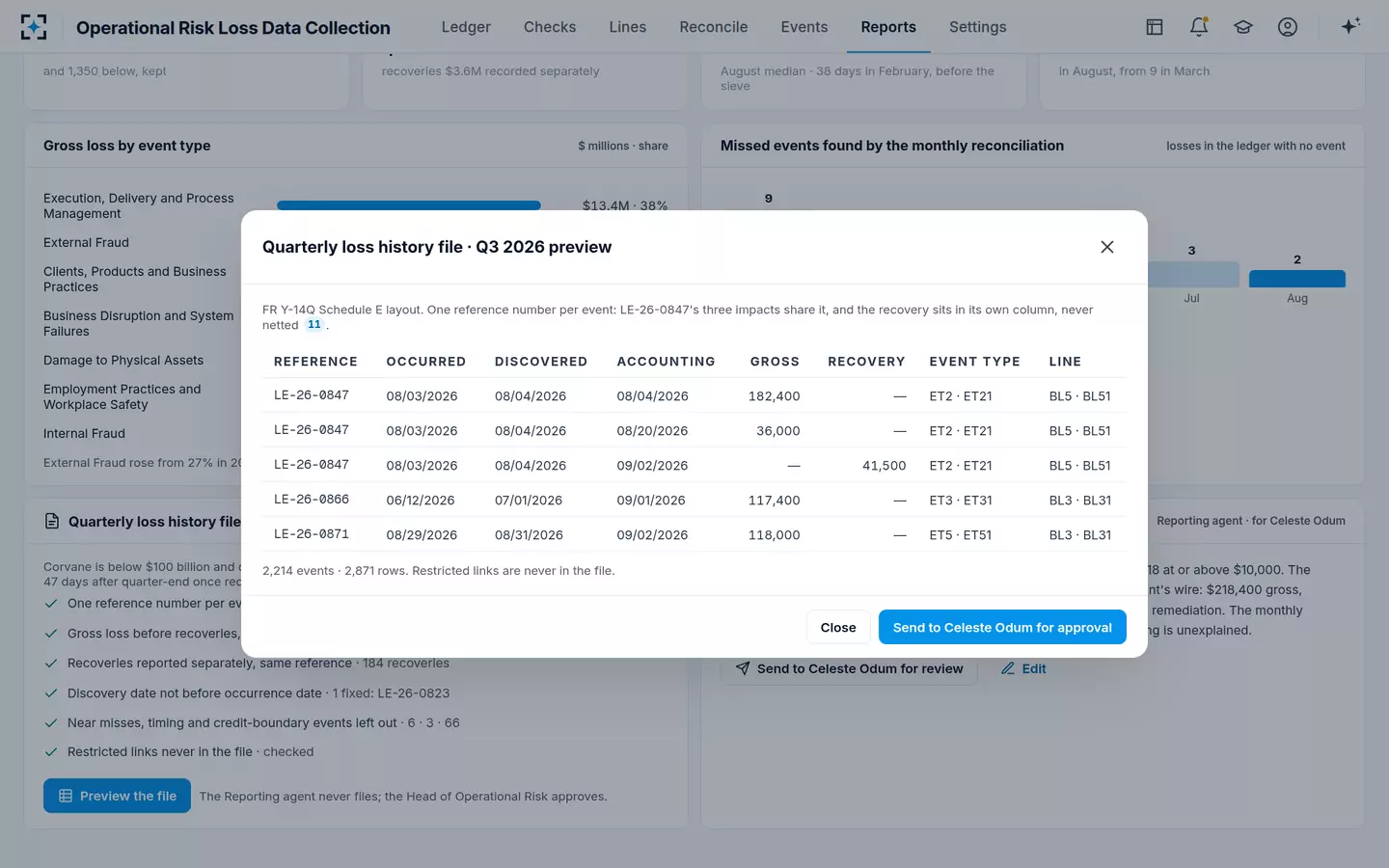
Three rows, one reference number (as instructed): 3, all LE-26-0847
Netted into one row (wrong): 08/04/2026
Three rows, one reference number (as instructed): 08/04/2026 · 08/20/2026 · 09/02/2026
Netted into one row (wrong): 176,900 (reimbursement plus legal fee, less recovery)
Three rows, one reference number (as instructed): 182,400 · 36,000 · none
Netted into one row (wrong): none
Three rows, one reference number (as instructed): none · none · 41,500
Netted into one row (wrong): 08/03/2026 and 08/04/2026
Three rows, one reference number (as instructed): 08/03/2026 and 08/04/2026 on every row
Netted into one row (wrong): ET7 · ET71 (the business line’s label)
Three rows, one reference number (as instructed): ET2 · ET21, BL5 · BL51 on every row
The netted version understates the gross loss by $41,500, misdates two of the three impacts and carries the wrong event type, all while looking tidy. Why gross, recovery and net must stay apart follows the same event's money over the month.
What is the collection threshold for Schedule E?
Each firm sets its own, and reports it. Field G carries the threshold "applicable to the respective business line/function and in effect at the time the loss event was captured", and Section E.4 lists every threshold used, the internal business lines it applies to and the period it was in effect. Schedule E does not prescribe a figure; the March 2026 capital proposal, still a proposal, would set $20,000 for loss data at Category I and II banking organizations.
The test is the event's total, not its pieces. The instructions' own example: "if an institution's collection threshold is $10,000 and a single loss event of $12,000 was assigned evenly to three business lines (i.e., $4,000 each), then the event needs to be included in the institution's submitted data file." A system that applies the threshold to rows or to business line shares will drop that event.
Can loss events be bundled on FR Y-14Q?
No. "Do not report separate, distinct operational loss events on an aggregated basis", the instructions say, and they give the example that matters: the "bundling" of separate events below the threshold into one event "should not be reported". Ten card frauds of $2,000 each are ten events below a $10,000 threshold, not one event of $20,000 above it.
Bundling is different from grouping. Losses with a common trigger, such as a reimbursement, a legal fee and a recovery from one wire fraud, are one event and share a reference number. Losses that merely share a type, a month or an account are separate events. In the solution, 31 small recurring losses below Corvane's $10,000 threshold were approved together in one action, but each stayed its own event, so none could be bundled into the file.
What is a loss reference number?
It is the firm's own identifier for a loss event, field B, used on every row that belongs to the event. "A single operational loss event could have multiple impacts (e.g., several accounting or recovery dates) and/or could be assigned to multiple business lines", and in those cases "the same loss reference number must be used to link these individual records to the same event". It should not contain spaces, tabs or special characters.
The reference number is what makes a cumulative history readable. Without it, the Federal Reserve sees rows; with it, events, and can compute an event's total gross, its recoveries and its timeline. Field A, the unique row identifier, does the other job: it lets the same row be recognized across quarters even as its event grows.
The quarterly loss history file, previewed in the Schedule E layout
Legal reserves, thresholds and mappings: the other Schedule E files
Three smaller files make the loss history interpretable. E.2 and E.3 map the numeric internal business line and unit-of-measure codes to names and descriptions. E.4 lists every collection threshold with its business lines and effective period, which is how a reader knows that a missing $15,000 event in 2012 was below the threshold then in force rather than lost.
E.5, the Legal Reserves Frequency file, counts outstanding legal events with reserves by event type and business line, grouped by the quarter of the first reserve. "The total number reported should be based on the number of legal events, not the number of "reserve entries."" Once a legal event settles, it leaves E.5 and appears, in full, in the loss history; until then, only settled portions belong in E.1.
Checks to run before a Schedule E submission
Most Schedule E errors can be caught by rules a machine can run, and the rest by a reconciliation a person signs. The list below follows the instructions field by field; the last two checks are about completeness, which no field rule can prove.
Twelve checks before the quarterly loss history goes out
- Discovery date is never before occurrence date
Corvane’s Q3 preview fixed one, LE-26-0823.
- Legal losses are dated no later than their reserve
Check every event in Clients, Products and Business Practices against legal reserve postings.
- Gross loss is not negative, except a decrease in reserves
And excludes insurance, tax effects and provisions.
- Recoveries sit in their own column under the same reference number
None netted, none negative, none from insurers.
- One reference number per event; unique identifiers unchanged from last quarter
Compare this quarter’s file with last quarter’s row by row.
- Thresholds are applied to the event total
And field G matches the E.4 threshold in effect at capture for that business line.
- No separate events bundled
Small recurring losses stay individual events.
- Codes are exact
ET1 to ET7, ET11 to ET76 or ET00; BL1 to BL9, BL11 to BL81 or BL00; no extra characters.
- Foreign currency converted at the accounting-date rate
For losses and for recoveries alike.
- Every event of $250,000 or more has a description
Including events that crossed $250,000 when a later cost posted.
- Exclusions applied by rule
Near misses, timing events, credit boundary events, forgone revenue and gains left out, each by a written rule.
- The quarter reconciles to the general ledger
Every difference between the loss database and the accounts explained before the file is approved.
How Operational Risk Loss Data Collection builds the Schedule E layout
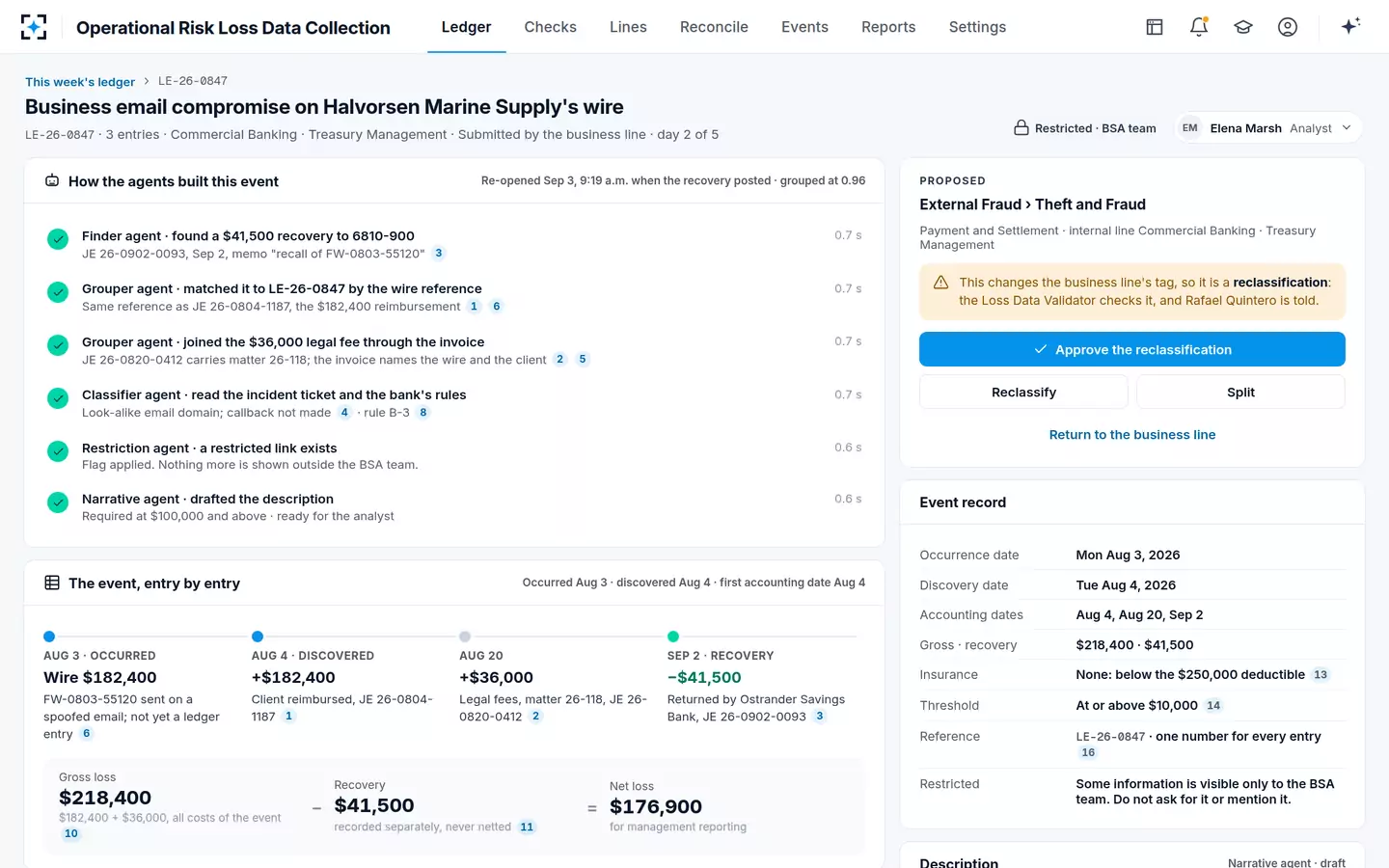
The Reporting agent builds the quarterly loss history from events the analyst has approved, the validator has checked and the monthly reconciliation has tied to the general ledger. Because the Grouper agent joined each event's entries under one reference number and kept recoveries apart from the start, the three-row shape of an event like LE-26-0847 is not reconstructed at quarter-end; it is how the event was built. The agent then runs field checks like those above and lists what it fixed or left for a person.
Three limits are deliberate. The agent never files: the head of operational risk approves the file and the bank's regulatory reporting system submits it. Restricted links, such as an event's connection to a confidential BSA matter, are never in the file. And fields that belong to the quantification team, such as the unit of measure and the capital-estimate flag, come from that team's mapping rather than from the agents. Why the database keeps the near misses that Schedule E leaves out covers the one exclusion that is most useful to keep. The full solution is at Operational Risk Loss Data Collection.
One event, three entries, built the way Schedule E reads it
Questions people ask
Where are the FR Y-14Q instructions?
On the Federal Reserve's reporting forms page for FR Y-14Q, which links the current form and instructions as PDF downloads alongside historical versions. Schedule E, Operational Risk, is one section of the instructions; the form page also lists the respondent panel and the reporting frequency.
When is a loss first reported on Schedule E?
From the quarter in which it is settled or realized: the schedule is meant to capture actual or realized losses, and that quarter will often differ from the accounting and capture dates. Pending legal events with reserves are counted in the Legal Reserves Frequency file until they settle.
Do insurance payments go in the recovery column?
No. The recovery amount excludes funds received from insurance providers, and the gross loss amount excludes insurance effects. A firm that wants to track insurance against losses keeps it in its own database, outside Schedule E's recovery field.
What is a unit of measure on Schedule E?
It is the level at which a firm's quantification model builds a separate loss distribution, such as a business line and event type combination, coded numerically in field Q and mapped in Section E.3. A firm that does not estimate operational risk with a statistical model enters "N/A" in field P.
How do acquired banks' losses appear on Schedule E?
With the acquired entity's name in field O, for events captured before the acquisition date and for later events not yet integrated into the merged firm's business lines. The March 2026 capital proposal would separately require loss data for acquired and merged entities going back ten full years.
What does a filer do if the loss database and the general ledger disagree?
Explain every difference before approval. Schedule E has no reconciliation field, but a file built from a database that does not tie to the accounts is a file whose completeness cannot be shown, which is the question an examiner asks first.