The Basel event types are the seven Level 1 categories every operational loss is mapped to: Internal Fraud; External Fraud; Employment Practices and Workplace Safety; Clients, Products and Business Practices; Damage to Physical Assets; Business Disruption and System Failures; and Execution, Delivery and Process Management. FR Y-14Q codes them ET1 to ET7 and splits them into 20 Level 2 categories. The definitions are short, but the hard cases are not: when a third party's deception gets a payment through a control that someone skipped, the business line usually calls it a processing error, and the definition calls it External Fraud. Botminds' Operational Risk Loss Data Collection puts a Classifier agent on that question for every loss event, arguing the type from the definition, the evidence and the bank's own boundary rules, while the analyst decides.
The examples come from fictional Corvane National Bank, a $92 billion regional bank, and its sample data in the solution; the industry figures come from the Federal Reserve, the OCC and Federal Reserve research, linked where they appear.
One wire, two classifications: the business line's and the definition's
The business line's classification: Execution, Delivery and Process Management
The Classifier agent's proposal: External Fraud
The business line's classification: Transaction Capture, Execution and Maintenance
The Classifier agent's proposal: Theft and Fraud
The business line's classification: "We skipped the callback. Processing failure in Treasury Management Operations."
The Classifier agent's proposal: A look-alike email domain changed the beneficiary; the client never authorized the wire. That is an act "intended to defraud ... by a third party".
The business line's classification: The skipped callback
The Classifier agent's proposal: Incident ticket INC-26-11873, the Basel definition, the bank’s rule B-3
The business line's classification: It is the event type
The Classifier agent's proposal: It is the cause: a control failure, linked to control WIR-CB-02
The business line's classification: Not stated
The Classifier agent's proposal: Payment and Settlement, because the loss came from a funds transfer for a client
What are the seven Basel event types?
The seven Basel event types are the operational loss categories defined by the Basel Committee and written into U.S. capital rules and reporting. The current advanced approaches rule defines them in 12 CFR 217.101, the FR Y-14Q instructions define and code them for the largest holding companies, and the March 2026 capital re-proposal, still a proposal, would require a bank to "be able to map its operational loss event data into the seven operational loss event type categories". The table gives each type its FR Y-14Q code and definition.
The seven Basel event types, with their FR Y-14Q codes and definitions
| Code | Level 1 event type | Definition (FR Y-14Q) | Level 2 categories |
|---|---|---|---|
| ET1 | Internal Fraud | Losses due to acts of a type intended to defraud, misappropriate property or circumvent regulations, the law or company policy, excluding diversity/discrimination events, which involves at least one internal party. | ET11 Unauthorized Activity · ET12 Theft and Fraud |
| ET2 | External Fraud | Losses due to acts of a type intended to defraud, misappropriate property or circumvent the law, by a third party. | ET21 Theft and Fraud · ET22 Systems Security |
| ET3 | Employment Practices and Workplace Safety | Losses arising from acts inconsistent with employment, health or safety laws or agreements, from payment of personal injury claims, or from diversity/discrimination events. | ET31 Employee Relations · ET32 Safe Environment · ET33 Diversity & Discrimination |
| ET4 | Clients, Products & Business Practices | Losses arising from an unintentional or negligent failure to meet a professional obligation to specific clients (including fiduciary and suitability requirements), or from the nature or design of a product. | ET41 Suitability, Disclosure & Fiduciary · ET42 Improper Business or Market Practices · ET43 Product Flaws · ET44 Selection, Sponsorship & Exposure · ET45 Advisory Activities |
| ET5 | Damage to Physical Assets | Losses arising from loss or damage to physical assets from a natural disaster or other events. | ET51 Disasters and other events |
| ET6 | Business Disruption and System Failures | Losses arising from disruption of business or system failures. | ET61 Systems |
| ET7 | Execution, Delivery and Process Management | Losses from failed transaction processing or process management, from relations with trade counterparties and vendors. | ET71 Transaction, Capture, Execution and Maintenance · ET72 Monitoring and Reporting · ET73 Customer Intake and Documentation · ET74 Customer/Client Account Management · ET75 Trade Counterparties · ET76 Vendors & Suppliers |
Level 1 and Level 2: what the codes ET1 to ET7 carry
Level 1 is required; Level 2 is optional on FR Y-14Q. Every loss event "must be mapped to one of the seven" Level 1 types, while a firm that does not map to Level 2, or cannot map a particular event, reports ET00. The capital rules ask only for the seven: the current rule and the proposal both speak of mapping to "the seven operational loss event type categories".
The Basel standard goes one level further for illustration. Its event-type table lists Level 3 "activity examples" under each category, such as "Theft / robbery", "Forgery" and "Check kiting" under External Fraud's Theft and Fraud, "Hacking damage" under Systems Security, and "Data entry, maintenance or loading error" and "Missed deadline or responsibility" under Execution, Delivery and Process Management (Basel Framework, OPE25). Most banks build their own Level 3 from these. Corvane's sits under its Level 2 and is kept in the solution's settings with its version number.
The business line is a separate dimension. FR Y-14Q maps every event to one of nine Level 1 business lines, from BL1 Corporate Finance to BL9 Corporate Level, and separately to the bank's own internal line. A wire fraud on a commercial client's payment sits in Payment and Settlement (BL5) for Basel, because the activity is a funds transfer, while the bank's internal line may still be Commercial Banking, Treasury Management.
Where large banks' operational losses fall by event type
Dollars concentrate in one type; counts and attention concentrate in others. In Federal Reserve supervisory data for the 35 largest U.S. bank holding companies from 2005 to 2019, Clients, Products and Business Practices accounted for 77.1% of operational losses by value, while External Fraud was 4.5% (Frame, Lazaryan, McLemore and Mihov, Federal Reserve Bank of Dallas Working Paper 2215).
Share of large banks' operational losses by Basel event type, by value
Value is not the whole picture for a classifier. External fraud is small in dollars at the largest firms and quick to surface, discovered on average within 0.4 quarters of occurring in the same data, and in the OCC's words this spring it is "a key driver of operational losses", with banks facing "elevated levels and sophistication of fraud and scams" including impersonation scams (OCC, Semiannual Risk Perspective, Spring 2026). Those are exactly the events where a business line's processing label and the fraud definition collide.
Is a wire sent on a spoofed email external fraud?
Usually, yes. A business email compromise is an act "intended to defraud ... by a third party", the External Fraud definition, and the fraud does not stop being fraud because a control that should have caught it failed. The failed control is the cause of the loss, not its type; most banks write that down as a boundary rule so the answer does not depend on who classifies the event.
The sample case shows why the question is contested. On August 3, 2026, Corvane's Treasury Management Operations released a $182,400 wire for commercial client Halvorsen Marine Supply on an emailed instruction from a look-alike domain that changed the beneficiary. The callback to the number on file, required by control WIR-CB-02, was not made. The client reported the wire as unauthorized on August 4 and was reimbursed the same day; outside counsel was retained, and the beneficiary bank returned $41,500 on September 2.
The business line's classification on August 5 was honest: "We skipped the callback." From inside Treasury Management, the event is the operations team's failure. From the definition's side, the loss exists because a third party lied to the bank, and the callback is the reason the lie worked. Classified as process, the bank's fraud history understates business email compromise, and the RCSA loses a fraud signal; classified as fraud without the cause, it loses the control failure. The bank needs both, in different fields.
How a classifier argues an event type: definition, evidence, bank rule
A classifier earns trust by showing its reasoning in the same three parts a good analyst would: what happened, which definition that matches, and which of the bank's rules decides the close calls. In the solution, the Classifier agent writes one plain sentence per event with each claim footnoted to its source, beside the business line's own classification.
The Basel event type, argued with its sources
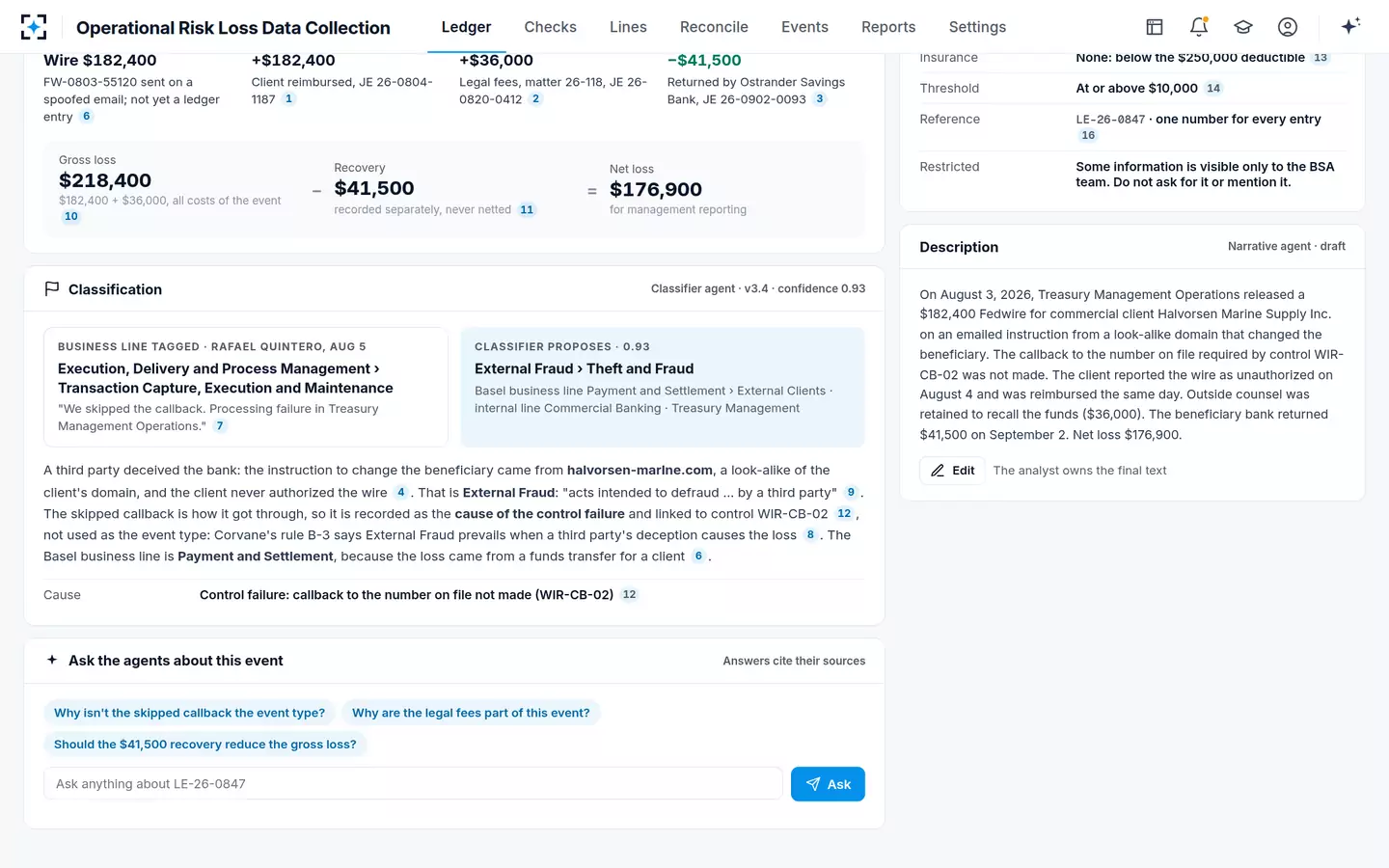
The three parts do different work. The evidence, here the look-alike domain halvorsen-marlne.com in the incident ticket and the client's statement that it never authorized the wire, establishes the facts of the event. The definition turns those facts into a type: deception, intent, a third party. The bank's rule settles the boundary the definitions leave open. Corvane's rule B-3 reads: "When a third party's deception causes the loss, External Fraud prevails; the failed control is the cause." Without a written rule, two analysts can read the same definitions and reach different types.
The proposal also names the business line, with its own reason: Payment and Settlement, because the loss came from a funds transfer for a client. And it keeps the cause on the event, linked to the control, so that Treasury Management's RCSA still sees a callback failure that let a $182,400 fraud through. The near misses the same week include a wire to a look-alike payee that a callback did stop; together they are the control's evidence.
When the evidence is split, the classifier asks
A classifier that always answers is a classifier that is sometimes confidently wrong. The solution's Classifier agent proposes only at or above 0.80 confidence, a setting the head of operational risk owns; below it, the agent asks the analyst a question instead.
The same week shows the other case. Two ATM deposits at the Riverside network were short, with two empty envelopes. The evidence fits Execution, Delivery and Process Management (a deposit processing failure) at 0.71 and External Fraud (a customer claiming a deposit that was never made) at 0.64. Neither clears the threshold, so the screen shows "Agent unsure · it asks you" with both readings and their reasons, and the analyst chooses, or answers the agent's question and lets it try again with the answer.
Propose, ask, decide, check, tell: who does what on an event type
Agent
Classifier agentReads the ticket, the entries and the bank’s rules; proposes the Level 1 and 2 type, business line and cause with citations.
Never: Never proposes below 0.80; it asks instead
A person decides
Operational risk analystReads the reasoning, asks the agents why if anything is unclear, and approves, reclassifies or splits. Changing the business line’s classification needs a reason code.
A person decides
Loss data validatorChecks every reclassification on the same evidence, and confirms, returns with a reason or escalates.
Agent
Narrative agentDrafts the notice to the business line: the new type, the rule, and where the cause now sits.
Never: Never sends without the analyst
A person decides
Business line risk managerAccepts the reclassification or disputes it with a reason within the bank’s deadline.
Who decides the event type, and what if the business line disagrees?
The analyst in the independent operational risk function decides; the business line is told and may dispute. That follows from the capital rules' requirement that the function running loss data be independent of business line management: a business line that could set its own event types would control how its own losses look.
In the sample case, Elena Marsh approved LE-26-0847 as External Fraud with reason code R2, "Boundary rule (fraud versus process)", and a note for the validator: "Look-alike domain in INC-26-11873; rule B-3. Callback failure kept as the cause (WIR-CB-02)." Jonah Whitcombe confirmed it. Rafael Quintero's Commercial Banking queue then showed the notice, with the rule and the control link, and a dispute deadline of Tuesday, September 8.
A dispute is not a vote. It sends the event back to the analyst with the business line's reason, and the analyst either changes the decision, with a new reason code, or keeps it and says why. Either way the exchange is on the audit trail, and the override count is reported: in the quarter shown, 23 of the agents' 812 proposals were overridden (2.8%), each with its reason code. That ratio, read by reason, tells the head of operational risk whether the rules or the agents need work.
Can AI classify operational losses? What supervisors said in 2026
An AI classifier can propose event types well enough to be useful, provided a person decides and the reasoning can be checked. We know of no U.S. rule written for AI loss classification as such. The interagency model risk guidance issued with SR 26-2 on April 17, 2026, which replaced SR 11-7, leaves generative and agentic AI outside its scope (Federal Reserve, SR 26-2); what that change means for a risk model is explained in another guide. The OCC's spring 2026 risk perspective describes banks' use of generative and agentic AI as measured and limited, with guardrails and human accountability.
The Financial Stability Board's final sound practices for AI, published October 15, 2026, include human oversight as a sound practice and warn that agents acting at scale strain real-time human monitoring (FSB, Sound Practices for Responsible Adoption of AI). A loss classifier that proposes and never decides, cites its sources, asks below a threshold and has every override counted is built to that shape. In the solution, prompts and models are versioned, and a new version runs on the previous month's events before the head of operational risk approves it.
There is a quieter argument for a classifier: consistency. Two analysts reading the same definitions can disagree on hard cases, and the disagreement is invisible until someone samples it. A classifier applying written rules makes the same call on the same evidence every time, so the disagreement that remains is between the rule and the analyst, where it can be seen and fixed. The credit boundary decision tree applies the same idea to the line between credit and operational losses.
Event type, cause and business line answer three different questions
Most classification arguments are two questions mixed together. The event type answers what kind of loss this was; the cause answers why the bank's defenses did not stop it; the business line answers whose activity it came from. The spoofed-email wire is External Fraud (type), caused by a skipped callback (cause), in Payment and Settlement (Basel line) for Commercial Banking (internal line). Each answer feeds a different consumer: capital and the regulatory file use the type and line, the RCSA uses the cause, and the business line's own reporting uses its internal line.
Keeping them apart also ends most disputes. Rafael Quintero's objection was not that the wire was not fraud; it was that his team's failure would vanish. Kept as the cause and linked to WIR-CB-02, it does not. The full set of agents behind the decision is at Operational Risk Loss Data Collection.
Questions people ask
What are the Basel Level 2 event types?
They are the 20 subcategories under the seven Level 1 types, coded ET11 to ET76 on FR Y-14Q: for example ET21 Theft and Fraud and ET22 Systems Security under External Fraud, and six under Execution, Delivery and Process Management, from ET71 Transaction, Capture, Execution and Maintenance to ET76 Vendors & Suppliers. Level 2 mapping is optional on FR Y-14Q; a firm that does not map an event reports ET00.
Is check fraud external fraud?
When a third party forges, alters or kites a check to take the bank's money, yes: the Basel standard lists "Forgery" and "Check kiting" as examples under External Fraud. If an employee is involved, Internal Fraud applies, because that type covers acts "which involves at least one internal party". If a loan customer's fraud causes a credit loss, the credit boundary rules decide instead.
What is the difference between external fraud and execution, delivery and process management?
Intent and who acted. External Fraud needs an act intended to defraud by a third party; Execution, Delivery and Process Management covers losses from failed transaction processing or process management with no such intent. A payment sent to the wrong account by a keying error is process; the same payment redirected by a forged instruction is fraud, even if a process failure let it through.
Does the Basel event type change a bank's capital requirement?
Not directly under the March 2026 proposal, which would set operational risk capital from a business indicator rather than a model, but the proposal would still require data that can be mapped to the seven types. Under today's advanced approaches, internal models use loss data by unit of measure, which some firms define by business line and event type combination.
How often do business lines get the event type wrong?
No regulator publishes a rate. In the solution's sample data the validator's most common reason for returning a decision was a wrong business line, and 23 of 812 agent proposals were overridden in a quarter. A bank can measure its own rate by sampling business line classifications against the definitions and its boundary rules.